AI Motion Design for Investor Pitch Decks
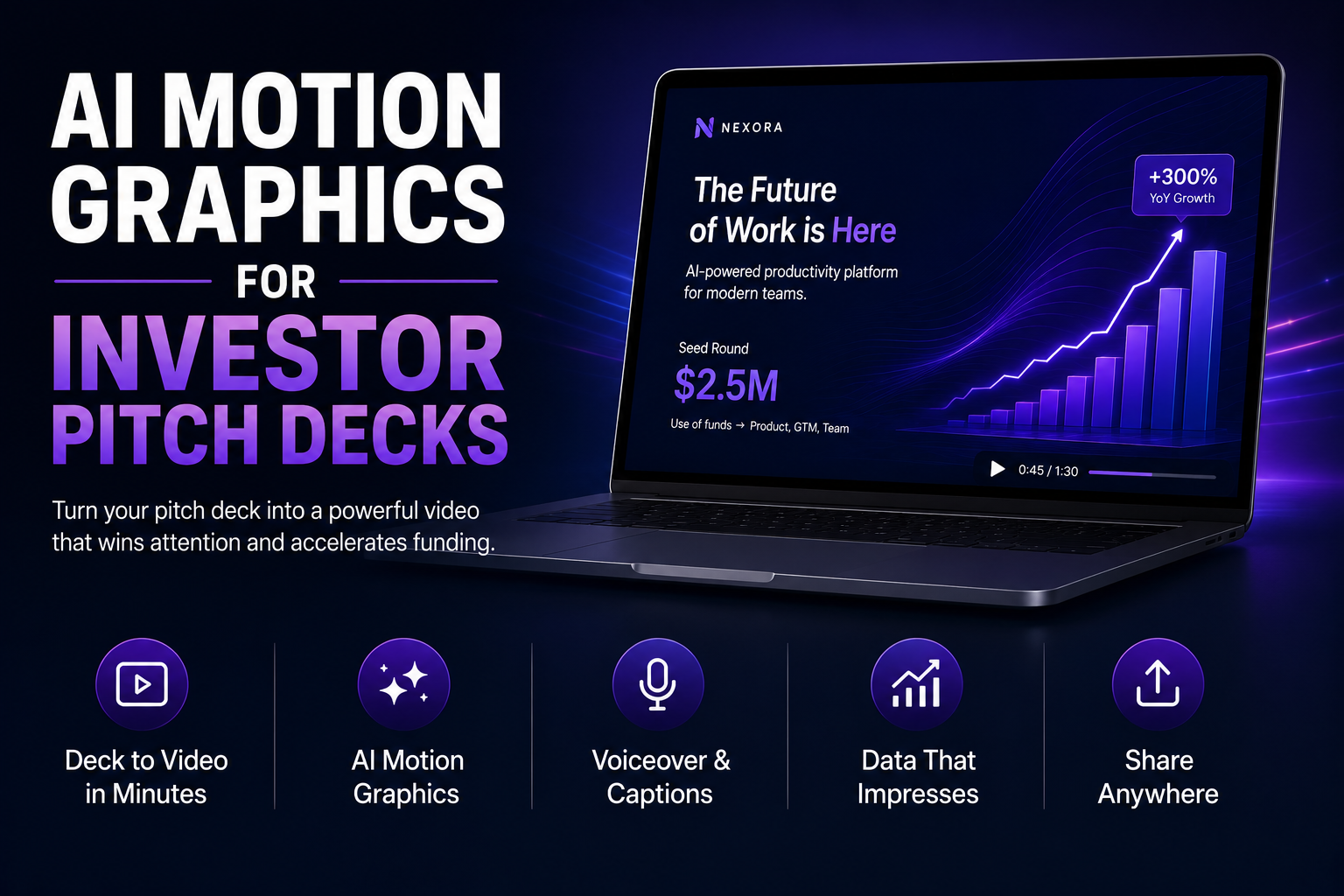
A great pitch deck still reads like a document, and investors watch more than they read
A founder can spend weeks perfecting a pitch deck's narrative and still lose an investor's attention in the first ninety seconds of a cold outreach email, because a PDF attachment is easy to skim and easy to set aside. A short, well-produced video version of the same narrative — the problem, the traction, the ask — gets watched in a way a deck rarely does, and it lets a founder's own delivery and energy come through in a way slides alone can't.
The trouble is that video production has never been part of a founder's normal toolkit, and hiring a motion designer or agency for a pitch video is exactly the kind of one-off, deadline-driven request that's hardest to get good results from quickly — the round is moving, the story keeps changing as new traction numbers come in, and a locked video file can't keep up with a deck that's still being revised the night before a key meeting.
Why the traditional path to a pitch video breaks down
Hiring a freelancer or small agency to turn a deck into a video usually means a multi-day turnaround at minimum, and every time the traction numbers update — a new customer signed, a revenue milestone hit — the whole video needs to be revised and re-rendered. For an early-stage founder running a fundraise on a compressed timeline, that lag is often the difference between having an up-to-date pitch video for a key meeting and not having one at all.
Template-based pitch video tools solve part of the speed problem but tend to produce something that looks like every other startup's explainer — the same stock transitions, the same generic corporate motion — precisely the opposite of what a founder needs when trying to stand out in an investor's crowded inbox.
There's also a founder-time problem specific to this stage of a company: the person best positioned to tell the pitch story compellingly is almost always the founder, not a hired freelancer working from a brief secondhand, and yet founders running an active raise have essentially no spare hours to also become a video editor, which is exactly why this task has historically either not gotten done or gotten done poorly.
What an AI-driven pitch video workflow looks like instead
An AI motion design approach lets a founder paste the actual deck content or describe the pitch narrative in plain language, and get back a fully animated, narrated video that visualizes the traction chart, the market-size breakdown, and the ask — not a talking head reading slides, but real motion graphics built around the founder's actual numbers and story.
Because the underlying composition is editable code rather than a locked file, updating the video after a new traction milestone is a targeted edit to one scene — swap the revenue chart, update a customer logo — rather than a full re-production, which matters enormously during an active fundraise where the story is genuinely changing week to week.
Where this shows up across a fundraising process
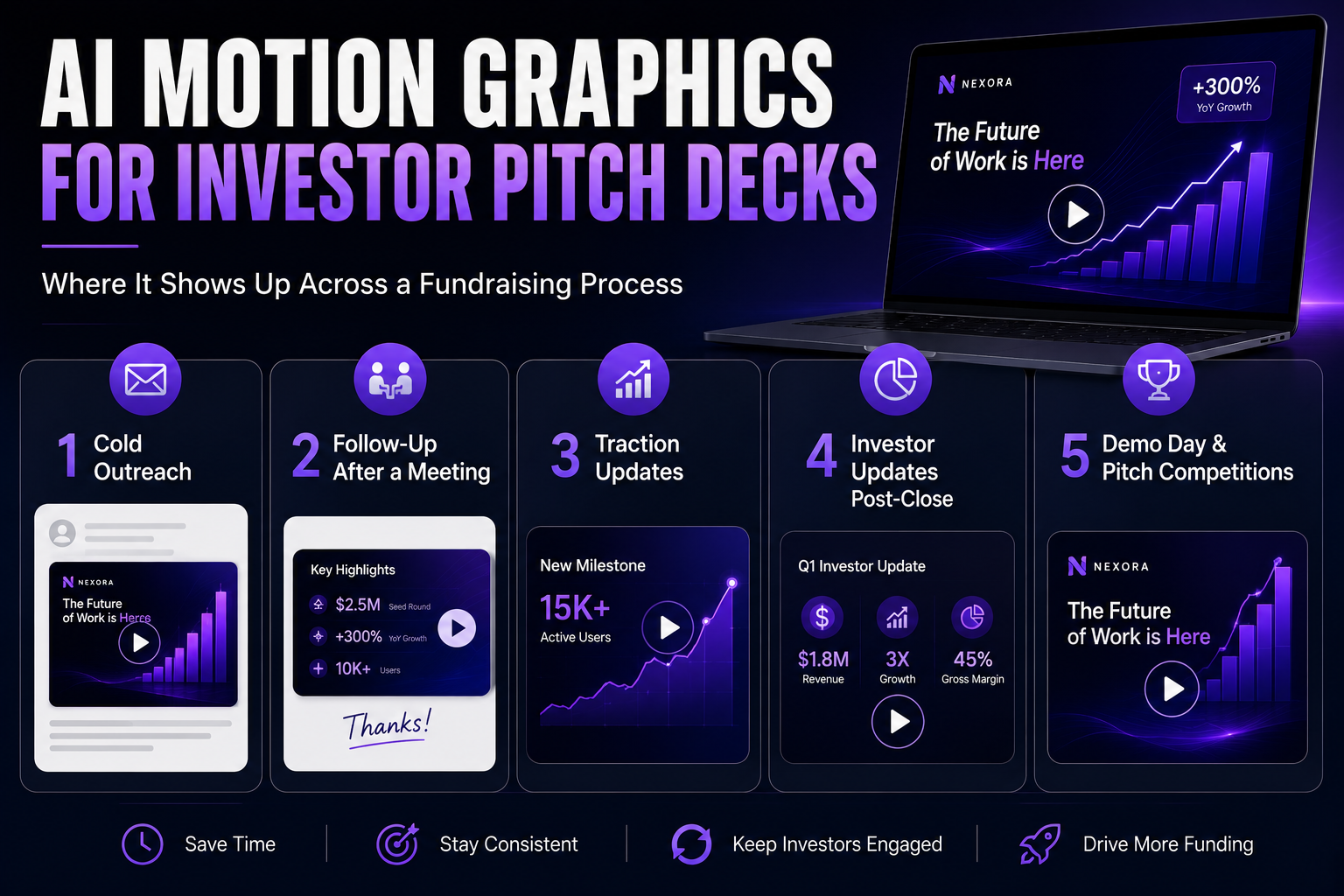
● Cold outreach: a 60–90 second video attached to an intro email, giving a warm or cold investor contact something more compelling than a deck alone.
● Follow-up after a meeting: a short recap video reinforcing the key numbers discussed, sent the same day as a thank-you note.
● Traction updates: a quick refresh of the video whenever a new milestone is hit, keeping outreach current throughout an active round.
● Investor updates post-close: the same visual format reused for monthly or quarterly investor updates once the round is closed.
● Demo day and pitch competitions: a polished video version of the pitch for events that accept or require a video submission.
The cost comparison in plain terms
Hiring a freelancer or small agency to produce a single pitch video commonly costs anywhere from several hundred to a few thousand dollars, with a turnaround measured in days at best — and every subsequent revision as the traction story changes typically resets that clock. For a founder running a multi-week or multi-month raise, revising the story that many times through a hired production process would either blow the budget or simply not happen, leaving outreach running on a stale video.
An AI-driven workflow collapses both numbers: the first version comes back in minutes rather than days, and each subsequent revision as new traction comes in is a small, fast edit rather than a new invoice. For an early-stage company where every dollar of runway matters, that's the difference between a pitch video being a one-time expense reserved for the final deck and a living asset that stays current for the life of the raise.
Why this shift is happening now, not five years ago
Founders have always known a video pitch would help — the constraint was always that producing one required either a design skill founders rarely have themselves or a hired specialist on a timeline that never matched how fast a live fundraise actually moves. What's changed is that AI models can now draft a complete, well-paced video narrative directly from a deck's real content, and a deterministic, code-based rendering foundation means that draft becomes an actual, reproducible file a founder can send immediately and revise in minutes rather than days as the story evolves.
How Kinetiq turns a pitch deck into an investor video
This is exactly the kind of fast-turnaround, frequently-revised video Kinetiq at https://kinetiq.nagent.ai is built for. A founder pastes the deck's actual content — the problem statement, the traction numbers, the ask — into the brief, or describes the pitch narrative directly in chat, and Kinetiq's Director plans a scene-by-scene structure that paces the story rather than rushing through slides. The Audio stage produces a synced voice-over automatically from the confirmed script, so the founder doesn't need separate narration or a professional voice actor.
Because the composition stays editable, a founder updating the video the night before an investor meeting can swap in a new traction chart or customer count through a scene-scoped chat edit, and re-render deterministically in minutes — a workflow built specifically for the reality that a pitch narrative during an active raise is a living document, not a finished one.
Feature by feature: what to reach for in a fundraising workflow
● Text video from your deck content — paste your actual slide content into Kinetiq and get a full narrated, animated composition back, not a slide-by-slide screen recording.
● Chart and data-viz motion — Kinetiq's built-in data-viz motion graphics turn a raw traction number or market-size figure into a visual moment, rather than a static bar chart.
● Scene-scoped chat edits — update just the traction slide or the ask amount in Kinetiq when a number changes, without re-producing the whole video.
● Unified chat audio — a synced voice-over is produced automatically from your confirmed script inside Kinetiq, with no separate recording session needed.
● Templates — save your pitch video's structure as a template in Kinetiq and reuse it for monthly investor updates after the round closes.
● Fast render and export — render the final video in Kinetiq in the aspect ratio that fits an email attachment, a LinkedIn post, or a demo-day submission.
The pipeline in more detail: from pasted deck content to a sendable video
Seeing Kinetiq's actual stages clarifies why this fits the pace of a live fundraise. The Brief stage takes the founder's pasted deck content or plain-language narrative, and the Generate stage produces a full composition with the Director planning which numbers and claims deserve their own visual moment versus a quick mention. The Audio stage produces synced narration directly from the confirmed script, so a founder isn't recording voice-over separately or hiring a voice actor for a fast-moving asset. A Quality pass checks for structural issues — a blank scene, a chart that doesn't render correctly — before the founder even sees the draft.
Refine is where a founder makes the last-minute adjustments that matter most during an active raise — a chat instruction to update a number, a canvas tweak to how a chart is framed — and Render/Download produces a deterministic file ready to attach to an email or post to LinkedIn within the same session. The speed of this loop is the entire point: a founder revising a video the morning of a pitch meeting needs minutes, not a new production request to a freelancer.
Beyond the initial pitch: reusing the same format through the relationship
Once a founder has a working pitch video template, the same structure and brand treatment extends naturally past the initial fundraise. A monthly or quarterly investor update video, built on the same template with updated metrics, gives existing investors a consistent, professional format to expect, which itself signals operational discipline. A board-meeting recap or an annual shareholder letter can borrow the same visual treatment, turning a one-time fundraising asset into a recurring communication tool for the life of the company rather than something built once and shelved after the round closes.
A sample workflow: refreshing a pitch video the night before a key meeting
A founder closes a new enterprise customer two days before a scheduled investor meeting. Instead of leaving the traction slide in the pitch video showing last month's numbers, they open the existing composition in Kinetiq and update the customer count and revenue figure through a quick chat instruction.
The affected scene regenerates with the new numbers while the rest of the video's narrative and pacing stay untouched, and the founder re-renders and re-sends the updated video before the meeting the next morning — a same-night turnaround that would have been unrealistic with a hired freelancer on any normal production timeline.
Common mistakes founders make with pitch videos
● Recording a screen-share narration over static slides instead of building real motion graphics that actually visualize the traction and market story.
● Letting the video go stale after a key milestone, so an investor receives outreach with numbers that are already out of date.
● Over-scripting the narration instead of letting a data-viz moment (a chart, a growth curve) carry the point faster than words can.
● Making one long video trying to cover everything, rather than a short, focused cut built specifically for outreach and a separate, longer version for a scheduled meeting.
● Not reusing the same visual format for post-close investor updates, missing an easy way to keep new investors engaged with familiar, consistent reporting.
How to know it's actually working
The most direct signal is response rate on outreach that includes a video attachment or link versus outreach with a deck alone, since the entire point of a pitch video is to earn attention in a crowded inbox. Beyond that, tracking how quickly a founder can turn around an updated video after a new milestone is a good proxy for whether the workflow is actually keeping pace with an active raise, since a video that takes days to refresh defeats the purpose just as much as not having one at all.
It's also worth watching meeting-to-follow-up conversion specifically for investors who received a video recap versus those who only received a written thank-you note, since that comparison isolates whether the format itself is doing real work in keeping an investor's interest warm between the pitch meeting and a final decision.
It's also worth tracking meeting-to-second-meeting conversion specifically for the investors who received a video versus those who only saw the deck, since a pitch video's real value shows up in whether it earns the founder a second, deeper conversation — not just an open or a reply to the first email.
Rolling this out during an active fundraise
The lowest-risk starting point is a single cold-outreach video built once, used across the earliest investor conversations, and refreshed weekly as new traction comes in. Founders running a live round rarely have time to overhaul their whole process mid-raise, so starting with Kinetiq on just the outreach video — rather than trying to redo the full deck and every follow-up asset at once — tends to produce the fastest, least disruptive win.
Once the format is proven, extending the same approach to post-close investor updates is a natural next step, reusing the same template and brand treatment so new investors recognize a consistent, professional reporting cadence from the very first update they receive.
Beyond the raise: what a fast, editable video habit builds long-term
A founder who builds one working pitch video template rarely stops using it after the round closes. The same skill — describing a narrative in plain language and getting back a polished, data-driven video in minutes — applies to a product launch announcement, a hiring pitch to a candidate considering multiple offers, or a partnership proposal to a potential integration partner. Founders who treat this as a one-time fundraising tool miss the compounding value of having a fast, reusable way to turn any important narrative into a video asset whenever the moment calls for it.
It's also worth noting that investors themselves increasingly expect a certain level of polish even at the earliest stages, given how competitive fundraising has become — a founder who can produce a clear, well-paced video from real numbers, on short notice, signals a level of operational capability that a static deck alone doesn't communicate nearly as effectively.
A quick checklist before sending a pitch video
● Are the traction numbers and customer counts current as of today, not from when the deck was first built?
● Does the video lead with the strongest hook — the problem or the traction — rather than a slow company-history preamble?
● Is the ask clearly stated on screen, not just mentioned once in narration?
● Has the video been rendered in a format that plays cleanly as an email attachment or link, not just inside the studio preview?
● If this is a recurring investor update, has the structure been saved as a template for next month's version?
Frequently asked questions
Can Kinetiq work directly from our existing pitch deck?
Yes — paste the deck's actual content (problem, traction, market, ask) into the brief and Kinetiq drafts a full animated, narrated composition from it rather than a slide-by-slide recording.
How do we update the video when our numbers change mid-raise?
Because the composition stays editable, updating a traction chart or customer count is a scene-scoped chat edit, not a full re-production, so the video can be refreshed the same day new numbers come in.
Does the narration sound synthetic?
Kinetiq offers local, no-key text-to-speech as well as premium voice options where a key is provided, giving founders a range of narration quality to choose from.
Can we reuse the same format for monthly investor updates after the round closes?
Yes — save the pitch video's structure as a template and regenerate it each month with updated numbers, giving investors a consistent, recognizable reporting format.
Can Kinetiq visualize our traction data as a chart rather than just narrating it?
Yes — Kinetiq's data-visualization motion graphics turn a raw number or growth curve into a real visual moment in the composition, rather than relying on narration alone to communicate it.
Is this only useful for the earliest, cold-outreach stage of a raise?
No — the same editable, deterministic composition works just as well for warm follow-ups, board updates, and recurring investor communications throughout the life of the company.
The takeaway
A pitch deck tells an investor what to think; a pitch video helps them feel it, and it earns attention a PDF attachment usually doesn't. Kinetiq lets a founder turn a deck's real numbers and narrative into a polished, up-to-date video in minutes, and keep it current for as long as the raise is live. Build your pitch video at https://kinetiq.nagent.ai.