
Agentic AI for AAA Game Studios: Ship Faster, Spend Less
Agentic AI for AAA Game Studios: Ship Faster, Spend Less
Studios that want to ship AAA titles faster don't need bigger teams — they need smarter agent infrastructure. Agentic AI can compress pre-production timelines, generate production-ready visual assets, automate narrative QA, and run continuous playtesting loops in parallel — tasks that traditionally consumed months of studio time. Studios that move now will ship faster, spend less on outsourcing, and build games that adapt to players in real time.
Implementation timelines and outcomes vary by studio, production stage, and agent configuration.
Why is AAA game development still so slow — and so expensive?
AAA game development is expensive because it is manual, sequential, and structurally resistant to parallelisation.
The average AAA title now costs $200–$300 million to produce and takes 4–7 years to ship[^3]. Most of that time is not spent making creative decisions — it's spent executing them. Concept art cycles, asset generation, localisation, QA loops, and marketing creative all run in serial queues. A single character redesign can cascade across six departments.
The conventional response is to hire more people. That compounds the problem: more headcount means more coordination overhead, more review cycles, and more risk.
The studios asking the right question aren't asking "how do we hire faster?" They're asking: which parts of this pipeline can an agent run autonomously while our humans focus on the 20% that requires genuine creative judgement?
What can agentic AI actually do inside a game studio?
Agents handle the execution layer of game production — the repeatable, high-volume, specification-driven work that currently consumes most of a studio's calendar.
Pre-production: Concept and brief generation
Before a single asset is built, studios spend weeks aligning on creative direction. An agent like ARIA can compress this phase by synthesising competitive intelligence, genre trend data, and player sentiment into structured creative briefs — in minutes, not weeks. Agents can also generate multiple narrative directions from a single concept document, giving creative directors real options to evaluate rather than blank pages to fill.
Results depend on brief quality, agent configuration, and studio workflow integration.
Visual asset production: From concept to campaign-ready
HeroLens generates hero shots with professional lighting and realistic scene integration. For gaming studios, it can produce character renders, key art compositions, and environment hero shots on demand, reducing dependency on external photography and CGI vendors.
GraphiXpert converts plain-text creative descriptions into structured image prompts and generates high-quality visuals using Flux. Studios can produce multiple creative directions within minutes where manual workflows might take days.
Virtual Photoshoot Agent orchestrates full-scale virtual productions with control over models, weather, lighting, and location. For character-driven marketing — RPGs, sports titles, open-world franchises — it enables photorealistic promotional visuals without physical shoots or external production vendors.
Background Replacement Agent and AI Product Photoshoot Director place game assets into any environment, creating lifestyle marketing images at scale for seasonal campaigns, regional variants, and platform-specific creatives.
Across these visual workflows, studios can reduce production time by up to 70–90%, depending on workflow and agent configuration.
Video advertising: From brief to platform-ready ad
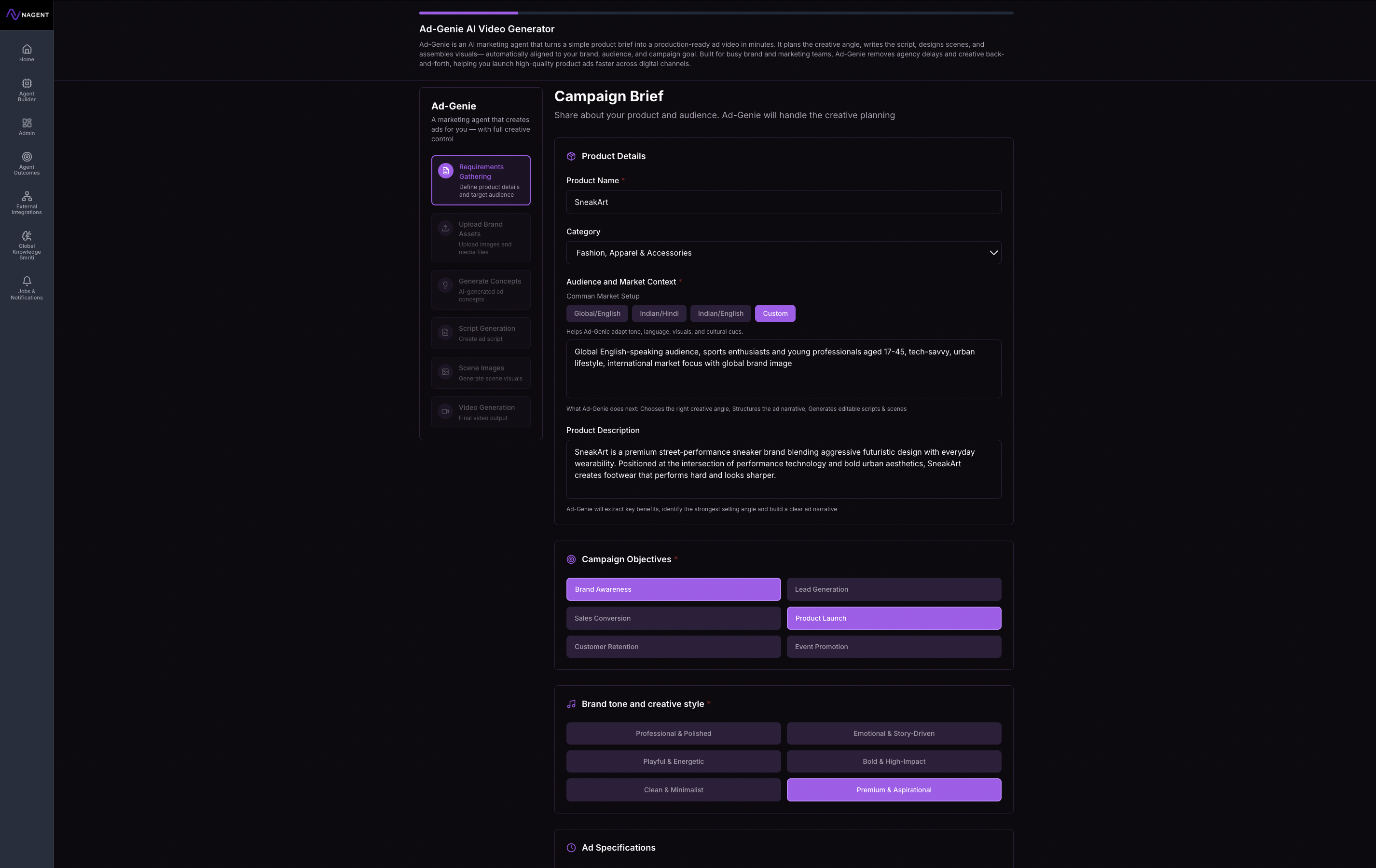
Ad-Genie turns a single brief into polished, platform-ready video ads, handling scripting, scene composition, and format adaptation across social channels. According to Nagent's published outcomes, Ad-Genie reduces video ad production time from 3–5 days to 10–20 minutes per creative, and can increase output from 4–6 ads per month to 100 ads per month per brand.
For a AAA launch campaign running multi-platform paid social across 15 markets, that output capacity is the difference between a campaign and a media blitz.
Copywriting and offer variation: Scaling campaign messaging
Offer Variation Agent generates dozens of distinct creative angles for a single marketing offer — headlines, body copy, and CTAs — structured for A/B testing. Nagent's published data indicates it can reduce copy testing preparation time by 70–90%, generating 10–50 campaign variants within minutes.
For a game launch, that means testing "pre-order now for exclusive DLC" against 30 other angles in the same afternoon — not across three agency review cycles.
Social content: Reels and Shorts at launch scale
ScrollStop AI transforms concepts into platform-optimised Shorts and Reels. Studios maintaining 20–30 pieces of short-form content per week at launch can use it to sustain publishing velocity without burning out internal creative teams.
UGC Muse crafts retention-focused scripts for TikTok, Reels, and YouTube Shorts, with hook writing optimised for the first three seconds. Nagent's data shows it can reduce short-form scriptwriting time by 70–90%.
Customer experience: Player support at scale
OpalReply analyses sentiment and generates empathetic, on-brand responses across reviews, tickets, and social comments. For studios managing launch-day support spikes — where ticket volume can surge 10x overnight — it can reduce response time by up to 70–90% without expanding support headcount.
Talklytics adds a multimodal voice and chat layer, resolving player queries, capturing session context, and converting transcripts into actionable CMS insights. Player feedback at launch is valuable, and most studios lose it to unstructured support queues.
What does a multi-agent game production pipeline actually look like?
The Nagent multi-agent orchestration framework allows agents to work in coordinated sequences, not in isolation. A practical AAA production pipeline might look like this:
- ARIA synthesises market research and player sentiment into a creative brief
- GraphiXpert generates concept visual directions from the brief
- Virtual Photoshoot Agent produces photorealistic character and environment marketing assets
- Ad-Genie converts approved assets into platform-ready video ads
- Offer Variation Agent generates 30+ copy variants for each ad concept
- ScrollStop AI produces short-form social content from the same brief
- OpalReply manages player sentiment and support at launch
Each agent runs in its lane; each output feeds the next stage. The studio's creative team reviews, approves, and directs — they don't execute.
What's the real competitive risk for studios that wait?
Studios that delay agentic adoption aren't just moving slower — they're ceding ground to competitors who can iterate faster, test more creative directions, and respond to player feedback in near real time.
The Nagent KARMIC continuous learning system means agents improve with every deployment. A studio that deploys agents today builds a compounding advantage — agents calibrated to its brand voice, asset standards, and audience segments. A studio that waits two years starts from zero while competitors run on trained systems.
The window for first-mover advantage in agentic game production is open. It won't stay open indefinitely.
Related reading
- How Nagent's Agent Orchestration enables multi-agent workflows at enterprise scale
- ARIA: Agentic Research & Intelligence Agent for competitive intelligence
- Ad-Genie: From brief to platform-ready video ad in minutes
- Nagent Agent Studio: Build and deploy custom agents for your production pipeline
Frequently Asked Questions
Can AI agents really produce professional-quality visual assets for AAA game marketing?
Agents can assist in producing professional visuals — hero shots, character renders, environment composites, and platform-ready ad creatives — at a scale and speed that manual workflows cannot match. Quality depends on agent configuration, brief specificity, and how well the studio integrates agents into its existing creative review process. Agents like HeroLens and GraphiXpert are designed to support professional production standards, not replace creative direction.
How does agentic AI fit into an existing game studio workflow?
Agents are most effective when mapped to the execution layer — asset generation, copy variation, video production, and player support — rather than creative strategy. Studios typically deploy agents through Nagent's Build Craft framework, connecting them to existing tools and review workflows. The creative team retains approval authority; agents handle the volume work between decisions.
How many AI agents does a studio need to see real impact?
Even a single well-configured agent — deployed at a high-volume bottleneck like ad creative production or player support — can produce measurable impact within the first sprint. Multi-agent pipelines compound that impact by connecting outputs across production stages. Studios typically start with one or two agents and expand as they calibrate results.
What is the risk of AI-generated content not matching brand standards?
Brand drift is the most common failure mode in AI-assisted production. Nagent's Smriti memory layer allows agents to retain brand voice, visual standards, and audience context across sessions, reducing inconsistency over time. Studios should establish a structured review gate between agent output and final approval, especially during early deployment.
How long does it take to deploy a Nagent agent for a game studio use case?
Deployment timelines vary by use case, integration complexity, and studio workflow. Pre-built agents on the Nagent marketplace can be configured and operational significantly faster than custom builds. Studios with clear briefs and defined workflows typically move from first deployment to active production use within days rather than months.
Sources
- The Agentic FMCG Playbook _(pdf)_
- The autonomous bank in Agentic Era _(pdf)_
- Agentic AI SYSTEM _(pdf)_
- Multi Agent Orchestration System by Nagent _(pdf)_
- ARIA — Agentic Research & Intelligence Agent _(product doc)_
- Talklytics _(product doc)_
- HeroLens _(product doc)_
- UGC Genie _(product doc)_