
AI Agent Builders Without Coding Are Moving Mainstream
The Illusion of the Engineering Moat and the Legacy Software Trap
Historically, if a business wanted to deploy intelligent software, the ultimate bottleneck was always the engineering department. Throughout the first two decades of the modern internet, writing code was a highly specialized, esoteric skill. This created a massive power imbalance within the enterprise.
If a revenue operations leader wanted to automate a complex lead routing process, or if a finance director wanted to build a dynamic invoice reconciliation system, they could not simply solve the problem themselves. They had to submit a ticket to the IT department. They had to wait for a product manager to prioritize their request. They had to wait for developers to write custom backend logic, configure servers, and manage fragile API connections.
Custom artificial intelligence solutions required immense capital, months of development, and highly specialized machine learning engineers. This created the illusion of the engineering moat. We falsely believed that because building software was hard, only software engineers could dictate how a business operates.
But in 2026, the landscape has fundamentally shifted. The core intelligence of large language models has commoditized. The raw cognitive reasoning power required to understand text, analyze data, and make logical decisions is now available on demand. Pure coding skill is no longer the ultimate barrier to entry. We are witnessing the death of the engineering bottleneck, and the rise of the operational architect.
The Shift to Intent Based Computing
To understand why no code agent builders are moving mainstream, we must understand the shift from instruction based computing to intent based computing.
For the past twenty years, enterprise automation relied on Robotic Process Automation. These systems were rigid. They required a human to define every single possible step and every single edge case. If an operator built a script that said "if an email contains an invoice, download the PDF," the script would break the moment a vendor sent a link to a portal instead of an attached PDF. Instruction based computing is fragile because it cannot adapt to ambiguity.
Agentic artificial intelligence is entirely different. It operates on intent. When you build an agentic system, you do not give it a rigid script. You give it a goal, a set of tools, and a boundary of logical guardrails. You tell the agent, "Ensure all vendor invoices are validated against our internal purchase orders and routed to the correct department head."
When the agent encounters an ambiguous situation, it does not crash. It uses its underlying foundation model to reason through the problem. It looks at its available tools, assesses its memory of past actions, and independently decides on the best path forward to achieve the original intent.
This is a profound leap in computer science. But until recently, building these intent based systems still required heavy programming. It required developers to manually string together prompts, manage vector databases, and write custom routing logic. That friction kept agentic artificial intelligence locked inside research labs and heavily funded tech startups.
The Rise of the Visual Primitive
The true revolution happened when the industry realized that the complex computer science of state management and context orchestration could be entirely abstracted behind a visual interface.
No code agent builder platforms have matured from prototyping toys into production ready enterprise infrastructure. Industry operators are realizing that up to eighty percent of business workflows can now be completely automated using visual multi agent systems.
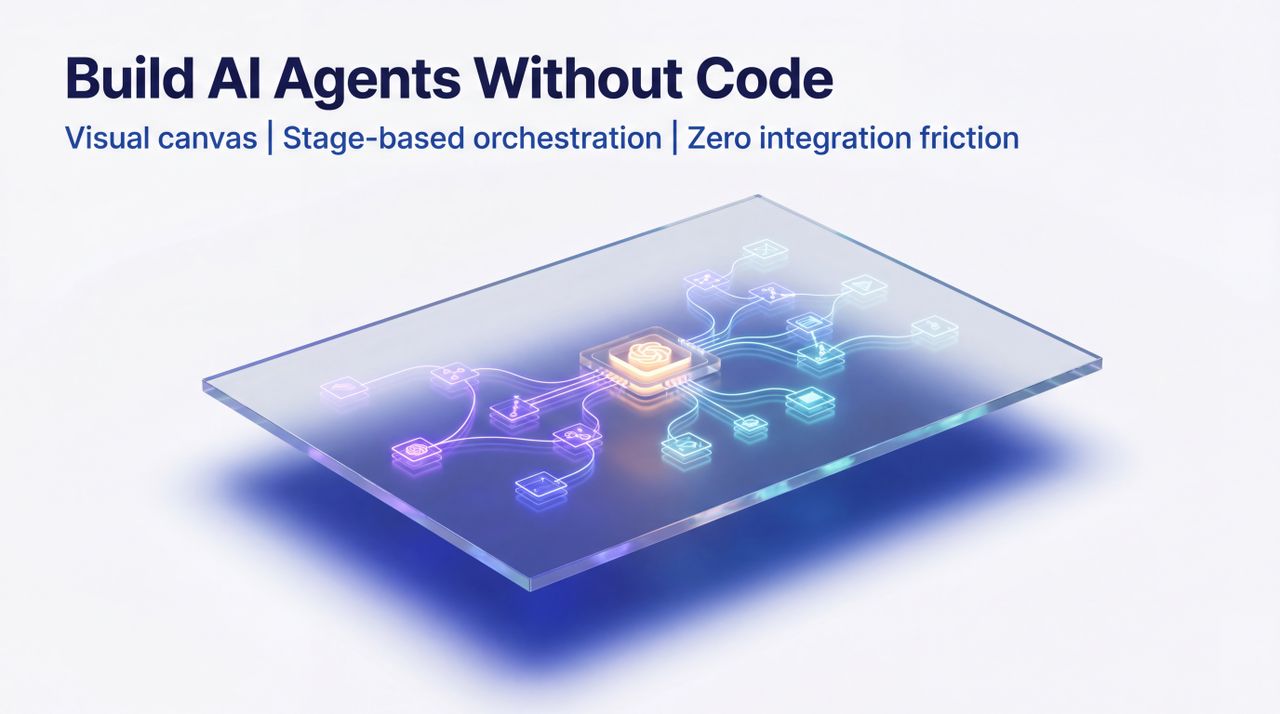
This shift is driven by the rise of the visual primitive. We have replaced the command line terminal with the drag and drop canvas. When a non technical marketing expert or a finance leader can visually map out a business process by connecting logical nodes on a screen, the velocity of innovation compounds exponentially.
Startups and massive enterprises alike are using these platforms to launch fully autonomous agents in a single afternoon. The people who actually understand the nuances of the business the subject matter experts are finally empowered to build their own tools. This eliminates the translation error that constantly occurs when business teams try to explain their needs to engineering teams.
The Orchestration Infrastructure Required
While the visual interface makes building easy, the underlying architecture required to make it reliable is staggering.
If you attempt to build an enterprise agent using a basic open source framework or a simple chat wrapper, it will inevitably fail in production. It will hallucinate. It will lose track of its context halfway through a long workflow. It will execute an API call incorrectly and wipe out a database.
For a no code agent to be truly autonomous and reliable, it requires heavy, proprietary orchestration. It needs scalable data infrastructure for real time ingestion, complex memory management, and secure retrieval augmented generation to ground its reasoning in proprietary corporate data.
Enterprise buyers do not want to manage this infrastructure. They just want the outcomes.
The Nagent Architecture Empowering the Operator
This deep architectural understanding is exactly what separates Nagent from the noise of the market. Nagent recognized early on that while everyone else was focused on building chat interfaces, the real enterprise unlock was giving subject matter experts absolute control over deep context orchestration.
Nagent provides a proprietary stage based orchestration layer that fundamentally changes how agents are built and debugged. Instead of allowing an artificial intelligence model to guess its way through a massive, sprawling task, the Nagent platform forces the logic into distinct, deterministic stages.
Imagine a supply chain manager building an agent to handle vendor logistics. Using the Nagent visual canvas, they can break the agent into clear stages. Stage one reads the incoming shipping manifest. Stage two cross references the manifest with the internal database. Stage three emails the vendor if there is a discrepancy.
Because Nagent uses this stage based orchestration, debugging becomes entirely visual and frictionless. If the agent makes a mistake in stage two, the operator knows exactly where to look. They do not have to scrap the entire system; they just tweak the logic in that specific node. This completely eliminates the compounding hallucinations that plague standard models.
The Ultimate Toolkit for the Non Technical Builder
Nagent has systematically removed every single point of friction that previously prevented non technical operators from building deep tech solutions.
The platform offers a highly intuitive form based agent builder for immediate deployment, alongside the advanced visual canvas for complex workflows. But the true secret weapon for the operator is the Agent Builder Co Pilot.
If a creator is staring at the canvas and feels unsure about how to structure a specific logic flow, the Agent Builder Co Pilot acts as a seasoned software architect sitting right beside them. The operator can simply describe their goal in plain English, and the Co Pilot will suggest the optimal node structure, recommend the best tools, and help refine the prompt engineering to ensure the final agent runs flawlessly.
Furthermore, Nagent is inherently multi modal and model agnostic. Operators are never locked into a single ecosystem. Using the canvas, a creator can instruct stage one of their agent to use the OpenAI GPT model for complex logical reasoning, and then instruct stage two to switch seamlessly to Claude for creative writing, or Gemini for rapid data parsing.
This level of granular control used to require a team of specialized engineers. Now, it requires a single click.
Zero Friction Procurement and Connectivity
The final, and perhaps most significant, barrier that Nagent dismantled is the integration bottleneck.
In a traditional software build, connecting a new artificial intelligence tool to an existing corporate system requires generating API keys, managing authentication tokens, and constantly monitoring billing limits across multiple third party services. It is a logistical nightmare that stops most automation projects before they even begin.
Nagent completely bypassed this nightmare by pre building the connectivity into the platform itself. The Nagent ecosystem comes equipped with over one thousand ready to use tools and integrations.
When a finance operator wants their new agent to read a Google Sheet, update a Salesforce record, and send a Slack notification, they simply drag those tool nodes onto their canvas. They do not need to hunt down developer documentation. They do not need to request API keys from the IT department. Nagent handles all the secure authentication and backend routing automatically.
By offering a fully managed environment with zero API setup required, Nagent allows operators to focus one hundred percent of their energy on designing business logic.
The Economic Implications of a Digital Workforce
The macroeconomic impact of this shift cannot be overstated. We are witnessing the transition from Software as a Service to Service as Software.
In the old paradigm, companies paid massive monthly subscription fees for rigid software dashboards, and then paid human employees to sit in front of those dashboards and manually move data around.
In the new paradigm, companies use platforms like Nagent to build autonomous digital workers that operate the dashboards themselves.
When you eliminate the engineering bottleneck through no code agentic platforms, the fundamental unit of economics changes. The time to market for a new internal automation drops from six months to three hours. The cost of deployment drops by orders of magnitude.
The companies that will dominate the next decade are not the ones that hire the most software engineers to build custom internal tools. The winners will be the organizations that empower their existing marketing, sales, finance, and operations teams to become architects of their own digital workforce.
No code agent builders are moving mainstream because they represent the ultimate democratization of computer science. They take the most powerful technology in human history and put it directly into the hands of the people who know exactly how to use it.