
AI Motion Design for Fintech Explainer Videos
Fintech has a communication problem before it has a marketing problem
A savings product, a credit line, a payments rail, or a compliance workflow is rarely self-explanatory. Fintech companies live or die on whether a new user understands what a product actually does in the first thirty seconds — and text and static screenshots consistently underperform motion for that job. A well-built explainer video can carry a mental model (how money moves, what a fee actually covers, what happens at each step of an application) in a way a paragraph of terms and conditions never will.
The catch is that fintech explainer video has historically been slow and expensive to produce precisely because the subject matter is complex. Every script has to be technically accurate, every visual has to represent a real financial mechanism correctly, and every claim has to survive a compliance and legal review before it ships. That review cycle is exactly where traditional production timelines blow up — a locked video file means every legal-requested change is a full re-edit, re-render, and re-review.
There's also a trust dimension unique to fintech. Consumers are more wary of financial products than almost any other category of purchase, and a confusing or overly salesy explainer erodes trust before a person even reaches the sign-up form. That raises the bar for the explainer video itself: it has to be clear, calm, accurate, and visually consistent with everything else the brand puts out, which is a harder needle to thread than a typical consumer explainer.
Where the traditional explainer pipeline slows down
A typical fintech explainer today runs through an agency or an in-house motion designer: a script draft, storyboard approval, an animation pass, a narration recording, then a compliance review that frequently sends the whole thing back for wording changes. Each round trip costs days, and because the output is an opaque rendered file, even a one-word copy fix on a lower-third means reopening the whole project in specialist software. For a category where messaging has to be reviewed, re-reviewed, and sometimes reviewed again after a regulatory update, that friction compounds fast.
The knock-on effect is that fintech marketing teams under-produce explainer video relative to how much they actually need it. A new account type, a repriced fee schedule, or a new disclosure requirement each, in principle, deserves its own updated explainer — but if every update costs a full production cycle, teams learn to make do with the video they already have, even after it's gone slightly stale relative to the current product.
What changes with a code-based, AI-authored approach
An AI motion design workflow built on a video-as-code foundation changes the economics of that review cycle. Because the underlying composition is structured and editable rather than a locked file, a compliance-requested wording change is a small, targeted edit — swap a line of narration, adjust an on-screen disclaimer, tighten a claim — not a full re-production. And because renders are deterministic, the exact same composition renders to the exact same frames every time, which matters when a legal team needs to sign off on a specific, reproducible final cut rather than trust that a new render matches what was approved.
The generation side moves just as much. A product or marketing lead can describe the explainer in plain language — what the feature does, the tone, the audience — or paste the actual product copy and let the system draft a first version, complete with a synced voice-over and on-screen motion graphics for the parts that benefit from visualization: a fee breakdown, a step-by-step application flow, a chart showing how a balance grows. That first draft becomes the thing legal and compliance review, rather than a blank page.
Where this shows up across a fintech company
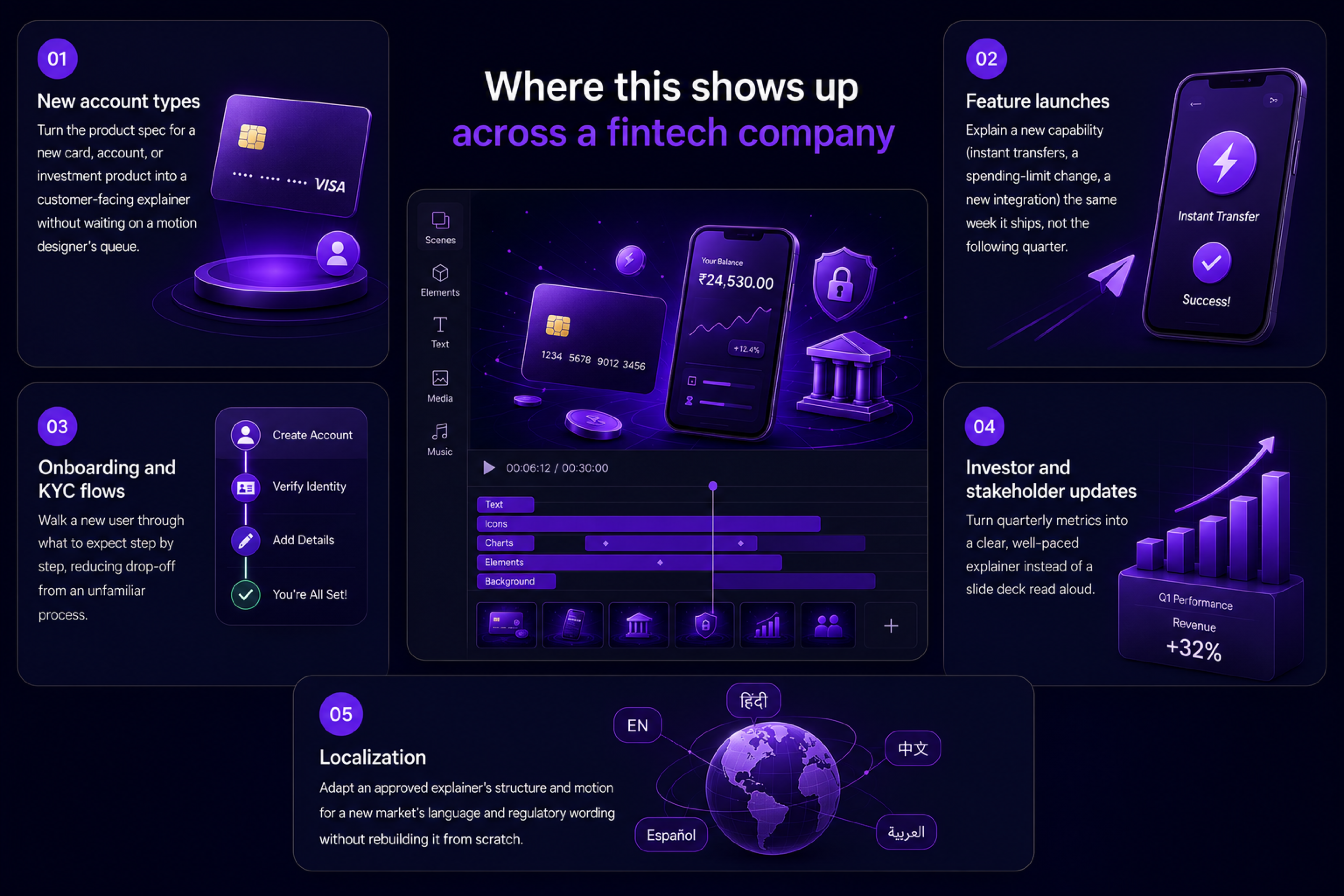
● New account types: turn the product spec for a new card, account, or investment product into a customer-facing explainer without waiting on a motion designer's queue.
● Feature launches: explain a new capability (instant transfers, a spending-limit change, a new integration) the same week it ships, not the following quarter.
● Onboarding and KYC flows: walk a new user through what to expect step by step, reducing drop-off from an unfamiliar process.
● Investor and stakeholder updates: turn quarterly metrics into a clear, well-paced explainer instead of a slide deck read aloud.
● Localization: adapt an approved explainer's structure and motion for a new market's language and regulatory wording without rebuilding it from scratch.
Why this shift is happening now, not five years ago
Fintech has historically been one of the more cautious adopters of new AI-driven creative tooling, and for good reason — the category's whole business is built on trust, and a hallucinated fee or an inaccurate claim in a video carries real regulatory and reputational risk. What's changed is that the underlying approach has moved from purely generative, non-reproducible video models toward a video-as-code foundation, where the finished asset is a structured, inspectable, deterministic composition rather than an opaque generated clip that might render differently on a second pass.
That distinction is exactly what makes the category defensible for a regulated business. A generative model that produces a different result every time it's asked for "the same video" is fundamentally incompatible with a compliance process that needs to approve a specific, reproducible artifact. A deterministic, editable composition is not — it behaves the way a document redline behaves, which is a review model compliance teams already understand and trust.
The other half of the shift is that authoring that composition no longer requires hand-writing code or hiring a developer to touch it. An AI layer can draft the full scene structure, pacing, and narration from a plain-language brief or from the product's own approved copy, while the deterministic, editable foundation underneath keeps everything reviewable. That combination — AI-authored speed with code-level reproducibility — is specifically what makes this moment, rather than an earlier wave of generative video tools, the one where fintech marketing teams can realistically adopt AI-assisted explainer production.
How Kinetiq handles a fintech explainer, from brief to compliance sign-off
This is the workflow Kinetiq at https://kinetiq.nagent.ai is built for. A product marketer describes the feature or account type in chat, or pastes the actual product copy and disclosures, and Kinetiq's Director plans the video beat by beat — deciding how many scenes a clear explanation needs and pacing them so nothing is rushed or padded. The Audio Director produces a synced voice-over automatically from the confirmed script, and a quality pass checks for structural issues (a blank scene, a dropped audio track, a broken opening frame) before the draft ever reaches a reviewer.
Because every Kinetiq composition is one editable HTML artifact rather than a locked file, a compliance team's requested change — updating a disclosure line, softening a claim, adjusting an on-screen figure — is a targeted edit through chat or the Properties panel, not a new production ticket. And because Kinetiq's render is deterministic, re-rendering after that edit reproduces the same exact video with only the requested change different, which is precisely the reproducibility a legal sign-off process wants.
Feature by feature: what to reach for in a fintech workflow
● Text video from product copy — paste your actual feature spec or terms into Kinetiq and let it draft an accurate first-pass script and visual explainer, rather than starting from a blank brief.
● The Director's duration-aware pacing — Kinetiq scales scene count and rhythm to the length the explanation actually needs, instead of forcing a complex mechanism into a rigid, too-short template.
● Unified chat audio — voice-over, background music, and any needed sound cues are confirmed and produced in the same conversation inside Kinetiq, with no separate recording session.
● Scene-scoped chat edits — when compliance flags one line, editing it in Kinetiq's chat leaves every other scene byte-for-byte untouched, which keeps a review trail clean.
● Deterministic rendering — Kinetiq renders the exact same frames from the exact same composition every time, so a legal team can sign off on a specific, reproducible final file.
● Variables for regional variants — one approved master explainer in Kinetiq can carry different disclosure wording or currency formatting per market without a separate production per region.
The pipeline in more detail: where compliance actually plugs in
The reason this workflow holds up under fintech's review requirements is visible in how Kinetiq's pipeline is structured. The Brief stage is where a marketer pastes the actual approved product copy, terms, or a fee schedule rather than a loose creative idea — and Kinetiq confirms anything hard to undo, like how a disclosure should be worded, before generating anything. The Generate stage produces a full composition with the Director planning scene-by-scene pacing so a multi-step process (like a loan application flow) gets the number of beats it actually needs to stay clear rather than being compressed into a fixed template length.
The Audio stage produces a synced voice-over from the confirmed script, which matters in fintech because narration wording is often exactly what compliance is reviewing — having it generated directly from the approved text, rather than transcribed by an outside voice talent who might paraphrase, keeps the spoken claims matched to what was signed off. The Quality pass then checks for structural issues before a human sees the draft, and because every render is deterministic, the specific file a compliance officer approves is the specific file that ships — there's no risk of a later re-render silently drifting from what was reviewed.
This is also where the four editing modes matter most for a regulated category: a legal team doesn't need to learn a video editor to request a change. A scene-scoped instruction in chat — "change this disclosure line to match the updated rate sheet" — produces a precise, reviewable edit, and the Properties panel lets a marketer adjust an on-screen figure without touching narration at all.
Common mistakes fintech teams make with explainer video
● Writing the video script independently from the approved product copy — starting from your actual disclosures and terms, rather than a fresh creative brief, avoids introducing claims that later need to be walked back.
● Treating every wording change as a new production request — once a composition is editable, a compliance edit should be a small, scoped change, not a reason to restart the review clock from zero.
● Over-explaining in narration what a visual could show instead — a fee breakdown or a step-by-step flow chart usually communicates faster and more accurately than a voice-over trying to describe the same numbers.
● Skipping a template for recurring formats like quarterly investor updates — without one, every quarter's update starts from scratch instead of inheriting an already-approved structure.
● Not planning for localization early — a disclosure that varies by state or country is much easier to handle as a variable from the start than to retrofit after a composition is already built.
How to know it's actually working
For fintech, the most meaningful metric is rarely a vanity view count — it's whether the explainer measurably reduces confusion at the moment it's shown, which shows up as fewer support tickets about the explained feature, higher completion rates on the flow being walked through, or fewer drop-offs at the step the video addresses. Because compliance review time is the other real cost in this category, tracking how long a video takes from first draft to final sign-off — and watching that number fall as legal gets comfortable with scoped, editable revisions instead of full re-productions — is often the clearest sign the workflow is paying off.
A sample workflow: shipping a new account-type explainer in a week instead of a quarter
A digital bank preparing to launch a new savings account type opens Kinetiq and pastes in the product's actual feature summary and fee structure. Within minutes, a first-draft explainer comes back: a calm, well-paced walkthrough of how the account works, a visual breakdown of the fee schedule, and a synced voice-over reading the approved copy.
The marketing lead reviews it on the canvas, tightens one line of narration through chat, and routes the composition to compliance. Compliance requests two wording changes to a disclosure and a clearer on-screen distinction between introductory and standard rates — both handled as scene-scoped chat edits in an afternoon rather than a new production request to an agency. The final, approved video renders deterministically, in every aspect ratio the bank's app and social channels need, inside the same week the account type is scheduled to launch.
Frequently asked questions
Can Kinetiq handle the level of accuracy fintech content requires?
Kinetiq works from the actual product copy, terms, and disclosures you provide, so the accuracy of the narration and on-screen claims depends on the source material you bring into the brief — the same way it would with a human scriptwriter.
How does a compliance team review a video made in Kinetiq?
Because the composition is editable and every render is deterministic, compliance can review a specific, reproducible cut and request precise wording changes, which are then applied as scoped edits rather than a full re-production.
Can we keep one master explainer and adapt it for other markets or products?
Yes — save the approved composition as a template and use variables to carry per-market wording, currency, or disclosure differences without rebuilding the video from scratch.
Does the video have to sound like a synthetic AI voice?
Kinetiq offers local, no-key text-to-speech as well as premium voice options where a key is provided, so the narration quality can match what your brand already uses elsewhere.
How do we avoid the video visually implying something we can't legally claim?
Because narration and on-screen text are generated directly from the copy and disclosures you supply, the safest approach is to bring your already-approved language into the brief rather than a loose creative summary, so the video's claims never exceed what legal has already signed off on.
Can we keep an audit trail of what changed between versions?
Every Kinetiq composition is structured, editable code, which means version differences between a draft and a compliance-revised cut are inspectable and specific, rather than two opaque video files that have to be compared frame by frame.
Rolling this out alongside legal, compliance, and an existing agency
A regulated category is understandably cautious about changing anything that touches customer-facing claims, so the most realistic path in is starting with lower-stakes content: an internal training explainer, an investor update, or a help-center walkthrough that doesn't carry the same regulatory weight as a customer acquisition asset. Building comfort with Kinetiq's editable, deterministic workflow on that lower-stakes content lets a compliance team see how scoped edits and reproducible renders work in practice before it's asked to sign off on something customer-facing.
Once that trust is established, the highest-value next step is usually the content that currently suffers most from slow revision cycles — a fee explainer that needs updating every time pricing changes, or a feature walkthrough that goes stale every product release. An existing agency relationship doesn't need to disappear; many fintech marketing teams keep an agency for brand campaign work and flagship video while moving the frequently-revised, compliance-heavy explainer content to a workflow built specifically around fast, reviewable edits.
It's also worth involving compliance and legal early in the rollout rather than after the fact — showing them the scene-scoped editing model and the deterministic render guarantee up front tends to convert skepticism into buy-in faster than presenting a finished video and asking for approval after the workflow is already in place.
A quick checklist before a fintech explainer goes to review
● Has the actual approved product copy, terms, and disclosures been pasted into the brief, rather than a paraphrased summary of them?
● Does the narration match the approved wording closely enough that a compliance reviewer isn't discovering new phrasing for the first time?
● Are the visual elements — a fee chart, a step-by-step flow — accurately representing the real mechanism, not a simplified version that changes the meaning?
● Is there a plan for which fields (currency, regional disclosure, rate) will need to vary by market, declared as variables rather than hard-coded into the composition?
● Has the composition been saved as a template if this is a recurring format, like a quarterly update or a standard new-account explainer?
The takeaway
Fintech doesn't need explainer video to be flashier — it needs it to be accurate, reviewable, and fast enough to keep pace with a product and regulatory environment that changes constantly. Kinetiq gives fintech teams a way to produce that video in days instead of months, without giving up the review discipline the category requires. Try it at https://kinetiq.nagent.ai.