How AI Motion Design Is Transforming Digital Advertising in 2026
Why speed, brand consistency, and AI-agent integration are becoming the new baseline for advertising creative — and how tools like Kinetiq are putting that shift into practice.
Digital advertising has always been driven by one goal: capturing attention. But in 2026, brands are facing a new challenge — creating high-quality visual content at a speed that matches today’s always-on digital world. Consumers scroll faster than ever, trends change overnight, and marketing teams are expected to launch campaigns across multiple platforms simultaneously.
This is where AI motion design is reshaping the advertising industry. Instead of spending days or weeks creating animated ad creatives, businesses can now generate engaging motion graphics, promotional videos, and social media assets in minutes.
Solutions like Kinetiq AI Motion Design Studio are helping marketers, agencies, and creative teams streamline production while maintaining creative quality. Kinetiq is built around a simple premise: turn a written brief, a script, or existing brand assets into an editable, After Effects-style motion video — explainers, SaaS demos, ads, and social videos — without the manual production work that traditionally sits between an idea and a finished asset.
You can explore the platform directly here: Kinetiq AI Motion Design Studio.
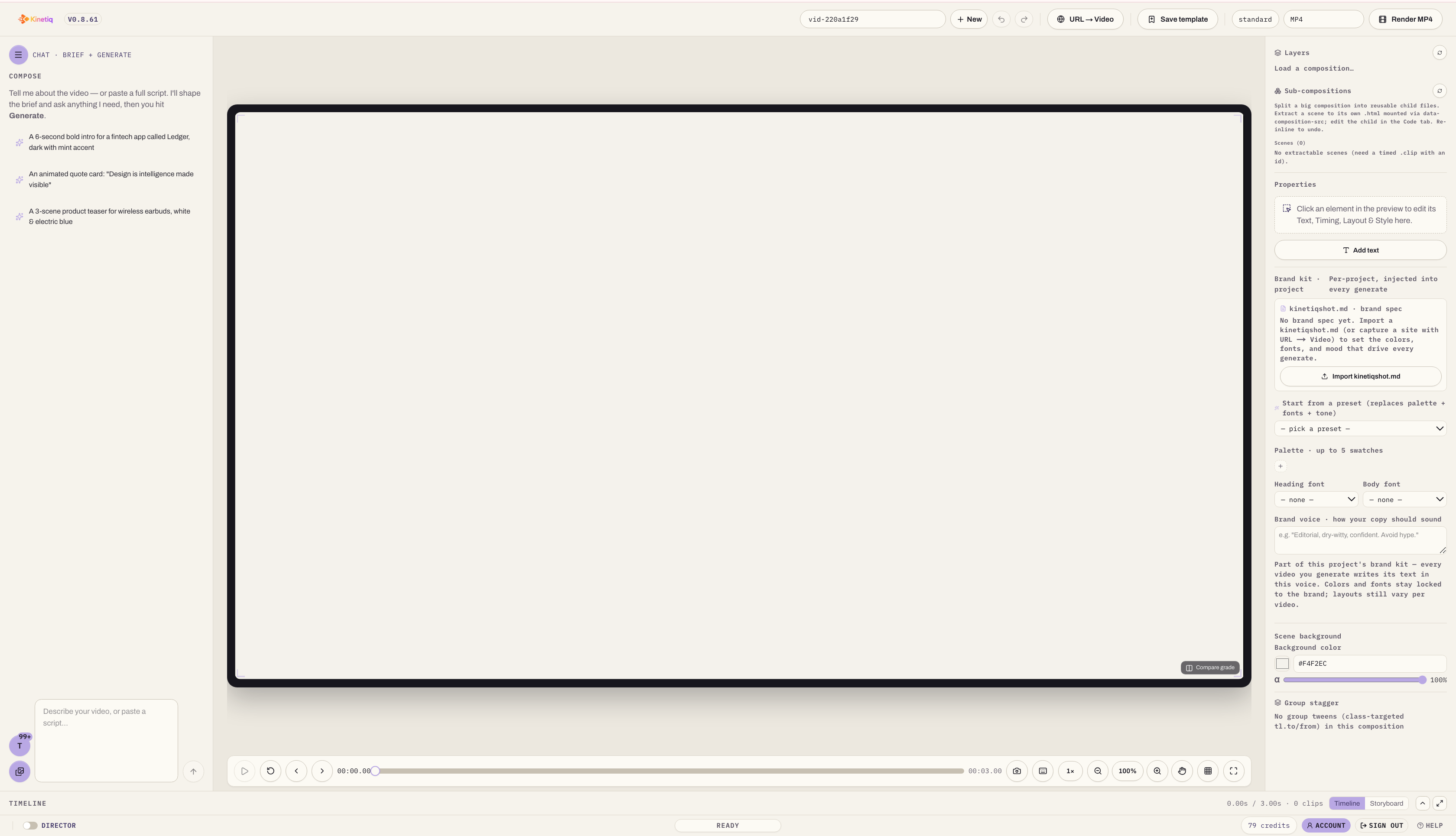
The Kinetiq studio interface: chat and brief panel on the left, a live canvas preview in the center, and layers and brand-kit properties on the right, with a timeline below.
Why This Shift Is Happening Now
A few converging trends explain why AI motion design has moved from a novelty to a genuine production category in the space of about two years, rather than staying a niche experiment.
First, video consumption itself has changed shape. Short-form video now dominates attention across nearly every major platform, which means a single campaign increasingly needs many short cuts rather than one long hero video — a 6-second bumper, a 15-second feed ad, a 30-second YouTube pre-roll, a square crop for one platform and a vertical crop for another. That multiplication of formats is exactly the kind of repetitive, high-volume work that traditional motion design workflows handle worst, since every additional cut has historically meant additional manual hours.
Second, the underlying generative AI models capable of producing coherent, on-brand visual output have improved sharply. Early AI video tools were often good enough for a novelty clip but not for anything a brand would put its name on — inconsistent characters, warped text, unpredictable framing. That gap has closed enough that a growing share of AI-generated motion graphics is now indistinguishable, at a glance, from work produced by a human designer, particularly for the kind of clean, typography-driven, brand-forward motion that dominates modern digital advertising.
Third, marketing organizations themselves have gotten leaner relative to the volume of content they’re expected to produce. Many teams are being asked to maintain a constant content cadence across five or more platforms without a proportional increase in creative headcount. That pressure is the direct cause of the “creative bottleneck” problem described below, and it’s the single biggest reason AI motion design has moved from an interesting side tool to something closer to core infrastructure for marketing and creative teams.
A Side-by-Side Look at Production Timelines
The gap between traditional and AI-assisted motion design is easiest to see laid out step by step. The table below reflects a typical 30-second branded promotional video, comparing a conventional agency or in-house production process against an AI-assisted workflow.
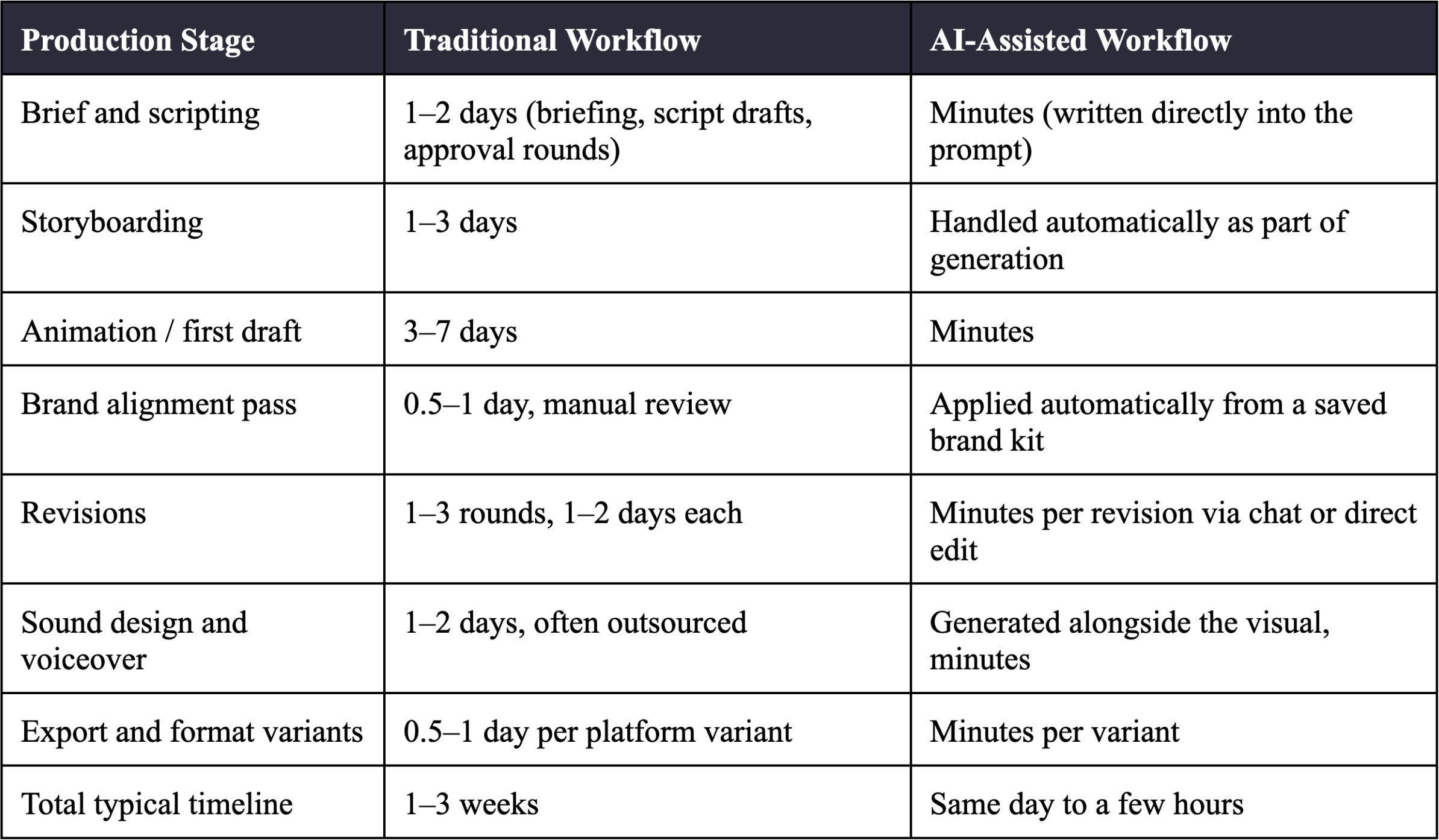
These figures are illustrative rather than a guarantee for every project — complex, highly bespoke creative will always take longer than a straightforward templated promo, regardless of the tool. But the pattern holds directionally across nearly every account of teams that have shifted a meaningful share of their production to AI motion design: the biggest time savings come not from any single step being faster, but from collapsing a chain of sequential handoffs — script, storyboard, animate, review, revise — into a single continuous session where a person can see a result and adjust it immediately.
Common Myths About AI Motion Design
As with any fast-moving category, a handful of misconceptions tend to follow AI motion design tools around. It’s worth addressing a few directly.
“AI motion design means giving up creative control.” In practice, the more capable tools in this category are built around the opposite idea: generation produces a first draft, and a person refines it — through chat instructions, direct manipulation, or in some cases raw code — rather than accepting whatever the model produces on the first pass. The creative decisions still belong to a person; what changes is how much manual labor sits between a decision and its execution.
“AI-generated video always looks generic or off-brand.” This was a fair criticism of earlier-generation tools, but it’s increasingly addressed by brand-kit systems that capture a company’s actual palette, typography, and tone — sometimes directly from its existing website — and apply that identity automatically to every generation, rather than relying on a generic AI aesthetic.
“AI tools are only useful for small, low-stakes content.” While AI motion design is a natural fit for high-volume social content, the same underlying workflow — brief in, editable composition out — is increasingly used for higher-stakes assets like product launch videos, investor materials, and SaaS demos, particularly as reliability and brand-consistency features have matured.
“Adopting AI motion design means replacing the creative team.” The more consistent pattern reported by agencies and in-house teams alike is a shift in where creative time gets spent — away from repetitive production tasks like resizing, re-exporting, and manual keyframing, and toward direction, strategy, and the judgment calls that determine whether a campaign actually resonates.
The Evolution of Motion Graphics in Advertising
Motion graphics have evolved dramatically over the last decade. Initially, animated advertisements required a specific, resource-heavy production stack: professional motion designers, storyboarding, manual animation, multiple rounds of revisions, expensive software licenses, and long production timelines that stretched from days into weeks.
As video became the dominant content format on platforms like Instagram, LinkedIn, YouTube, and TikTok, the demand for animated creatives skyrocketed. Unfortunately, traditional production workflows couldn’t keep pace with the growing volume of content required by modern marketing teams. A single campaign might now need a dozen different cuts — different aspect ratios, different lengths, different hooks for different platforms — and producing every one of them by hand simply doesn’t scale.
Today, AI is changing that equation. By combining generative AI with motion design principles, businesses can transform simple ideas, prompts, or existing creative assets into polished marketing videos — dramatically reducing production time while maintaining consistency. AI-powered creative tools can generate videos, motion elements, images, and presentations from natural-language prompts, enabling marketing teams to move from concept to finished asset in minutes instead of weeks.
The Challenges of Traditional Motion Design
While traditional animation delivers excellent creative control, it also comes with several limitations that become more painful the larger and faster-moving a marketing operation gets.
1. Long Production Cycles
Creating even a 30-second promotional video often involves scripting, designing, animating, reviewing, and editing — a sequence of handoffs that can take days or even weeks from brief to final export. Each round of feedback typically means returning to an earlier stage in that chain, which compounds delays rather than resolving them.
2. High Production Costs
Hiring designers, video editors, illustrators, and motion artists significantly increases campaign costs, especially for businesses producing content regularly. For smaller teams and startups, that cost structure can put professional-grade motion design out of reach entirely, forcing a choice between static creative and a stretched budget.
3. Limited Scalability
Modern campaigns require multiple versions of the same creative across a growing list of destinations:
Facebook
Instagram
LinkedIn
YouTube
Google Ads
Display advertising
Producing every variation manually — different dimensions, different durations, different copy — becomes both expensive and time-consuming, and it’s often the first thing cut when a production team is stretched thin.
4. Creative Bottlenecks
Marketing campaigns frequently wait on creative approvals or production capacity, delaying product launches and reducing campaign agility. A trending moment or a competitor’s move often has a shelf life measured in hours, not weeks — and a bottleneck in the creative pipeline can mean missing the window entirely.
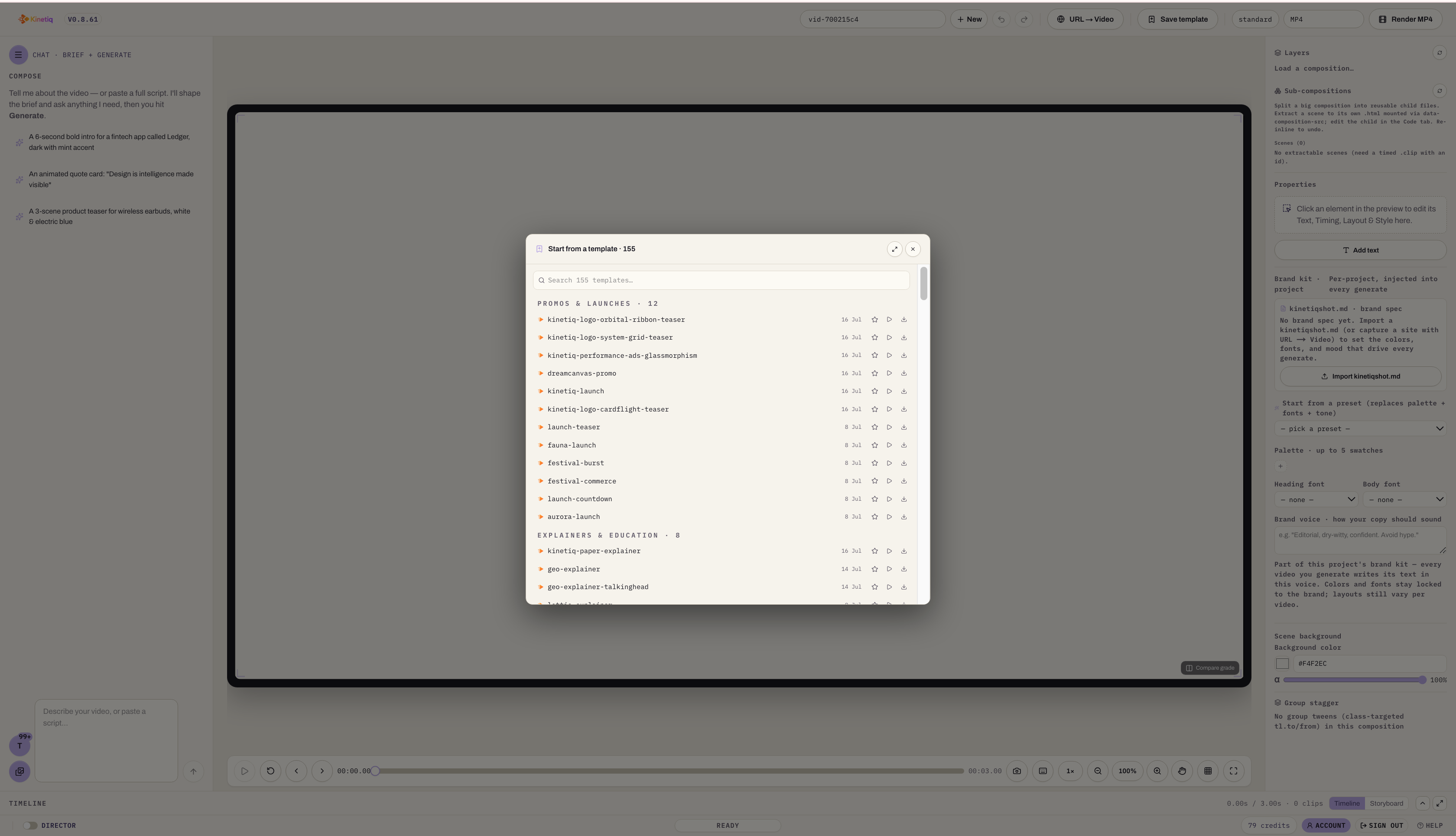
A searchable template library inside Kinetiq, organized under studio picks, with templates applicable in a single click.
How AI Motion Design Speeds Up Creative Workflows
AI motion design automates many repetitive production tasks while allowing creative teams to focus on storytelling and strategy. Instead of building animations frame by frame, marketers simply describe what they need.
For example, a brief as simple as: “Create a 15-second product launch video with modern typography, smooth transitions, and energetic background animation” is enough for the system to work from. Within minutes, AI generates a polished first draft that can be refined or regenerated with updated prompts, rather than rebuilt from a blank canvas.
This dramatically shortens the creative cycle from days to hours — or even minutes. In a tool like Kinetiq, that first draft isn’t a locked, one-shot render either: because the output is built as a structured composition rather than a flattened video file, a marketer can keep adjusting it afterward through chat instructions, direct manipulation on the canvas, a properties panel, or even the underlying code, without needing to regenerate the whole video from scratch every time a small change is needed.
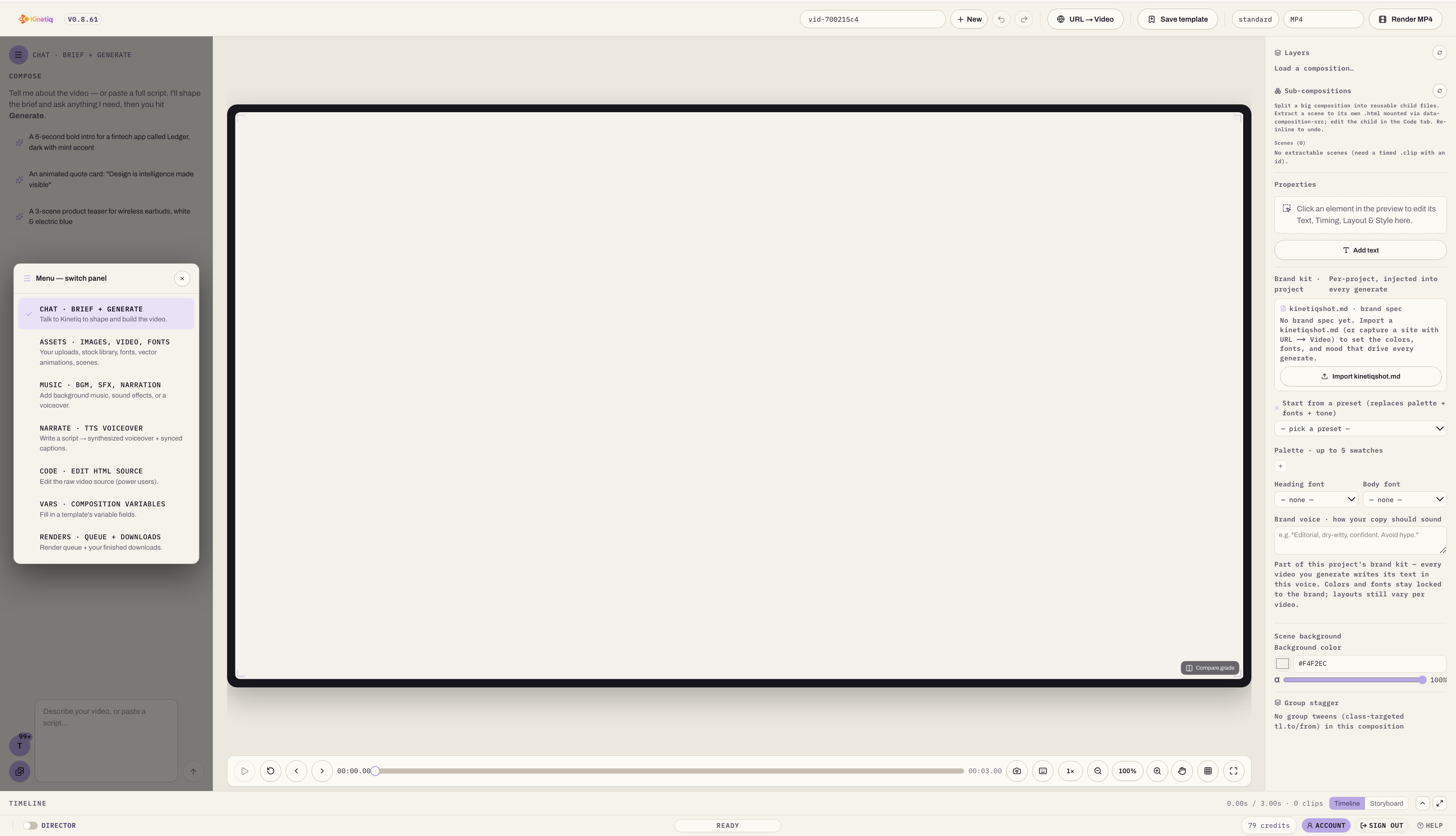
Kinetiq's panel switcher, giving access to Chat, Assets, Music, Narrate, Code, Vars, and Renders — each a fully built section of the product rather than a single generic "generate" button.
Benefits of AI Motion Design for Marketing Teams
Faster Campaign Launches
Speed matters in digital marketing. Whether responding to a trending topic or launching a seasonal campaign, AI enables teams to produce professional creative assets without lengthy production timelines. A campaign that once required a multi-week production runway can now move from brief to first draft inside a single working session.
Lower Creative Costs
Businesses no longer need to outsource every animation project. AI reduces production expenses while making professional-quality motion design accessible to startups and growing companies that previously couldn’t justify a full in-house motion design hire or a steady stream of freelance production work.
Consistent Brand Identity
Modern AI tools can maintain consistent colors, typography, logos, visual styles, and brand messaging across every asset they produce. In practice, this typically works through a brand-kit mechanism: brand details are captured once — in some tools directly from a company’s existing website — and then applied automatically to every future generation, so a marketing team isn’t re-explaining its identity in every new prompt. This ensures every campaign aligns with established brand guidelines, even when dozens of variants are being produced in parallel.
Rapid A/B Testing
Successful advertising relies on experimentation. AI allows marketers to generate multiple creative variations quickly, making it easier to test headlines, visuals, animations, and calls to action to identify top-performing campaigns — turning what used to be a slow, resource-intensive process into something that can run continuously alongside a live campaign.
Increased Team Productivity
Rather than spending hours on repetitive animation work, designers can focus on creative direction, storytelling, campaign strategy, and brand development. The result is better creative output with significantly less manual effort, and a creative team that spends its time on the decisions that actually require human judgment.
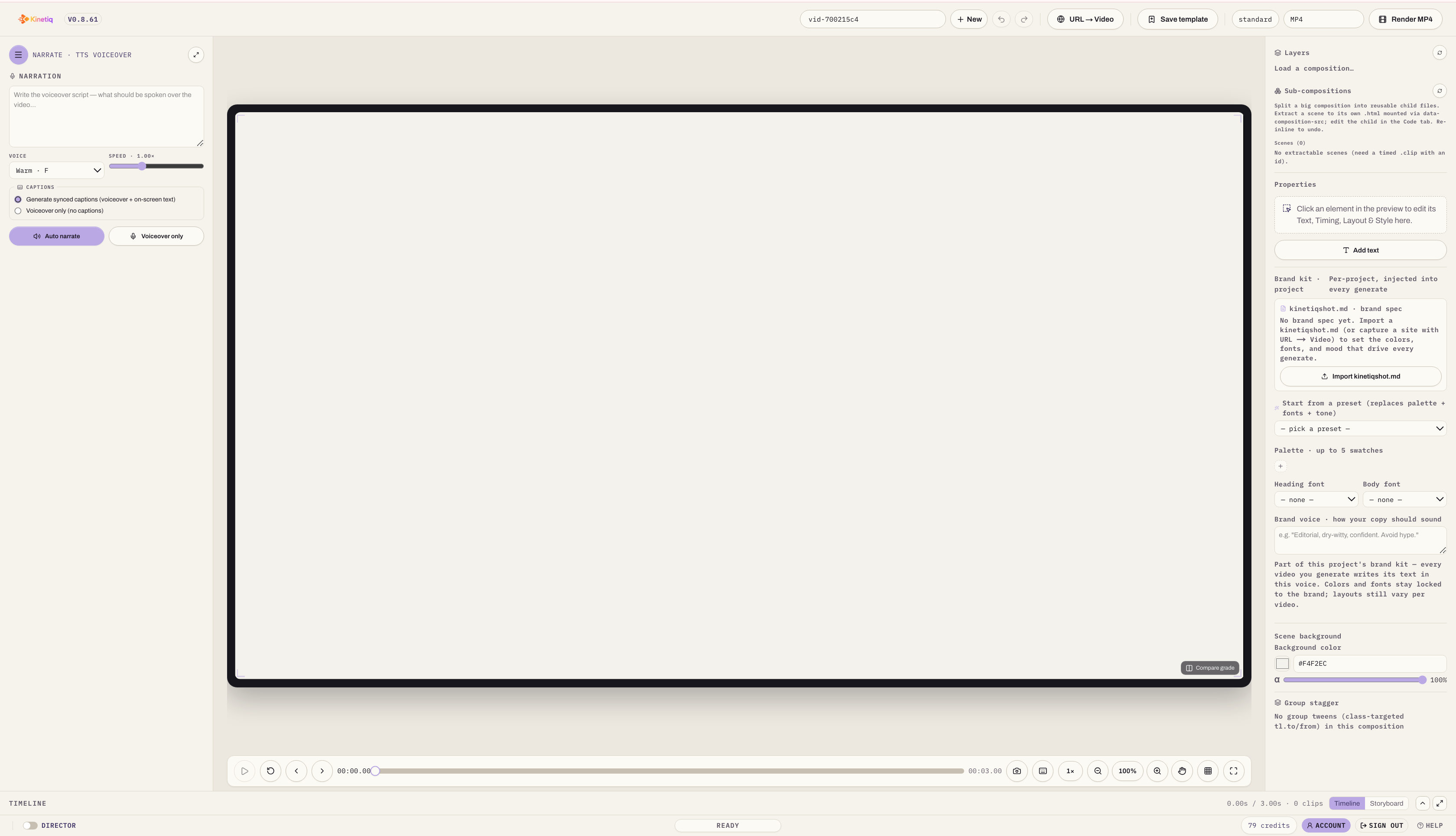
Kinetiq's Narrate panel, converting a written script into synced voiceover and captions as part of the same generation workflow.
Why Agencies Are Embracing AI Motion Design
Creative agencies manage multiple clients, each requiring unique campaigns, formats, and deadlines — a workload that scales linearly with headcount under a traditional production model. AI motion design changes that math.
AI motion design helps agencies:
Deliver projects faster
Scale creative production
Reduce turnaround times
Handle more clients without expanding production teams
Improve collaboration between marketers and designers
Instead of replacing creative professionals, AI acts as a production accelerator that removes repetitive tasks and frees teams to focus on high-value creative work — the strategic thinking, brand storytelling, and creative direction that actually differentiate one agency’s output from another’s.
What This Looks Like in Practice: Sound, Templates, and Output Management
Speed and brand consistency only matter if the finished asset is actually usable, which is why the more mature AI motion design tools go well beyond a single “generate” button. A few examples of what a complete workflow tends to include:
Built-in sound design — background music and sound effects sourced automatically and ducked under narration, so audio doesn’t require a separate editing pass
Voiceover and captions generated directly from a written script, kept in sync with the visual timeline
A searchable template library for teams that want a proven starting point rather than a blank canvas
A structured render queue that tracks file size, render duration, format, resolution, and bitrate for every export, so a team can manage output the way it would manage any other production asset
Kinetiq’s own workflow reflects this pattern directly: a dedicated Music panel handles background audio and automatic ducking, a Narrate panel converts scripts into synced voiceover and captions, a 135-template library organized under “studio picks” gives teams a searchable starting point, and a render queue tracks every export’s technical details in one place.
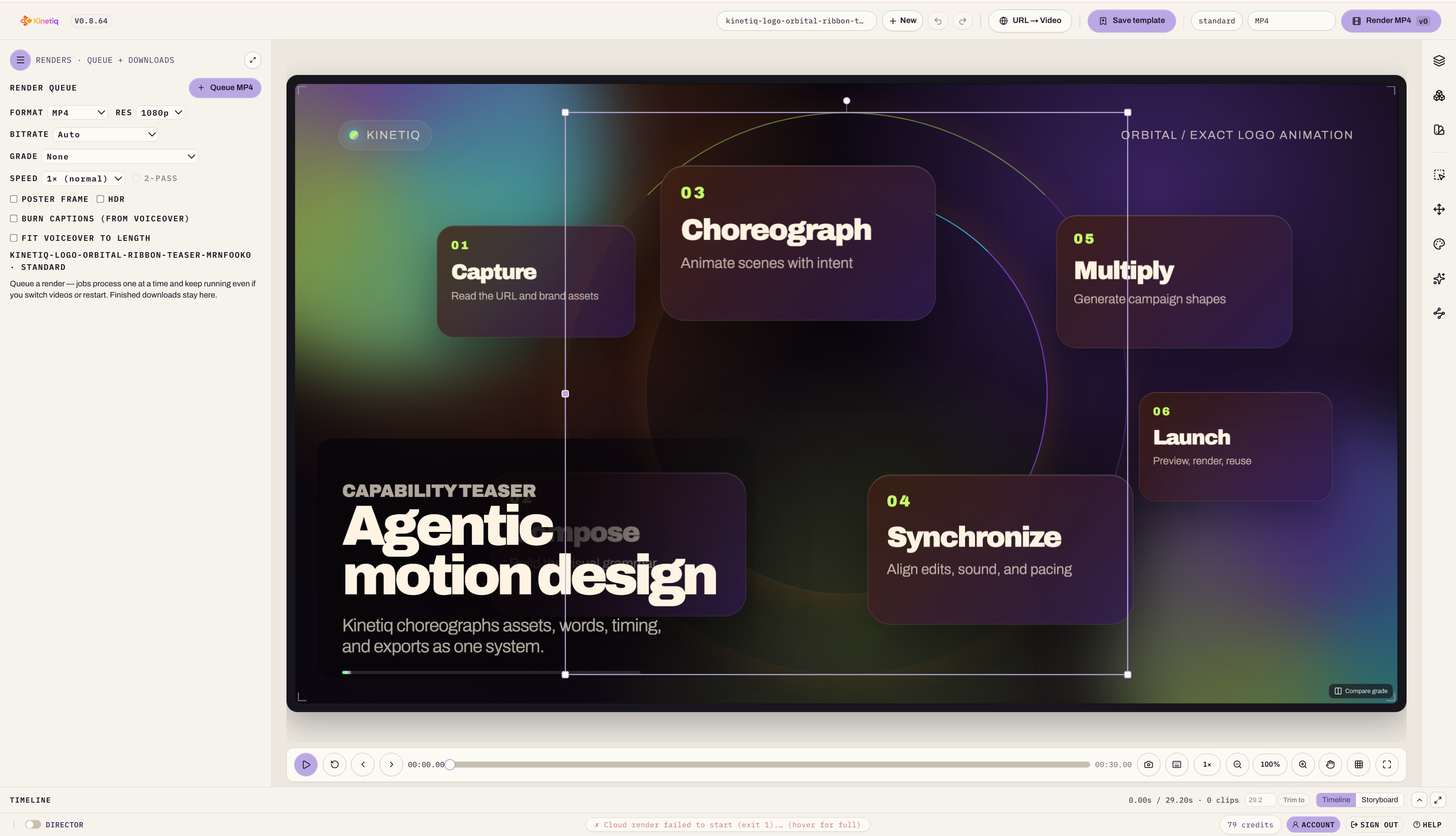
The Kinetiq render queue, tracking file size and render duration per export, alongside format, resolution, bitrate, and grading controls.
See It in Action
Screenshots only tell part of the story with a motion design tool — the workflow itself, from brief to finished render, is easier to understand in motion. Kinetiq’s product walkthroughs show the full path: capturing a brand kit from a URL, writing a brief in the chat panel, watching a multi-scene composition build out on the canvas, and refining the result through chat, direct manipulation, or code, before sending it to the render queue.
The Future of AI-Generated Advertising
AI motion design is rapidly becoming an essential part of modern marketing workflows. Over the next few years, several trends are likely to accelerate:
Hyper-personalized video advertisements tailored to individual audience segments rather than a single mass-market cut
AI-generated creatives built around specific audience data rather than generic templates
Real-time campaign optimization, with creative adjusting alongside performance data rather than waiting for the next production cycle
Automated localization for global markets, adapting language, voice, and cultural references without a full re-production
Voice, video, and animation generated from a single prompt, collapsing what used to be three separate production tracks
Faster collaboration between AI agents and creative teams, with agents handling first drafts and routine variants while people focus on direction and approval
As AI capabilities continue to evolve, advertising will become more data-driven, personalized, and scalable than ever before. That last point — collaboration between AI agents and creative teams — is worth dwelling on, because it points to a structural shift beyond just faster production. A growing share of marketing work increasingly runs through automated pipelines: a content calendar that triggers its own asset generation, a product update that needs an accompanying video without a person manually kicking off the job, a campaign management system that requests new variants based on performance data. Tools built to be operated only by a person clicking through a UI are starting to look less flexible next to tools that can be briefed and run by an AI assistant or an internal automation directly.
How Kinetiq AI Motion Design Studio Fits Into This Future
Kinetiq AI Motion Design Studio is designed to simplify creative production by enabling teams to generate motion graphics, marketing videos, presentations, and visual assets from simple prompts or existing designs. Its workflow emphasizes rapid creation, conversational refinement, and export-ready assets, making it well suited for marketing teams, content creators, and product teams that need to produce high-quality visuals at scale.
A few specific characteristics stand out in how the platform approaches this problem:
Brand capture from a URL, so a project inherits a consistent palette, typography, and tone without manual re-entry
A four-surface studio — chat, canvas, layers/properties, and timeline — that keeps a composition editable after generation rather than treating it as a locked clip
A searchable, 135-template library for teams that want a fast starting point
Integrated sound design and voiceover generation, rather than a separate manual audio pass
A structured render queue for managing exports at production scale
For businesses looking to accelerate content production without sacrificing creativity, this kind of AI-powered motion design offers a practical path toward faster campaign execution and greater marketing efficiency — particularly for teams that need to produce many on-brand variants rather than a single hero asset.
Getting Started: What to Look For When Evaluating an AI Motion Design Tool
If your team is evaluating AI motion design tools for the first time, a few questions tend to separate a tool that will genuinely fit into a production workflow from one that will end up producing disposable, one-off clips:
Does the output stay editable after generation, or do you have to regenerate the whole asset for even a small change?
Can the tool capture and consistently apply your brand identity, or does every prompt need to re-explain your colors, fonts, and tone?
Does the platform include sound design and voiceover, or will you need a separate tool and a separate manual step for audio?
How is output managed at scale — is there a structured way to track renders, formats, and versions, or does everything live as loose files?
Can the tool be integrated into a broader automated workflow, or does it require a person to operate the interface for every single asset?
Answering these questions honestly before committing to a tool will do more for a team’s long-term production efficiency than any single feature comparison — the goal isn’t just faster first drafts, it’s a workflow that still holds up once a team is producing dozens of variants a week rather than one showcase video a month.
How Different Teams Are Putting AI Motion Design to Work
The specific way AI motion design gets used tends to vary quite a bit by team type. A few common patterns:
E-commerce and DTC Brands
Product-led brands typically use AI motion design to turn static product photography into short, platform-native ads at high volume — seasonal promotions, flash sales, and new product launches that need dozens of format variants across paid social channels within a single week. Brand-kit consistency matters enormously here, since a mismatched font or an off-palette color is immediately noticeable across a catalog of similar-looking ads.
B2B SaaS Marketing Teams
SaaS teams frequently use these tools for feature-launch explainers, onboarding walkthroughs, and changelog videos — content that needs to be produced on a recurring, often weekly, release cadence rather than as a one-off campaign. A structured, editable composition matters particularly here, since a UI screenshot or a pricing detail referenced in the video often needs a quick update after the fact rather than a full re-shoot.
Agencies Managing Multiple Client Accounts
Agencies tend to value the combination of speed and brand-kit management most directly, since they’re maintaining several distinct brand identities in parallel and need to avoid any bleed-through between clients. The ability to save and reuse templates across similar campaign types — while keeping each client’s brand kit strictly separate — is often the deciding factor in whether an agency adopts a given tool org-wide.
In-House Creative and Product Teams
Product and content teams inside larger organizations often use AI motion design for internal-facing content — investor updates, sales enablement videos, and internal announcements — where speed and consistency matter more than the highly bespoke, awards-oriented craft of a hero brand campaign.
Frequently Asked Questions
Is AI motion design good enough to replace a professional video production team?
For high-volume, format-driven content — social ads, product explainers, recurring campaign variants — AI motion design now produces output that’s broadly comparable in polish to conventional production, at a fraction of the time and cost. For highly bespoke, awards-oriented brand films, a dedicated production team and a human motion designer’s judgment still tend to produce a different caliber of work. Most organizations end up using both, allocating AI-assisted production to volume content and reserving human-led production for flagship pieces.
How much does an AI motion design tool typically cost compared to traditional production?
Pricing varies significantly by platform and usage tier, but AI motion design tools generally operate on a subscription or credit-based model running from roughly $10–$200 per month depending on volume and resolution needs, compared to freelance or agency motion design work that commonly runs from several hundred to several thousand dollars per finished video. The larger cost saving for most teams comes less from the per-video price and more from the ability to produce many variants from a single brief without incurring a proportional cost increase.
Can AI motion design tools maintain brand consistency across a large volume of content?
Yes, provided the tool includes a brand-kit mechanism that captures a company’s palette, typography, logo usage, and tone once and applies it automatically to future generations. Without that kind of persistent brand configuration, consistency across dozens of AI-generated variants becomes much harder to maintain, since each new prompt would otherwise need to re-specify brand details from scratch.
Do these tools work for agencies managing multiple client brands?
Most platforms built for professional or agency use support separate, isolated brand-kit configurations per project or client, which is generally the feature to confirm before adopting a tool at agency scale — without it, there’s a real risk of one client’s visual identity leaking into another’s output.
What happens if I need to edit a video after it's already been generated?
This is one of the clearest differences between AI motion design tools and traditional one-shot video generators. Tools that produce a structured, editable composition — rather than a flattened, locked clip — allow targeted edits after generation, whether through a chat instruction, direct manipulation on a canvas, or code-level access, without requiring a full regeneration. Tools that only output a rendered file typically require starting over, or manually editing the exported video in a separate application.
Measuring the Impact: What to Track After Adopting AI Motion Design
Speed is the most visible benefit of AI motion design, but it isn’t the only one worth measuring once a tool is in production use. Teams that get the most lasting value out of these platforms tend to track a small set of metrics beyond simple turnaround time.
Cost per finished asset, including subscription or credit costs, compared against the prior cost of freelance or agency production for an equivalent piece of content
Number of creative variants produced per campaign, since the ability to test more headlines, hooks, and formats is often where AI-assisted production creates the most downstream value
Time from brief to first shareable draft, which is usually the most dramatic before-and-after number and the easiest to communicate internally
Brand consistency across output, ideally reviewed periodically by a design lead rather than assumed, particularly in the early months of adoption
Creative team time reallocated toward strategy and direction versus production mechanics, which is harder to quantify precisely but often the most meaningful long-term shift
None of these metrics needs to be tracked with extreme precision to be useful — the goal is simply to confirm that faster production is translating into better campaign outcomes, rather than just a larger volume of interchangeable content. A team producing ten times as many variants that all perform the same as before hasn’t actually gained much; a team producing even modestly more variants that let it identify a genuinely stronger creative direction has gained a great deal.
Final Thoughts
Digital advertising is evolving faster than ever, and traditional creative workflows are struggling to keep up. AI motion design bridges the gap by enabling marketers to produce engaging, high-quality content with unprecedented speed and efficiency.
Rather than replacing creativity, AI enhances it — allowing teams to spend less time on repetitive production tasks and more time crafting campaigns that resonate with audiences. As brands continue to compete for attention in an increasingly crowded digital landscape, AI-powered motion design will become a core component of every modern marketing strategy.
Businesses that embrace AI today will be better positioned to launch campaigns faster, experiment more effectively, and deliver richer visual experiences that drive engagement and conversions.