
How Kinetiq Balances Creative Control With Automation
Key takeaways
Automation and creative control are usually framed as a trade-off — more of one means less of the other. Kinetiq's architecture is built to avoid that trade-off by separating what gets automated from what stays reviewable and precisely editable.
The Director automates structural planning — scene sequencing, pacing, beat timing — which is exactly the part of production that benefits most from consistency and least from ad hoc human invention on every single project.
Four synced editing surfaces — chat, canvas, properties, and code — mean automation's first pass is never the final word; a person can intervene at whatever level of precision a given note actually requires.
This is a Human-on-the-Loop model, not full autonomy: the system carries repetitive, mechanical work, and a person retains approval authority over what ships, with a system's independent scope expanding only as its reliability is demonstrated.
The practical result is that automation handles volume and consistency while a human's judgment is reserved for the smaller number of decisions that actually need it — which is a better division of labor than either full manual control or full autonomy on their own.
Every conversation about AI and creative work eventually arrives at the same anxious question: how much of this can actually be automated before it stops being creative at all? The question assumes a straight line running from full manual control at one end to full automation at the other, with quality and authorship draining away the further a system moves toward the automated end. That framing is intuitive, and it's also not how a well-built system actually has to work — automation and creative control aren't opposite ends of one dial; they're two separate design decisions that can be made independently, and made well, at the same time.
This piece looks at how Kinetiq, the AI motion design studio built by Nagent, is architected around exactly that separation: automating the parts of production that genuinely benefit from consistency and speed, while keeping every part of the result open to precise human judgment, at whatever level of detail a given decision actually calls for.
See automation and control working together
Watch a Director-planned composition arrive already structured, then take it apart by hand exactly where you want to.
The False Trade-Off
The fear that automation erodes creative control comes from a real pattern, just not a universal one: some automated tools genuinely do trade control for convenience, producing a locked or difficult-to-adjust result in exchange for speed. A single-pass generative clip tool is the clearest example — it automates the entire process at once, and the cost of that automation is that a near-miss result usually can't be precisely fixed, only regenerated and hoped for again. In that specific architecture, more automation really does mean less control, because the system wasn't built to let a human intervene anywhere in the middle.
That's a property of how that particular kind of tool is built, not a law governing all automation. The alternative is to automate the parts of the process that are genuinely repetitive and low-variance across projects — structural planning, brand application, technical rendering — while keeping the parts that carry real creative judgment fully open to precise intervention. Done this way, automation and control aren't competing for the same territory; they're operating on different layers of the same system.
What Gets Automated, and Why Those Specific Things
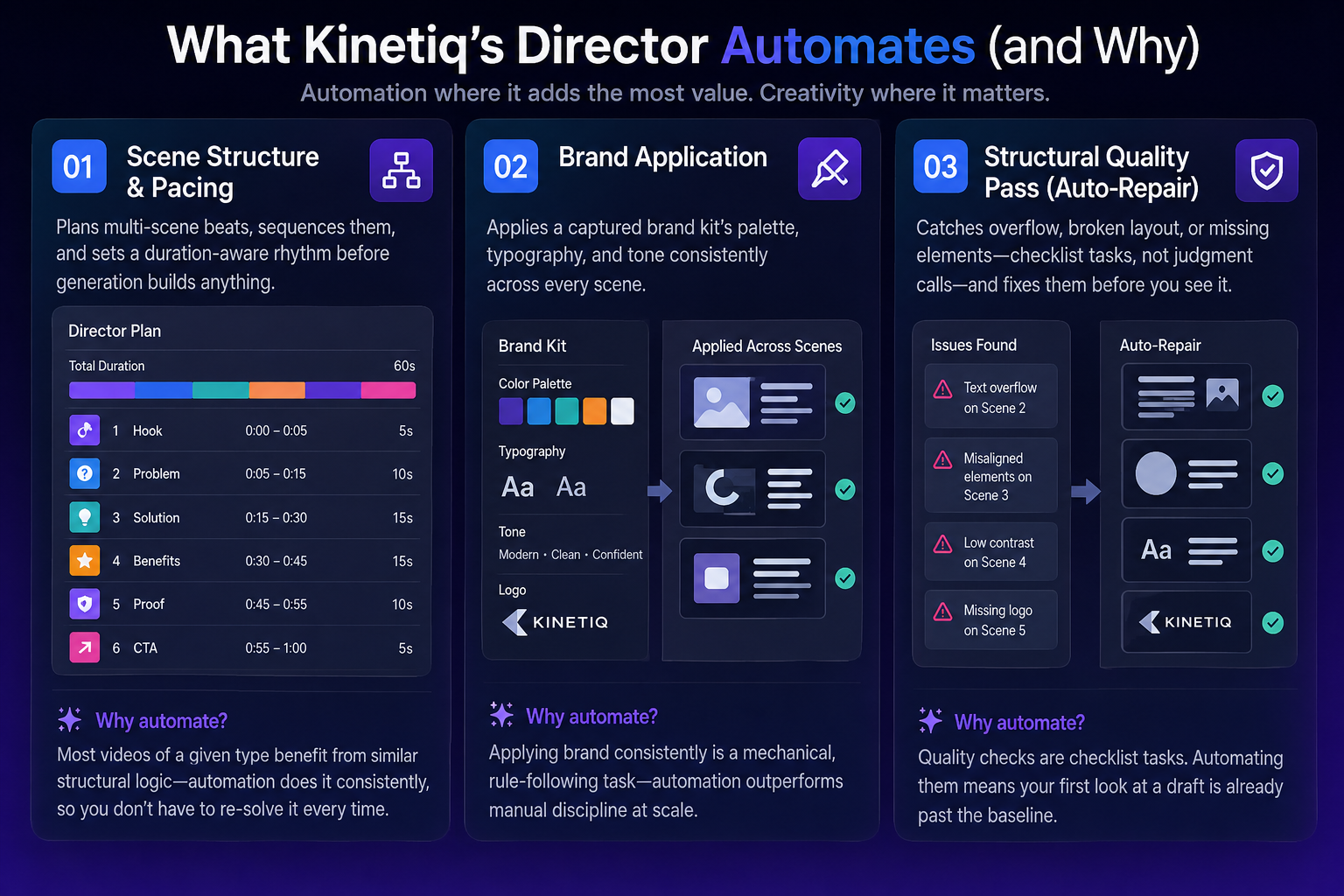
Kinetiq's Director automates scene structure and pacing — planning multi-scene beats, sequencing them, and setting a duration-aware rhythm before generation builds anything. This is a deliberate choice about what to hand to a system: structural planning is the part of motion design where a competent, consistent default adds the most value and where ad hoc human invention on every single project adds the least differentiated value. Most videos of a given type — a launch piece, an explainer, a social cutdown — benefit from broadly similar structural logic, and a system that plans that logic well, every time, frees a person from re-solving the same structural problem from scratch on every brief.
Brand application is automated the same way, and for a similar reason: applying a captured brand kit's palette, typography, and tone consistently across every scene is a mechanical, rule-following task, not a creative one, and it's exactly the kind of task where automation reliably outperforms manual discipline at scale, as covered in more depth elsewhere in Kinetiq's own documentation. A structural quality pass — auto-repair and validation — is automated for the same reason: catching overflow, broken layout, or missing elements is a checklist task, not a judgment call, and automating it means a person's first look at a draft is already past that baseline.
What Stays Under Precise Human Control
Everything downstream of the automated first pass remains editable at whatever level of precision a given note actually requires, through four surfaces operating on the same synced composition:
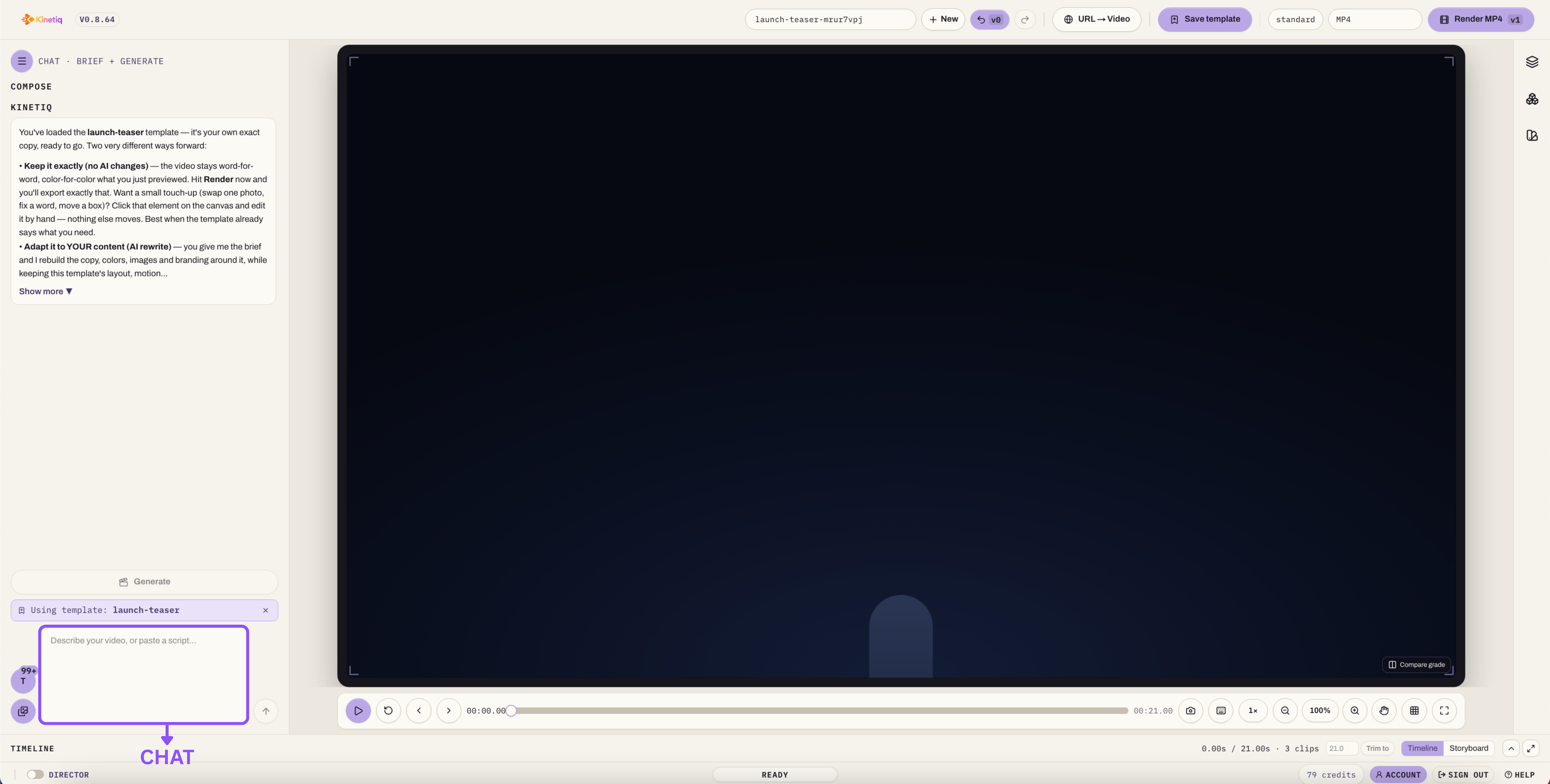
Chat, for intent-level notes — “make this feel more urgent,” “slow the middle section down” — the kind of direction a creative lead gives without needing to specify an exact numeric value.
Canvas, for direct visual manipulation — dragging, resizing, and rotating elements by hand, the same tactile control any visual design tool offers.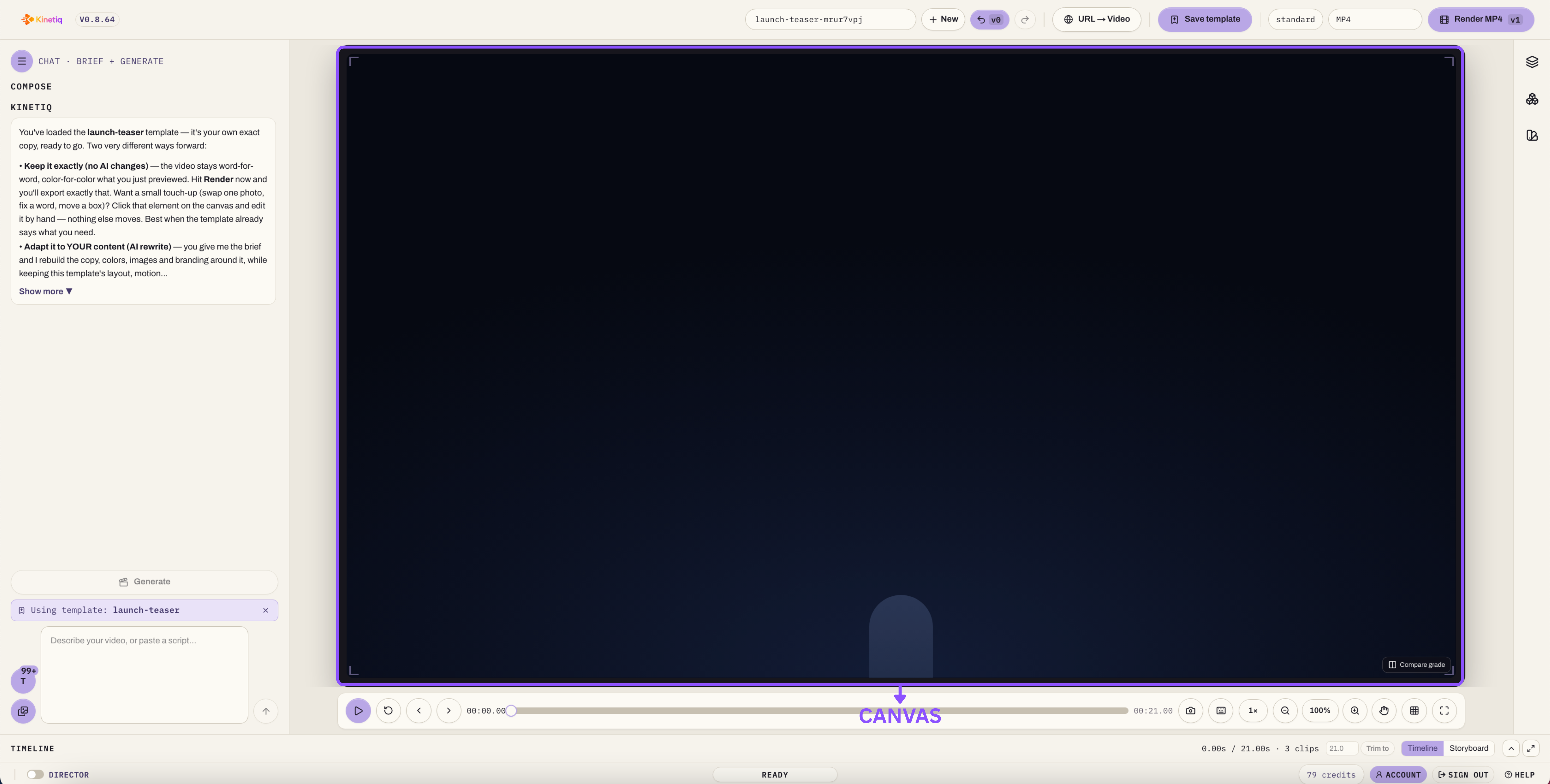
Properties, for exact precision — a specific color value, an exact gradient angle, a precise easing curve, for the moments when a note has to become a specific number rather than an approximation.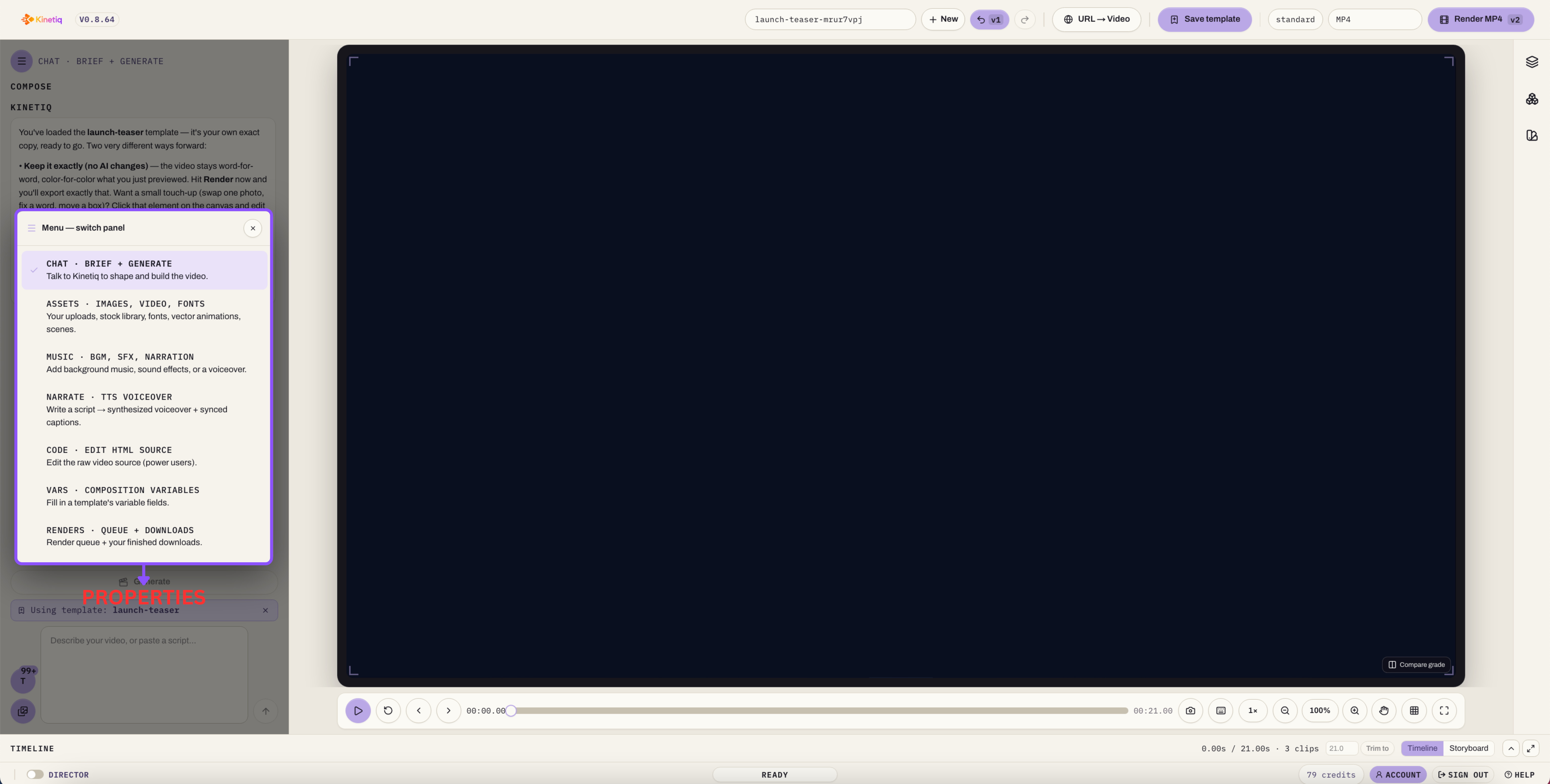
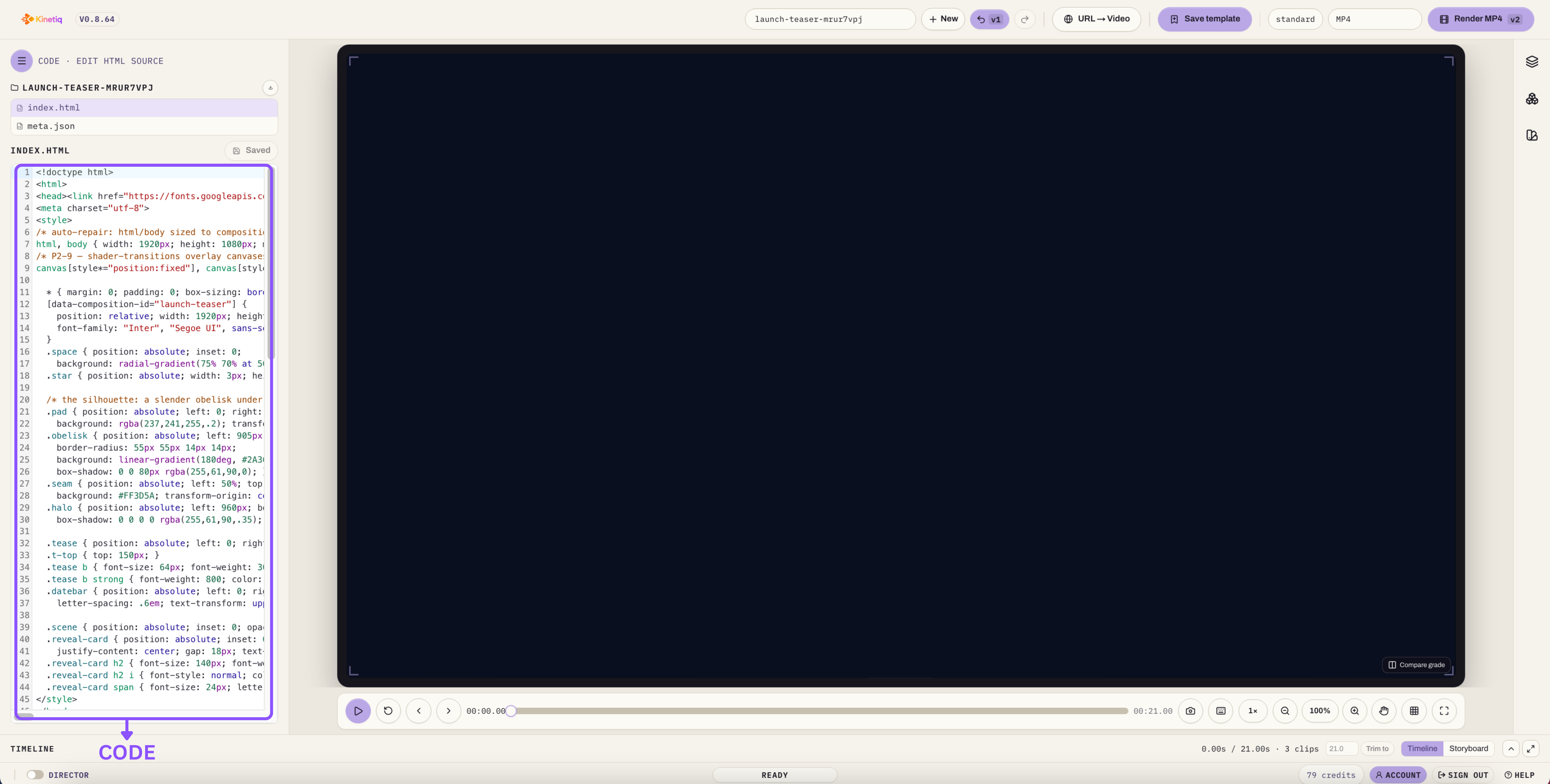
Code, for anyone who wants to work directly in the underlying HTML, with every change round-tripping cleanly back to the visual canvas rather than forking into an unsynced file.
None of these surfaces is a fallback for when automation fails — they're the normal, expected next step after any automated first pass, because the Director's plan and the quality pass's structural check were never meant to be the final word on a composition's creative direction. They're a strong, checked starting point that a person then directs toward whatever the specific brief actually needs.
Automation for structure, precision for everything you care about
Let the Director handle pacing and structure, then take control exactly where your judgment matters most.
Human-on-the-Loop, Not Full Autonomy
The governance model underneath this balance matters as much as the editing mechanics. Kinetiq's approach reflects what the broader category has started calling a Human-on-the-Loop model, as distinct from full autonomy: a system carries the mechanical, repetitive labor — planning, brand application, structural checking, reformatting across sizes — while a person retains authority over what actually ships. Autonomy in this model is earned through demonstrated reliability inside defined guardrails, rather than switched on universally by default.
This distinction is what separates a governed automation architecture from an unsupervised one. Full autonomy without a human checkpoint is a real risk for anything brand-facing, because a system can be reliable on average and still occasionally produce something structurally or tonally wrong, with no one positioned to catch it before it ships. Human-on-the-Loop keeps a person in exactly the position where their judgment adds the most value — reviewing and approving a competent, checked first pass — without requiring that person to have built the first pass by hand.
Where the Balance Shifts by Use Case
The right balance between automation and manual control isn't fixed — it shifts depending on what's being produced, and Kinetiq's architecture is flexible enough to support that shift rather than forcing one fixed ratio onto every project.
High-volume, routine production — weekly social cutdowns, recurring format variants — leans heavily on automation, with a person's review closer to a final check than a deep creative pass, because the format is already proven and the marginal value of manual refinement on each individual asset is low.
Flagship or first-of-its-kind pieces — a new brand film, a first launch video for a new product category — use the Director's plan as a starting hypothesis, with substantially more time spent in canvas, properties, and code refining the result toward something genuinely bespoke.
Automated, agent-driven pipelines — a changelog video triggered by a product release, a scheduled batch of ad variants — push automation furthest, governed by the same hard cost allowlist and per-video metering that makes it safe to let a system generate against a fixed budget with a human approving in aggregate rather than per request.
Why This Balance Is the Actual Product, Not a Feature List
It's worth naming directly that this balance — automate structure and consistency, keep judgment precisely editable — isn't one feature among many in Kinetiq's catalogue. It's closer to the organizing principle the rest of the product is built around. A system that automated everything, including creative judgment, would be fast but untrustworthy for real brand work. A system that automated nothing would be safe but no faster than the traditional process it's meant to replace. The specific choice of what to hand to a system and what to keep precisely in human hands is what makes the difference between a tool that's genuinely useful for professional production and one that's merely fast.
Frequently Asked Questions
Can automation be turned off entirely for a project that needs full manual control?
A composition can be built from a blank brief and then extensively hand-refined through canvas, properties, and code, effectively minimizing reliance on the Director's automated structural plan for any project where a team wants maximum manual input from the start.
Does more automation mean less oversight of what actually ships?
No — the Human-on-the-Loop model keeps a person in the approval role regardless of how much of the construction work is automated. Automation reduces the manual labor of building a first pass; it doesn't reduce or remove the review step before something ships.
How much manual refinement does a typical automated first draft actually need?
It depends on the use case — a routine, template-based asset often needs only a light review, while a flagship or genuinely novel piece typically benefits from substantially more manual work in canvas, properties, and code. The system is built to support either case rather than assuming one fixed amount of refinement is always right.
Is it safe to let an automated pipeline generate and publish video without a human checking every single one?
That depends on the use case and the organization's own risk tolerance, but Kinetiq's hard provider allowlist and per-video cost metering are specifically designed to make bounded, governed automation safer — a fixed budget and approved model set, with a human able to review in aggregate rather than approving every individual generation, is a materially different risk profile than fully unsupervised generation.
Say it. See it. Ship it.
Automation and creative control were never actually opposites — they just needed to be applied to different parts of the process. Kinetiq automates structure and consistency, and leaves judgment exactly where it belongs: with a person.
Get the speed of automation without losing the last word
Kinetiq is an AI motion design studio built by Nagent, built around a Human-on-the-Loop model for real production work.