How Kinetiq Reduces Decision Fatigue in Design
How Kinetiq Reduces Decision Fatigue in Design
Key takeaways
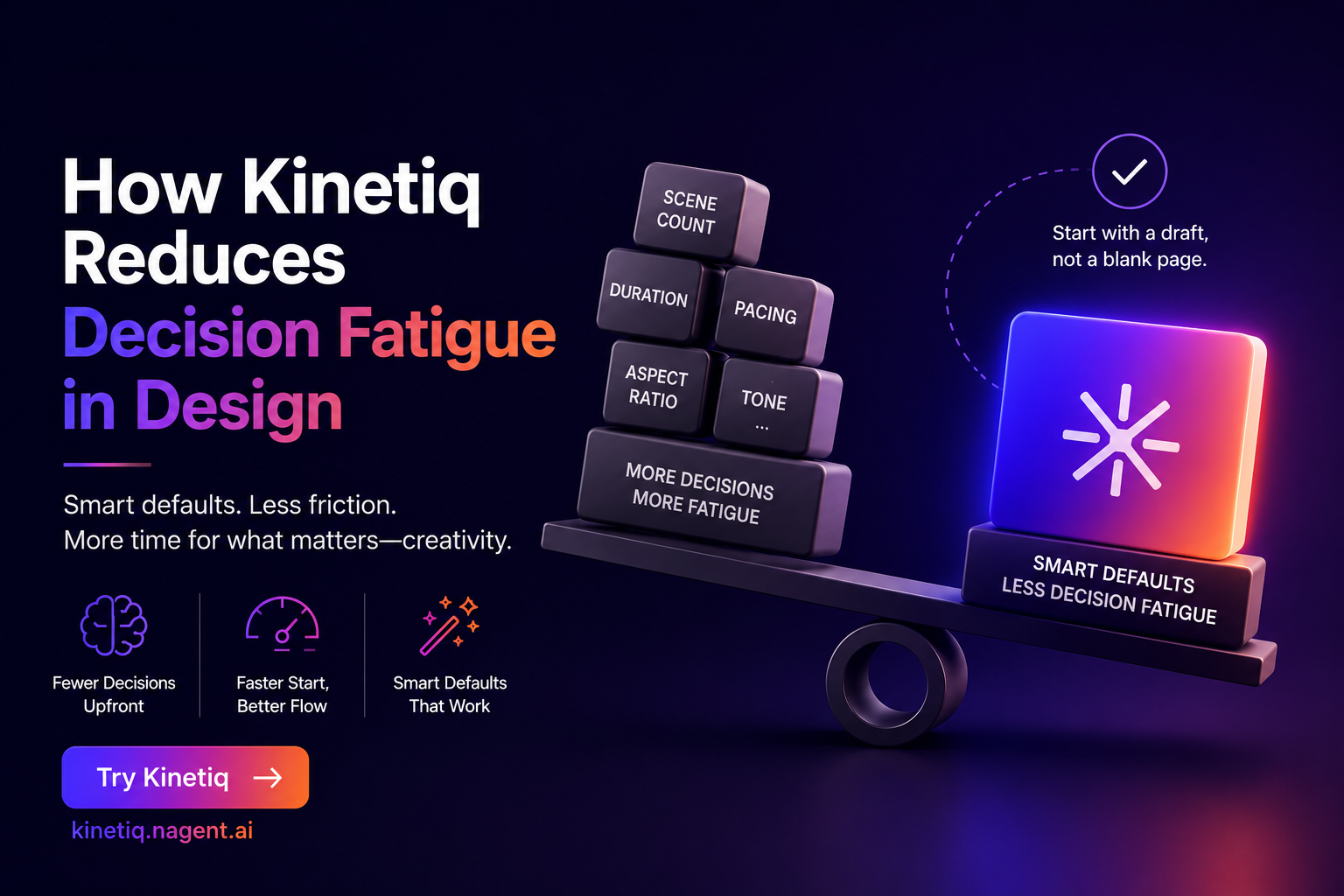
A blank motion design project confronts a person with dozens of unstated decisions before any real creative work begins — scene count, pacing, duration, aspect ratio — and answering all of them upfront is a real cognitive cost, not a neutral starting point.
Kinetiq chat interface is built to reason like a producer: inferring sensible defaults for anything left unspecified, and asking a single, crisp clarifying question only when something is genuinely ambiguous, rather than presenting a form full of settings before letting anyone start.
Duration-aware pacing and a Director that plans scene structure automatically remove two of the highest-stakes early decisions — how long, and how many beats — from the list of things a person has to get right before generation even begins.
Smart defaults aren't about removing choice entirely — every default remains visible and editable afterward, so the benefit is fewer decisions required before starting, not fewer decisions available overall.
The cumulative effect matters most for non-specialists and for high-volume routine work, where re-deciding the same settings on every single project is pure overhead that a good default absorbs invisibly.
Open a blank motion design project and, before any actual creative thinking happens, a surprising number of decisions are already silently demanded of you. How many scenes should this have? How long should it run? What aspect ratio? Should the pacing be quick and energetic or slower and more deliberate? A blank canvas doesn't ask these questions out loud, but it doesn't answer them either, which means answering them is quietly transferred onto whoever's staring at the empty timeline, before they've had a chance to think about what the video should actually say.
This is decision fatigue in a very literal sense, and it's a real cost that most motion design tools impose without acknowledging it. This piece looks at how Kinetiq, the AI motion design studio built by Nagent, is built to absorb a meaningful share of that upfront decision load through sensible, visible, overridable defaults — not by removing choice, but by not requiring every choice to be made before the real creative work can start.
Start without deciding everything first
Type a brief and let sensible defaults handle the rest — adjust anything afterward, once you can see it.
The Hidden Cost of a Blank Canvas
Decision fatigue is a well-documented phenomenon in behavioral research: the quality of a person's decisions degrades over a sequence of choices, particularly when many of those choices are unfamiliar or high-stakes-feeling relative to the decider's experience. A blank motion design project front-loads an unusually large number of these decisions onto a single moment, right at the start, before a person has any concrete material to react to. Scene count, pacing, duration, aspect ratio, tone — all of it has to be decided in the abstract, based on imagination alone, rather than in response to something already on screen.
For an experienced motion designer, many of these decisions have become close to automatic, absorbed through repetition into something closer to instinct than deliberate choice. For anyone else — a marketer, a founder, an account lead — each one is a genuine decision point, made without the benefit of that accumulated instinct, which is exactly the population decision fatigue affects most, and exactly the population a genuinely accessible tool needs to support well.
Reasoning Like a Producer, Not a Form
Kinetiq's chat interface is explicitly built around a different interaction model than a settings form: rather than presenting every decision upfront as a field to fill in, it infers intent and fills sensible gaps automatically, asking a single, crisp clarifying question only when something is genuinely ambiguous — and even then, offering a clear recommendation rather than a wall of undifferentiated options for the user to weigh unassisted. This mirrors how a competent human producer actually operates: a producer doesn't hand a client a twenty-field intake form before starting work; they ask a few grounding questions, make sensible assumptions about everything else based on experience, and flag anything genuinely important that's still unclear.
This matters because the number of decisions a system asks a person to make upfront is itself a design choice with real consequences, independent of how good the tool is at executing any individual decision well. A tool that asks fewer upfront questions and fills the rest with reasonable defaults gets a person to a concrete first draft faster, and — this is the less obvious benefit — gives them something real to react to, which is almost always easier than generating an opinion from nothing. It's easier to say “make it faster-paced” while looking at a draft than to specify an exact pacing preference before anything exists.
Duration-Aware Pacing: One Default That Removes Several Decisions at Once
A concrete example of a smart default doing real work: Kinetiq's Director applies duration-aware pacing automatically, meaning scene count and rhythm scale sensibly to whatever length a brief calls for, rather than requiring a person to separately specify how many scenes a five-second piece needs versus a three-minute one. This single default is quietly absorbing several individually nontrivial decisions — how many beats, how long each one holds, where the pacing should pick up or slow down — that a blank-canvas tool would otherwise require a person to work out from scratch, informed only by whatever intuition they happen to already have about pacing.
The Director's broader planning role does something similar at a larger scale: it plans a full multi-scene structure before generation happens, which means a person isn't required to have a fully formed opinion about scene sequencing before starting. They can react to a proposed structure — approving it, or asking for a specific change — which is a meaningfully easier cognitive task than generating that same structure from nothing.
Let pacing scale itself to your video's length
Duration-aware pacing means you don't have to work out scene count and rhythm by hand before you start.
Defaults Are Visible and Overridable, Not Hidden
A reasonable concern about smart defaults is that they quietly remove control — that a system making decisions on a person's behalf means those decisions become invisible or difficult to change afterward. This isn't how Kinetiq's defaults function, and the distinction matters. Every default the Director or chat interface applies — pacing, scene structure, an inferred creative direction — is visible in the resulting composition and fully editable afterward through chat, canvas, properties, or code, the same as anything else in the project.
The benefit smart defaults provide isn't fewer decisions available overall — it's fewer decisions required before a person can see something concrete to react to. That's a meaningful difference: a decision deferred until there's a real draft to evaluate is a much lighter cognitive load than the same decision made in the abstract, even though the total number of decisions available to make hasn't actually shrunk.
Where Decision Fatigue Costs the Most
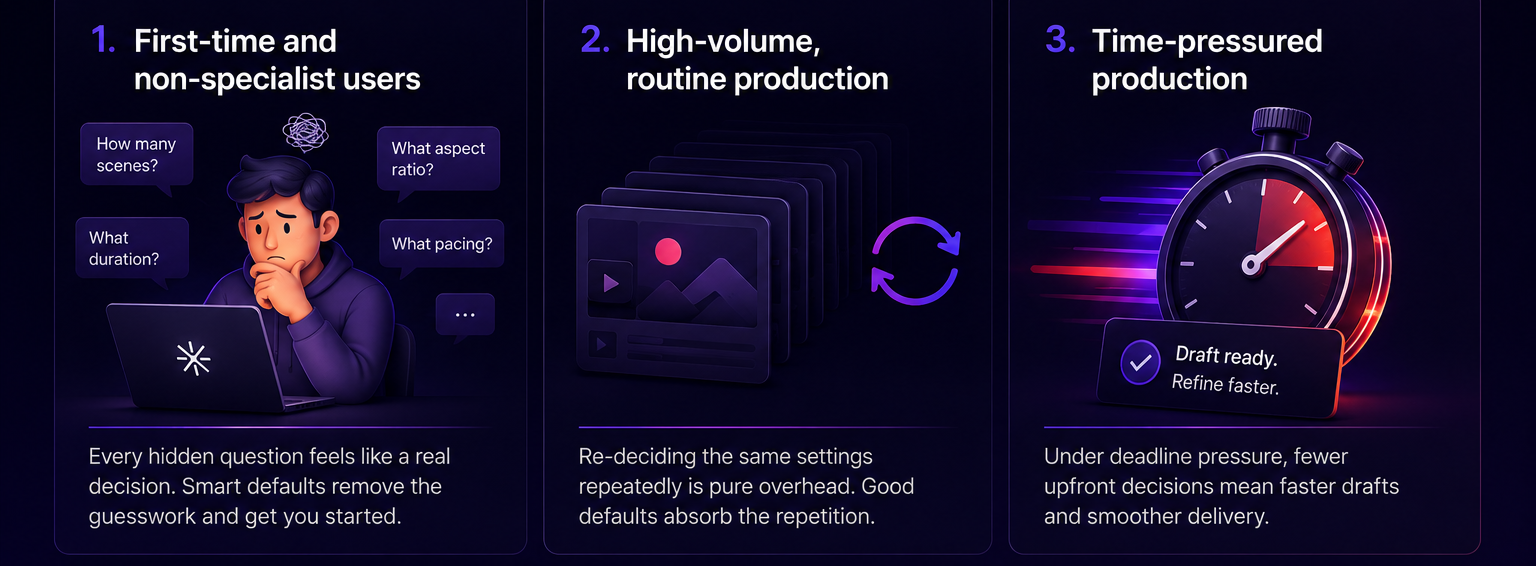
First-time and non-specialist users. Someone without years of accumulated motion design instinct feels every one of a blank canvas's implicit questions as a genuine, effortful decision, which is exactly the friction that keeps non-specialists from attempting motion design work at all.
High-volume, routine production. Re-deciding the same pacing and structural questions on the fortieth similar video of the month is pure overhead — the answer was already effectively settled by the first few, and a good default should absorb that repetition rather than asking the same questions again every time.
Time-pressured production. Under deadline pressure, every unnecessary upfront decision is a place a project can stall, and a system that gets a person to a concrete draft with fewer prerequisite decisions gets them into productive, reactive refinement work faster.
The Broader Principle: Defer, Don't Eliminate
The underlying design principle worth naming explicitly is that smart defaults work best when they defer a decision to the moment it's easiest to make, rather than eliminating the decision entirely. Almost every default described in this piece — pacing, scene structure, brand tone inference — remains fully visible and adjustable once a draft exists. What's changed is when a person is asked to weigh in: not in the abstract, before anything is real, but in response to something concrete, which is a fundamentally easier kind of judgment to exercise well.
Frequently Asked Questions
Do smart defaults reduce the amount of creative control available?
No — every default remains visible in the resulting composition and fully editable afterward through chat, canvas, properties, or code. The benefit is fewer decisions required before starting, not fewer decisions available once a draft exists.
How does Kinetiq know when to ask a clarifying question versus just assuming a default?
The chat interface is built to infer intent and fill sensible gaps automatically, reserving a clarifying question for situations that are genuinely ambiguous — and even then, offering a clear recommendation rather than an open-ended list of options for the user to evaluate unassisted.
Does duration-aware pacing mean every video of the same length looks structurally identical?
No — pacing scales sensibly to a requested duration, but the specific creative execution within that structure still varies per generation, drawing on a rotating art-direction and structure engine rather than applying one fixed template regardless of brief.
Is this mainly useful for beginners, or does it help experienced designers too?
It helps most visibly for non-specialists facing a blank canvas for the first time, but experienced designers benefit as well, particularly on high-volume, routine work, where re-deciding the same structural questions on every similar project is unnecessary overhead regardless of skill level.
Say it. See it. Ship it.
A blank canvas asks dozens of silent questions before any real creative work begins. Kinetiq answers most of them with sensible, visible, overridable defaults — so the first decision you have to make is about something you can actually see.
Start from a draft, not a blank page full of decisions
Kinetiq is an AI motion design studio built by Nagent, built to defer decisions until there's something real to react to.