
How Video as Code Powers AI Motion Design Tools
Most conversations about AI video generation focus on speed: how fast can a tool go from a prompt to a finished clip. That's a fair thing to care about, but it misses the more consequential architectural decision separating serious AI motion design platforms from novelty generators — whether the video that comes out the other end is a disposable file, or a reproducible, editable, versioned artifact. The industry has started calling the latter approach "video as code," and understanding what it actually means is useful for anyone deciding which category of tool to build a workflow around.
This piece is a closer look at that architecture: what treating video as code actually requires, why it matters more than it might initially seem, and how it changes what's possible for teams and developers building on top of tools like Kinetiq AI Motion Design Studio.
The Problem With Treating Video as a File
Traditional video production, whether done by hand in After Effects or generated by an early wave of AI tools, produces a file. A file is a fixed sequence of pixels, useful for playback but nearly useless as a starting point for anything else. Once a project exists only as an exported MP4, several things become difficult or impossible: you can't reliably reproduce the exact same output if the source project is lost, you can't hand it to another tool or another person's workflow and expect them to modify it meaningfully, and you can't audit how it was built beyond whatever documentation someone happened to keep alongside it.
Early AI video generators inherited this limitation and made it worse. A prompt fed into a black-box model produces a video, but running the same prompt again often produces a meaningfully different result, because the generation process isn't deterministic. That's fine for casual, disposable content, but it's a serious liability for any use case where a specific approved version needs to exist reliably — advertising creative that legal has signed off on, a product demo that matches exactly what a sales team was trained on, a brand asset that needs to be reproduced identically for a different platform months later.
What "Video as Code" Actually Means
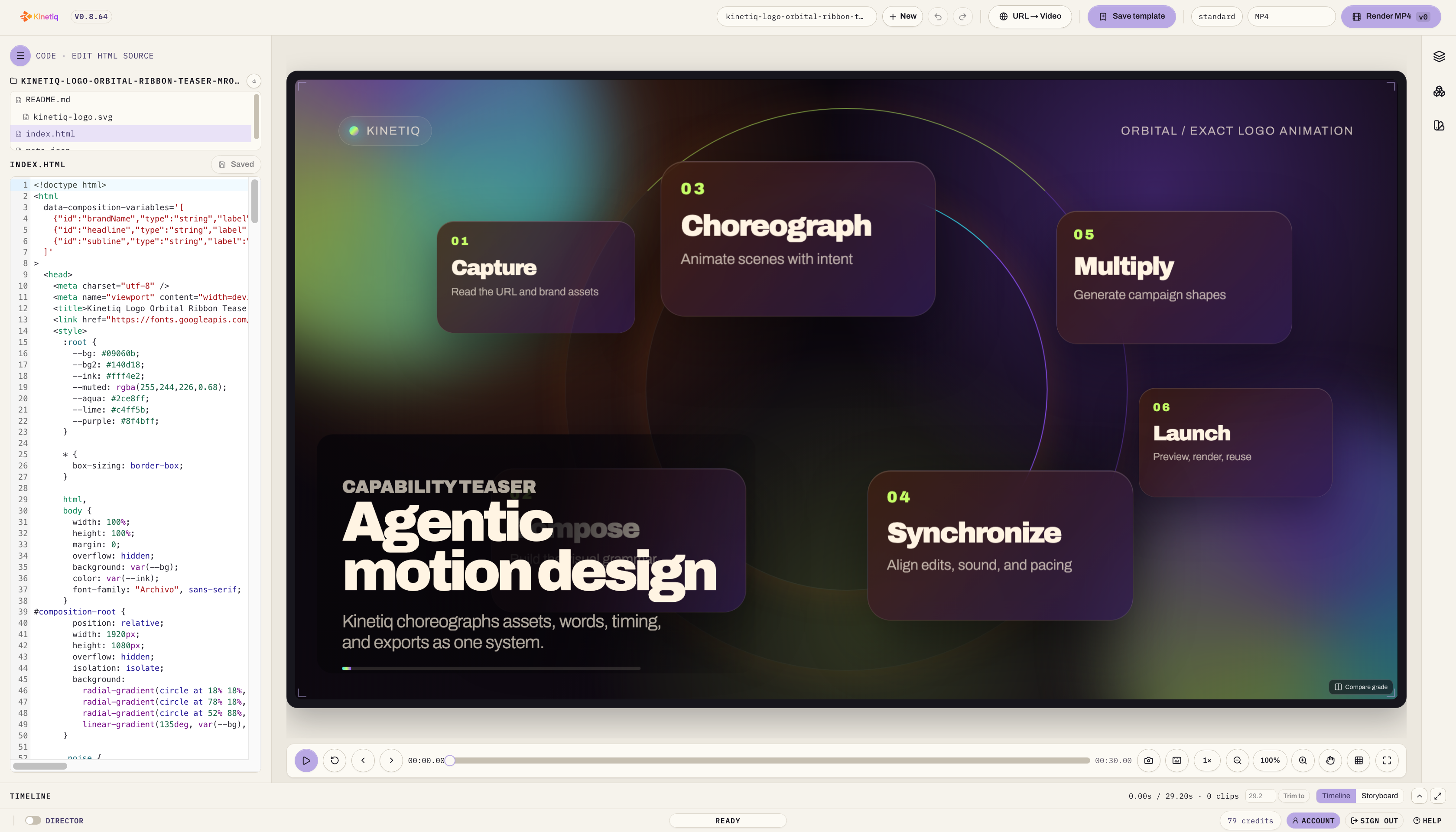
The alternative architecture treats a video not as a rendered file first and a concept second, but as a structured, editable composition first, with the rendered file as one output of that composition rather than the composition itself. Kinetiq describes this directly: a video is reproducible, versioned, auditable, and editable by both people and agents, and a saved composition renders to the exact same frames every time it's rendered, the same way a locked print file would, while still remaining fully editable as a source.
This has a specific technical implication worth spelling out: the underlying representation of the video isn't just pixels, it's something closer to a program — a structured description of scenes, elements, timing, and motion that can be inspected, modified, and re-executed. Kinetiq exposes this directly by letting users drop into the HTML source of a composition at any point, with changes round-tripping back to the visual canvas. That's a fundamentally different object than an exported video file, even though both can be played back and look identical when they are.
Determinism: Why the Same Input Should Always Produce the Same Output
One of the more easily overlooked but structurally important properties of a well-built AI motion design system is render determinism — the guarantee that rendering a given composition produces the exact same frames every time, regardless of how many times it's re-rendered or how much time has passed since it was first created.
This matters because generation and rendering are conceptually different steps, even when a user experiences them as a single action. Generation is where creative and often probabilistic decisions get made — composing a scene from a brief involves genuine choices about pacing, layout, and content that reasonably vary between attempts. Rendering, by contrast, is the mechanical process of turning an already-decided composition into pixels, and that step should be fully deterministic: given the same composition, the same render should come out every time.
Systems that conflate these two steps — where "regenerating" a video means re-running the whole probabilistic process from scratch — can't offer this guarantee, because there's no stable intermediate representation to render deterministically from. Systems built around video as code separate the two cleanly: generate once to produce a composition, then render that composition as many times as needed with guaranteed consistency. This is what allows a team to reproduce an approved video exactly, months later, without needing to keep a separate archival copy of the original export as insurance against ever needing to touch it again.
Auto-Repair, Scoring, and Structural Validation
A second architectural piece that distinguishes mature AI motion design platforms is treating quality assurance as part of the generation pipeline rather than something left entirely to human review afterward. Kinetiq describes every generation as repaired, scored, and structurally validated, with built-in audits for contrast, overflow, and motion, run from the same toolkit the rendering engine itself exposes.
This is worth unpacking because it reflects a specific design choice: rather than generating a composition and hoping it's well-formed, the system checks it against the same structural rules a human reviewer would apply — does text fit inside its container, is there sufficient contrast between foreground and background elements, does motion timing stay within acceptable bounds — and automatically repairs violations where possible before a human ever sees the draft. This is meaningfully different from bolting a review step onto the end of a pipeline; it's baking the review criteria into the generation and rendering process itself, using the same toolkit programmatically that a human reviewer would use manually.
For teams operating at any real scale, this matters because it changes the failure mode. A tool without structural validation produces occasional broken output that a human has to catch, which doesn't scale past a small volume of generations. A tool with validation built into the pipeline produces a much higher baseline of well-formed output automatically, which is what actually makes high-volume generation viable without a proportionally growing review team.
Agent-Native Design: Building for Non-Human Operators
The most forward-looking piece of this architecture is the explicit design for agents, not just people, to operate the tool. Kinetiq describes itself as agent-native, with a model-agnostic skills system drivable by any capable agent, alongside an MCP server and API that let the tool be driven programmatically from another system entirely.
This is where video as code stops being a nice property for human editors and becomes a functional requirement. An AI agent driving a video generation pipeline — say, one that watches a product's release notes feed and generates a changelog video automatically, or one that pulls performance data from an ad platform and generates fresh creative variants in response — needs a composition it can inspect, modify, and re-render programmatically, the same way a CI/CD pipeline needs source code rather than a compiled binary to make meaningful automated changes. A locked video file gives an agent nothing to work with beyond replacing it wholesale; a structured, code-like composition gives it something to actually operate on.
This is also where the MCP server and API surface become more than a developer convenience. Model Context Protocol support specifically signals that a tool is meant to be one node in a larger agent-driven workflow, callable by other AI systems as part of a broader automated pipeline rather than only reachable through a human-facing interface. For organizations building toward more automated marketing and content operations — where an agent monitors triggers and generates draft content for human approval, rather than a human initiating every request — this architectural choice is what makes AI motion design tools composable with the rest of an agent-driven stack, instead of being an isolated point tool a human has to operate manually.
Provider-Neutral and Cost-Safe by Design
A related architectural decision worth including here, because it stems from the same underlying philosophy, is how these systems handle the AI models doing the actual generation work. Rather than being locked to a single proprietary model, Kinetiq is provider-neutral: organizations bring their own preferred providers and API keys, with a hard allowlist capping which providers and models can be used, and per-video cost metering keeping spend visible and bounded.
This matters architecturally for the same reason video as code matters generally: it avoids a single point of lock-in and opacity. A team isn't dependent on one model vendor's roadmap or pricing decisions, and cost isn't an opaque monthly bill disconnected from actual usage. For agent-driven use cases specifically, a hard allowlist is what makes it safe to let an automated system trigger generations without a human approving spend on each one — the ceiling is enforced structurally rather than relying on an agent's judgment about what's reasonable to spend.
What This Architecture Enables That a Simpler Tool Can't
It's worth being concrete about the practical capabilities this architecture unlocks, because they're easy to take for granted once available and easy to underestimate before you've needed them.
Exact reproduction on demand. A previously approved video can be re-rendered identically at any point in the future, without needing to locate and preserve the original export file as the only source of truth.
Meaningful version history. Because a composition is a structured object rather than a file, changes to it can be tracked the way changes to code are tracked, giving teams an actual history of how a piece of creative evolved rather than a folder of differently-named exports.
Safe automation. Agents and automated pipelines can generate, inspect, and modify video content programmatically, because there's a structured representation to operate on rather than only a rendered file to replace wholesale.
Cross-skill-level collaboration. A single composition can be edited through chat, a visual canvas, a properties panel, or raw code, with all four staying in sync, because they're all operating on the same underlying structured object rather than separate, disconnected tools.
Reliable scaling of quality assurance. Structural validation applied automatically at the composition level, rather than only visually at the rendered-file level, catches a class of errors that would otherwise require a human reviewer watching every single output.
Why This Matters Beyond the Technical Audience
It would be easy to read this as a technical detail relevant only to developers building integrations, but the practical consequences reach every team using these tools, whether or not they ever touch the underlying code view. A marketing team benefits from render determinism every time they need to reproduce an approved ad exactly. A brand team benefits from structural validation every time it catches an off-brand or malformed generation before it reaches a reviewer. An operations team benefits from cost-safe, provider-neutral design every time they need to forecast spend confidently as adoption grows across the organization. None of these benefits require the person experiencing them to understand "video as code" as a concept — they experience it as the tool simply being more trustworthy and more capable than a black-box generator, without necessarily knowing why.
What to Look For if This Architecture Matters to You
Teams and developers evaluating AI motion design tools with an eye toward this architecture should look for a few concrete signals rather than taking marketing claims at face value:
Ask whether re-rendering a saved project guarantees identical output, not just similar output. This is the clearest test of genuine determinism versus a system that regenerates probabilistically each time.
Check whether the tool exposes an editable source representation, such as an HTML or structured code view, rather than only a visual canvas with no underlying inspectable format.
Look for a documented API and MCP or equivalent agent-integration surface, not just a chat interface, if programmatic or agent-driven use is part of the roadmap.
Ask how cost is capped for automated or high-volume use, since a tool without a hard spend ceiling is a much harder sell for any automated pipeline that generates without a human approving each individual request.
Confirm what structural validation actually runs automatically, and whether it's documented, versus a vague claim of "quality checks" without specifics.
A Note on What "Editable" Actually Requires
It's worth being precise about a distinction that's easy to blur in marketing copy across this category: a tool can let a user drag elements around a canvas without that canvas being backed by the kind of structured, code-like representation described above. Surface-level editability — moving a text box, changing a color — is table stakes for any modern tool and doesn't by itself indicate a video-as-code architecture. The actual signal is whether that surface-level editing round-trips to and from an inspectable underlying structure, whether renders are deterministic across repeated attempts, and whether the composition can be operated on programmatically by something other than the visual editor itself. A tool can look identical to a user clicking around a canvas while having a completely different, far more limited architecture underneath, which is exactly why the evaluation questions in the next section matter more than a feature checklist.
The Bigger Picture
The category of AI-generated video is still young enough that the difference between a novelty generator and a genuine production tool isn't always obvious from a demo. Video as code is the architectural choice that separates the two: it's the difference between a tool that produces something that looks like a finished video, and a tool that produces a reproducible, auditable, editable, and automatable creative asset that happens to render as video. For any team or developer planning to build real workflows — not just occasional one-off clips — on top of AI motion design, this is the property worth checking for first, because it's the one that determines whether the tool can actually grow with how the work gets used, rather than needing to be replaced once real requirements show up.
A Concrete Example: What Version History Looks Like in Practice
Abstract architecture claims are easier to evaluate with a concrete scenario. Consider a marketing team iterating on a product launch video over several weeks. A first composition is generated from the initial brief and reviewed internally. Feedback comes back requesting a different opening scene and a change to the call-to-action at the end. Because the composition is a structured object rather than a locked file, those changes can be made directly against the existing project — adjusting the specific scenes in question — rather than requiring the entire video to be regenerated from scratch and re-reviewed in full.
A week later, a second round of feedback asks for a shorter cut for a paid social placement, alongside the original long-form version for the website. Because the underlying composition is the same structured source, both versions can be maintained and rendered from that shared source rather than becoming two separately-maintained files that drift apart over subsequent edits. If the campaign later needs the exact long-form version that was approved three weeks earlier — for a compliance review, or to reuse in a different context — that version can be identified and re-rendered exactly as it was, rather than the team needing to have manually archived a separate export at the time in anticipation of that future need.
None of this requires the marketing team to understand the underlying architecture in technical terms. What they experience is a tool that behaves the way they'd expect a well-built piece of software to behave — changes are traceable, old versions aren't lost, and nothing has to be rebuilt from zero just because a small adjustment is needed. That experience is the direct product of the video-as-code architecture underneath it, even for users who never think about it in those terms.
Ready to create production-ready videos in minutes instead of weeks? Try Kinetiq today and see how AI-powered motion design can transform the way your team creates, edits, and scales video content.
Frequently Asked Questions
The following questions come up most often when teams and developers are deciding whether this architectural distinction actually matters for their specific use case, rather than being a purely academic concern.
What does "video as code" mean in practice?
It means a video's underlying structure — its scenes, elements, timing, and motion — is stored as an editable, inspectable composition rather than only as a rendered file, similar to how source code is distinct from a compiled program.
Why does render determinism matter for a marketing or brand team?
It guarantees that a previously approved video can be reproduced exactly, at any point in the future, without needing to preserve the original export as the only reliable copy.
How is this different from just re-running the same AI prompt again?
Re-running a prompt through a probabilistic generator can produce a different result each time. Video as code separates the creative generation step from the mechanical rendering step, so a saved composition renders identically every time, regardless of how many times it's rendered.
Why does agent-native design matter if my team doesn't use AI agents today?
It determines whether the tool can be integrated into automated pipelines later without switching platforms, which matters increasingly as more marketing and content operations move toward agent-driven workflows.
Is this architecture only relevant to developers?
No. Non-technical teams benefit from it indirectly through reliable reproduction of approved assets, automatic structural quality checks, and predictable costs, even without ever interacting with the underlying code.