Manual Editing to AI-Directed Motion Design
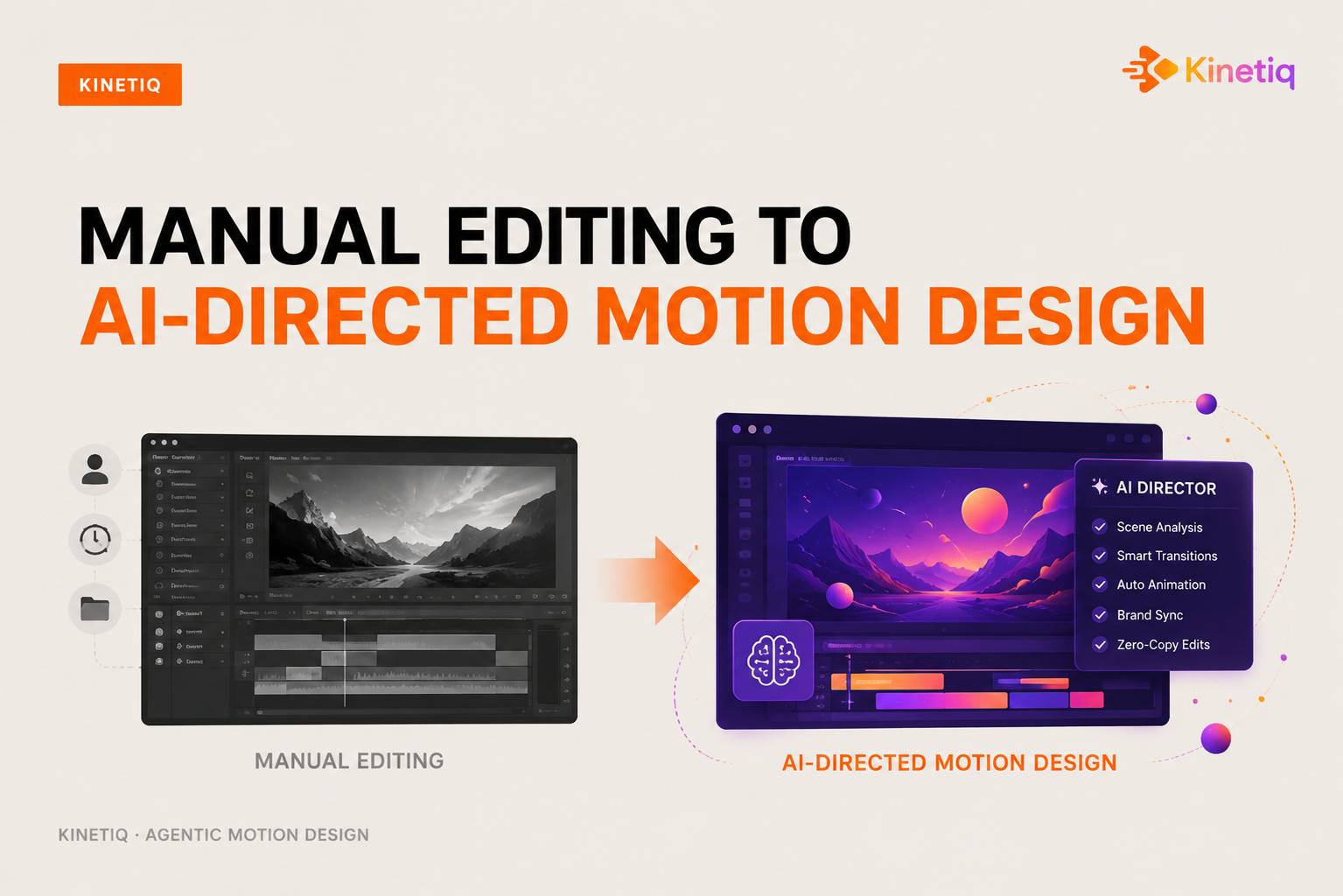
Open a professional motion design tool for the first time and the interface tells you, before you've typed anything, what kind of work you're about to do. A blank canvas. A timeline with no clips on it. A layers panel with nothing in it yet. The tool is honest about its model of you: you are the author of every frame, and the software's job is to make each individual keyframe, easing curve, and transform easier to place than it would be by hand. That model has been correct, and largely unchallenged, for the entire history of motion graphics software.
A newer generation of tools is built on a different model entirely, and the difference is easy to understate if you describe it only as “AI added to the timeline.” The real change is structural: instead of a person specifying motion one decision at a time, a person specifies an outcome, and a system plans the sequence of decisions needed to get there — scenes, pacing, transitions, timing — before handing the result back for direction and refinement. That's the shift this piece is about, using Kinetiq, the AI motion design studio built by Nagent, as the concrete example of what “AI-directed” actually means once you look past the phrase.
See a directed first draft happen in real time
Describe a video in plain language and watch Kinetiq plan the scene structure before a single frame renders.
What “Manual” Actually Means in Motion Design
It's worth being precise about what the manual-editing model actually asks of a person, because the phrase undersells how much specialized judgment it has always required. In a timeline-based tool, producing ten seconds of polished motion means deciding, for every element on screen, when it enters, how it moves, what curve its easing follows, when it exits, and how all of that lines up against everything else happening at the same moment. None of these decisions is trivial on its own, and a skilled motion designer makes hundreds of them per project, largely from muscle memory built over years of practice. That skill is real, and nothing in this piece argues otherwise.
What the manual model doesn't provide is a starting structure. Before any of those hundreds of small decisions can be made, someone has to invent the larger shape they all sit inside — how many scenes, what order, how long each beat holds, where the narrative or product story actually turns. That's a different kind of decision than “what easing curve should this text use,” and it's the one that a blank timeline offers no help with at all. A new motion designer's steepest learning curve usually isn't the software's buttons; it's developing the judgment to plan a structure from nothing, on a deadline, for a brief they may have only just received.
What “AI-Directed” Actually Changes
The core claim behind AI-directed motion design is narrow and specific: the structural planning step — the part that has nothing to do with keyframes and everything to do with narrative shape — can be handed to a system that plans it well, before a human ever opens a timeline. Kinetiq's own architecture calls this component the Director, and its job is exactly the gap identified above: multi-scene beat planning for longer narratives, with pacing that is duration-aware, so a five-second sting and a three-minute explainer get structurally different treatment rather than the same rhythm stretched or compressed to fit.
This planning happens before any rendering does. A written brief goes in; the Director produces a scene-by-scene plan — what happens, in what order, at what pace — and only then does generation actually build the composition against that plan. This ordering matters more than it might seem. A tool that generates a full composition in one uninterrupted pass and calls that “AI-directed” is really just a faster version of the blank-timeline problem: it still has to guess the whole structure at once, with no intermediate checkpoint. Planning the beats first, the way a human director would block a scene before shooting it, is what actually earns the word “directed.”
The system doesn't stop at the plan, either. Kinetiq's generation pipeline includes a quality pass — auto-repair and structural validation, with a fuller inspect-and-fix loop for contrast, overflow, and layout issues on the roadmap — so the first thing a person sees isn't a raw, unchecked output but something that has already been checked against a baseline of structural correctness. That's the meaningful difference between “AI-generated” in the sense of a single unsupervised pass and “AI-directed” in the sense of a system that plans, builds, checks, and only then hands the result to a human for judgment.
Direction Isn't the Same as Losing Control
The most common, and most reasonable, objection to AI-directed workflows is that handing planning to a system means giving up precision — that the trade for a faster first draft is losing the ability to fix the one specific thing that's wrong with it. This objection is correct about a real category of tools: pure generative-clip platforms, where a near-miss result typically can only be addressed by regenerating the whole piece and hoping for a better roll. It is not correct about systems built around an editable, structured composition, and the difference is worth walking through concretely.
Kinetiq's underlying composition is one artifact that four different editing surfaces operate on simultaneously, and all four stay in sync regardless of which one made the most recent change:
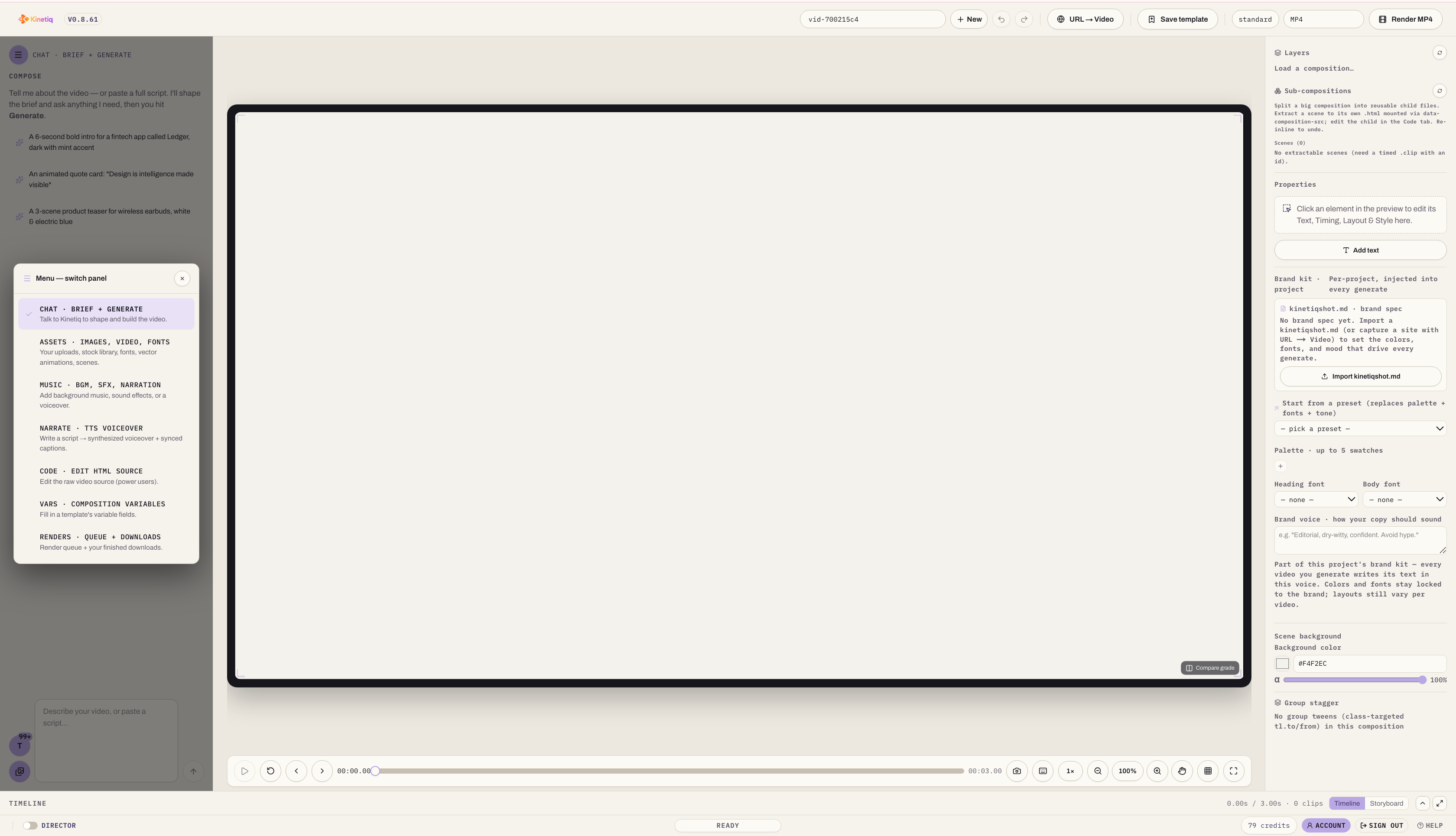
Chat — for intent-level direction after the first draft exists. “Make the headline bigger, slow the intro, swap the accent to navy” edits the composition the same way a director gives a note to a specific shot, rather than re-shooting the whole scene.
Canvas — for direct visual manipulation. Click any element to drag, resize, or rotate it, with snap-to-guides and alignment, the same hands-on control a designer expects from any visual tool.
Properties — for numeric precision — exact color values, gradient angles, easing curves, and stagger timing, for the moments when a note like “slow the intro” needs to become a specific, exact number.
Code — the raw HTML source, for anyone who wants to work at that level, with every change round-tripping cleanly back to the canvas rather than forking into an unsynced file.
This is the structural answer to the control objection: direction replaces the blank-page problem, not the editing process. A person still has every tool a manual workflow offers — dragging an element, tuning an easing curve, editing raw markup — they simply start from a planned, checked first pass rather than an empty timeline. The system plans; the human directs the plan's execution down to the pixel, whenever that level of precision is actually what a note requires.
Direction with precision, not direction instead of it
Chat for intent, canvas for feel, properties for exact numbers, code for everything else — all editing the same live composition.
Where the Rest of the Category Sits on This Spectrum
This split — planned-then-editable versus generate-and-hope — is one of the clearest lines running through the current motion and video tooling market, and it's worth being specific about where different platforms actually sit, because “AI-powered” is used to describe products on both sides of it.
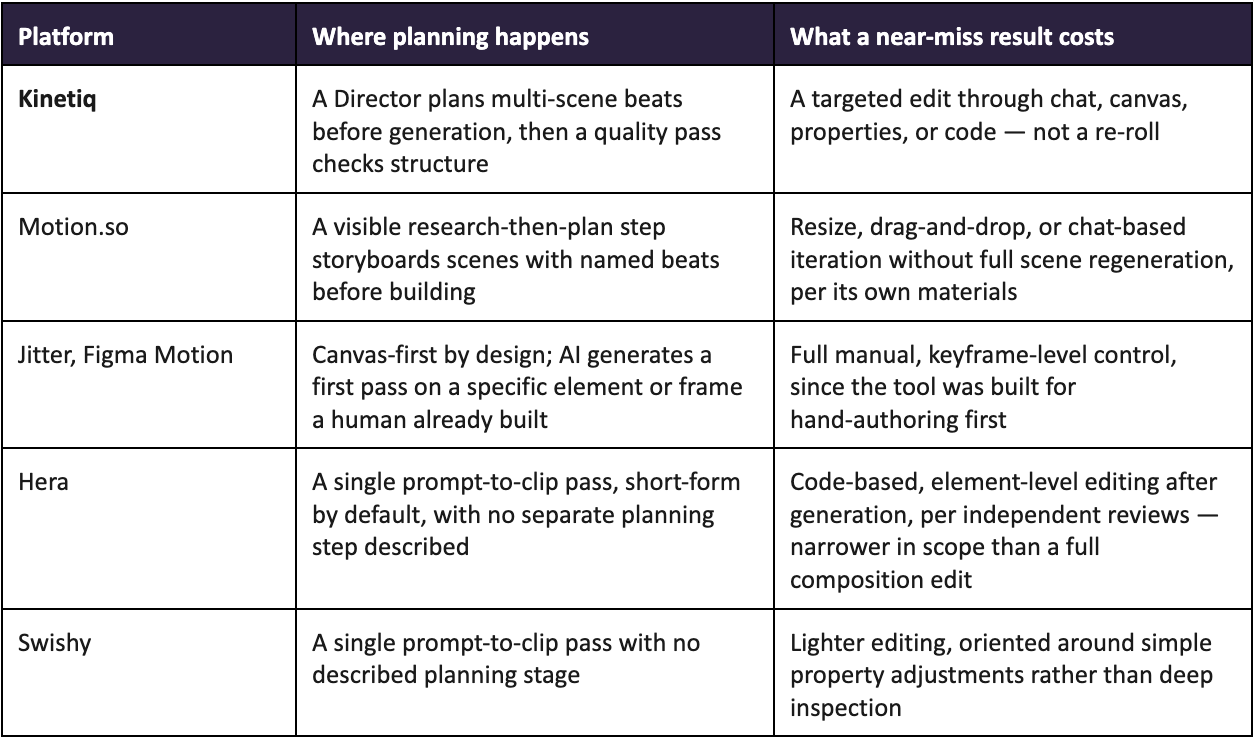
Reading this comparison, the useful question to ask about any “AI motion design” tool isn't whether it uses AI — nearly all of them now do — but where in the process the AI is doing its work, and what a person's options are the moment its first attempt isn't quite right. A tool that plans before it builds, and stays editable after it builds, is offering direction. A tool that generates a finished clip in one pass and offers little beyond regenerating it is offering something closer to a slot machine with better production values.
Governed Autonomy: Direction Without Losing Authority
There's a governance dimension to this shift that matters as much as the editing mechanics. Handing planning to a system only makes sense for real production use if a human retains clear authority over what actually ships, and the industry's own framing for this — a Human-on-the-Loop model, as opposed to full autonomy — is a useful one to borrow here: the system carries the repetitive, mechanical labor of planning and constructing a first pass, while a person retains approval authority over the result, and the system's scope of independent action expands only as its reliability is demonstrated, rather than being switched on all at once by default.
This is the piece that makes “AI-directed” a genuinely different claim from “AI-automated.” Automation without a human retaining review authority is a real risk for anything brand-facing — nobody wants a system quietly shipping an off-brand or structurally broken video with no checkpoint. Direction, in the sense used throughout this piece, keeps a person in the reviewing seat at exactly the point where their judgment is most valuable: after a competent first pass exists, deciding whether it's right and refining the parts that aren't, rather than staring at a blank timeline deciding what to build first.
A Day in Each Model
The manual model
A brief arrives Monday morning: a ninety-second product explainer, three key features, a call to action at the end. A motion designer opens a blank project and starts with structure — how many scenes, how long each one holds, where the pacing should pick up. That planning happens in the designer's head, informally, before a single keyframe gets placed, and it's the least visible but most consequential part of the whole project, because a wrong structural call early on means reworking everything built on top of it later. Keyframes get placed, eased, and previewed scene by scene; a first full preview might not exist until Wednesday. Feedback on Thursday asks for a pacing change in the middle section, which means reopening the timeline and manually adjusting the timing of everything that follows it. The piece ships Friday, later than planned, with the designer's actual creative judgment spread thin across both the big structural calls and the small mechanical ones.
The directed model
The same brief arrives Monday morning. It's described to Kinetiq in a few sentences; the Director plans a scene structure — three feature beats plus an opening hook and closing call to action, paced for ninety seconds — and a first full composition, quality-checked, exists within the same session. The designer's Monday is spent reviewing that plan and the first draft, not inventing a structure from nothing. A pacing note on the middle section is a chat instruction, applied to the existing composition rather than a manual re-timing of everything downstream of it. The piece is ready for stakeholder review by Tuesday, and the time that would have gone to Wednesday's first-preview wait and Thursday's manual rework instead goes to a second, more ambitious idea the team wouldn't otherwise have had the bandwidth to attempt that week.
The point of this comparison isn't that the manual model produces worse creative judgment — a skilled designer's Monday-morning structural instincts are genuinely valuable. The point is where that judgment gets spent. In the directed model, the same judgment is applied to reviewing and refining a competent plan rather than to inventing one from a blank page under time pressure, and the mechanical cost of a mid-project change drops from a re-timing exercise to a sentence.
What This Shift Doesn't Do
It's worth stating plainly what AI direction is not, because overclaiming here would undercut an otherwise honest argument. It does not eliminate the value of a trained eye — knowing whether a planned structure actually serves a brief, or whether a pacing choice will read as confident rather than rushed, remains a human judgment call that a planning system can support but not replace. It does not make every generated first pass correct on arrival; the quality pass catches structural issues, not taste, and a designer's review remains a necessary step, not a formality. And it does not remove the value of deep manual craft entirely — a bespoke, frame-level hero piece where every transition is hand-tuned for a specific emotional effect is still real work that a fast, general-purpose planning system isn't trying to replace, in the same way a well-built framework doesn't replace a bespoke build for the one project that genuinely needs one.
What the shift does is narrower and, for most real production volume, more consequential: it removes the specific cost of inventing structure from nothing, on every single project, when a huge share of that structural work — pacing a product explainer, blocking a launch video, sequencing a set of feature highlights — follows patterns a system can plan well, leaving a human's most valuable hours for the judgment calls that are genuinely particular to the brief in front of them.
Frequently Asked Questions
Does AI-directed motion design mean I can no longer control individual details?
No — in Kinetiq specifically, the same composition that the Director plans and generates stays editable through chat, canvas, properties, and raw code, all synced to the same source. Direction changes how a first draft comes to exist; it doesn't remove any of the manual control a designer would otherwise have afterward.
How is a Director-planned composition different from a single-pass generated clip?
A Director plans scene structure and pacing before generation happens, the way a human director blocks a scene before shooting it, and the result passes through a structural quality check before a person sees it. A single-pass generator builds the whole thing in one uninterrupted attempt, with no intermediate planning step and, in most cases, no way to precisely fix a near-miss beyond generating again.
Will planning by a system make every video look structurally the same?
Kinetiq's own architecture pairs a high-entropy creative seed with a rotating art-direction and structure engine specifically so the same brief doesn't return a carbon-copy result twice, and duration-aware pacing means a five-second sting and a three-minute explainer are planned with genuinely different rhythms rather than the same structure stretched to fit.
Is this suitable for a bespoke, hero-quality piece, or only for routine production?
Both, though the balance of direction versus manual refinement shifts by project. A routine weekly asset might need very little beyond reviewing the Director's first pass. A flagship piece typically uses that same first pass as a stronger starting point, with a designer spending proportionally more time in canvas, properties, and code refining it toward something bespoke.
Does a directed workflow still require someone who understands motion design principles?
Yes. The judgment to recognize whether a planned structure and a generated first pass are actually right for the brief — and to know precisely what to ask for when they're not — is still a trained skill. What changes is that this judgment no longer has to be spent inventing a structure from a blank timeline before it can be applied to anything else.
Say it. See it. Ship it.
Manual editing asked a person to author every decision from a blank page. AI direction asks a person to review a competent plan and refine the parts that need their judgment — with every manual tool from a first-generation tool kit still there the moment you need it.
Start from a plan, not a blank timeline
Kinetiq is an AI motion design studio built by Nagent: a Director that plans your composition, and four synced editing surfaces to refine it exactly.