
No Code AI Agent Platform: Why It's Only Useful If It Ships Fast
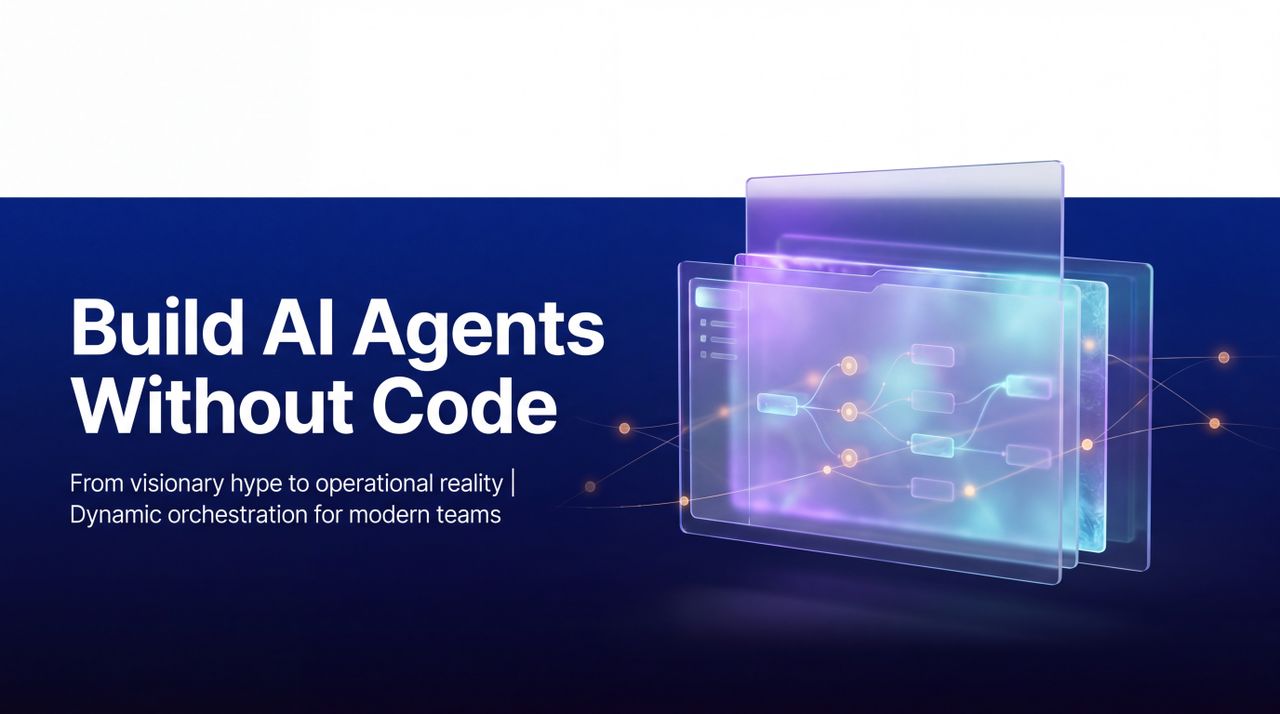
The Semantic Shift: From Visionary Hype to Operational Reality
If you want to understand the maturity curve of any transformative technology, look at the vocabulary of its buyers. In the early stages of a platform shift, much like the dawn of cloud computing or the introduction of the first iPhone, the language is highly abstract. The market is obsessed with the underlying technology. For the past few years, the enterprise AI conversation has been dominated by parameters, context windows, model benchmarks, and the philosophical debate around AGI (Artificial General Intelligence).
But as technology matures, it becomes invisible. We stop talking about how the engine works, and we start talking about where the car can take us. In 2026, we will have crossed that exact threshold in the field of artificial intelligence. The hype has settled, the tourists have left, and the operators have taken over.
This maturation is reflected in how organisations procure software. The most telling signal of this shift is the rise of a specific, hyper-targeted search term. The No-Code AI Agent Builder is the practical buyer keyword because it represents the exact intersection of technological capability and business necessity. It strips away the science fiction and asks a very human, very urgent question: How can I build an intelligent system to do this exhausting work for my team, without waiting six months for IT to write the code?
Decoding the Practical Buyer Keyword
To understand why a No-Code AI Agent Builder is the practical buyer keyword, we must deconstruct the psychology of the modern B2B buyer. Today’s software buyers are not central IT procurement officers buying multi-year, monolithic software suites. They are department heads. They are the VP of Marketing, the Head of RevOps, and the Director of Customer Success.
These operators are intimately familiar with the friction in their departments. A VP of Marketing knows exactly how many hours are wasted manually pulling campaign performance data from Salesforce, formatting it in Google Sheets, and cross-referencing it with ad spend in Meta. They know the workflow that needs to be automated.
However, when these operators historically tried to solve these problems, they faced a binary, lose-lose choice:
Submit an IT Ticket: Wait in an endless backlog for a developer to write a custom Python script or build an RPA (Robotic Process Automation) bot. By the time it was built, the API had changed, or the business process had evolved, rendering the tool useless.
Buy Another Point Solution: Purchase yet another specialised SaaS tool that solved one micro-problem but created another data silo, adding to the "SaaS sprawl."
The search for a No-Code AI Agent Builder is a rejection of both of these flawed models. The word No-Code signals that the operator refuses to be blocked by the engineering backlog. The word Agent signals that they want a system capable of reasoning and autonomous execution, not just rigid if/then logic. And the word Builder signals that they want a platform, an infrastructure, where they can craft bespoke solutions for their highly specific, proprietary workflows.
When a user searches this term, they are no longer kicking the tyres of Generative AI. They are actively seeking to hire a digital workforce.
What Constitutes a True No-Code Agent Builder?
Recognising that the No-Code AI Agent Builder is the practical buyer keyword, the market was quickly flooded with legacy workflow automation companies rebranding their old software. But adding a chat interface to a Zapier integration does not make it an AI Agent.
True agentic AI requires a fundamental architectural paradigm shift. In a traditional workflow automation tool, the human provides all the logic. The human says, If X happens in this app, do Y in that app. It is deterministic. It breaks if a single piece of unstructured data enters the pipeline.
A true AI agent builder introduces dynamic orchestration. The human operator does not provide the step-by-step logic; instead, they provide a Goal, a set of Guardrails, and a toolbox. The AI uses its reasoning engine to determine the path.
For a platform to truly fulfil the promise of this keyword, it must master several core pillars:
Secure Data Connectivity (RAG): The agent must be able to read unstructured enterprise data like HR manuals, past campaign briefs, or compliance PDFs- securely.
Tool Orchestration: The agent needs hands. It must be able to push and pull data via APIs across the enterprise tech stack.
State and Memory: An agent cannot have amnesia. It must remember what happened in step one to successfully complete step five.
Visual Abstraction: All of this profound computer science complexity must be completely hidden behind an elegant, drag-and-drop, zero-code user interface.
How Nagent is Driving Change and Defining the Category
This is precisely where Nagent has positioned itself as the definitive answer to the enterprise's most urgent search query. Nagent recognised early on that the No-Code AI Agent Builder is the practical buyer keyword, and built a platform engineered exclusively to satisfy the rigorous demands of the operator class.
Nagent’s products are driving change and striving towards success by completely democratising the creation of advanced AI systems. Through the Nagent Agent Builder Studio, a non-technical RevOps manager can literally build an intelligent system while they think.
The studio utilises a deeply intuitive visual node system. You drag an Input Node, connect it to a Knowledge Node (where your proprietary data lives securely), route it through a Logic Node (to establish your business rules), and attach it to a Tool Node (to execute the action in your CRM).
But Nagent’s true brilliance lies in the friction it removes. For a no-code builder to be truly practical, it cannot force users to manage developer backends. With Nagent, you do not need to bring your own API keys. You do not need to negotiate usage limits with OpenAI or Anthropic. Furthermore, Nagent is inherently multimodal and model-agnostic. Inside the visual builder, an operator can switch between top-tier reasoning engines—from GPT-4 to DeepSeek to Claude with a single click, ensuring the agent always utilises the most optimal model for the task.
And because an agent is useless if it cannot interact with your existing software, Nagent comes pre-loaded with over 1,000 integrations. The heavy lifting of API maintenance has been abstracted away, allowing operators to focus on business outcomes rather than broken endpoints.
The "Service as Software" Economic Paradigm
The thought leaders in Silicon Valley, particularly firms like a16z, have been vocal about the transition from Software-as-a-Service (SaaS) to Service-as-Software. We are moving from a world where software is a tool you pay to use to a world where software is a worker you pay to execute.
When an enterprise buyer searches for a no-code agent builder, they are actively participating in this economic shift. They are calculating the cost of "human middleware", the expensive, soul-crushing hours their highly paid employees spend moving data between screens.
By deploying an AI agent, the business is effectively decoupling its growth from its headcount. A marketing team of five, empowered by Nagent’s Campaign Hub Agent, can now produce the localised, brand-aligned creative output of a fifty-person agency. A small finance team can automate their end-of-month reconciliation process with absolute auditability.
Nagent accelerates this paradigm by offering the Agent Store a repository of pre-built, production-ready agents that teams can deploy instantly without building from scratch. And for massive enterprises with highly bespoke, complex requirements, Nagent goes a step further by offering an Agentic AI Lab as a Service, where their internal experts act as an extension of your team to architect and deploy these systems on your behalf.
Conclusion: A Keyword That Shapes the Future of Work
The evolution of enterprise search queries is a roadmap to the future of work. The transition from abstract concepts like AGI to highly actionable phrases proves that we have crossed the chasm.
The phrase No-Code AI Agent Builder is the practical buyer keyword because it embodies the ultimate desire of the modern enterprise: the power of advanced cognitive computing, placed directly into the hands of the people who actually run the business, with zero technical friction.
Nagent is striving towards success not just by capturing this demand, but by delivering a platform that genuinely honours the promise of the keyword. By removing the barriers of code, API management, and integration, Nagent ensures that the next great leap in enterprise productivity will be driven not by software engineers but by operators themselves.
10 Frequently Asked Questions
1. How is Nagent different from other AI agent builder platforms? Unlike rigid workflow automation tools or open-ended platforms that require deep technical knowledge, Nagent provides true dynamic orchestration through a purely visual interface. It offers an enterprise-grade Agent Builder Studio alongside a rich Agent Store. Nagent doesn't just execute static tasks; it empowers agents to reason, adapt, and drive actual business outcomes without writing a single line of code.
2. How can I know my existing software tools are integrated with Nagent? Nagent makes enterprise connectivity effortless. The platform boasts over 1,000 out-of-the-box integrations with the most popular enterprise and SMB tools (CRMs, ERPs, marketing platforms, customer support hubs, and more). Furthermore, if you use highly niche or proprietary software, Nagent fully supports custom API integrations.
3. Which AI models are available on the Nagent platform? Nagent is a fully multimodal, model-agnostic platform, meaning you are never locked into a single provider. You can seamlessly switch between top-tier models like OpenAI, DeepSeek, and others with a single click inside the Agent Builder Studio. This ensures your agents always leverage the smartest, most cost-effective reasoning engine for their specific task.
4. Do I need to know how to code to build agents on Nagent? Not at all. Nagent is a zero-code and no-code AI agent builder. Its intuitive, visual node-based interface allows non-technical business operators, marketers, RevOps leaders, and founders to build and deploy sophisticated, reasoning AI agents simply by dragging, dropping, and connecting logical blocks on a canvas.
5. Do we need to provide our own API keys to run agents on the platform? No, you do not need to bring your own API keys for the underlying language models. Nagent is a fully managed platform. This removes a massive layer of technical friction, security concerns, and billing complexity, allowing your teams to start building and deploying immediately.
6. Do we have to build our own AI agents, or can Nagent build them for our organisation? You have ultimate flexibility. You can build your own using the zero-code studio, instantly deploy pre-built agents from the Agent Store, or utilise Nagent’s "Agentic AI Lab as a Service." With this premium service, Nagent’s internal experts will architect, build, and deploy highly tailored, complex multi-agent workflows specifically designed for your business operations.
7. Why is "no-code AI agent builder" considered a high-intent buyer keyword? When someone searches for Generative AI or AGI, they are usually researching trends. When a professional searches for a "no-code AI agent builder," they have a specific operational problem, a desire to automate a workflow without relying on their IT department, and the budget to procure a practical solution.
8. How does a no-code agent builder change the software procurement process? Traditionally, business units had to submit tickets to IT, wait months for custom development, or buy rigid point-solution SaaS. A no-code builder allows the actual department (e.g., Marketing or HR) to procure a central platform and rapidly build their own custom, reasoning workflows, decentralising and accelerating digital transformation.
9. Can a no-code agent handle complex enterprise data and APIs? Yes. "No-code" refers to the user interface, not the platform's backend power. Nagent securely connects to your enterprise databases and documents via RAG (Retrieval-Augmented Generation) and interacts with other software via APIs. The platform abstracts all this complexity so operators can manage data connectivity visually.
10. What is the difference between a workflow automation tool and a no-code agent builder? Traditional workflow tools (like Zapier) are deterministic; they rely on rigid, linear "If X, Then Y" rules provided by the human, and they break easily. A no-code agent builder creates non-deterministic systems. You give the agent a goal, data, and tools, and the AI's reasoning engine dynamically figures out the best path to achieve the outcome, adapting to errors along the way.