Prompt-Native AI Agent Builders Will Replace Workflow UIs
The Broken Promise of the Visual Canvas
For the last ten years, the software industry promised that low code platforms would entirely democratize enterprise development. We were sold a vision where drag and drop app builders would serve as a visual environment for anyone to create interfaces and logic. The premise was simple. By placing components on a canvas and connecting data through configuration rather than raw code, product teams could turn ideas into working software in days instead of months. This approach was supposed to keep non technical stakeholders in the loop and reduce the heavy burden on the engineering department.
However, the reality of visual workflow builders fell drastically short of that utopian promise. While visual platforms removed the need to understand specific coding syntax, they did not remove the need for strict software engineering logic. A creator still had to understand complex logic controls, conditional branching, data connectors, and iterative loops. Building a workflow still meant manually mapping out application programming interface calls, defining data structures, and painstakingly connecting individual visual nodes.
As enterprise workflows scaled in operational complexity, these visual canvases turned into incomprehensible webs of lines and logic gates. The industry simply replaced code spaghetti with visual spaghetti. The fundamental bottleneck remained entirely intact because the cognitive load of system architecture was still placed squarely on the shoulders of the human operator. If a finance manager wanted to automate lead qualification, they still had to manually map out email monitoring, web scraping for LinkedIn data, decision logic for scoring, and the final integration into a customer relationship management database. It was too much friction for the average operator.
The Emergence of Prompt Native Architectures
The artificial intelligence revolution is fundamentally destroying this outdated paradigm. We are experiencing a massive shift from visual programming to natural language orchestration. Prompt native artificial intelligence agent builders are moving mainstream, and they will inevitably replace traditional workflow user interfaces.
What exactly is a prompt native orchestrator? Instead of forcing a human to drag nodes across a screen, a prompt native platform allows you to describe a complex workflow in plain English, and the artificial intelligence automatically scaffolds the entire process. For instance, a modern system can convert a single natural language prompt into a living dashboard or an autonomous multi step agent in a matter of seconds.
In a prompt native environment, the underlying artificial intelligence parses the human intent and writes the underlying logic, tool calling loops, and memory systems autonomously. It handles the orchestration layer dynamically. If you want to build a system that manages vendor invoices, you no longer have to manually connect the email ingestion node to the optical character recognition node. You simply state your intent, and the prompt native builder translates that intent into a fully functioning digital worker.
Democratization Through Natural Language
When you abstract the immense complexity of workflow architecture into natural language, the pool of people who can build enterprise solutions expands dramatically. A human resources coordinator, a marketing director, or a facilities manager can now build and own automations that previously required a dedicated IT department to deliver.
This completely mirrors a pattern we are seeing with artificial intelligence adoption across the broader macroeconomic landscape. When the cost and friction of building drops, the number of builders skyrockets. Marketers are suddenly writing database queries, and product managers are building complex prototypes without an engineering background. By removing the technical expertise that came with manually building workflows, the person who intimately understands the business process becomes the exact person building the workflow. When the domain expert is the architect, the resulting software actually matches the true business intent.
This eliminates the massive translation error that constantly occurs when business teams try to explain their operational needs to software engineering teams. You are not just replacing the build tool; you are replacing the entire corporate reporting and development ritual. A deployment that used to take a data engineer four to six weeks to model, build, and test is now collapsed into a single afternoon of prompting and tweaking.
The Danger of the Opaque Black Box
While prompt native generation feels like magic, it introduces a severe enterprise risk if it is not architected correctly. If you rely solely on natural language to execute operations without any visibility into the underlying mechanics, you create an opaque black box.
If an artificial intelligence generated workflow cannot be easily inspected, versioned, or debugged by a human operator, it will never make it past an enterprise IT review. And frankly, it shouldn't. An enterprise cannot afford to deploy autonomous agents that run mission critical financial or security processes if the logic is completely hidden from the compliance team. If your prompt native builder only helps with the initial creation phase but offers no transparency into the execution phase, the technical bottleneck simply moves downstream. When something inevitably breaks, tracing the error becomes impossible.
An enterprise grade artificial intelligence workflow must be transparent and always auditable. A human operator needs to be able to open the environment, inspect every condition, review every code block, and trace exactly where a failure occurred. The developer must know if findings were filtered out by internal validators, as this builds crucial trust in the filtering mechanism because it remains an auditable layer rather than a hidden process. This transparency is the only way an IT lead can look at an artificial intelligence built workflow from a finance team member and confidently authorize it for production use.
Nagent The Hybrid Orchestration Masterpiece
This precise tension between the rapid velocity of prompt native generation and the strict safety of deterministic enterprise auditing is what makes the Nagent platform a generational leap forward in software architecture. Nagent perfectly fuses the speed of natural language orchestration with the safety of a visual canvas.
The platform features an incredibly advanced Agent Builder Co Pilot. When a subject matter expert wants to build a digital worker, they do not start by staring at a blank canvas and dragging empty nodes. They use the form based agent builder to describe their business intent in plain text. The Co Pilot acts as an elite senior software architect sitting right beside them. It takes that natural language prompt and instantly scaffolds the entire workflow logic, connecting the necessary tools and establishing the memory parameters automatically.
However, crucially, the workflow generated by the prompt native Co Pilot lands directly on the Nagent proprietary stage based orchestration canvas. The canvas is no longer a place where operators suffer through manual construction from scratch. Instead, it becomes a place where operators audit, refine, and govern the artificial intelligence.
Because the Nagent orchestration is strictly stage based, operators can easily read the logic visually, modify specific nodes, and ensure the agent behaves exactly as intended. Every workflow the Co Pilot builds lands on the same visual canvas as a manually built one, meaning any stakeholder can open it, inspect every node, and extend it safely. The visual layer exists for ultimate enterprise trust and debugging, while the prompt layer exists for sheer creation velocity.
Continuous Evolution and Iterative Refinement
Building a workflow is always a one time cost, but maintaining it is an ongoing operational tax. Business requirements change constantly, APIs update, and internal policies shift.
Traditional visual builders require operators to manually trace through complex nodes to find where something went wrong or where an update needs to be applied. A true prompt native system fundamentally changes how software is maintained. With a prompt native builder, an operator can return to a workflow weeks or months later, describe the required change in plain language, and the artificial intelligence modifies it autonomously.
The orchestrator understands the existing structure and adjusts it dynamically rather than forcing the user to rebuild from scratch. If an error occurs, instead of manually hunting for the bug, the operator can describe the issue and have the artificial intelligence identify and fix the underlying logic. Your first output is rarely the final version, and the platform allows you to use follow up prompts to refine the system effortlessly. The system iterates with you in real time, reacting to your feedback within the same environment.
Nagent embraces this continuous evolution perfectly. The Agent Builder Co Pilot is always available to help refine the stage based orchestration layer. If a compliance rule changes, the operator simply prompts the Co Pilot to update the logic within that specific visual node, ensuring the digital workforce is always perfectly aligned with current business intent.
Absolute Frictionless Autonomy
True agentic builders do not just map visual processes; they actually execute code and connect external systems seamlessly. When an operator describes a workflow that requires both native actions and complex external systems, the artificial intelligence must figure out how to build the parts that the platform does not have pre built primitives for. It must navigate sandboxed execution with explicit permission scopes.
Nagent empowers this level of absolute autonomy by completely removing integration friction. In a legacy system, connecting a newly built workflow to a corporate database requires manual engineering. The platform must be integrated, API keys must be generated, and webhooks must be configured.
The Nagent ecosystem is pre loaded with over one thousand ready to use software tools. When the Agent Builder Co Pilot scaffolds an agent based on a natural language prompt, it automatically assigns the correct tools from this massive library. It does this without ever requiring the user to generate an API key, manage authentication tokens, or configure complex routing. The artificial intelligence understands the semantic layer of the data, inferring column types, relationships, and business meaning autonomously.
Furthermore, because Nagent is fully multi modal and entirely model agnostic, the prompt native orchestrator can dynamically assign different cognitive engines to different stages of the workflow. An operator might instruct the system to use the OpenAI foundation model for complex logical reasoning in stage one, and then switch seamlessly to Claude for creative text generation in stage two.
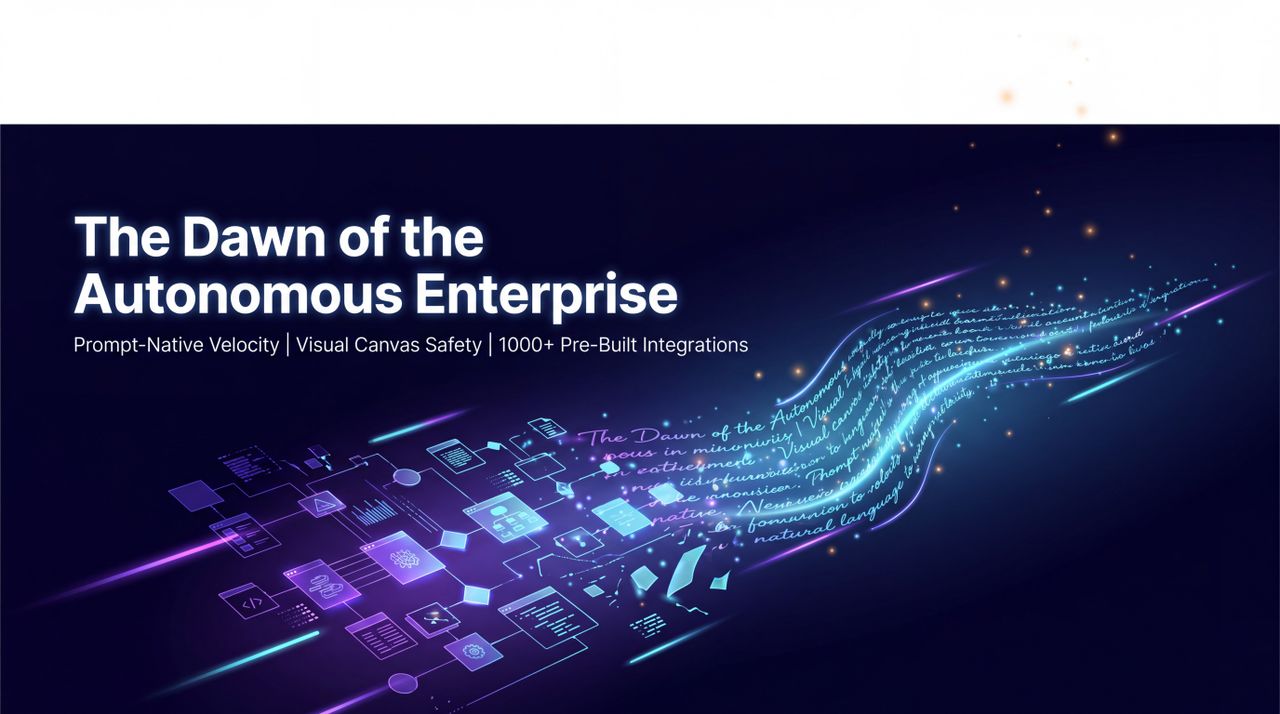
This level of granular control used to require a team of highly specialized machine learning engineers. Now, it is executed through a single prompt and managed effortlessly on a visual canvas. Prompt native artificial intelligence agent builders are not just a new feature in the software landscape. They represent the complete replacement of the workflow user interface and the dawn of the autonomous enterprise.