
Sovereign Agentic Intelligence
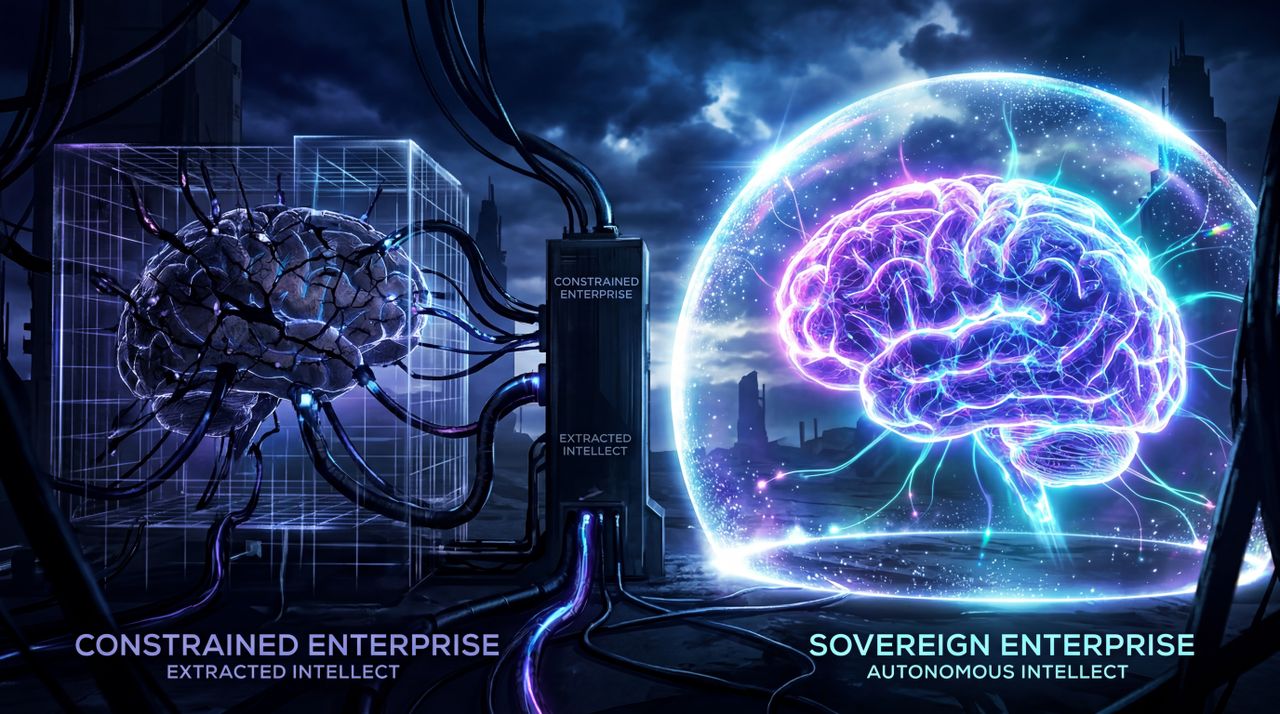
Sovereign Agentic Intelligence: Why the Smartest Enterprises Are Building Independent AI State Layers
The Illusion of AI Adoption
Over the past two years, artificial intelligence has rapidly transitioned from a boardroom curiosity to an execution mandate. Leaders are no longer asking if they should adopt AI, but how fast they can weave it into the fabric of their operations. Budgets are being reallocated, dedicated AI teams are being formed, and successful pilots are being graduated into production systems.
Yet, beneath this momentum lies a critical misunderstanding that could cost enterprises their long-term competitive advantage.
Most enterprises believe they are simply adopting new "capabilities"—a faster way to write emails, a smarter way to analyze spreadsheets, or a more efficient chatbot for customer support. In reality, they are making a far deeper decision: Where will the intelligence of the enterprise live—and who will ultimately control it?
This distinction is subtle, but it is the most important strategic choice a CEO will make in the next decade. AI is not just a tool; it is a system that learns. Over time, what the system learns about your business processes, your customer preferences, and your internal decision-making becomes more valuable than the software itself. If you do not own that learning, you do not own your future.
“Enterprises will not lose to better AI.
They will lose to companies that own how their AI learns.”
:quality(80) "Sovereign Agentic AI: glossary")
The urgency around AI sovereignty is driven by three structural changes in the nature of work:
AI Can Now Understand Unstructured Work:
For the first time, technology can interpret the "messy" parts of a business—emails, meeting transcripts, and complex documents—that used to be trapped in human brains.
Work Has Become Digitally Traceable:
Every approval, every workflow modification, and every collaborative decision now leaves a digital footprint. This data exhaust is the raw material for institutional intelligence.
Agents Can Act and Learn in Real-Time:
Unlike traditional software, AI "agents" can execute tasks, observe the outcomes, and refine their behavior based on what worked and what didn’t.
For the first time in history, enterprise intelligence is not just being created; it is being captured, structured, and compounded.
As Jaya Gupta highlights in her work on the compounding nature of enterprise AI, systems are now beginning to capture not just outcomes—but the reasoning and decision context behind them.
You can read more in her essays:
Which leads to a new, unavoidable question that the smartest CXOs are now asking:
“Who owns our intelligence?”
:quality(80))
The Default Trap: How Enterprises Lose Sovereignty
Most organizations are not explicitly deciding to surrender their intelligence. They are drifting into it through a process of "outsourced intelligence." It happens gradually:
It starts with simple API usage for a specific task.
Then, workflow automation is added to connect that task to other systems.
Next, "memory" is introduced so the system can remember past interactions.
Finally, feedback loops are enabled to let the system improve its performance.
At each step, the system becomes more useful and more deeply embedded in your operations. But it also becomes less replaceable. If that memory and those learning loops live inside a vendor’s proprietary silo, you are building your house on rented land.
The result is a new and dangerous form of lock-in. It is not just "data lock-in," where your records are hard to move. It is "intelligence lock-in," where the system that knows how your company thinks and operates belongs to someone else.
From Software to Intelligence Systems
To understand the magnitude of this shift, we must look at how enterprise software has evolved.
The SaaS Era was defined by "Systems of Record." CRM systems like Salesforce captured customer data, and ERP systems like SAP captured financial data. The core strategy was simple: whoever owned the data layer owned the enterprise moat.
The AI Era is defined by "Systems of Intelligence." In this era, the most valuable layer is no longer where data is stored, but where data is interpreted, acted upon, and refined through feedback. These systems don’t just store information; they observe workflows, encode decision patterns, and improve continuously. Over time, they accumulate Institutional Intelligence—the digital equivalent of "muscle memory."
The Three Layers of AI Control
To maintain sovereignty, enterprises must evaluate their AI strategy across three distinct layers:
:quality(80))
The Model Layer: This is the reasoning engine (e.g., GPT-4, Claude). While critical today, models are rapidly improving and becoming commoditized. In a sovereign architecture, models are treated as swappable components.
The Execution Layer: This consists of the agents and orchestration frameworks that carry out tasks.
The State Layer (The Most Critical): This is where memory, context, decision intelligence, and learning loops reside. It is the "brain" of the operation.
Whoever controls the state layer controls the future. Most enterprises are focused on the first two layers, but the state layer is where the real competitive moat is formed.
“The default AI stack is not neutral.
It is designed to capture your intelligence - not return it.”
:quality(80))
Introducing Sovereign Agentic Intelligence
This leads to a new architectural paradigm that platforms like Nagent AI is pioneering: Sovereign Agentic Intelligence.
Sovereign Agentic Intelligence is an architectural paradigm where AI agents execute across enterprise workflows, while the "state"—encompassing memory, context, and decision intelligence—is persistently accumulated in a layer fully owned and governed by the enterprise.
Unlike traditional AI systems, in a sovereign model:
Intelligence is not embedded within vendor systems.
The learning process is transparent and inspectable.
The state is portable, allowing you to swap models or vendors without losing the "brain" of your organization.
Smriti: The Enterprise Memory Layer
At the core of Nagent’s architecture is Smriti (a Sanskrit word meaning "remembrance"). Smriti is not just a database; it is the accumulated intelligence of an enterprise.
:quality(80))
Smriti captures:
Decisions: Why a specific path was chosen over another.
Context: The situational data that informed a specific action.
Workflows: The evolving patterns of how work actually gets done.
Outcomes: The success or failure signals of every agentic action.
If data is what your company knows, Smriti is how your company thinks. It is a living, evolving organizational memory that compounds value with every interaction. Because Smriti is self-hosted and knowledge-graph-native, your data never leaves your control.
"If models are the brain, Smriti is the memory.
Without memory, intelligence cannot compound."
Agent SmritiTM is a patent filed technology by Nagent AI
The Karmic Feedback Loop
How does this intelligence actually compound? Through what we call the Karmic Feedback Loop (Knowledge Acquisition and Reformation for Multi-Agent Iterative Correction).
:quality(80))
In a sovereign system, every agentic action produces an outcome that is evaluated and fed back into the state layer. This ensures that every decision leaves a trace that shapes future behavior.
For example, when a human reviewer overrides an AI-generated recommendation, that override is captured in the sovereign learning loop as a corrective signal. This "Muscle Memory" ensures that the enterprise—not the AI vendor—retains the benefit of that human expertise.
KARMIC feedback loop is a patent filed technology by Nagent AI
The Strategic Shift: From Adoption to Ownership
Forward-thinking CXOs are no longer asking "Which AI tool should we use?" They are asking, "Where should our intelligence live—and how do we ensure we own it?"
The most strategic enterprises are deliberately avoiding the concentration of intelligence within their model providers or cloud ecosystems. Instead, they are building an independent layer where memory is owned, workflows are controlled, and learning loops are governed.
Three Approaches to Enterprise AI
:quality(80))
10. The Point of No Return
As AI systems learn from your enterprise, they begin to encode your unique decision heuristics and operational patterns. Once this intelligence is deeply embedded, it reaches a "point of no return." At this point, it cannot be easily exported or replicated.
If you reach this point using a vendor-controlled state, you have effectively outsourced your core intellectual property. By the time the risk becomes visible, the system is already indispensable. Sovereignty must be intentional, not accidental.
:quality(80))
11. What Happens If Enterprises Ignore This Shift?
Enterprises that fail to establish a sovereign state layer will face four inevitable consequences:
Invisible Dependency: AI systems become critical to daily operations, but the enterprise has no control over the underlying logic or "brain" of those systems.
Intelligence Fragmentation: Learning is scattered across dozens of different vendors and tools, preventing the organization from building a "Unified Context Layer."
Strategic Blindness: While decisions may improve, the enterprise does not own the reasoning behind those improvements, making it impossible to audit or explain actions to regulators.
Irreversible Lock-in: Switching systems means suffering "organizational amnesia"—losing years of accumulated intelligence and context.
12. The Intelligence Balance Sheet: Evaluating AI as Capital
To manage this shift, CEOs must move from project-based ROI to an "Intelligence Balance Sheet." This is a board-level framework that evaluates AI not as a cost center, but as institutional capital formation.
An Intelligence Balance Sheet tracks:
Decision Assets: Reusable, governed decision-making capabilities that improve over time.
Control Equity: The enforceable strength of your governance systems at runtime.
Memory Equity: Your organization’s ability to convert daily operations into a compounding source of learning.
By treating intelligence as a strategic asset, you ensure that every dollar spent on AI increases the permanent value of your enterprise.
Like financial balance sheet, every CEO and CAIO should manage at intelligence balance sheet
:quality(80))
13. What Should Enterprise Leaders Do Tomorrow?
For the CIO, CTO, and Chief AI Officer, this shift requires a move from awareness to action. Nagent AI recommends a five-step path to sovereignty:
Decouple Intelligence from Vendors: Audit your AI supply chain to ensure that your long-term memory and learning signals do not reside inside external, proprietary systems.
Establish a Sovereign State Layer: Create a dedicated, enterprise-controlled layer where memory persists, context accumulates, and decisions are encoded (e.g., Smriti).
Design for Portability: Assume that models and tools will change. Ensure your intelligence is stored in model-agnostic formats that can migrate across any reasoning engine.
Implement Feedback Loops Early: Start capturing human-in-the-loop signals and decision overrides on day one to begin compounding your unique institutional intelligence.
Audit for "Quiet Power" Accumulation: Ensure that your contracts and architecture explicitly define your ownership of fine-tuned weights, reasoning traces, and telemetry.
14. Conclusion: The Moat is Sovereignty
The last decade of enterprise software was defined by data ownership. The next decade will be defined by intelligence ownership.
While almost every company will adopt AI, only a few will truly own what the AI learns. This is the difference between being a "renter of cognition" and an "owner of intelligence."
Because in the agentic era:
The moat is not the model.
It is not the tool.
It is sovereignty over how your system learns.
:quality(80))
FAQs: Sovereign Agentic Intelligence
1. What is Sovereign Agentic Intelligence, and how is it different from traditional AI?
Sovereign Agentic Intelligence is an architectural approach where AI agents operate across enterprise workflows while the underlying intelligence—memory, context, and learning loops—is fully owned and governed by the enterprise. Unlike traditional AI systems that rely on vendor-controlled platforms, this model ensures that all accumulated intelligence remains within enterprise boundaries. This shift moves AI from a tool that delivers outputs to a system that builds long-term institutional intelligence, creating a compounding strategic advantage.
2. Why is “state” considered the most critical layer in AI systems?
The state layer is where memory, context, decision logic, and feedback signals are stored and evolve over time. While models generate responses and agents execute tasks, it is the state layer that enables systems to learn, adapt, and improve continuously. Without control over this layer, enterprises risk losing the intelligence generated from their own operations. Controlling state ensures that learning compounds internally, making it the most important determinant of long-term competitive advantage.
3. What risks do enterprises face if they rely entirely on external AI platforms?
Enterprises that rely solely on external AI platforms risk creating intelligence that they do not own or control. Over time, these systems learn decision patterns, workflows, and operational nuances, but that intelligence remains embedded within vendor ecosystems. This leads to intelligence lock-in, where switching platforms becomes difficult without losing accumulated knowledge. Additionally, lack of transparency and governance can create compliance risks, making enterprises dependent on systems they cannot fully audit or manage.
4. How does Sovereign Agentic Intelligence help avoid vendor lock-in?
Sovereign Agentic Intelligence decouples the intelligence layer from vendors by ensuring that memory, context, and learning loops reside within an enterprise-controlled environment. This allows organizations to switch models, tools, or infrastructure without losing accumulated intelligence. By maintaining portability and governance over the state layer, enterprises retain control over their AI systems. This prevents long-term dependency and ensures that innovation can continue without being constrained by any single provider.
5. What is Smriti, and why is it important?
Smriti is the enterprise memory layer that captures accumulated intelligence, including decisions, context, workflows, and outcomes. It goes beyond storing data to encode how an organization thinks and operates. By structuring and preserving this intelligence, Smriti enables AI systems to reuse past learnings and improve over time. This makes it a foundational component of Sovereign Agentic Intelligence, as it ensures that the enterprise—not the vendor—owns and benefits from its evolving knowledge base.
6. How does the Karmic Feedback Loop improve AI systems?
The Karmic Feedback Loop is a continuous learning mechanism where every action taken by an AI agent is evaluated and used to refine future behavior. It incorporates system-level feedback, human input, and business outcomes to create a closed-loop improvement cycle. Over time, this ensures that successful decisions are reinforced and errors are corrected. This approach transforms AI from a static tool into a dynamic system that continuously evolves, enabling enterprises to build compounding intelligence.
7. Why are leading enterprises moving toward independent AI platforms?
Leading enterprises are adopting independent AI platforms to maintain control over their intelligence layer. Model providers focus on capability, cloud providers focus on infrastructure, and systems of record focus on data—but none are designed to ensure full ownership of evolving intelligence. Independent platforms provide a dedicated layer for memory, orchestration, and learning, allowing enterprises to retain sovereignty. This enables flexibility, reduces dependency, and ensures that intelligence compounds within the organization rather than outside it.
8. What is the “point of no return” in AI systems?
The point of no return refers to the stage where an AI system has accumulated significant enterprise-specific intelligence—such as decision patterns and workflows—that cannot be easily extracted or replicated. At this stage, switching systems would result in losing critical knowledge, making the organization highly dependent on the existing platform. If this intelligence resides within a vendor-controlled environment, the enterprise effectively loses ownership of its operational intelligence, creating long-term strategic risk.
9. How should CXOs evaluate AI investments in this new paradigm?
CXOs should move beyond traditional ROI metrics and evaluate AI as a long-term strategic asset using frameworks like the Intelligence Balance Sheet. This includes assessing decision assets (reusable intelligence), memory equity (accumulated learning), and control equity (governance capabilities). Leaders should prioritize state ownership, portability, and compounding potential when making decisions. This ensures that AI investments not only deliver short-term efficiency but also build enduring competitive advantage.
10. What are the first steps to building a sovereign AI architecture?
The first step is to decouple intelligence from vendor systems by ensuring that memory and learning signals are not stored externally. Next, enterprises should establish a dedicated state layer to manage context and decision intelligence. Designing for portability ensures flexibility across models and tools. Implementing feedback loops early enables compounding from the start. Finally, governance frameworks should be put in place to maintain control, auditability, and compliance as the system evolves.