
The AI ROI Stack: From Infrastructure to Business Outcomes
The AI ROI Stack: From Infrastructure to Business Outcomes
Most ROI conversations about AI start at the wrong layer. Infrastructure spend gets measured. Adoption never does.
That single fact explains more about failed AI initiatives than any model benchmark. It shows up in board decks that report strong infrastructure utilization next to a business outcome nobody can quite draw a line to, and in leadership teams that only discover eighteen months into a rollout that the number they had been tracking the whole time was never the number that mattered. Ask a finance team to account for an AI budget and the number that surfaces fastest is almost always compute cost, API spend, licensing fees, or seats. It's the easiest number to produce, because it arrives with an invoice attached. It is also the number that says the least about whether the investment is doing anything for the business.
Value from an AI deployment is not created at the infrastructure layer. It is created, or quietly destroyed, three layers further up: in whether daily work actually changed, whether the people doing that work trust the system enough to rely on it without checking every output, and whether that trust eventually shows up in a number the business actually tracks. Most ROI conversations stop at layer one, because layer one is the only layer that comes with a receipt. The rest of the stack goes largely unmeasured, which is exactly why so many AI ROI calculations turn out to be wrong months later, when the invoice looked reasonable and the outcome never arrived.
A more complete way to think about AI ROI is as a stack: four layers, each one dependent on the layer beneath it. Infrastructure. Workflows. Adoption. Business outcomes. Skipping straight from the bottom of that stack to the top, which is what most ROI math quietly does, is the single most common reason the math stops matching reality.
Layer one: Infrastructure
Infrastructure is the layer everyone measures, because it is the layer that is easy to measure. It covers model access, compute, storage, integration tooling, and the licensing fees that show up on a vendor invoice. It is a real cost, and it deserves to be tracked. The mistake is treating it as a proxy for value, when increasingly, it isn't one.

Model access has become a commodity. Two companies can license the exact same frontier model, on the same day, at the same price, from the same vendor. Whatever advantage exists on day one of that license evaporates by day two, once every competitor with a similar budget has the same access. That used to not be true. For a brief window, having early access to a capable model actually was an advantage. That window has closed, and it keeps closing faster: a new frontier model now ships roughly every few weeks, and each launch resets every company that depends on model access alone back to the same starting line.
This creates a strange inversion. The layer of the AI stack that gets measured most rigorously, infrastructure, is becoming the layer that explains competitive advantage the least. A company can have the best model money can buy and still get no value from it, while a competitor on a cheaper, slightly older model outperforms them completely. If infrastructure spend is the only line item on the ROI dashboard, that dashboard is measuring the wrong thing, and it will keep looking healthy right up until the outcomes never show up.
Layer two: Workflows
The workflow layer is where infrastructure either gets put to work or gets quietly wasted. A workflow is the actual sequence of steps, handoffs, and decision points where an AI system is supposed to do something inside a real business process, not in a demo, in production, on a Tuesday, with a real customer or a real invoice on the other end of it.
Most companies adopt AI by adding it to a workflow that was designed for a human to run alone. A support ticket still routes through the same three approval steps it always did, except now a chatbot handles the first reply. A sales team still manually copies a lead from one system to another, except now an AI drafts the follow up email instead of a rep. The infrastructure is new. The workflow around it is the same one built for a team that didn't have it.
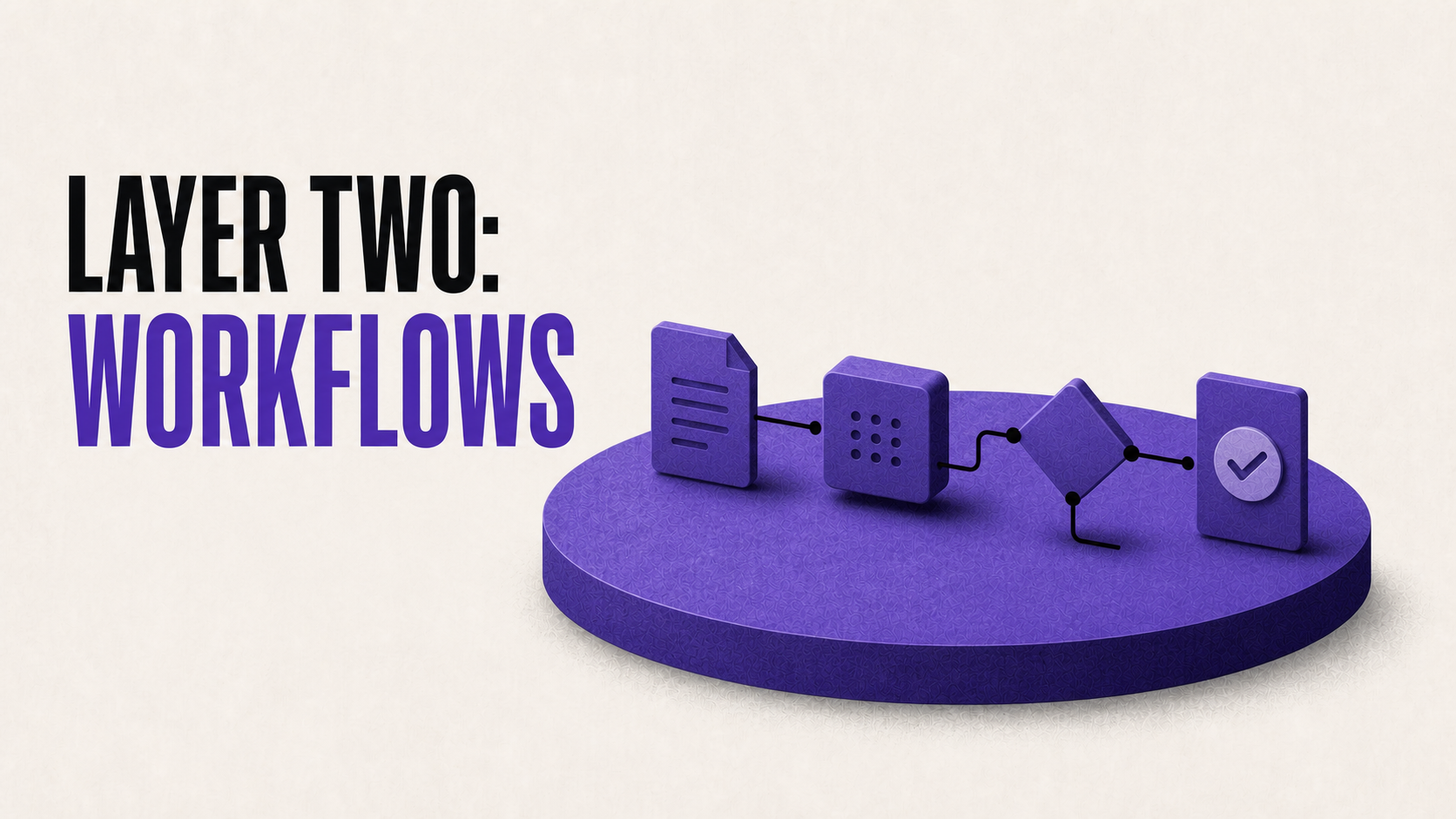
Picture a support team that adds an AI system to draft first responses to incoming tickets. Before the system arrived, an agent read a ticket, decided how to respond, and sent it. After the system arrived, the AI drafts a response, a supervisor reviews it, edits it, and sends it anyway. The infrastructure invoice looks identical to what a fully automated setup would cost. The actual workflow now has one more step in it than before, not fewer, because nobody removed the review step it was originally built around. Six months later, the dashboard shows healthy infrastructure utilization and a support team that is, if anything, slightly slower than it was before the AI arrived.
This is where a significant share of AI ROI quietly leaks out, not because the model underperforms, but because the process around it was never redesigned to use what the model can actually do end to end. A workflow that still requires a person to manually move an agent's output from one system into another is not automated. It is decorated. The infrastructure spend shows up on the invoice either way. The value only shows up if the workflow was rebuilt around what autonomous execution actually makes possible, instead of being bolted onto what already existed.
Layer three: Adoption
This is the layer almost no ROI calculation touches, and it may be the most decisive one in the entire stack.
Adoption is not login counts. A team can have strong daily active usage on an AI tool and get almost nothing of value from it, because usage measures curiosity, not competence. Real adoption is something quieter and slower to build: the accumulated, specific knowledge of where a given AI system succeeds without supervision, and where a human still needs to step in. That knowledge only exists after months of watching a system handle real edge cases, tracking every place it got something wrong, and learning exactly which categories of work it can be trusted with unattended.
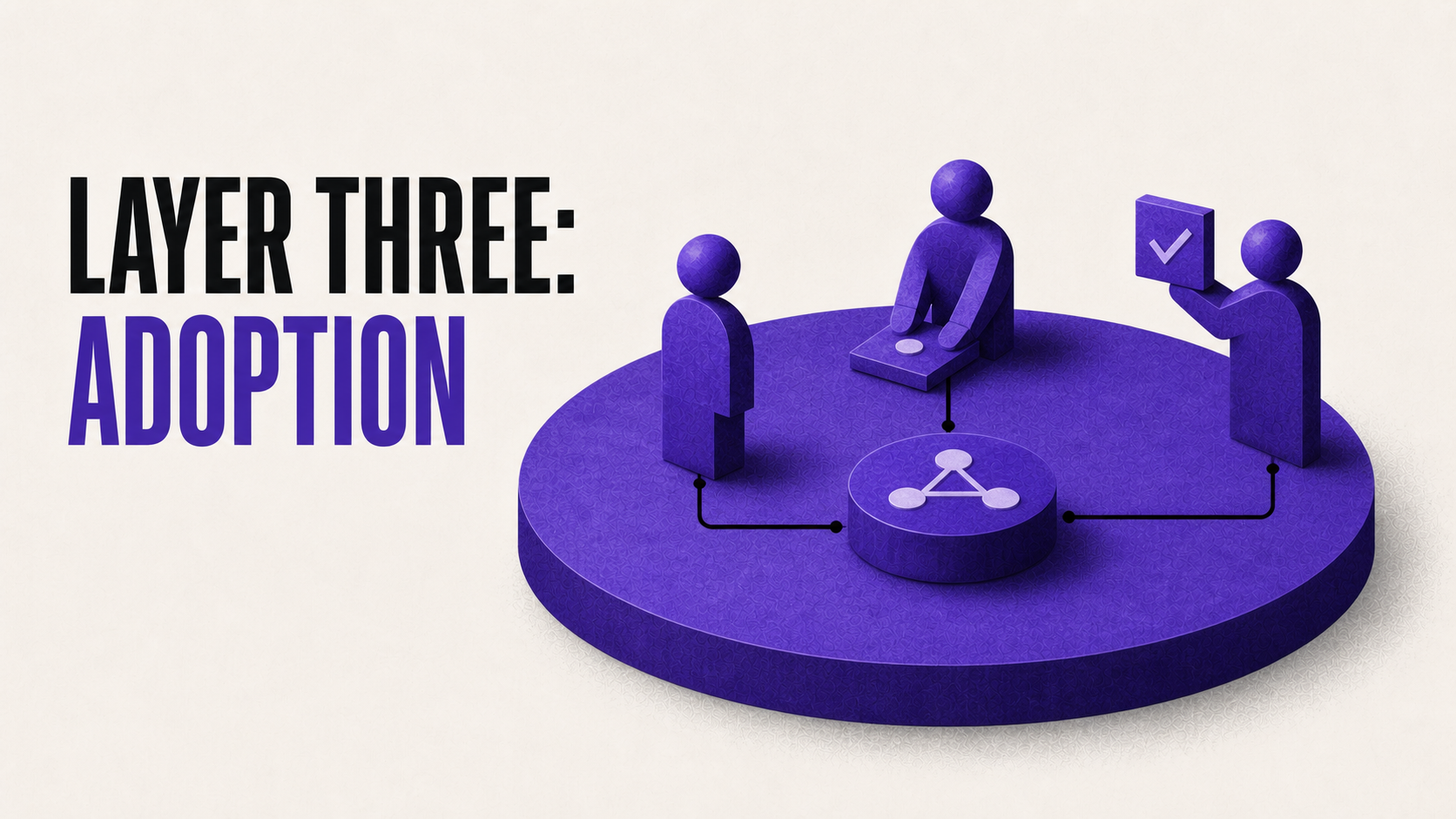
That knowledge cannot be bought from a vendor, no matter how good the vendor's model is. It has to be built, one deployed workflow at a time, by a team willing to spend the months it takes to find out where a system actually breaks inside their specific business, not inside a benchmark. A company that has spent a year building that judgment can switch to a completely new underlying model in a week and keep most of its edge, because the edge was never really about the model. A company that spent that same year waiting for a better model to arrive has nothing to switch, because it never built anything worth defending in the first place.
This is also where the infrastructure story and the adoption story connect. As model access keeps commoditizing, the thing that stays scarce is exactly this: organizational memory about how AI performs inside one company's own processes. That memory is not a resource any vendor sells, which is precisely what makes it valuable.
Layer four: Business outcomes
Business outcomes are the layer executives actually care about: revenue, cost reduction, cycle time, customer satisfaction, retention. It is also the layer that is hardest to attribute back to any specific AI investment, because it sits at the top of a stack where every layer underneath it has to hold for the outcome to show up at all.
If infrastructure is solid but the workflow around it was never redesigned, no outcome appears, no matter how capable the model is. If the workflow is genuinely well built but the organization never developed the adoption layer, the outcome that shows up in a pilot quietly disappears the moment the system runs unattended in production, because nobody built the judgment to catch what breaks. This is the actual mechanism behind a familiar and frustrating pattern: an AI pilot that looked excellent in a controlled test and then stalled indefinitely once it needed to run without a safety net.
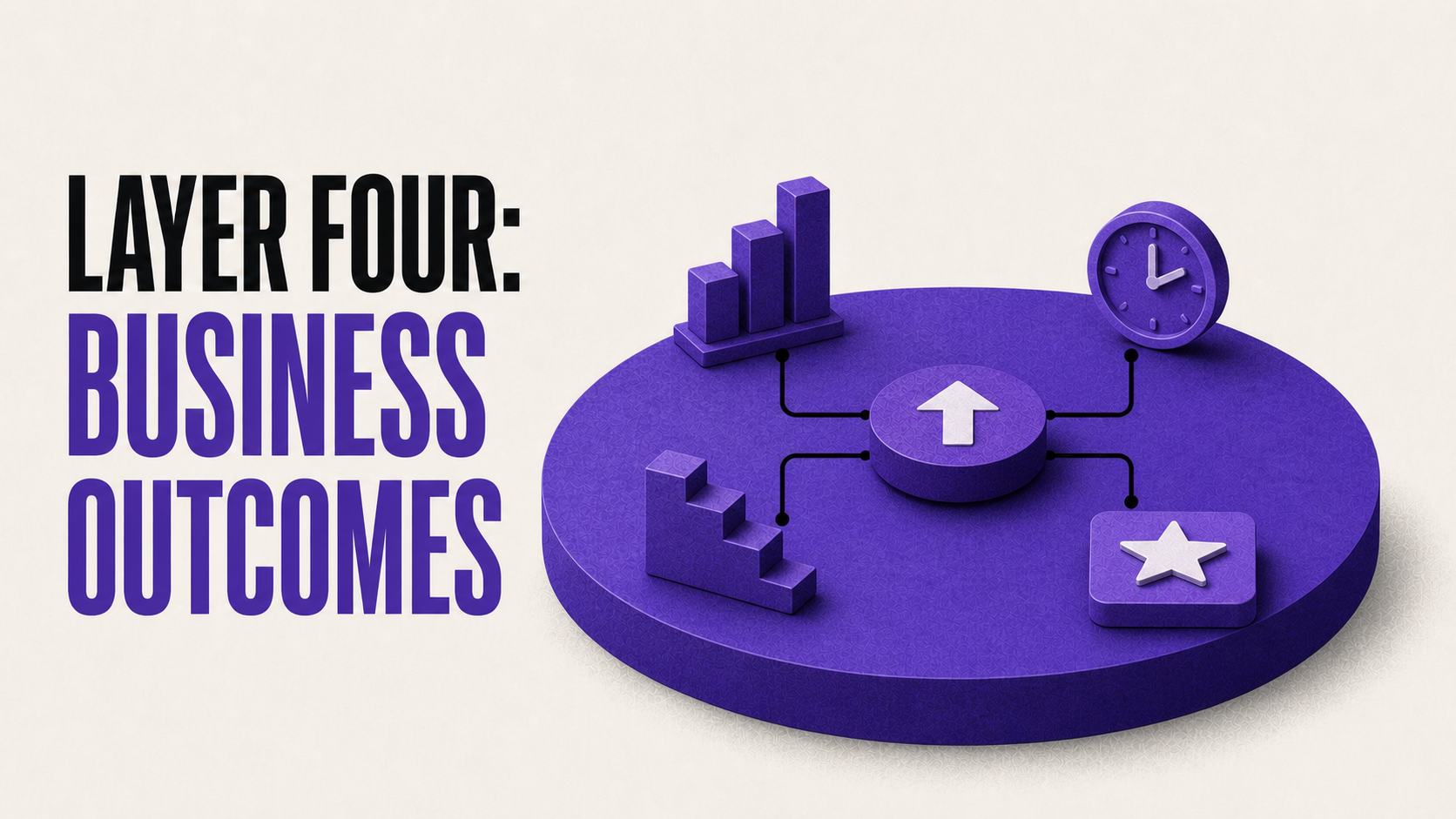
Most AI ROI calculations try to draw a straight line from infrastructure spend directly to a business outcome, skipping the two layers in between where the value is actually created or destroyed. That is the mathematical version of the same mistake as the finance conversation at the very top of this piece: measuring the layer that is easiest to see, and assuming it explains the layer that is hardest to see.
Why a stack, and not a checklist
A checklist implies four independent items that can each be optimized on their own schedule. A stack implies dependency: each layer only pays off if the layer beneath it is solid, in the same order, every time.
That distinction matters because it changes where a leadership team should actually look when an AI ROI number does not add up. If the infrastructure spend is high and the outcome is flat, the instinct is usually to blame the model, license a better one, and repeat the exact same measurement mistake a quarter later. The more useful question is which of the layers in between actually broke. Was the workflow ever redesigned, or just decorated. Did the organization spend the months required to build real adoption, or did it measure login counts and call that adoption. Those are the questions a stack framework forces a team to ask, and a single infrastructure invoice never will.
This is also why the earlier layers matter even when they do not show up on an ROI dashboard themselves. Workflow redesign and adoption depth are hard to put a single number on, which is exactly why most organizations skip straight past them to the layer that does have a number. The absence of a clean metric is not the same as the absence of value. It is often where the most value in the entire stack is sitting, unmeasured.
A short diagnostic helps here, one question per layer. At infrastructure: if a competitor had access to the exact same model tomorrow, would the advantage disappear. At workflows: does finishing the task still require a person to manually bridge two systems together by hand. At adoption: could the team name the three most common ways the system fails, without opening a dashboard to check. At business outcomes: does the metric that improved actually trace back to a redesigned workflow, or just to a new invoice. A team that can answer all four is measuring the stack. A team that can only answer the first one is measuring the receipt.
The stack, not the receipt
Model access will keep commoditizing. That trend is not going to reverse, and every company evaluating an AI investment should assume it continues. As the infrastructure layer keeps shrinking as a source of real differentiation, the workflow and adoption layers above it become where the actual competitive gap opens up, and where it stays open, because organizational memory is far slower to copy than a model license.
The companies that build ROI measurement systems tracking all four layers, not just the one with an invoice attached, will be the ones that can tell early whether an AI investment is genuinely working, rather than discovering eighteen months in that a promising pilot never became a production capability. None of that requires a better model. It requires treating AI ROI as a stack instead of a receipt, and building the measurement discipline to match.
See an AI team at work
Book a 15-minute demo and watch a Nagent team plan, do and hand back real work in its room.