
The Strategic Value of Fast Creative Iteration
Key takeaways
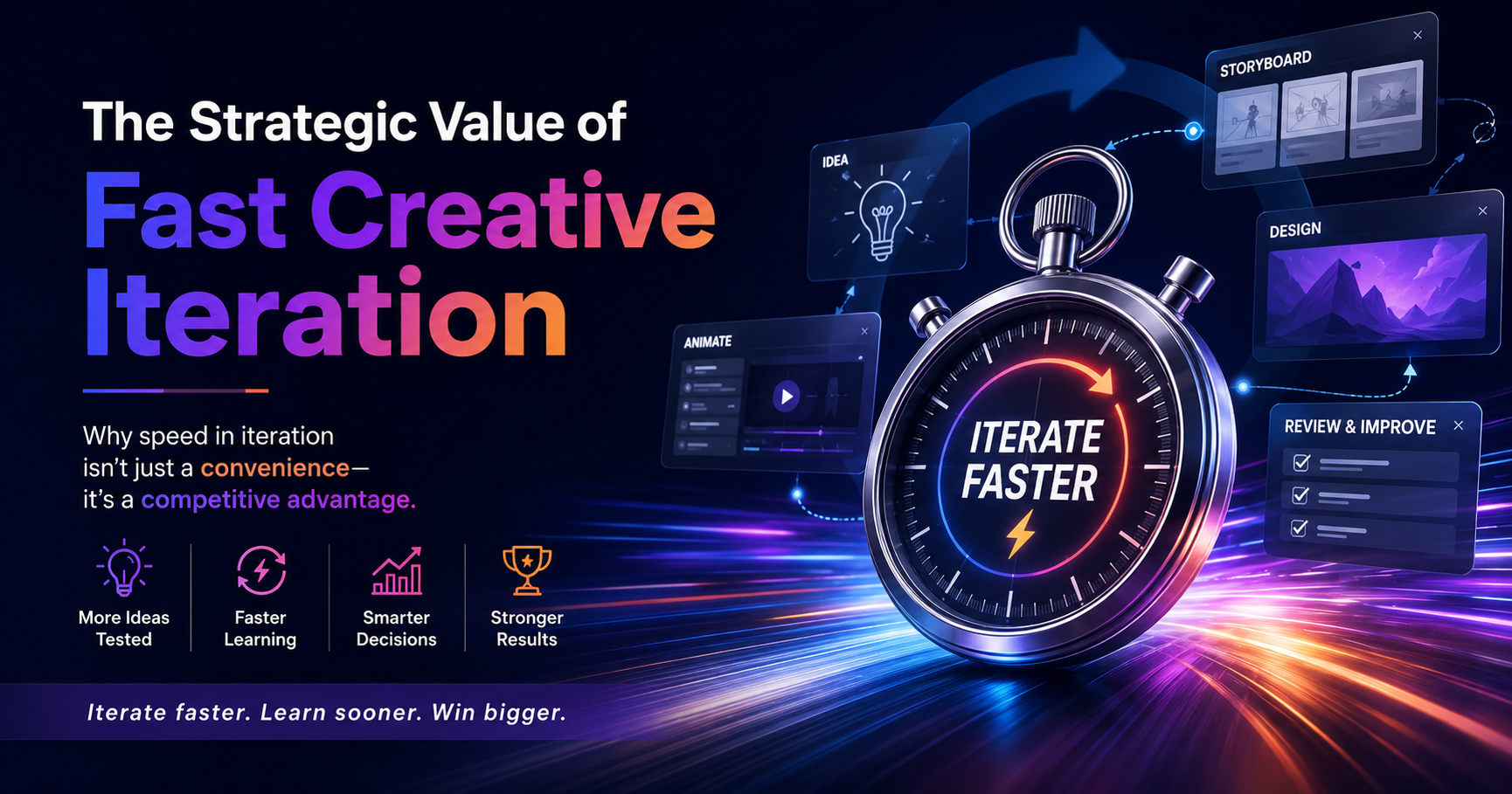
Iteration speed isn't just a convenience — it changes what a team can strategically attempt, because ideas that would never survive a multi-day production cycle become worth trying when testing them costs an afternoon.
Slow iteration doesn't just delay good ideas. It quietly filters them out before they're ever attempted, because the calculus of “is this worth the production cost” kills marginal ideas before anyone finds out whether they were actually good.
Kinetiq deterministic, targeted editing — a chat instruction, a canvas drag, a properties change — turns a revision into a specific, bounded task instead of a full re-production, which is the mechanism that actually makes fast iteration possible rather than just faster rendering.
Fast iteration compounds with testing: a team that can produce and adjust five creative directions in a day learns more about what actually works than a team that can only afford to fully produce and evaluate one.
The strategic advantage isn't speed for its own sake — it's the ability to respond to a live moment (a trend, a competitor's move, a real-time performance signal) while it's still relevant, instead of after the window has closed.
Every creative team has had the experience of an idea that felt right in the room and wrong three days later, once it finally existed as a finished asset. Under a traditional production timeline, that gap between conception and evaluation is where a lot of strategic value quietly leaks away — not because the idea was bad, but because by the time it was real enough to judge, the moment it was meant to respond to had moved on, or the team had already sunk enough cost into it that walking away felt harder than shipping something mediocre.
This piece argues that iteration speed is not a secondary convenience sitting underneath the real strategic decisions a creative or marketing team makes — it's one of the more consequential strategic variables itself, because it determines which ideas get tested at all, how much a team actually learns from each attempt, and whether creative work can respond to something happening in the world while that thing is still happening.
Feel the difference a fast iteration loop makes
Make a change and see it re-rendered in the same session — no re-export, no waiting on a specialist's calendar.
Slow Iteration Doesn't Just Delay Ideas — It Kills Them
The obvious cost of a slow production cycle is the calendar time it adds before a finished asset exists. The less obvious, and arguably larger, cost is what a slow cycle does to which ideas get attempted in the first place. When producing a first version of a creative idea costs a day or more of a scarce specialist's time, every idea has to clear a fairly high bar before anyone commits that time to it — which means the marginal ideas, the ones that might be brilliant or might be nothing, tend to get filtered out before anyone actually finds out, simply because trying them isn't worth the production cost relative to the odds of success.
This is a quiet but real strategic loss. Some meaningful share of a team's best creative work has always come from ideas that looked uncertain on paper and only proved themselves once someone actually saw them made real. A production cycle that makes every attempt expensive systematically biases a team toward safer, more obviously justified ideas, and away from the exploratory swings that are disproportionately likely to produce the work that actually breaks through.
What Actually Makes Iteration Fast
It's worth being precise about what makes an iteration loop genuinely fast, because raw generation speed on its own doesn't fully solve the problem. A tool that generates a full clip quickly but can only be revised by regenerating the whole thing is fast at the first draft and slow at everything after it — every round of feedback is effectively a new production, with all the same odds of missing the mark again. That's a shorter cycle, but it's still the same fundamental shape of cycle: produce, evaluate, redo from scratch.
Genuine iteration speed comes from being able to make a targeted change without redoing the whole piece. Kinetiq's architecture is built around exactly this: a composition edited through chat, canvas, properties, or code stays the same underlying artifact, so a note like “slow the intro, make the headline bigger, try a darker palette” is a specific, bounded change applied directly to what already exists, not a fresh roll of the dice. Because rendering is deterministic, that change can be previewed and re-rendered with confidence that nothing else in the composition shifted unexpectedly — which is what actually lets a team iterate rapidly, rather than just generate rapidly.
What Fast Iteration Makes Strategically Possible
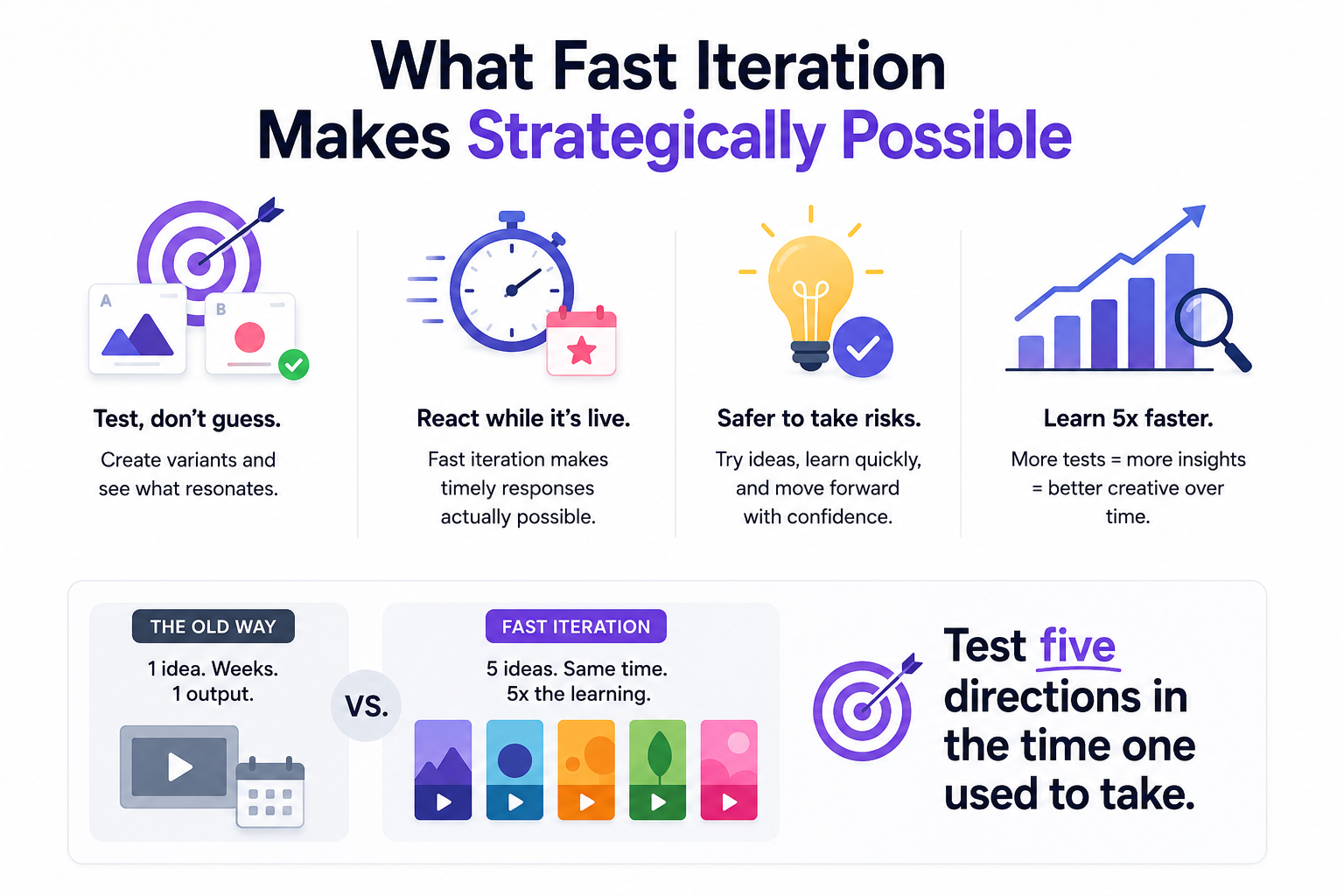
Real creative testing, not guessing. When producing a second and third variant of an idea costs an afternoon rather than a week, a team can actually test which direction resonates instead of debating it in a conference room and shipping whichever version won the argument rather than the audience's actual response.
Responding to a live moment while it's still live. A trend, a competitor's announcement, a cultural moment relevant to the brand — these have short half-lives, and a production cycle measured in days routinely means the response arrives after the moment has already passed. A same-session iteration loop is what makes a genuinely timely response possible at all.
Cheaper permission to be wrong. A team that can afford to try an uncertain idea and quickly find out it didn't work has effectively bought itself the freedom to take creative risks that a slower, more expensive cycle would have talked itself out of before ever attempting.
Faster organizational learning. Every fully produced and evaluated variant teaches a team something about what its audience responds to. A team that can run five honest tests in the time it used to take to produce one accumulates that learning proportionally faster, which compounds over a quarter into a meaningfully sharper sense of what actually works.
Test five directions in the time one used to take
Fast, targeted iteration means creative testing stops being a luxury reserved for the biggest campaigns.
The Revision Cost Nobody Budgets For
Most production budgets account for the cost of a first draft reasonably well and account for revision cost badly, because revision cost is unpredictable under a traditional model — it depends on how many rounds of feedback a piece happens to need, which is rarely known in advance. This unpredictability itself has a strategic cost: teams often build in padding, extra calendar time or a lighter creative ambition, specifically to hedge against a revision cycle that might run long, which means the fear of slow iteration shapes decisions even on projects where it never actually materializes.
A fast, targeted revision loop doesn't just make the revisions that do happen cheaper — it removes the need to hedge against revision cost in the planning stage at all. A team that trusts its ability to adjust quickly can commit to a more ambitious first attempt, because the cost of that attempt being wrong in some specific, fixable way is low. That shift, from planning defensively around revision risk to planning ambitiously because revision is cheap, is itself a strategic change in how a team approaches creative work, not just an operational efficiency gain.
Where This Matters Most
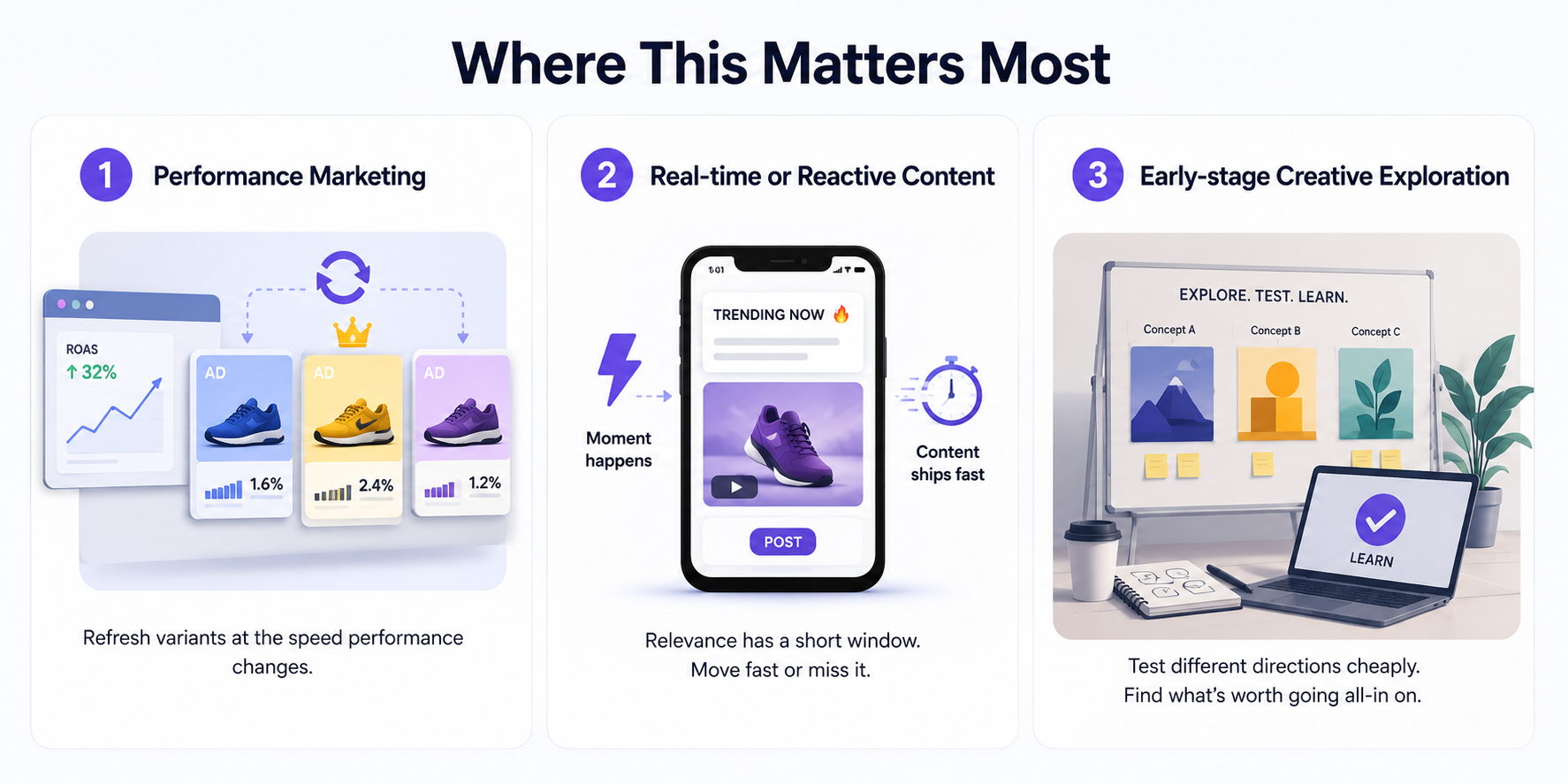
Performance marketing. Ad creative fatigues on a timeline measured in days, and a team's ability to refresh variants at the same pace it's losing effectiveness is directly gated by iteration speed — slow iteration here has a direct, measurable cost in declining performance.
Real-time or reactive content. Product launches that respond to a competitor's move, social content tied to a live cultural moment, anything where relevance has a short window — the strategic value of the content itself depends entirely on whether production can keep pace with the moment it's responding to.
Early-stage creative exploration. Before a team has committed to a campaign direction, fast iteration is what makes genuine exploration possible rather than nominal — testing three fundamentally different creative territories cheaply, instead of committing early to the one that seemed safest to fully produce.
Frequently Asked Questions
Isn't fast iteration just a nice-to-have compared to getting the first version right?
Getting a first version exactly right on the first attempt is rare for genuinely new creative territory, no matter how skilled the team. Fast iteration is what makes it economically sane to attempt ambitious or uncertain ideas in the first place, precisely because being wrong on the first pass is cheap to correct rather than a sunk cost.
How does Kinetiq's iteration speed compare to a generative clip tool that also renders quickly?
Raw generation speed only addresses the first draft. The meaningful difference is in revision: a targeted chat, canvas, or properties edit changes one thing about an existing composition, while a locked-clip generator typically has to regenerate the whole piece and hope for a better result, which is a fundamentally slower and less predictable revision loop even if the initial generation itself is fast.
Does faster iteration reduce creative quality by encouraging rushed decisions?
It has the opposite effect in practice, because a team with a fast iteration loop can afford to test and refine an idea multiple times before committing, rather than shipping the first version because a second attempt wasn't affordable. Quality tends to rise when a team can iterate toward it rather than having to guess correctly on the first and only attempt.
What's the best way to start using fast iteration strategically rather than just tactically?
Treat the first generated draft as a starting hypothesis rather than a near-final asset, and build in a deliberate round of testing two or three targeted variations before choosing a direction — the strategic value comes from actually using the speed to learn something, not just from having the speed available.
Say it. See it. Ship it.
Slow iteration doesn't just cost time — it quietly decides which ideas a team is willing to try in the first place. A fast, targeted revision loop changes that calculus, and changes what a team can strategically attempt as a result.
Make iteration cheap enough to use strategically
Kinetiq is an AI motion design studio built by Nagent, built around targeted, deterministic revision — not regeneration and hope.