
The Technical Architecture Behind Agentic Motion Design
Key takeaways
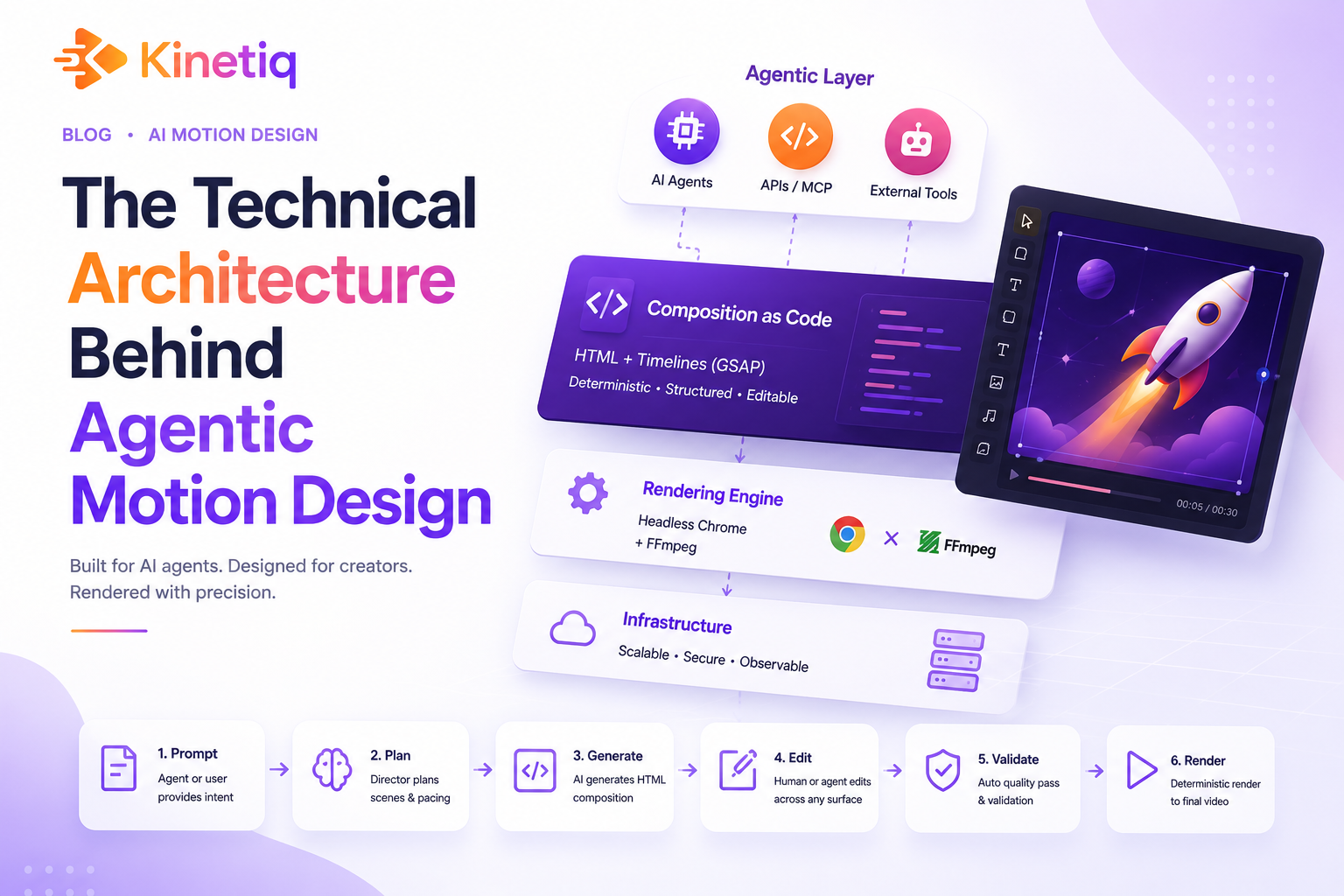
Agentic motion design rests on a specific architectural choice: representing a video as a structured, deterministic HTML composition rather than a rendered file or an opaque project format, so it can be authored, checked, and rendered by the same pipeline.
A Kinetiq composition is a root element with explicit width, height, and duration, containing timed clips and GSAP-driven animation timelines that are created paused and controlled by seeking — which is what makes rendering wall-clock-independent and frame-exact.
Generation, editing, and rendering all operate on the same artifact: an AI model writes or edits the HTML directly, a human edits it visually on a canvas, and a headless-Chrome-plus-FFmpeg pipeline renders it — with no format translation between any of those steps.
A model-agnostic skills system, rather than a single hardcoded model integration, is what lets the same authoring expertise steer any frontier model identically, and lets Kinetiq upgrade its underlying model without rebuilding its authoring logic.
A built-in MCP server and API tier extend the same architecture to external agents, so Claude, Cursor, ChatGPT, or a custom pipeline can generate and render video headlessly, governed by a hard provider allowlist and per-video cost metering.
“Agentic motion design” is a phrase that shows up in a lot of product marketing right now with very little explanation of what it actually requires underneath. It's easy to say a tool is agent-native; it's harder to build one, because most of the software history behind motion graphics assumes a human operator at every step, and retrofitting agent access onto that assumption tends to produce something that can be scripted but not genuinely authored. This piece is a more technical look at what actually has to be true, architecturally, for a system to support real agentic authoring — using Kinetiq, the AI motion design studio built by Nagent, as a concrete example of the choices involved.
The short version: the foundation is a deterministic, structured representation of video as code, and everything else — AI generation, human editing, agent access, reliable rendering — follows from that one representational choice being made correctly at the base of the stack.
See the architecture from the inside
Drop into Kinetiq's HTML source editor on any generated composition and see the structure an agent actually authors.
The Foundational Choice: Video as a Structured Artifact
Traditional motion design software — and most video-focused AI tools built on top of it — treats a finished video as either a rendered file (a locked MP4 or an opaque generative output) or a proprietary project format that only that specific application can meaningfully open. Both of these representations share a common limitation for agentic use: neither is something an AI model can read, reason about, and precisely edit without either re-rendering from scratch or working through a fragile, application-specific plugin layer.
Kinetiq's foundation, described in its own architecture documentation as an approach inspired by HyperFrames, represents a composition instead as plain HTML annotated with data attributes for timing: a root element carrying data-composition-id, data-width, data-height, and data-duration; individual clips marked with data-start, data-duration, and data-track-index; and animation timelines registered on a global timelines object, created paused and driven entirely by seeking rather than by a live clock. This last detail is what makes the whole system deterministic — because nothing depends on wall-clock time during capture, rendering the same composition twice produces frame-identical output every time.
Why HTML, Specifically
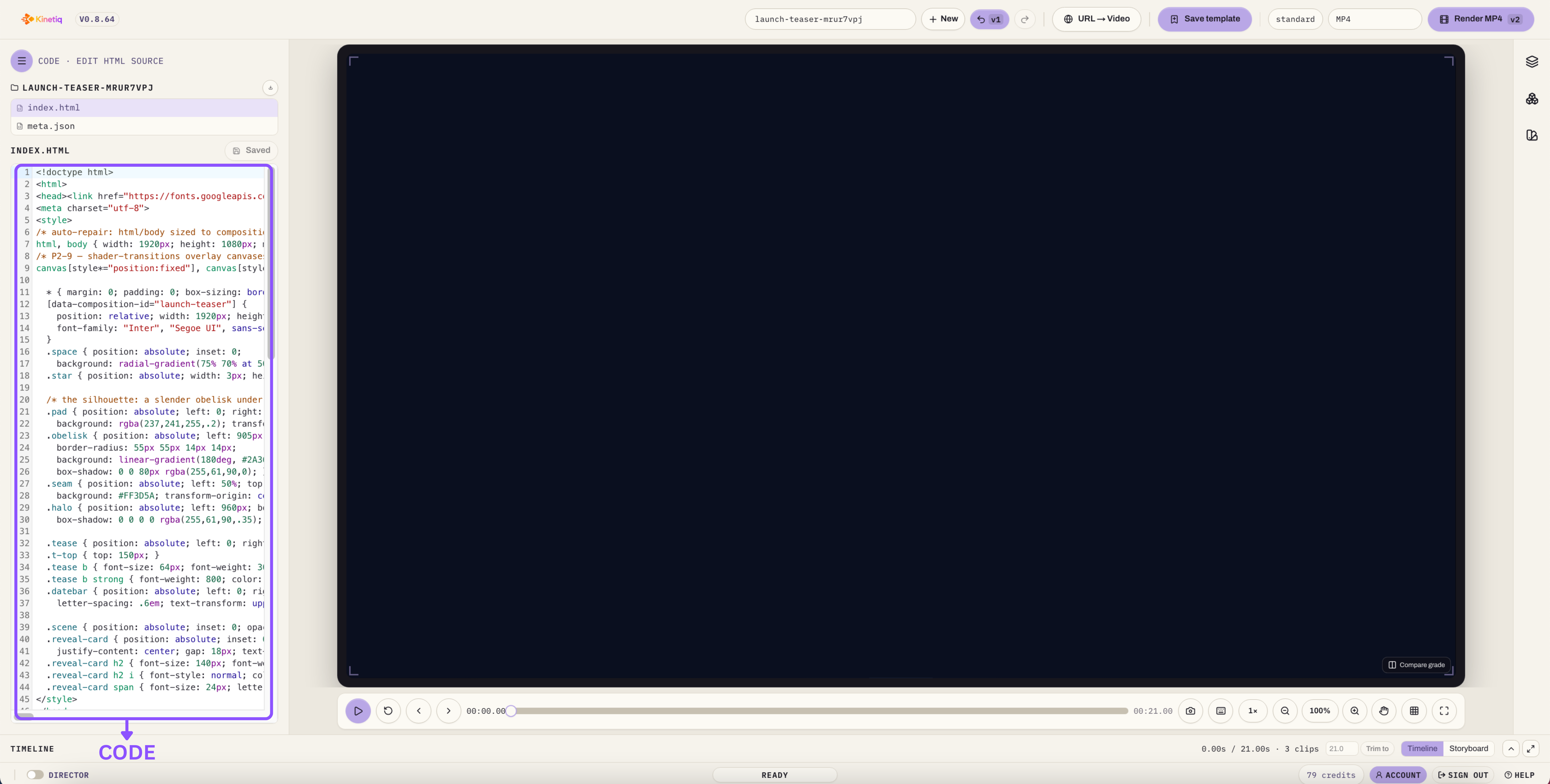
The choice of HTML as the underlying representation is not incidental. It's a format every modern AI model has been extensively trained on, which means a model can read an existing composition, understand its structure, and make precise, targeted edits to it using the same general capability it already has for editing any other HTML document — no bespoke, proprietary schema for the model to be separately trained on. It's also a format a browser can render natively, which is what allows an in-studio live preview to show exactly what a final render will look like, and a format a person can drop into directly through a standard code editor, with changes round-tripping cleanly back to a visual canvas.
This single representational choice is what lets four very different consumers — an AI model generating a first draft, a human dragging an element on a canvas, a developer editing raw markup, and a rendering pipeline producing a final MP4 — all operate on exactly the same artifact, with no lossy translation between any of them. Compare this to a traditional pipeline where a design tool, an editing tool, and a rendering engine each use different formats, requiring export and import steps that lose information at every boundary.
From Composition to Rendered Frame
Turning the structured composition into a final video file is handled by a headless-Chrome-plus-FFmpeg pipeline: a real browser engine, running without a visible window, loads the composition, seeks the registered animation timelines to each required frame, captures that frame, and hands the resulting sequence to FFmpeg for encoding into the requested output format. Because capture is driven by seeking rather than by playing the composition in real time, the pipeline can run in parallel across many frames at once, and because the same seek-and-capture process runs identically on every render, the output is exact and reproducible rather than approximate.
This is also the mechanism that supports Kinetiq's range of export formats and resolutions from a single source composition — MP4 with H.264 video and AAC audio for universal delivery, alpha-capable WebM and MOV for compositing pipelines, and numbered PNG sequences for frame-accurate VFX handoff, all generated by pointing the same rendering pipeline at the same composition with different output parameters, rather than requiring separate authoring work per format.
Watch a composition become a rendered frame
See the deterministic pipeline in action — generate a composition, then render it twice and compare.
The Authoring Layer: Skills, Not a Single Hardcoded Model
A structured, editable composition format solves the representation problem, but it doesn't by itself solve the authoring problem — something still has to generate a good first composition from a written brief, and do it well across whichever frontier AI model happens to be best at a given moment. Kinetiq's answer is a skills system: domain knowledge and authoring playbooks stored as portable, model-agnostic documents that are injected into whichever model is handling a given request, rather than logic baked into a single model-specific integration.
Because the skills are model-agnostic, the same authoring expertise steers Claude, Gemini, OpenAI's models, or Grok identically, through a primary-to-fallback provider chain with per-request cost metering and a spend-safety allowlist. This is what lets Kinetiq's own documentation describe the product as getting smarter as the underlying models do, without a rewrite: when a stronger model becomes available, it's added to the routing chain, inherits the same skills, and every subsequent generation benefits, without the authoring logic itself needing to change.
A Director, Not a Single-Shot Generator
For anything longer than a very short piece, generating a full composition in one uninterrupted pass tends to produce weaker structural results than planning first. Kinetiq's Director component handles this by planning multi-scene beats — what happens, in what order, at what pace — before generation actually builds the composition against that plan, with pacing that's explicitly duration-aware rather than applying the same rhythm regardless of target length. A structural quality pass, including auto-repair and validation, runs on the result before it reaches a person, catching a category of structural issue — overflow, broken layout, missing elements — that a single-shot, unchecked generation wouldn't catch until a human noticed it manually.
Extending the Architecture to External Agents
The same properties that make Kinetiq's internal AI authoring possible — a structured, editable composition and a deterministic render pipeline — are what make external agent access technically sound rather than a bolted-on integration. A built-in MCP server exposes the ability to generate and render video as a callable tool for any MCP-capable agent, and a dedicated API tier extends the same capability to custom pipelines. Because the underlying artifact is the same structured composition an internal user would work with, an external agent isn't working through a limited or simplified interface — it has access to the same authoring surface a human does, headlessly.
This is governed rather than open-ended: a hard, provider-neutral model allowlist ensures only approved models can ever bill a key, and per-video cost metering makes spend visible and boundable, which is the specific architectural detail that makes it reasonable to let an external agent generate video against a production budget without a human approving every individual request.
Why This Architecture Matters More Than Any Single Feature
Individual capabilities — brand capture, templates, voice narration, image generation — are each useful on their own, but they're not what makes the system agentic. What makes it agentic is that all of them operate on the same underlying structured artifact, which is what allows an agent, internal or external, to read a composition's current state, reason about what to change, and make that change precisely, using a representation it already understands from its general training rather than a proprietary schema it has to be specially taught. A system built the other way — agent access added on top of a traditional locked-file or rendered-clip model — can offer automation, but it can't offer the same depth of precise, agent-authored editing, because the underlying artifact was never built to be read and reasoned about in the first place.
Frequently Asked Questions
Why HTML instead of a purpose-built video description format?
Every modern AI model already has deep, general-purpose training on HTML, which means a model can read and edit a composition using capability it already has, rather than needing to be specifically trained or fine-tuned on a proprietary schema. It also renders natively in a browser for live preview and is human-readable for anyone who wants to work directly in code.
How is determinism actually guaranteed during rendering?
Animation timelines are created in a paused state and advanced only by explicit seeking to a specific point in time, rather than by letting them play against a live clock. Because frame capture always seeks to the same points regardless of how fast or slow the underlying machine runs, the same composition produces frame-identical output on every render.
What happens when a new, stronger AI model is released?
Because authoring expertise lives in model-agnostic skills rather than model-specific logic, a new model can be added to the provider routing chain and inherit the same skills immediately, improving generation quality without requiring the underlying authoring system to be rebuilt.
Is external agent access, through MCP or the API, working with a limited version of the product?
No — an external agent operates on the same structured composition format a human user works with inside the studio, governed by the same hard model allowlist and per-video cost metering that applies to any generation, rather than a simplified or restricted interface.
Say it. See it. Ship it.
Agentic motion design isn't a feature you add to a video tool — it's a consequence of representing video as something a model can genuinely read, reason about, and edit. That representational choice is the foundation everything else in Kinetiq is built on.
Build on an architecture designed for agents from the ground up
Kinetiq is an AI motion design studio built by Nagent, with a structured, deterministic composition format at its core.