
Top AI Agent Marketplaces in 2026 | Platforms Powering the Agent Economy
The Evolution of Agentic Ecosystems: A Strategic Analysis of the Top 13 AI Agent Marketplaces in 2026
The global landscape of artificial intelligence has undergone a fundamental paradigm shift in 2026, transitioning from assistive chatbots to autonomous agentic systems. These systems do not merely provide information but execute complex, multi-step workflows independently, moving beyond the "read path" of traditional retrieval to the "write path" of active intervention. The global agentic AI market, valued at approximately $9.14 billion in early 2026, is currently projected to grow to over $139.19 billion by 2034, exhibiting a compound annual growth rate (CAGR) of 40.50%. This expansion is underpinned by a massive increase in enterprise adoption, with forecasts indicating that nearly 80% of businesses will have integrated some form of intelligent automation by 2026.
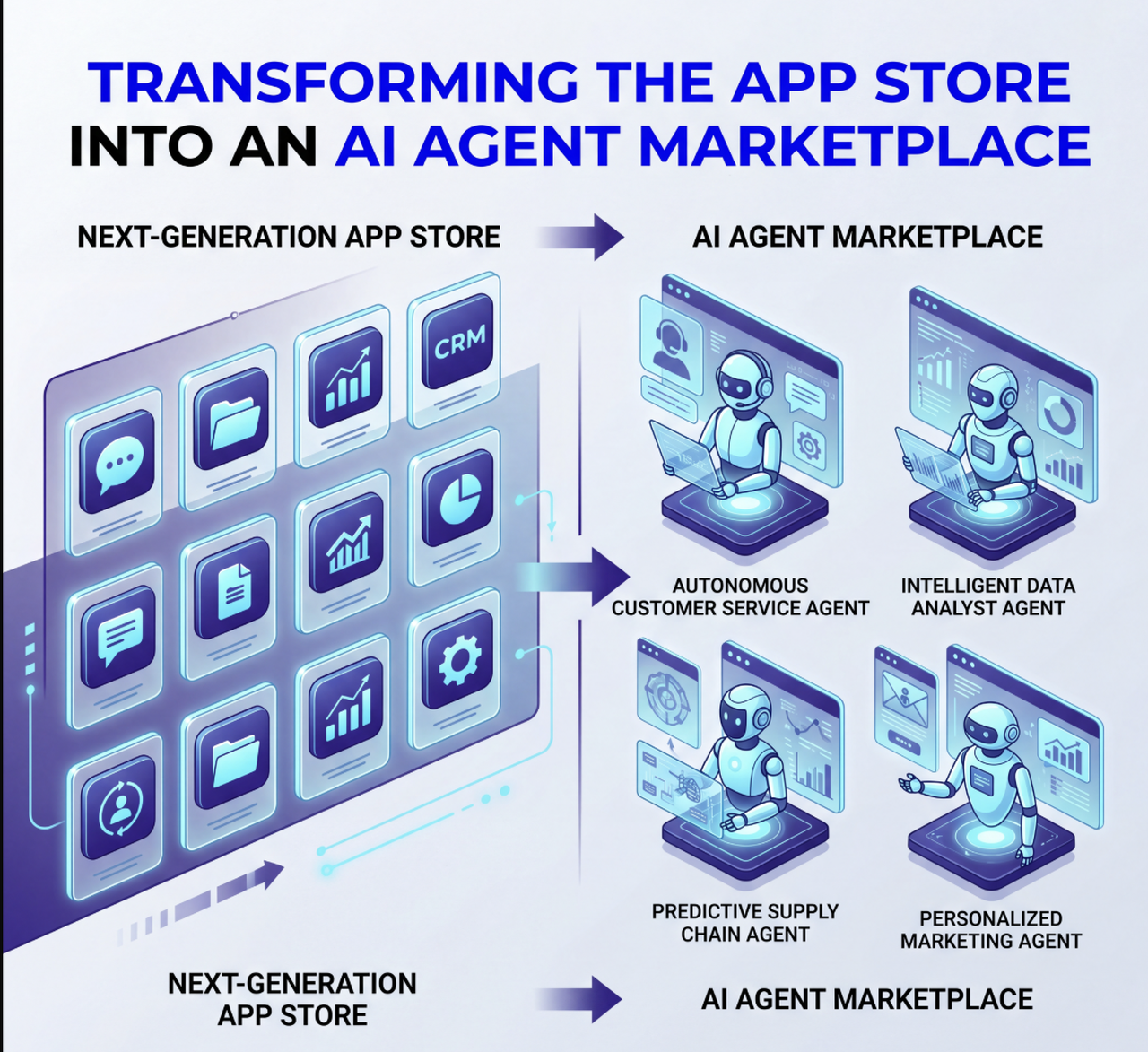
The central pillar of this transformation is the AI agent marketplace—a centralized hub where pre-built, production-ready autonomous systems are discovered, vetted, and deployed. These platforms serve as the conduits for "digital assembly lines," where specialized agents from diverse vendors collaborate to handle entire job functions.
Categorization Framework for Strategic AI Agent Marketplaces
To effectively navigate the current landscape, marketplaces are categorized based on their primary agent architecture and the level of operational autonomy they offer to businesses.
Table 1: Categorization of Top 13 AI Agent Marketplaces (2026)
:quality(80))
1. OpenAI GPT Store: The Consumer and Prosumer Hub
The OpenAI GPT Store remains the most recognizable marketplace, serving individuals and SMBs with over 3 million custom GPTs. The integration of the "Operator" agent - a browser-based system capable of autonomously navigating the web—has expanded the store's utility to active task execution like booking and ordering. Through the Agentic Commerce Protocol (ACP), Shopify and Stripe merchants can now sync product catalogs directly into the ecosystem for agent-led vetting and checkout.
:quality(80)) Categories of agents on Open AI GPT store:
Categories of agents on Open AI GPT store:
Top Picks
Curated, high-performing GPTs across categories—these represent the best examples of what custom agents can do today, from creativity to productivity.
Writing
Agents designed for content creation, editing, and storytelling—used for blogs, emails, scripts, and social media at scale.
Productivity
Task-oriented agents that help automate workflows, manage schedules, summarize information, and boost day-to-day efficiency.
Research & Analysis
Agents built for deep thinking—analyzing data, generating insights, conducting market research, and supporting decision-making.
Education
Learning-focused agents that explain concepts, tutor users, generate practice material, and personalize knowledge delivery.
Lifestyle
Everyday utility agents—from travel planning and fitness coaching to personal finance and recommendations.
DALL·E / Creative Tools
Agents that generate images and visual content, enabling rapid design, ideation, and creative exploration.
Programming / Developer Tools
Technical agents that assist with coding, debugging, architecture design, and building software faster.
The OpenAI GPT Store is currently the largest hub for conversational AI, featuring over 3 million custom agents. Below are the key pros and cons for both users and creators as of 2026:
Pros of Open AI GPT Store
Accessibility and Discoverability: The store is built directly into the ChatGPT interface, providing instant access to millions of active users and high visibility for popular agents.
Ease of Creation: It features a low-code builder that allows non-technical users to create specialized assistants for tasks like research or coding without writing any software.
Advanced Capabilities: Newer experimental agents like "Operator" enable autonomous browser-based task execution, such as booking flights or placing orders.
E-Commerce Integration: Through the Agentic Commerce Protocol, merchants can sync product catalogs directly into the ecosystem, allowing agents to handle real-time vetting and checkout via Shopify and Stripe.
Cutting-Edge Models: Users get immediate access to the latest frontier models, including the GPT-5 family, which provides industry-leading reasoning and intelligence.
Cons of Open AI GPT Store
Monetization Barriers: Direct monetization is still limited; while a revenue-sharing program based on engagement has been announced, it is currently restricted to U.S. builders and lacks clear implementation details globally.
Subscription Paywall: Access to the GPT Store and its custom agents is generally restricted to ChatGPT Plus, Pro, Team, or Enterprise subscribers, creating a barrier for free-tier users.
OpenAI Lock-in: The platform is not model-agnostic, meaning agents are strictly limited to OpenAI's models and cannot leverage other engines like Claude or Gemini.
Limited Autonomy: Unlike dedicated enterprise platforms, "write" actions (such as sending data to other apps) often require manual user confirmation, which can bottleneck complex autonomous workflows.
Single-Agent Focus: The store is primarily built for single-agent conversational use cases and lacks the native multi-agent orchestration capabilities found in platforms like Relevance AI or AutoGen.
I tried one of the agent - Data Analyst built by Open AI team and gave it a 30 MB excel file to analyse.
2. Claude Marketplace: The B2B Procurement Streamliner
Anthropic’s Claude Marketplace addresses enterprise procurement friction by allowing businesses to apply existing spending commitments toward Claude-powered applications built by third-party partners. This "one-contract" model eliminates months of legal and security vetting typically required for new SaaS tools. Initial partners include GitLab, Snowflake, and Harvey AI, focusing on high-reasoning tasks in software development and legal workflows.
:quality(80))
Categories of agents on Claude marketplace:
The agents and tools within the Claude ecosystem are categorized into two distinct layers: the official Claude Marketplace for enterprise B2B applications and the community-driven Claude extension directory for technical skills and servers.
1. Official Claude Marketplace (B2B SaaS)
The official marketplace is a curated environment designed for enterprise-grade autonomous software. These agents are categorized by their vertical business function and are often delivered through top-tier SaaS partners.
Software Development: This is the most mature category, featuring agents that understand entire codebases, manage Git workflows, and perform autonomous migrations. Partners include GitLab, Replit, and Lovable Labs.
Legal Tech: High-reasoning agents tailored for legal workflows, contract analysis, and regulatory compliance. The flagship partner in this category is Harvey AI.
Financial Analysis: Specialized agents designed for complex data operations, risk assessment, and financial modeling. Key partner: Rogo.
Enterprise Data & Operations: Agents that integrate directly with data warehouses to perform multi-step analysis and manage enterprise data lifecycles. Key partner: Snowflake.
Healthcare Documentation: (Strategic domain) Agents designed to automate medical scribing and clinical documentation while adhering to strict privacy standards.
2. Community and Developer Ecosystem (Skills & MCP)
Beyond formal SaaS applications, the ecosystem features a massive directory of over 2,400 skills and 770+ MCP (Model Context Protocol) servers categorized by technical function.
Agent Skill Categories:
Frontend & UI Design: Skills like
ui-ux-pro-maxthat provide design intelligence for building interfaces.Testing & Code Quality: Autonomous agents dedicated to code review, bug hunting, and Java unit testing (e.g.,
Diffblue Cover).DevOps & CI/CD: Agents that manage infrastructure, handle release management, and automate deployment pipelines.
Marketing & SEO: Agents designed for technical SEO audits, competitive analyzer flows, and brand-aligned content drafting.
MCP Server Categories (Tool Access):
Web & Browser Automation: Servers like
Chrome DevToolsthat allow agents to debug browsers orFirecrawlto turn websites into LLM-ready data.Database Connectivity: Direct connectors for Postgres, MySQL, and Dolt (Git for data).
Productivity & Planning: Integration agents for tools like Linear, Slack, and Google Calendar.
Search & Web Crawling: Advanced retrieval servers that allow agents to conduct deep research across the live web and research papers.
Anthropic's Claude Marketplace is specifically designed to streamline the adoption of generative AI within complex enterprise environments. Below are the key pros and cons as of 2026:
Pros
Streamlined Procurement: The "one-contract" billing model allows enterprises to apply their existing Claude spending commitments toward third-party applications, eliminating months of separate legal and security vetting.
High Reasoning Focus: Unlike consumer-focused stores, this marketplace prioritizes specialized B2B tools for software development, legal workflows, and financial analysis.
Implicit Vetting: Anthropic serves as a gatekeeper, vetting third-party partners to lower the friction for corporate procurement teams who otherwise have to evaluate vendors independently.
Deep Developer Integration: The ecosystem is tightly integrated with tools like Claude Code, allowing agents to operate directly within terminal environments and understand entire codebases.
Consolidated Invoicing: Anthropic manages all invoicing for partner spend, meaning businesses deal with one invoice and one renewal conversation rather than dozens of separate SaaS contracts.
Cons
Vendor Lock-in: Consolidating both model access and application procurement through a single provider creates significant switching costs and concentration risk.
Limited Initial Selection: The marketplace launched with a small, curated set of partners (such as GitLab, Snowflake, and Harvey AI), offering far less variety than the millions of agents in the OpenAI GPT Store.
Technical Barrier: Advanced capabilities, such as "Claude Computer Use," are heavily developer-oriented and require API configuration rather than being a "plug-and-play" experience for average business users.
Closed Submission Model: Unlike open directories, the marketplace is based on a formalized partner network, making it difficult for independent creators or small startups to list their agents without an existing enterprise-level partnership.
3. AWS Marketplace: The Enterprise Infrastructure Standard
AWS has established an agent-focused category to help enterprises move from experimentation to scaled deployment. It offers reported savings of 60% in procurement time and 30% faster deployment for pre-built agents. The marketplace distinguishes itself through "Private Marketplace" capabilities, allowing large organizations to curate approved agent catalogs for internal departments.
:quality(80))
AWS Marketplace has transitioned from a software repository to a leading infrastructure-centric hub for "Agentic AI Tools," serving technical leaders who require agents built on high-performance infrastructure with built-in governance.
Categories of Agents in AWS Marketplace
The AWS Marketplace categorizes thousands of agents and tools into vertical business functions and technical use cases :
Software Development & IDE
Agents that automate code migration, bug fixes, and spec-driven development
Examples: Kiro, AWS TransformIT Support & DevOps
Frontier agents that resolve incidents, maintain context across sessions, and improve system reliability
Examples: AWS DevOps AgentSecurity & Compliance
Agents with embedded security expertise for design-to-deployment protection and automated compliance checks
Examples: AWS Security AgentResearch & Business Insights
Autonomous agents that synthesize data from multiple sources to generate insights and support decision-making
Examples: Amazon QuickData Analysis
Reasoning agents that query data warehouses, automate analytics workflows, and deliver actionable insights
Examples: SmythOS, GumloopSales & Marketing
Agents for lead qualification, proposal generation, and end-to-end marketing automation
Examples: Boomi Agentstudio, AppsmithCustomer Support
Resolution-focused agents for handling chat, email, and voice interactions across channels
Examples: Intercom FinOperations & Supply Chain
Agents designed for procurement, logistics optimization, and financial operations automation
Examples: Activepieces
Pros
Procurement Efficiency: Organizations report an average of 60% savings in procurement time and 30% faster deployment for agents discovered through the marketplace.
Security and Compliance: Agents are pre-vetted for enterprise security standards. AWS offers "Private Marketplace" capabilities, allowing large organizations to create a curated catalog of approved agents for their internal teams to ensure policy compliance.
Flexible Deployment: The marketplace supports multiple delivery methods, including API-based access for vendor-hosted agents and container deployment for running agents within a customer's own Virtual Private Cloud (VPC) for maximum data control.
Infrastructure Synergy: Agents integrate natively with Amazon Bedrock AgentCore, providing a secure, scalable platform to build and operate autonomous systems using various foundation models.
Consolidated Billing: Purchases are made through existing AWS accounts, often moving AI investment from a Capital Expenditure (CapEx) to an Operating Expenditure (OpEx) model.
Cons
Technical Complexity: There is a high technical barrier to publish and deploy agents compared to consumer-focused platforms like the GPT Store.
Vendor Lock-in: The marketplace requires an AWS-focused architecture, making it difficult to port agents or workflows to other cloud providers.
B2B Only: The platform is designed exclusively for enterprise and technical buyers rather than the general consumer market.
Transformation Burden: Partners report that enterprises often underestimate the foundational data and infrastructure work required before they can realize ROI from these agents.
4. Hugging Face Hub: The Open-Source Developer Oasis
Hugging Face has evolved into the "GitHub of AI," hosting over 2 million models and 1 million "Spaces". By adopting the Model Context Protocol (MCP), Hugging Face allows agents to discover and use tools across its ecosystem seamlessly. Its "Skills" marketplace features reusable definitions for ML tasks, interoperable with major coding agents like Claude Code and Cursor.
:quality(80))
Categories of Agents in the Hugging Face Hub
Hugging Face agents are primarily categorized by their technical functions and the "Skills" they possess to interact with the Hub's massive data and model layers.
Coding & Development
Agents that integrate with IDEs to perform autonomous code generation, bug fixing, and repository management
Primary Examples: Claude Code, OpenAI Codex, Cursor, ZedML Operations (Skills)
Reusable task definitions that enable agents to train models, evaluate benchmarks, and manage cloud compute workflows
Primary Examples: hf-cli, huggingface-llm-trainer, huggingface-jobsSearch & Discovery
Agents designed for deep research, model discovery, dataset exploration, and semantic search across ecosystems
Primary Examples: Hugging Face MCP Server, Papers Semantic SearchMultimodal Generation
Agents capable of generating images, video, and synchronized audio from prompts, enabling advanced creative workflows
Primary Examples: Z Image Turbo, Wan2.2 14B Fast, LatentSyncData & Analytics
Reasoning agents that query datasets using SQL or natural language to extract insights and automate analysis
Primary Examples: huggingface-datasets, parquetlensPhysical AI & Robotics
Agents focused on enabling hardware systems with contextual awareness and spatial intelligence
Primary Examples: LeRobot, Gemini Robotics
Pros of the Hugging Face Marketplace
Unmatched Open-Source Variety: Access to a vast ecosystem of over 2 million models and 500,000 datasets, allowing developers to avoid vendor lock-in.
Standardized Interoperability: By adopting the Model Context Protocol (MCP), Hugging Face allows agents from diverse vendors (like Claude or ChatGPT) to discover and use community tools seamlessly.
Robust Free Tier: The Hub is free to use for unlimited model access and building proof-of-concept projects. It now includes ZeroGPU Spaces for running AI applications without upfront hardware costs.
Rapid Innovation Cycle: The platform's open governance encourages daily contributions from industry leaders like NVIDIA, Meta, and Google, as well as thousands of independent researchers.
Cloud Agnostic: Hugging Face integrates with all major providers (AWS, Azure, and Google Cloud), enabling enterprise teams to deploy models within their existing infrastructure.
Cons of the Hugging Face Marketplace
Unpredictable Model Quality: Due to the open-submission nature of the Hub, the performance and accuracy of specific models can vary significantly and require manual vetting.
High Technical Barrier: Unlike consumer-facing stores, this ecosystem is geared toward AI engineers and developers. Non-technical users will find the CLI and SDK-based setup difficult to navigate.
Licensing and Compliance Risks: Open repositories often contain user-uploaded content that may have complex or proprietary licensing. Businesses must perform their own due diligence to ensure legal compliance.
Unpredictable Scaling Costs: While the initial tier is free, moving from prototypes to production-grade APIs or dedicated GPU inference endpoints introduces hourly costs that can escalate quickly.
Fragmented Documentation: As the ecosystem evolves rapidly, documentation for newer integrations and community-contributed "Skills" can be inconsistent or outdated.
5. Salesforce AgentExchange: The CRM Integration Leader
Built into the AppExchange, AgentExchange allows businesses to deploy Agentforce solutions native to the Salesforce CRM. These agents have direct access to customer interaction history without needing middleware, significantly reducing "hallucinations" in customer-facing roles. Solutions from partners like Docusign and Box can be discovered directly within the Agent Builder workflow.
:quality(80))
Categories of Agents on AgentExchange
Agents and solutions in the marketplace are primarily categorized by business function and industry-specific needs:
Core Business Functions:
Sales & Service: Agents for lead qualification, sales coaching (e.g., Tackle GTM Coach), and automated customer service (e.g., Natterbox AI Contact Center).
Marketing & Commerce: Tools for end-to-end campaign creation and autonomous commerce tasks.
Operations & Analytics: Agents that summarize complex cases (e.g., Case InsAIghts), conduct business analysis, or provide real-time user engagement insights.
IT & DevOps: Specialized agents for release management and deployment troubleshooting (e.g., Copado DevOps Automation).
Industry-Specific Solutions: The marketplace offers tailored agents for over a dozen verticals, including Financial Services, Healthcare & Life Sciences, Manufacturing, Retail, and the Public Sector.
Cross-Platform Integration: "Partner Agents" from companies like Docusign, Box, and Highspot that automate content-centric workflows and document generation directly within Salesforce.
Pros and Cons of Salesforce AgentExchange
Pros
Native Data Grounding
Agents have direct access to full customer lifecycle data without requiring complex middleware, improving accuracy and reducing hallucinationsIn-App Discovery
Solutions can be discovered and deployed directly within the Agent Builder, enabling admins to add capabilities without leaving their workflowEnterprise-Grade Trust
Built on the Salesforce Trust Layer, ensuring strong compliance (GDPR, SOC2) and data protection for regulated industriesMulti-Agent Orchestration
Supports advanced workflows where multiple specialized agents collaborate seamlessly on a single task
Cons
Ecosystem Lock-in
Entirely dependent on the Salesforce stack, offering limited value for organizations outside the ecosystemHigh Implementation Effort
Transitioning from discovery to production can take months due to integration complexity and enterprise testing requirementsOversized for SMBs
Cost and complexity make it less suitable for small businesses or D2C brandsSlow Sales Cycles
Curated, partner-driven ecosystem slows down onboarding of new third-party agents
6. Microsoft Copilot Studio: The Productivity Orchestrator
Microsoft positions Copilot Studio as the primary orchestrator for agentic AI within the Microsoft 365 ecosystem. Its "Work IQ" intelligence layer tunes agents specifically to an organization’s unique workflows and business context. It features role-based interaction models with "virtual employees" like Researcher, Analyst, and Scrum Master.
:quality(80))
Categories of Agents in Microsoft Copilot Studio
Agents in this ecosystem are generally categorized into out-of-the-box "virtual employees" and customizable industry templates.
Out-of-the-Box Role-Based Agents:
Researcher: Synthesizes information from internal data and the web to create in-depth reports and brainstorm ideas.
Analyst: Transforms complex datasets into visualizations and clearer business insights within Copilot Chat.
Project Manager: Automates task execution and status reporting specifically within Microsoft Planner.
Facilitator: Moderates Teams meetings, takes automated notes, and identifies action items in real-time.
Interpreter: Provides real-time speech-to-speech interpretation for meetings in up to nine languages.
Customizable Templates:
Customer Insights Assistant: Streamlines research on industry trends and business priorities to help sales teams prepare for engagements.
Scrum Assistant: Embedded into daily workflows to analyze sprint artifacts and reduce friction in agile delivery.
IT Help Desk: Designed for support automation, integrating with tools like ServiceNow to resolve internal tickets.
Specialized Copilot Experiences:
Security Copilot: A frontier agent focused on threat detection, incident response, and security posture management.
Sales & Service Copilots: Specialized agents for Dynamics 365 that handle lead scoring, customer inquiry resolution, and automated CRM updates.
Pros and Cons of Microsoft Copilot Studio
Pros
Deep Native Integration
Agents work seamlessly across Teams, SharePoint, Outlook, and Dynamics 365, embedding directly into existing workflowsWork IQ & Data Grounding
Leverages Microsoft 365 Graph API to ground agents in real organizational data—emails, meetings, and documents—for contextual accuracyMulti-Agent Orchestration
Enables creation of collaborative agent teams that can hand off tasks (e.g., researcher → writer workflows)Low-Code Accessibility
Visual, guided builder allows business users and citizen developers to create agents without heavy engineering supportEnterprise Governance
Strong security framework with SOC 2 compliance, role-based access control (RBAC), and detailed audit logs
Cons
Ecosystem Lock-in
Agents are tightly coupled with the Microsoft stack, making migration to other platforms difficultData Quality Dependency
Performance is highly dependent on how well internal M365 data is structured and maintainedHigh Entry Cost
Standalone pricing ($21–$30/user/month) can be expensive for SMBs without clear ROITechnical Complexity at Scale
Advanced workflows with APIs and multi-step logic still require significant technical expertiseLimited Model Variety
Primarily optimized for OpenAI/GPT models, with limited flexibility compared to more open ecosystems
7. Google Cloud Agent Garden: The Analytical Engine
The Agent Garden is a specialized Vertex AI library containing pre-built, end-to-end solutions for customer service, data analysis, and creative writing. Google maintains exclusive publishing rights to the Garden, ensuring strict quality standards. The ecosystem is uniquely grounded in "Scientific and Physical AI," featuring robotics models that track food journeys from satellites to seeds.
:quality(80))
The Vertex AI Agent Garden (part of Google Cloud’s Vertex AI Agent Builder) serves as a specialized library for pre-built, production-ready AI agents and tools designed to accelerate enterprise development within the Google Cloud ecosystem.
Categories of Agents in Vertex AI Agent Garden
Agents in the Garden are categorized by business function and emerging specialized industries:
Core Business Functions:
Customer Service: Agents designed for omnichannel support, resolving inquiries, and product recommendations.
Data Analysis: Reasoning agents that connect to data warehouses (like BigQuery) to perform complex analysis and generate insights.
Creative Writing & Content: Agents for marketing copy, personalized email sequences, and creative asset generation.
Employee Productivity: Tools for summarizing internal documents, answering HR/Policy questions, and streamlining routine internal workflows.
Code & IT: Agents that assist in code generation, modernization of legacy code, and security threat detection.
Scientific and Specialized Industry Agents:
Scientific Discovery: Agents like the "AI Science Explorer" that track food lifecycles from satellites to seeds.
Physical AI & Robotics: Advanced models developed with partners like Boston Dynamics for contextual hardware reasoning in real-world environments.
Healthcare: Specialized guides for home recovery and physical therapy using real-time visual feedback.
Media & Entertainment: Agents that assist in the end-to-end production of short films, including visuals and audio.
Pros and Cons of Vertex AI Agent Garden
Pros
Deep Google Ecosystem Integration
Seamlessly integrates with Vertex AI (Gemini), BigQuery, Google Search grounding, and Cloud IAM for secure, end-to-end workflowsScientific & Physical AI Focus
Strong capabilities in grounded reasoning for complex domains like manufacturing, agriculture, and roboticsProduction-Grade Operations
Offers managed runtimes, enterprise SLAs, and built-in telemetry (tracing, logging) for scaling beyond prototypesGrounding Accuracy
Native support for Retrieval-Augmented Generation (RAG) using both internal data and real-time Google Search results
Cons
Closed Publishing Model
Only Google can publish agents, limiting participation from third-party developers and creatorsCloud Provider Lock-in
Highly optimized for Google Cloud, making cross-cloud portability difficult and costlySteep Learning Curve
Requires strong technical expertise and familiarity with GCP compared to more accessible platformsPricing Complexity
Usage-based pricing across models, compute, and storage makes total cost of ownership harder to predict at scale
8. Nagent AI: The Scalable Business Implementation Hub
Nagent AI is an enterprise-focused platform specializing in custom-built autonomous agents implemented in real businesses at scale. The marketplace hosts more than 100 specialized agents across Content Creation, Marketing, Operations, Analytics, and Research. These agents are designed as sophisticated multi-agent workflows with self-learning enabled, allowing them to optimize performance based on real-world outcomes. Case studies highlight high-scale deployment in Indian e-commerce, wholesale banking, and national insurance regulation.
:quality(80))
The Nagent AI marketplace currently hosts more than 100 specialized agents designed for Content Creation, Marketing, Operations, Analytics, and Research. These are not mere prompt wrappers but end-to-end autonomous implementations. Case studies highlight successful scale implementation for national insurance regulators building compliance checkers, wholesale banks automating document screening, and leading e-commerce platforms managing end-to-end campaign creation.
Categories of Agents in Nagent AI Marketplace
The marketplace hosts over 100 specialized agents designed as sophisticated multi-agent workflows. These are categorized by their business outcome:
Content Creation: Agents for high-volume automated workflows, such as UPSC CSE study material, daily current affairs digests, and static subject notes.
Marketing & E-commerce: Includes "Campaign Hub" agents that convert briefs into brand-aligned copy, CTAs, and static creatives at scale, as well as LinkedIn ad generators.
Operations & Onboarding: Agents for automating document screening, customer communication, and accelerating onboarding processes for wholesale banking and insurance.
Analytics & Research: Reasoning agents for competitive teardowns, product-description writing, and automated performance analysis.
Regulatory & Compliance: Specialized tools like "AI Compliance Checkers" built for national regulators to automate industry-specific monitoring.
Pros and Cons of Nagent AI
Pros
Multi-Agent & Self-Learning Systems
Designed as collaborative workflows where agents continuously learn from real-world outcomes, enabling performance to improve over time—not just execute static tasksProven Enterprise-Scale Deployments
Demonstrated success across high-impact industries like e-commerce, banking, and insurance, validating its ability to operate in complex, real-world environmentsMulti-Model Intelligence Layer
Dynamically leverages the best underlying models (GPT, Claude, Gemini) for each task—optimizing for cost, speed, and output quality without manual interventionNo-Code + Deep Customization
Combines an intuitive visual Agent Builder with advanced capabilities (memory, logic, tool integrations), enabling both rapid deployment and enterprise-grade flexibility
Cons
Built for Serious Enterprise Use Cases
Pricing is aligned with mission-critical deployments, making it more suitable for organizations focused on ROI-driven, large-scale automation rather than lightweight experimentationPower Over Simplicity
The platform prioritizes capability and flexibility, which may require an initial learning curve—but unlocks significantly more sophisticated multi-agent systemsOutcome-Aligned Pricing Model
Combines subscription with usage-based scaling, allowing businesses to start small and expand with value—though it requires active optimization for maximum efficiencyEarly but Rapidly Evolving Ecosystem
While newer compared to legacy platforms, its focused ecosystem enables faster innovation cycles and tighter alignment with real enterprise needs
9. Relevance AI: The Collaborative Workforce Hub
Relevance AI focuses on building "AI Workforces"—teams of specialized agents that collaborate to handle entire job functions. It features a visual, drag-and-drop builder for multi-agent teams that think, use tools, and hand off tasks autonomously. It is primarily utilized by operations teams for lead enrichment, customer support routing, and data-heavy analytical tasks.
:quality(80))
Relevance AI is a low-code "AI Workforce" platform specifically designed for building and orchestrating teams of specialized agents that collaborate on complex business processes. Unlike conversational bots, its marketplace focuses on production-ready templates for data-heavy operations and automated workflows.
Categories of Agents in Relevance AI Marketplace
The marketplace features over 400 pre-built templates categorized by their role in the "AI Workforce" :
Sales & GTM Operations: This is the most prominent category, featuring agents like Agent Frank for 24/7 automated prospecting, as well as BDR agents, lead researchers, and tools for qualifying incoming leads.
Agentic Analytics: Reasoning agents designed to analyze large datasets, query data warehouses, and generate automated operational reports.
Customer Support & Routing: Agents that triage support requests, perform sentiment analysis, and route complex cases to the appropriate team members.
Lifecycle Marketing: Specialized agents for account-based research, content operations, and personalized nurturing sequences.
Enterprise Administration: Functional agents for identity governance, CRM management, and cross-departmental process automation.
Pros and Cons of Relevance AI Marketplace
Pros
Multi-Agent Orchestration
Excels at building collaborative workflows where specialized agents (e.g., researcher → analyst → writer) autonomously hand off tasksExtensive Template Library
400+ templates provide strong starting points, significantly reducing initial development timeLLM-Agnostic with BYOK
Supports major models (OpenAI, Anthropic, Google) and allows “Bring Your Own Key,” offering flexibility and cost controlStrong for Data-Heavy Workflows
Particularly effective for use cases involving unstructured data, large datasets, and analytical operationsAccessible Entry Point
Generous free tier (200 actions/month) enables teams to experiment and validate use cases before scaling
Cons
Build-It-Yourself Friction
Not plug-and-play—requires significant setup, testing, and iteration to achieve production-ready outcomesUnpredictable Scaling Costs
Credit-based usage can be difficult to manage, especially with complex multi-step workflowsTechnical Learning Curve
While positioned as no-code, advanced logic and API integrations require structured thinking and technical familiarityLimited Native Integrations
Fewer out-of-the-box integrations compared to broader automation platforms (e.g., limited support for channels like LinkedIn outreach)Complex Pricing Model
Dual structure (Actions + Vendor Credits) can make cost tracking and forecasting challenging
10. Poe (by Quora): The Creator Monetization Marketplace
Poe remains the leader for independent creators, offering a "Bot Monetization API" that allows builders to set variable pricing per message. It supports a multi-model environment, giving users access to Claude, GPT-4, and various open-weights models like Llama within a single interface.
:quality(80))
Pros
Active Creator Monetization: Poe is currently the only major marketplace with functional, variable monetization, allowing developers to set per-message pricing or earn revenue shares when their bots drive new subscriptions.
Model Agnosticism: Users and creators have access to a massive variety of underlying models, including Claude, GPT-4, LLaMA, and custom open-weights models, within a single interface.
Developer-First APIs: A dedicated Bot Monetization API allows for variable pricing models based on the input/output length or the computational complexity of the specific agent.
Integrated Payment Infrastructure: The platform manages payments through Stripe in USD, facilitating a sustainable business environment for small-scale developers and researchers.
Cons
Smaller Audience: Poe maintains a significantly smaller user base compared to the ubiquity of the OpenAI GPT Store.
Geographic Restrictions: The monetization program is not global; it is currently limited to creators residing in approximately 17 supported countries.
Subscription Friction: Access to many high-performing features and frontier models requires users to maintain a Poe subscription, which can limit the reach of a creator's bots.
Limited Orchestration: The platform is highly optimized for single-agent conversational interactions but lacks the robust multi-agent workflow orchestration found in enterprise platforms.
Categories of Agents on Poe
The marketplace is defined by its focus on persona-driven interaction and specialized reasoning :
Niche Personas: AI identities tailored for unique creative writing, roleplay, and professional personas.
Expert Tutoring Bots: Specialized agents designed to teach complex subjects, provide homework assistance, or offer language learning support.
Coding Assistants: Bots that leverage various LLM backends to help developers with script generation, debugging, and technical analysis.
Research and Analysis: Agents capable of multi-model synthesis to provide diverse perspectives on complex queries or data sets.
Content Generation: Tools for drafting specialized content, such as SEO-optimized articles, marketing copy, and structured long-form reports.
11. Gumloop: The No-Code Marketing Orchestrator
Gumloop is an "AI-first" version of Zapier, specializing in web scraping, SEO analysis, and social media monitoring. Its unique "Subflows" feature allows users to isolate specific workflows and embed them as modular components within larger, complex agentic systems.
:quality(80))
Gumloop (founded in 2023) is frequently described as the "AI-first version of Zapier," providing a visual, no-code environment specifically optimized for building autonomous agents and complex automated workflows.
Pros
Unique Modular Architecture: Features "Subflows," a distinctive capability that allows users to isolate specific workflows and embed them as modular components within larger, more complex agentic systems (a "flow within a flow").
Model-Agnostic Flexibility: Provides built-in access to major LLMs (OpenAI, Claude, Gemini) through a unified credit system, allowing teams to switch models for specific tasks without managing multiple API keys.
Slack-First Collaboration: Teams can tag agents directly within Slack to kick off multi-tool workflows, keeping the automation inside the communication tools the team already uses.
Ease of Deployment: The "understanding a task should be the only prerequisite to automating it" philosophy is supported by an exceptional UI/UX and a library of proven templates that allow agents to be rolled out in minutes.
Advanced Web Scraping: Includes a dedicated Chrome extension that allows users to record browser actions and turn websites into clean, LLM-ready data for agents to process.
Cons
Support Limitations: Unlike enterprise-tier competitors, Gumloop does not currently offer live chat support; assistance is handled via email, a Slack community, or forums.
Speed for High Complexity: Performance and execution speed can slow down significantly when handling extremely long or multi-branch workflows.
Trigger Restrictiveness: Some users report that the available automation triggers can feel limited compared to more mature, deterministic platforms like Zapier.
Scale Costs: While the starting tier is accessible ($37/month), the credit-based model can become expensive for high-volume operations where agents run 24/7.
Deterministic Reasoning: While powerful for workflows, the agent layer is often described as "intelligent automation" rather than fully autonomous reasoning; it follows the defined visual logic strictly and may struggle with highly ambiguous tasks.
Categories of Agents in Gumloop Marketplace
The marketplace is organized around specialized agents that can be customized via drag-and-drop nodes to handle specific business outcomes:
Marketing & Brand Listening: Agents that autonomously browse platforms like TikTok, Reddit, and Instagram to scrape comments, perform sentiment analysis, and provide real-time reports on brand perception.
Sales & CRM Operations: Specialized tools for Lead Qualification (monitoring form submissions), Call Analysis (identifying patterns in recordings), and CRM Maintenance (researching prospects and syncing data).
Data Analysis & Reasoning: Reasoning agents designed to query a company’s Data Warehouse, reconstruct onboarding funnels, and break down conversion data by acquisition channel.
Operations & HR Support: Includes internal AI Slackbots for document search and policy Q&A, and agents for automating hiring surveys and onboarding workflows.
SEO & Content Strategy: Tools for Competitive SEO Analysis, auditing competitor blog posts, and repurposing existing content for different social channels.
Security & Risk: Autonomous Security Audit agents designed to run on a schedule (e.g., every 8 hours) to identify new operational risks.
12. ServiceNow Store: The Enterprise Service Operations Hub
ServiceNow leverages its dominant position in IT Service Management (ITSM) to host agents built for enterprise-grade reliability. These agents use "Service-Linked Roles" to operate with specific permissions and identities within highly regulated environments.
:quality(80))
The ServiceNow Agentic AI Marketplace (integrated into the ServiceNow Store) focuses on operationalizing autonomous agents within high-scale enterprise workflows. It leverages the "Now AI" infrastructure to move from static automation to outcome-driven, self-healing processes.
Pros
Deep Workflow Integration: Agents operate natively within established ITSM, HR, and CSM workflows, reducing the need for complex external middleware.
Proactive Operations: The ecosystem excels at "proactive incident resolution" and "self-healing infrastructure," where agents monitor system health and trigger remediation before users are impacted.
Reduced MTTR: By automating routine judgment calls and ticket summarization, the platform significantly reduces the Mean Time to Repair (MTTR) for technical issues.
Enterprise-Grade Governance: Provides robust audit trails, "kill switches," and service-linked roles that ensure autonomous actions are policy-compliant and auditable.
Unified Data Model: Agents have context from across the entire organization (one data model), allowing them to handle complex cross-departmental requests like employee onboarding.
Cons
Technical Setup Barrier: Despite low-code marketing, production-ready agents require highly specialized technical knowledge and specific security roles (e.g.,
sn_aia.admin).Data Accuracy Dependency: Agents rely heavily on precise, clean data and knowledge articles; inaccurate internal data leads to misinterpreted intents and "hallucinations."
Steep Learning Curve: Users frequently report that initial configuration for distributed microservice architectures is time-consuming and challenging.
Ambiguity Struggles: While effective for standard queries, the NLP often struggles with informal or highly ambiguous phrasing, requiring human-in-the-loop intervention.
Licensing Complexity: Many advanced agentic features and "Now Assist" capabilities require additional tier-based licensing beyond the base platform cost.
Categories of Agents on ServiceNow Marketplace
Agents are primarily categorized by their target business domain and the complexity of their decision-making architecture.
ITSM (IT Support)
Core Workflow: Incident Management & DevOps
Primary Capability: Self-healing infrastructure, proactive issue resolution, and intelligent request fulfillmentCSM (Customer Service)
Core Workflow: Customer Case Resolution
Primary Capability: Proactive support, complex query routing, and personalized customer recommendationsHRSD (HR Delivery)
Core Workflow: Employee Lifecycle Management
Primary Capability: Autonomous onboarding/offboarding, policy guidance, and personalized employee supportSecOps (Security)
Core Workflow: Threat Detection & Incident Response
Primary Capability: Automated vulnerability management and end-to-end incident responseField Service
Core Workflow: Technical Field Operations
Primary Capability: Optimized technician scheduling and reduction of unnecessary site visitsFinance & Procurement
Core Workflow: Accounts Payable & Sourcing
Primary Capability: Autonomous invoice processing, supplier lifecycle management, and spend optimizationIndustry-Specific Use Cases
Core Workflow: Domain-Specific Operations (e.g., Banking, Healthcare, Manufacturing)
Primary Capability: Tailored automation and intelligence aligned to industry-specific workflows and compliance needs
13. Zapier Central: The Ubiquitous Connector Hub
Zapier Central provides the most accessible entry point for non-technical users to build agents that work across 8,000+ app integrations. While focusing more on "intelligent automation" than deep reasoning, its agents excel at trigger-based tasks like updating CRMs when specific Slack messages are posted.
:quality(80))
Zapier Central serves as a conversational orchestration layer built on top of the existing Zapier automation engine, allowing users to build, teach, and interact with AI agents across more than 8,000 integrated apps.
Pros
Unmatched Integration Breadth: Natively connects with 8,000+ apps, the largest ecosystem in the industry, including Google Workspace, Slack, HubSpot, and Salesforce.
Plain English Interface: Features a "Copilot" that allows non-technical users to build complex workflows from simple natural language instructions (vibe coding).
Enterprise-Grade Security: Holds SOC 2 Type II, SOC 3, ISO 27001, and PCI DSS certifications, providing centralized oversight and audit trails for all AI interactions.
Immediate Time-to-Value: Designed for "citizen developers" to go from a concept to a working autonomous teammate in minutes without writing code.
All-in-One Toolkit: Includes "Tables" for data storage and "Forms" for custom data collection, allowing agents to access a company's internal "source of truth".
Cons
Task-Based Pricing: Pricing is based on agent actions; complex multi-step workflows can become significantly more expensive at high volumes than alternative execution-based models.
Rule-Based Limitations: While called an "agent," the system functions more like "intelligent automation"; it handles rule-based logic well but struggles with highly ambiguous tasks or long, open-ended reasoning plans.
Compliance Gaps: Zapier is currently not HIPAA compliant and cannot be used for tasks involving Protected Health Information (PHI).
Maintenance Overhead: Agents rely on stable third-party APIs; if an integrated app updates its interface or API, the agentic workflow may break and require manual repair.
Ecosystem Lock-in: Workflows and data mappings are native to the Zapier platform and cannot be easily exported or ported to other agentic frameworks.
Categories of Agents in Zapier Central
The marketplace is organized around role-based templates designed to function as "autonomous teammates":
Sales & GTM
Typical Capabilities: Prospecting, lead enrichment, qualifying inbound leads, and generating personalized outreach sequencesCustomer Support
Typical Capabilities: Monitoring shared inboxes, triaging support tickets, performing sentiment analysis, and routing complex casesOperations & HR
Typical Capabilities: Automating onboarding workflows, managing hiring processes, categorizing expenses, and organizing documentsFinance & Accounting
Typical Capabilities: Invoice tracking, automated payment reminders, and budget monitoring with variance alertsIT & Security
Typical Capabilities: Automated helpdesk support, system health monitoring, and scheduled security audits to identify risksResearch & Analysis
Typical Capabilities: Synthesizing information from documents and emails, tracking competitors, and generating insights from connected data
Governance, Security, and the "Trust Layer"
As agents gain write access to databases and financial systems, security has transitioned from a technical best practice to a compliance obligation.
Audit Trails: Marketplaces now prioritize recording every decision branch for regulatory review.
Kill Switches: Mechanisms to immediately halt agent actions across all connected systems.
Identity Management: Protocols like Microsoft Entra Agent ID provide secure authentication for autonomous systems.
Only 14.4% of organizations report that their AI agents go live with full security or IT approval, highlighting a critical gap between adoption and control.
Strategic Decision Framework: Choosing the Right Marketplace in 2026
Selecting the right AI agent marketplace is no longer about picking a single platform—it’s about evaluating how well a system can integrate, scale, and evolve with your business. Four key dimensions define this decision: ecosystem affinity, technical readiness, task precision, and economic model.
1. Ecosystem Affinity
Organizations must align agent marketplaces with their existing “source of truth”—but increasingly, they also need a layer that can unify fragmented ecosystems.
Standardized on M365/Azure: Microsoft Copilot Studio embeds agents deeply into Teams and SharePoint workflows.
Standardized on Salesforce: AgentExchange offers native access to customer lifecycle data within CRM environments.
SaaS-Heavy SMBs: Tools like Zapier Central or Gumloop help connect disparate applications.
However, as workflows span multiple systems, enterprises are moving toward platforms like Nagent AI—which act as an orchestration layer across ecosystems, enabling agents to operate seamlessly across tools rather than being confined to a single stack.
2. Technical Readiness vs. Performance
The spectrum ranges from no-code experimentation to highly engineered, production-grade systems.
Non-Technical Teams: No-code platforms like Airtable or Stack AI enable rapid prototyping through natural language instructions.
AI Engineering Teams: Frameworks such as Hugging Face or CrewAI offer granular control for building custom agents.
Enterprise-at-Scale: Nagent AI bridges this gap—combining ease of deployment with deep customization, allowing organizations to move from simple prompts to fully orchestrated multi-agent systems without rebuilding infrastructure from scratch.
3. Task Precision and Risk
As agents gain execution capabilities, precision and governance become critical.
Low-Precision / Repetitive Tasks: Consumer marketplaces like OpenAI GPT Store or Zapier are effective for tasks where human oversight is minimal.
High-Precision / Regulated Environments: Platforms like AWS Marketplace or ServiceNow Store provide strong compliance and audit capabilities.
Increasingly, enterprises require a middle ground—where automation meets accountability. Platforms like Nagent AI are evolving toward human-in-the-loop + self-learning systems, ensuring agents not only act, but continuously improve while maintaining governance standards.
4. Economic and Monetization Model
The economic model must align with both current usage and future scale.
Predictable Workloads: Flat-rate tools offer budget stability for fixed use cases.
Scaling Workflows: Usage-based platforms like Vertex AI or Relevance AI provide flexibility but require active cost management.
Outcome-Aligned Systems: Nagent AI enables organizations to start with targeted use cases and scale into full agentic systems, aligning cost directly with business outcomes and ROI rather than isolated tool usage.
Additionally, for creators and enterprises alike, Nagent AI is building toward a more mature agent monetization ecosystem, enabling reusable, scalable agent deployments across organizations.
Final Insight
The shift in 2026 is no longer about choosing the “best” marketplace.
It’s about building the right agentic stack.
Organizations will continue to use lightweight marketplaces for simple tasks—but the real advantage will come from platforms that can orchestrate, learn, and scale across the business.
In that landscape, systems like Nagent AI are emerging not just as marketplaces—but as the operating layer for enterprise-grade agentic execution.
Conclusion:
As the agent marketplace landscape evolves, one thing is becoming clear:
the winners won’t be platforms that simply host agents—but those that enable agents to learn, adapt, and operate autonomously at scale.
This is where Nagent AI is beginning to stand apart.
With a multimodal foundation spanning text, image, video, and real-world workflow execution, Nagent AI is not just enabling isolated use cases—it is powering end-to-end agentic systems across marketing, operations, analytics, and beyond. Its strength lies in orchestrating multiple agents into cohesive systems that can drive measurable business outcomes.
More importantly, its focus on self-learning agents—systems that evolve through feedback loops, real-world actions, and continuous optimization—is pushing the boundary from static automation to true autonomy.
While currently seeing strong traction across India and the Asia-Pacific region, enterprises deploying Nagent AI are already realizing significant value—from faster execution cycles to meaningful improvements in efficiency and decision-making. In many cases, these systems are beginning to deliver ROI comparable to high-complexity agentic deployments, which can exceed 300% in the first year.
The shift is no longer theoretical.
It’s operational.
And the platforms that will define the next decade of AI won’t just provide intelligence—
they will build systems that learn, improve, and act on their own.