
Your mascot is the most underutilized asset in your brand portfolio
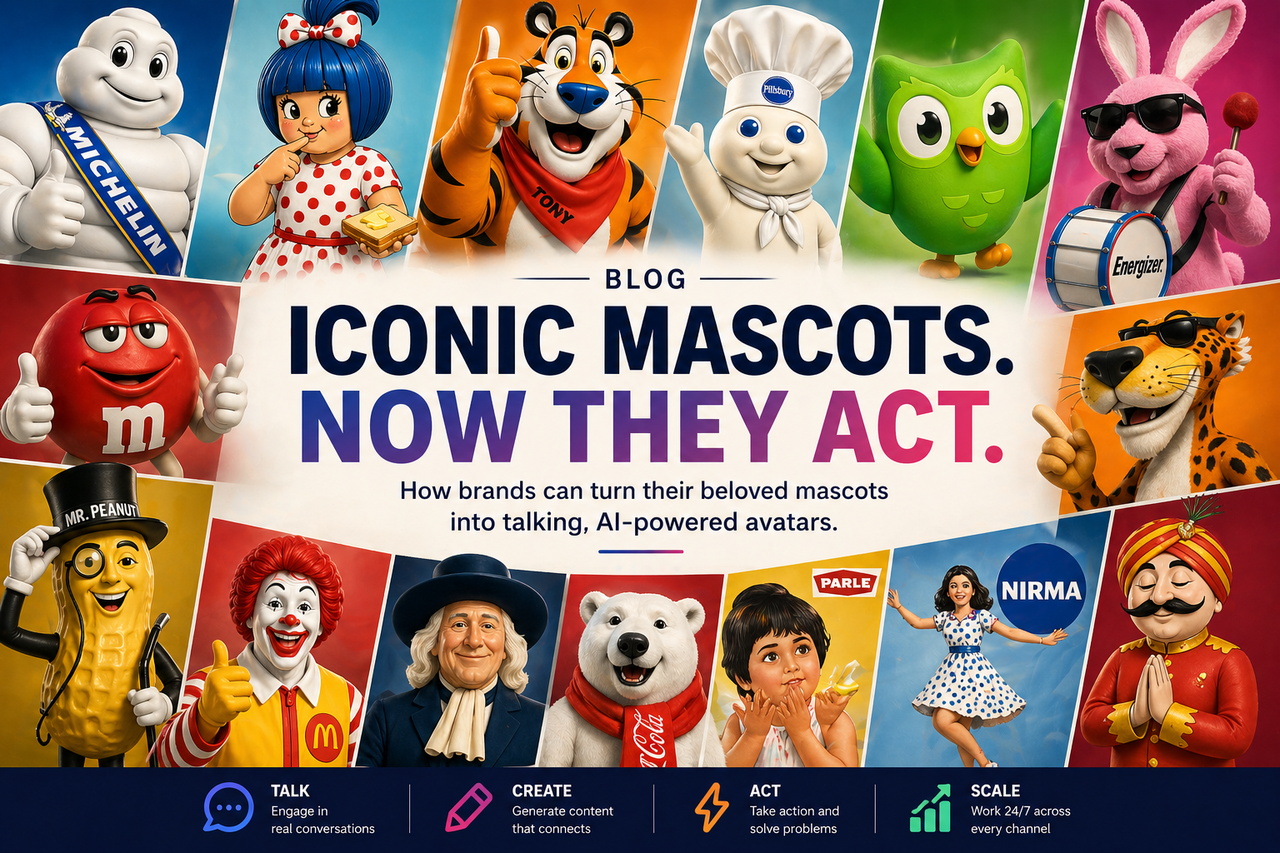
Ronald McDonald is one of the most recognised faces on earth; more so, in some studies, than most heads of state. The Michelin Man has been a brand asset since the nineteenth century. The Amul Girl has outlasted prime ministers, cricket captains, and three generations of advertising trends.
These are not mascots. They are institutions.
And yet, ask what they do on any given Tuesday; and the answer, for most brands, is nothing. They wait. They appear when summoned for a campaign, then disappear until the next brief. Characters with decades of built equity, sitting dormant between activations.
That is the strategic paradox at the heart of modern brand management: the most trusted, most recognised faces in your portfolio are also, structurally, the least utilised.
That's about to change. And the window to act is narrower than most CMOs realise.
The core problem with how we've thought about mascots
What's actually possible now
Until now, every digital brand touchpoint has been fundamentally the same thing: a document. A website is a document. An app is a set of documents. A chatbot is a document with a text box attached. The customer arrives, navigates the document, finds what they need — or doesn't — and leaves.
That model is ending.
What replaces it is something closer to a conversation with a person - except the person is Bibendum, the Michelin Man, rendered in real-time video, speaking in his voice, responding to what you actually said. Or the Amul Girl, animated and present, guiding a first-time customer through a product range with the wit and warmth that sixty years of brand-building created. Or the Air India Maharaja, finally fulfilling the promise of the character - a genuinely gracious, knowledgeable host, available to every customer, at any moment, on any device.
The mascot doesn't live on a page. The mascot is the page.
One interface. One character. Every brand interaction — handled through a single, continuous, living conversation. And concretely, this means a mascot can now do four things it has never been able to do before:
Generate content without a production cycle. Instead of campaign bursts, a mascot-as-agent produces continuously - twice/thrice daily social content, topical reactions to current events, video explainers tied to product moments. The Duolingo Owl already behaves like a personality with genuine cultural awareness; the next step is making that capability fully autonomous and brand-controlled, not gated by a social media manager's bandwidth or a six-week production schedule.
Engage in actual conversation. The mascot speaks. It listens. It responds — not from a script, but from genuine reasoning. It can reply to a comment, answer a product question, handle a complaint, or walk a first-time customer through a purchase. This transforms marketing from broadcast to dialogue, and gives the mascot the one thing static characters never had: a real relationship with actual customers, in real time, at scale.
Become the entire brand interface. No menus to navigate. No forms to fill. No hold music. The character knows who you are, what you've bought, what you're looking for — and guides you through it, face to face, the way a genuinely helpful person would. Book a table. Track an order. Understand a product. File a return. The mascot handles all of it, through natural conversation, entirely personalised, on a single page.
Compress timelines from weeks to minutes. When intent becomes output in minutes rather than weeks, a brand can participate in culture rather than react to it. The old flow — brief, agency, production, publish — measured in weeks and dependent on budget cycles. The new flow: intent, generation, publish. That compression is not just an efficiency gain. It is a fundamentally different competitive posture, and one that compounds over time.
What this adds up to is not an incremental improvement on digital customer experience. It is a different model entirely: the brand interface as a living character rather than a structured document. No website. No app. No navigation. Just the face of the brand — present, speaking, responding, acting — doing the job it was always designed for: building a relationship, one conversation at a time, at global scale.
Why this works: you've already done the hard part
Here's the strategic insight that gets overlooked in most conversations about AI and brand: the hardest thing about building a trusted AI agent isn't the technology. It's the trust.
People are skeptical of automated interactions. They want to know who they're talking to and whether that entity has their interests at heart. Established mascots have already solved this problem. They carry decades of positive association, emotional warmth, and cultural legitimacy. When you activate a well-loved mascot as an agent, you're not introducing something unfamiliar — you're extending something already loved.
That's a moat. And it's one that late movers cannot easily replicate.
The industries where this is most immediate
Fast-moving consumer goods. The mascot that once smiled from a packet now becomes a kitchen companion. It suggests recipes based on what's in your fridge, explains the difference between product variants, and shows up at the exact moment a shopper is deciding between your brand and a competitor's — not with an ad, but with a genuinely helpful conversation.
Travel and hospitality. This is perhaps the most natural fit of all. The Air India Maharaja was always conceived as a host — gracious, knowledgeable, attentive. An agentic Maharaja fulfils that promise for the first time: planning itineraries, handling rebookings, answering visa questions, and making a customer who has just missed a connection feel like someone is actually looking after them.
Financial services. Finance is an industry built on trust and paralysed by complexity. A familiar, warmly regarded character — one that explains a home loan in plain language, walks a first-time investor through a mutual fund, or flags an unusual transaction without triggering panic — removes the friction that causes customers to disengage entirely. Advice at scale, with a face people already trust.
Retail and e-commerce. The mascot becomes a personal shopper who actually knows you. It remembers your size, your past purchases, your preferences — and uses that knowledge to surface the right product at the right moment, not through an algorithm you can't see, but through a conversation that feels human. Returns, exchanges, and after-sale support handled the same way: by the character, not a ticket system.
EdTech and learning. A tutor with infinite patience and a consistent personality — one that adapts to how a student learns, celebrates progress in the brand's voice, and keeps showing up even when motivation dips. The mascot becomes the reason a learner comes back, not just the logo on the login screen.
Healthcare and wellness. Brands in this space carry an unusual responsibility: they need to be trusted before they can be useful. An established character — whether it's a pharmacy chain's mascot or a health insurer's brand figure — can guide patients through medication schedules, explain test results in plain language, and answer the anxious 2am question that would otherwise go to an unreliable search result.
Automotive. The car-buying journey is long, high-stakes, and riddled with moments where customers feel out of their depth. A brand mascot that walks someone through a configuration, explains financing options without the pressure of a showroom, and stays available through delivery and beyond transforms what has historically been a one-time transaction into an ongoing relationship.
Banking and fintech. Onboarding a new banking customer involves more friction than almost any other consumer experience. A recognisable brand character that guides someone through account setup, explains fee structures honestly, and checks in proactively when something looks unusual turns a compliance-heavy process into something that feels, remarkably, like service.
A word on what makes this work — and what doesn't
The technology layer is, in practice, four things working together: visual consistency (trained on existing mascot assets), voice synthesis (personality-driven, not robotic), LLM-based reasoning (for genuine conversation and content generation), and workflow orchestration (to actually execute actions, not just respond to prompts). None of these is exotic. All of them are production-ready today.
What does fail — consistently — is treating this as a tech project rather than a brand project. The brands that get this right spend as much time defining the mascot's personality, values, and conversational guardrails as they do on the infrastructure. A technically flawless agent that speaks out of character will do more damage than good.
Where to start: a framework for CMOs
The instinct, when a capability this significant becomes available, is to move fast and move big. Resist it. The brands that will get this wrong are the ones that treat it as a technology deployment. The brands that will get it right are the ones that treat it as a brand decision first — and build accordingly.
Start by auditing your mascot honestly. Not through the eyes of your marketing team, who are professionally obligated to believe in it, but through the eyes of a customer who hasn't thought about your brand since the last time they needed something from you. Does the character exist in their mind at all? Is it genuinely recognised — on the street, unprompted, without the logo next to it? Does it carry emotional weight, or is it simply a design asset that appears in brand guidelines and nowhere else? Most CMOs, if they answer honestly, will find that their mascot is significantly more recognised than it is loved, and significantly more loved than it is used. That gap is where the opportunity lives.
Then do the work most brands skip: define the personality, not just the design. A visual identity tells you what the mascot looks like. It tells you nothing about how it handles a frustrated customer at 11pm, what it refuses to say, how it navigates a sensitive topic, or what its sense of humour is in a culture it wasn't originally designed for. These are not soft questions. They are the questions that determine whether an agentic mascot builds trust at scale or quietly erodes it. Before any technology decision is made, a brand needs a personality brief as rigorous and considered as its visual identity guidelines — covering voice, values, boundaries, and behaviour across every scenario it is likely to encounter.
Build a proof of concept, not a transformation. The temptation at this stage is a full platform build - months of development, a large vendor contract, a board presentation about the future of the brand. That is almost always the wrong move. Start instead with a single, specific, real interaction: the mascot responding to a genuine customer question, in character, on video, in under three seconds. Nothing more. This single demonstration will do more to build internal alignment, surface creative gaps, and clarify what the character actually needs than any strategy document or roadmap. It also tends to be the moment the organisation stops debating whether this is possible and starts debating how far to take it.
Then expand from talking to doing — in deliberate layers. Once the character is stable and trusted internally, add capability incrementally: content generation first, then live customer engagement, then transactional workflows that let the mascot actually complete tasks on a customer's behalf. Each layer should be proven before the next is added, because each layer compounds the value of everything beneath it. A mascot that can generate content is useful. One that can generate content and hold a conversation is powerful. One that can generate content, hold a conversation, and complete a transaction is a fundamentally different kind of brand asset — one that is, at that point, genuinely difficult for a competitor to replicate quickly.
The competitive window is open — but it won't stay that way
Most marketing organizations are still thinking in the old unit of account: campaigns, creatives, channels. Very few are thinking in terms of persistent brand entities — characters that operate autonomously, build relationships at scale, and compound brand equity through every interaction.
That gap is the opportunity. The brands that move now will establish mascot-as-agent as a core capability before their competitors understand what's happening. The brands that wait will spend the next five years explaining to their boards why a competitor's character feels more alive than theirs.
For decades, brand mascots have reacted to culture — appearing when summoned, speaking when scripted, engaging when production allowed. The next generation of brand characters will participate in culture: always present, always engaging, always creating.
The question isn't whether your mascot can evolve into an agent. The question is whether your organization is ready to let it.