
Convexa: Conversational AI That Converts & Supports
Convexa: Conversational AI That Converts & Supports
Most businesses treat chat as a support tool. Convexa treats it as a revenue channel. This multimodal conversational AI agent — available in the Nagent Agent Marketplace — engages, qualifies, guides, and converts visitors across websites, mobile apps, and digital channels without adding headcount. It handles the full customer motion: first contact, needs discovery, objection handling, support resolution, and expansion triggers — in a single, always-on conversational layer.
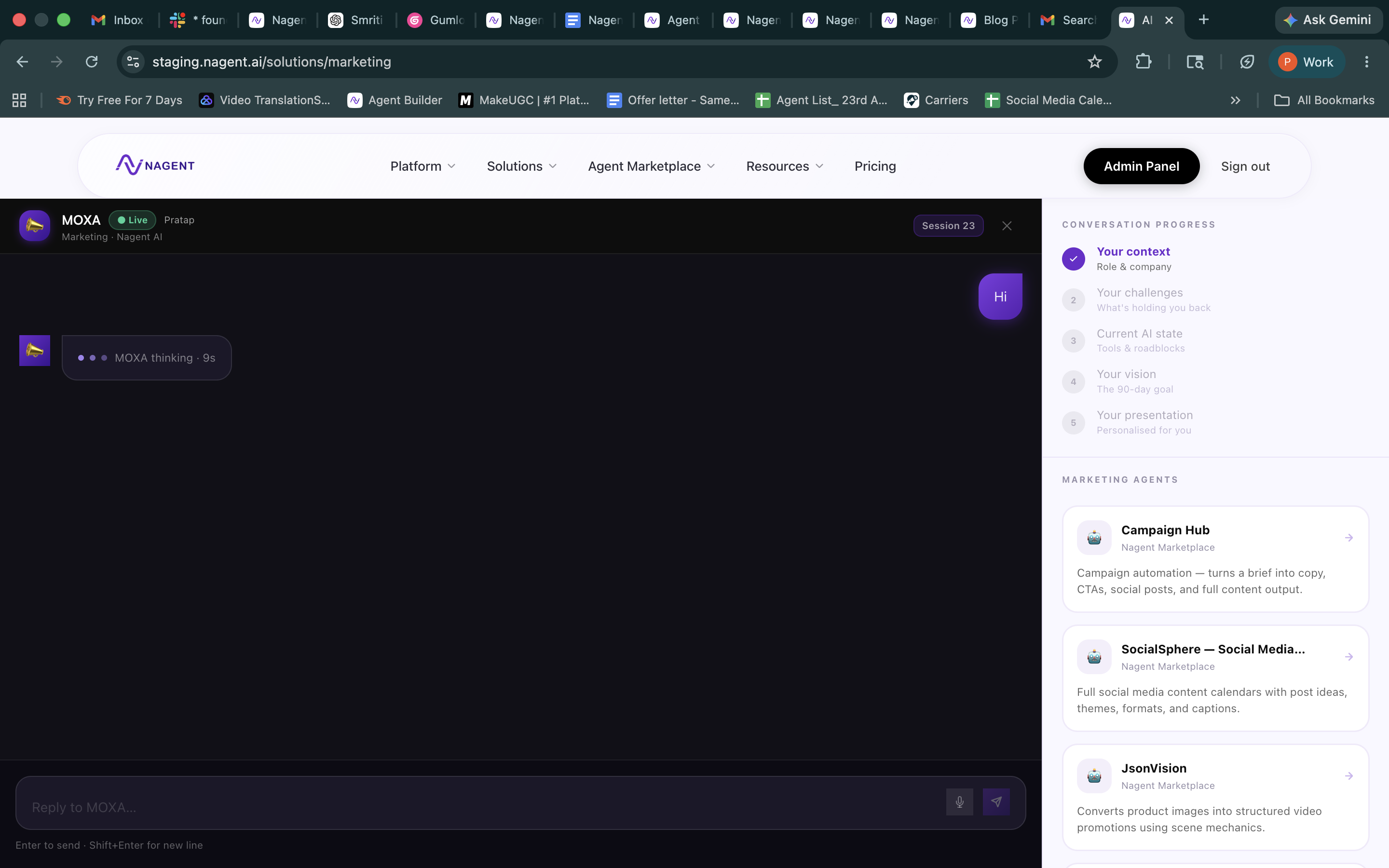
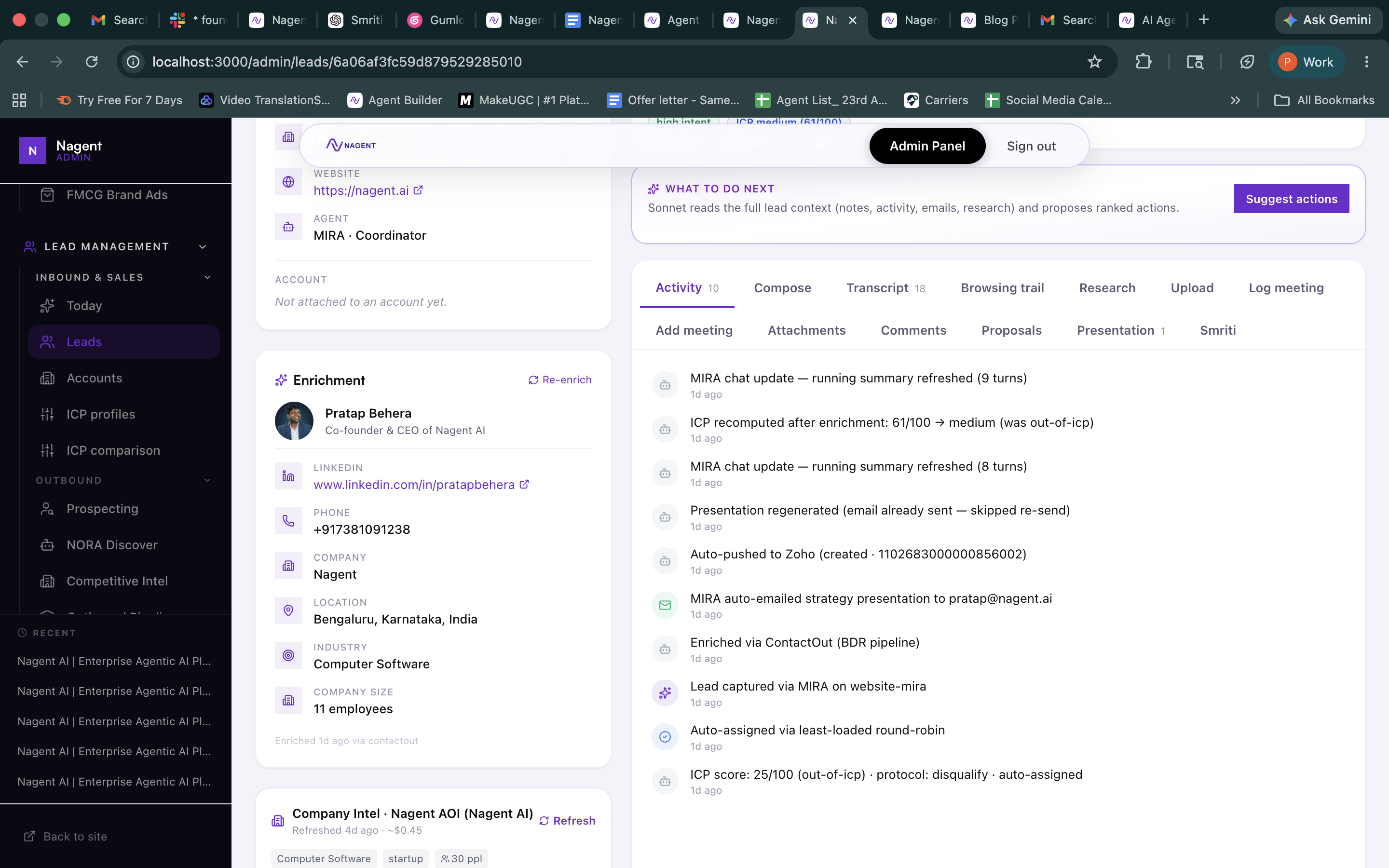
We at Nagent AI implemented Convexa for different use cases and are presently surprised by its activity to converse with customers, add leads into the CRM.
What problem does Convexa actually solve?
Most enterprise chat tools are glorified FAQ bots. They answer questions. They don't do anything.
The real problem isn't that customers can't find answers — it's that every unguided conversation is a lost conversion. A visitor who waits four minutes for a live agent has a 65% lower likelihood of converting (Drift, 2023). A support ticket that bounces three times costs 3× more to resolve than one handled on first contact.
Convexa closes that gap. It replaces the passive chat widget with an active, intelligent agent that reads context, takes action, and moves the customer forward — whether the goal is a booked demo, a resolved ticket, or an upsell.
We at Nagent AI solved this by equipping the agent with access to enterprise knowledge, sales decks, details about product & services etc. Now the agent qualifies the lead while conversing with the customers.
"The cost of a bad first conversation isn't just one lost sale. It's the referral that never happened, the renewal that slipped, and the competitor who answered faster."
What does Convexa actually automate?
Convexa automates the full conversational funnel — from first touch to conversion and post-sale support — without human intervention at each step.
Inbound qualification and routing
A prospect lands on your pricing page at 11 PM. Convexa reads the page context, identifies intent, asks two qualifying questions, scores the lead, and routes a hot lead to a booked calendar slot — all before your SDR opens their laptop the next morning. No generic "How can I help?" No 48-hour response window.
Guided product discovery
In D2C and e-commerce, Convexa acts as a personal shopping adviser. It asks about use case, budget, and preference, then recommends the right product variant, surfaces relevant reviews, and handles objections on price or delivery. Retailers using guided-conversation flows report 20–35% higher average order values (industry benchmarks; outcomes vary).
Support resolution without tickets
Convexa handles tier-1 and tier-2 support natively. It parses the issue, checks order or account status via integrated data sources, executes resolution steps — refund initiation, password reset, plan upgrade — and closes the loop. Only genuinely complex cases escalate to a human agent, with full context already attached.
Churn and expansion signals
In B2B SaaS and BFSI, Convexa monitors conversation patterns for churn signals — repeated complaints, pricing questions, feature gaps — and triggers expansion or retention workflows automatically. This is where conversational AI stops being a cost centre and starts being a revenue signal.
Who deploys Convexa — and why?
Convexa is built for mid-market and enterprise teams where volume, speed, and channel consistency are non-negotiable.
TeamPrimary useCore outcomeB2B SaaSInbound qualification + demo bookingMore pipeline, same SDR headcountBFSILoan/account enquiries + compliance-safe responsesFaster resolution, lower compliance riskE-commerce / D2CProduct discovery + cart recoveryHigher conversion rate, lower abandon rateHealthcarePatient intake + appointment schedulingReduced admin load, faster patient responseRetail / FMCGPost-purchase support + loyalty engagementRepeat purchase rate improvementCustomer SuccessHealth monitoring + proactive outreachEarlier churn signals, higher NRR
The common thread: high inbound volume, inconsistent human coverage, and a measurable cost attached to every slow or failed conversation.
How does Convexa integrate with existing systems?
Convexa connects natively to the tools your team already runs — no rip-and-replace required.
Nagent's integration ecosystem includes direct connectors to Salesforce, HubSpot, Zoho CRM, Shopify, Stripe, Twilio, SendGrid, Google Workspace, and Microsoft 365. Convexa plugs into these via Nagent's BuildCraft low-code flow editor or directly through the REST API.
In practice:
CRM sync: every conversation, qualification score, and outcome writes back to Salesforce or HubSpot in real time
Order and account lookup: Convexa queries your database mid-conversation to give personalised, accurate answers — not canned scripts
Escalation with context: when a conversation exceeds Convexa's scope, it hands off to a human agent with a full transcript, sentiment score, and recommended next step
Cross-channel continuity: Agent Smriti — Nagent's cross-session memory layer — means Convexa remembers the customer from their last website visit, support ticket, or email thread
That last point matters more than most teams realise. Stateless chatbots force customers to repeat themselves. Customers who repeat themselves churn.
What makes Convexa different from a standard chatbot?
Standard chatbots follow scripts. Convexa reads context and makes decisions.
The distinction is architectural, not cosmetic. Most chat tools are rule-based: if user says X, respond with Y. They break the moment a customer deviates from the expected path — which is most of the time.
Convexa is built on three Nagent-native capabilities:
KARMIC continuous learning: every conversation produces a labelled outcome — converted, resolved, escalated, abandoned. KARMIC feeds those signals back into Convexa's decision policy automatically, so the agent improves over time without a retraining project.
Agent Smriti memory: Convexa retains context across sessions, channels, and users. A customer who raised a billing issue last Tuesday gets a different opening than a first-time visitor. That personalisation drives resolution speed and conversion rates.
Helix multi-agent orchestration: when a conversation triggers a downstream workflow — send a follow-up email, update the CRM, flag a churn risk, book a calendar slot — Helix routes the action to the right agent. The customer sees one seamless conversation; behind it, multiple agents are executing.
This is the gap between a chatbot and an agentic conversational AI. One answers. The other acts.
What does a real Convexa deployment look like?
A mid-market FinTech company deploys Convexa across its loan application flow. Previously, the process took five days — a mix of form submissions, email follow-ups, document requests, and manual credit checks.
With Convexa handling intake, document collection, and status updates:
Loan processing time dropped from five days to under four minutes for standard applications
Inbound support tickets on application status fell by over 60%
The operations team redirected 40% of manual review hours to exceptions only
These outcomes come from Nagent's Agentic AI Lab observations across FinTech deployments. Exact numbers vary — but the pattern is consistent: automate the conversation layer and downstream operations compress dramatically.
When should you deploy Convexa first?
Deploy Convexa first when inbound volume is high, conversion or resolution rates are low, and human coverage is inconsistent.
Three signals that you're ready:
Your live chat response time exceeds two minutes on average
More than 20% of inbound leads never receive a follow-up
Your support team spends more than 30% of its time on tier-1 queries with the same answer every time
If any two apply, Convexa will return measurable impact within the first 30 days. Start with one channel — your highest-traffic web page or primary support inbox. Let Convexa run for two weeks; KARMIC will have already learned from the first 200 conversations. Then expand.
Related reading
Frequently Asked Questions
What is Convexa and what does it do?
Convexa is a multimodal conversational AI agent in the Nagent Marketplace. It engages, qualifies, supports, and converts customers across websites, mobile apps, and digital channels without a human in the loop. It handles inbound qualification, product discovery, support resolution, and churn or expansion signalling in a single agent.
How is Convexa different from a standard chatbot?
Standard chatbots follow fixed scripts and break when customers deviate. Convexa uses Nagent's KARMIC learning loop to improve from every conversation, Agent Smriti to retain cross-session memory, and Helix to trigger downstream workflows. It doesn't just answer — it acts on the outcome.
What systems does Convexa integrate with?
Convexa connects natively to Salesforce, HubSpot, Zoho CRM, Shopify, Stripe, Twilio, SendGrid, Google Workspace, and Microsoft 365, among others. It also exposes a REST API for custom integrations. Every conversation outcome syncs back to your CRM in real time.
How long does it take to deploy Convexa?
Most teams deploy their first Convexa instance in under two hours using Nagent's pre-built agent configuration. Helix handles orchestration setup; BuildCraft handles custom integration flows. No engineering sprint required.
Which industries get the most value from Convexa?
Convexa sees strongest adoption in B2B SaaS, BFSI, e-commerce, D2C, healthcare, and retail — any sector where inbound volume is high and the cost of a slow or failed conversation is measurable. It is particularly impactful in regulated industries where compliance-safe, consistent responses matter.
What's next
See exactly what Convexa automates — and how it fits your stack — on the Convexa agent page in the Nagent Marketplace. Or book a 30-minute demo and we'll map the conversational workflows your team should automate first.