
Bank Marketing Localization AI: From 6 Weeks to 2 Days

Bank Marketing Localization AI: From 6 Weeks to 2 Days
Bank marketing campaign localization AI cuts a six-week product launch cycle to days. When a bank launches a new savings account or credit card, the messaging can't be generic, every region needs adapted copy, local regulatory disclosures, and language variants that resonate with the community. Agentic workflows now handle this end-to-end: researching regional compliance requirements, generating localized copy, flagging disclosure gaps, and routing drafts for approval, without a team of 12 coordinators burning six weeks on version control.
Why Does Product Launch Localization Take So Long at Banks?

The six-week cycle isn't a people problem, it's a workflow architecture problem.
A typical bank launching a new credit card across 18 regional branches runs a sequential process. Legal drafts the master disclosure. Compliance reviews it. Regional marketing managers request language edits. Translators produce variants. Compliance reviews again. Then someone realizes the Tamil Nadu variant missed a Reserve Bank of India disclosure requirement added in Q3.
Start over.
The bottlenecks compound because:
Regulatory requirements differ by state, language, and product type: and they change quarterly
Translation is treated as a final step, not a parallel workstream
Version control is manual: spreadsheets, email chains, shared drives
Approval loops are sequential, not concurrent
The result: product marketing managers spend more time managing the process than shaping the message. Campaign managers wait for assets that arrive after the launch window closes.
What Does an Agentic Localization Workflow Actually Look Like?
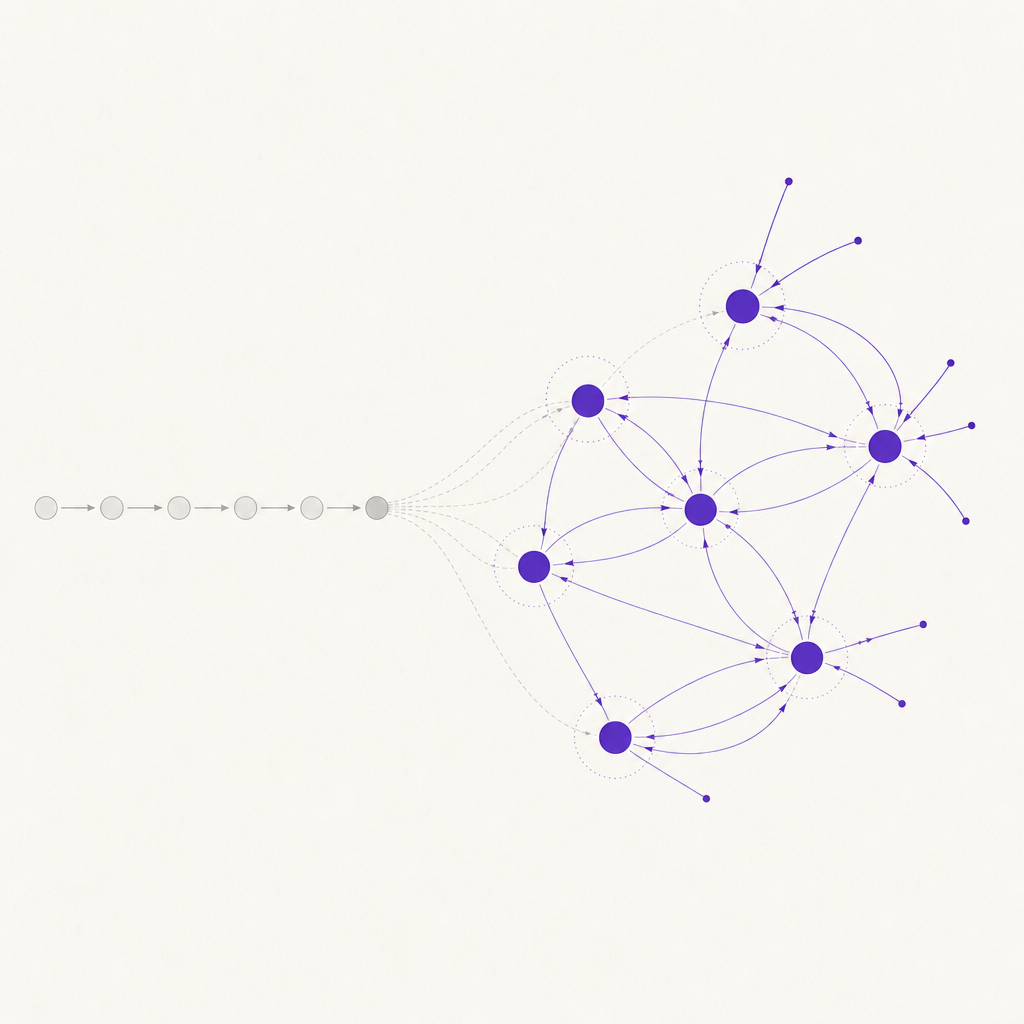
An agentic workflow replaces the sequential chain with a parallel, self-coordinating system.
Here's what the architecture looks like in practice for a bank launching a new fixed-deposit product across six regional markets:
Step 1: Brief ingestion
The campaign manager submits one master brief: product name, key features, target segment, launch date, and the markets in scope.
Step 2: Regulatory research (automated)
An agent queries the current disclosure requirements for each market. For a bank operating in India, this means pulling RBI circulars, state-level consumer protection rules, and language mandates. The agent surfaces gaps between the master copy and each market's requirements, before a human touches a keyboard.
Step 3: Parallel copy generation
Localized variants are generated simultaneously across all markets, not sequentially. Each variant is anchored to the master brief but adapted for regional tone, language, and the specific disclosures flagged in Step 2.
Step 4: Compliance flagging
A validation agent cross-checks every variant against the disclosure checklist. It marks each line item: compliant, missing, or needs human review. Only the flagged items go to the legal team.
Step 5: Approval routing
Drafts route to regional managers and legal reviewers in parallel. Feedback triggers an automated revision cycle. Approved variants are formatted for each channel, branch poster, digital banner, SMS, in-app notification.
The entire sequence runs in 2-4 days. Not six weeks.
How Do AI Agents Handle Regulatory Compliance Without Cutting Corners?

Compliance isn't bypassed, it's restructured so humans review decisions, not documents.
This is the question every compliance officer asks, and it deserves a direct answer. Agentic workflows don't remove human oversight. They remove the manual assembly work that surrounds human oversight.
The distinction matters. In a traditional cycle, a compliance officer reviews 47 pages of regional copy variants, most of which are identical except for the language. In an agentic workflow, the compliance officer reviews a structured exception report: three flagged items across six markets, each with the specific clause, the regulatory reference, and a suggested fix.
That's a 90-minute review replacing a three-day review.
On Nagent this gets better over time. Every compliance decision (approved, rejected or revised) is recorded against the draft it was made on, so the team can see which categories keep coming back and tighten the checklist. The compliance team stops reviewing the same categories of errors repeatedly.
Which Nagent AI Teammates Power a Bank Localization Stack?
On Nagent, a chief of staff runs the work and hands each piece to the teammate who owns it.
MIRA, the AI chief of staff for Marketing, takes the master brief (product name, features, target segment and regional markets), plans the launch and routes each piece of work to its owner, so the campaign manager tracks one plan instead of 18 threads.
CREA's Content team handles the copy and tone adaptation layer: variants for branch collateral, e-mail, SMS and landing pages, written from your own Knowledge Hub and brand, and published only when a person approves.
For paid social, HOOK (Beta) turns the brief into angles, hooks and scripts and checks every claim against your proof, which matters when every claim in a bank ad is a disclosure risk. HOOK never changes live ads.
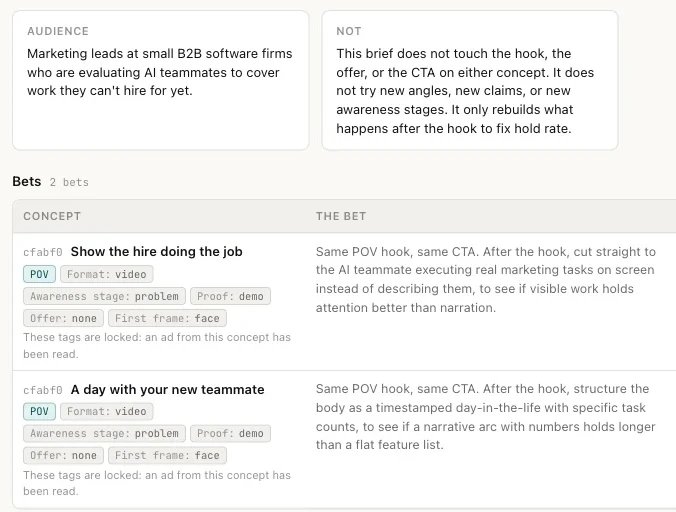
A HOOK creative brief, with the audience and what it will not touch.
Every step runs on the control plane: proposed, approved, run and audited. The compliance flagging loop and the approval routing are part of the plan, and nothing goes live until the right person approves it.
The Knowledge Hub holds the bank's approved claims, disclosure checklists and past campaigns, so the messaging angle that drove deposit signups in one region last quarter is in front of the team when the next campaign targets a similar segment. Nobody starts from zero.
What Does the Before-and-After Look Like for a Campaign Manager?
The job changes from coordinator to strategist.
Before agentic localization:
| Task | Time |
|---|---|
| Brief distribution to regional teams | 2 days |
| Regional copy drafting | 10 days |
| Translation | 7 days |
| Compliance review (sequential) | 8 days |
| Revision cycles | 6 days |
| Final formatting per channel | 3 days |
| Total | ~36 days |
After agentic localization:
| Task | Time |
|---|---|
| Brief submission (one master) | 2 hours |
| Parallel copy + disclosure generation | 6 hours |
| Compliance exception review | 4 hours |
| Regional manager sign-off (parallel) | 1 day |
| Channel formatting (automated) | 2 hours |
| Total | 2-3 days |
The campaign manager's role shifts. Instead of tracking 18 regional email threads, they're reviewing a structured dashboard of exceptions and approvals. Instead of chasing translators, they're pressure-testing the messaging strategy.
That's not a marginal efficiency gain. That's a structural change in what the job is.
Is This Approach Viable for Banks With Legacy Infrastructure?
Yes, because the agents work alongside existing systems, not instead of them.
This is the practical objection that surfaces in every enterprise conversation. Banks run core banking on systems that predate the iPhone. Campaign managers work in tools their IT department approved in 2014.
Nagent's AI teammates work with the systems already in use, including Google Workspace, Microsoft 365, Salesforce and HubSpot. For custom CRM or campaign infrastructure, ask for the integration map for your stack; there is no rip-and-replace project.
For regulated industries that need data to stay in their own environment, Nagent's Enterprise plan runs in a private VPC, with your own model and key, so customer data, campaign content and disclosure documents stay inside the bank's environment.
The deployment model is also incremental. A bank doesn't need to automate the entire localization chain on day one. Start with one product, one market cluster, one agent. Measure the cycle time reduction. Expand from there.
Related Reading
Frequently Asked Questions
How does bank marketing campaign localization AI handle regulatory compliance?
Agentic localization workflows don't remove compliance review; they restructure it. Agents research current disclosure requirements per market, flag gaps in generated copy and surface only the exceptions that need human judgment. Compliance officers review a structured exception report rather than 40+ pages of full copy variants. On Nagent every decision is recorded, so the checklist gets sharper across campaigns, and nothing goes live without approval.
How long does it take to deploy an agentic localization workflow at a bank?
Start with one product and one market cluster. On Nagent you brief MIRA with the launch, connect the tools the team already uses and set who approves what. A full localization flow across regions takes longer to configure, depending on how many markets and approvers are in scope, and a private VPC on the Enterprise plan adds implementation time.
Can agentic workflows handle multiple languages simultaneously?
Yes. Unlike sequential translation workflows, agentic systems generate all language variants in parallel from a single master brief. Each variant is independently checked against its market's disclosure requirements. The system handles simultaneous generation across languages without a linear time cost, which is the primary driver of cycle time compression.
What happens when regulations change mid-campaign?
The disclosure checklist used for each campaign sits in the Knowledge Hub. When a regulatory update is logged, the check can be re-run against active campaigns to surface variants that now need revision, which beats a manual process where a mid-cycle change typically triggers a full restart.
Is Nagent compliant with banking data security requirements?
Nagent is ISO/IEC 27001:2022 certified; SOC 2 Type II programme underway; tenant isolation, RBAC, append-only audit and private VPC available today. On the Enterprise plan, AI teammates can run inside the bank's own private VPC, with your own model and key.
What's Next
If your team still runs a six-week localization cycle for every product launch, the gap is worth closing. Book a demo to see how MIRA, CREA and the approval flow would run a multi-region launch.
Sources
AI ranking optimisation _(pdf)_
The Agentic FMCG Playbook _(pdf)_