AI UGC vs Creator Agencies: The ROAS Case for CROs
AI UGC vs Creator Agencies: The ROAS Case for CROs
AI UGC consistently outperforms creator agency retainers on three dimensions that matter to revenue: speed, volume, and iteration velocity. A brand running paid social at scale needs 50–100 creative variants tested per month. Creator agencies deliver 8–12. That gap costs you ROAS. Replacing — or significantly supplementing — your agency retainer with an AI UGC agent is not a creative decision. It is a revenue decision.
Why is creative velocity the real ROAS lever in paid social?
Creative fatigue kills ROAS faster than audience targeting errors.
Meta's own performance data shows ad frequency above 3.5 causes CPMs to spike and CTR to collapse — often within 10–14 days of a campaign launch. The fix is not a bigger budget. It is more creative variants, refreshed faster. Most CROs know this. Most still fund agency retainers that structurally cannot keep pace.
A typical creator agency retainer at $15K–$40K/month produces:
- 8–12 final assets per month
- 3–5 week lead time from brief to delivery
- 2–3 revision rounds baked into the timeline
That math does not work for a paid social program spending $500K+ annually. You are paying for exclusivity and craft. You are not paying for volume or speed.
The CRO's job is to connect creative investment to revenue outcomes. When creative is the constraint on iteration, it becomes the constraint on growth.
What does ai ugc vs creator agency actually look like in production?
The comparison is not about quality — it is about throughput and cost-per-learning.
Here is what the production reality looks like side by side:
| Metric | Creator Agency | AI UGC Agent |
|---|---|---|
| Assets per month | 8–12 | 80–150+ |
| Brief-to-launch time | 3–5 weeks | 20–60 minutes |
| Cost per creative | $800–$2,500 | $15–$40 |
| Revision cycles | 6–8 rounds | 1–2 internal reviews |
| A/B variant coverage | Low | High |
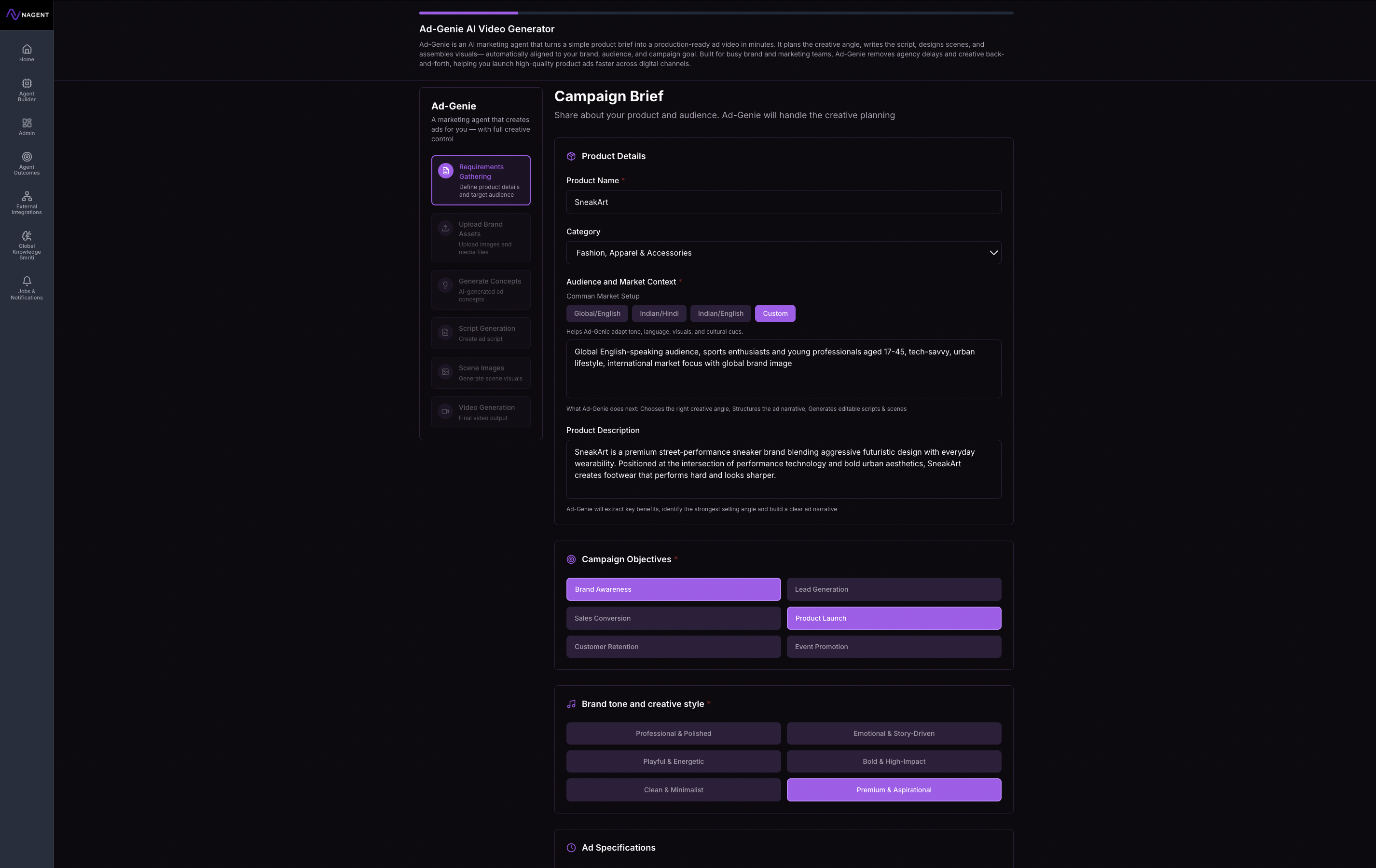
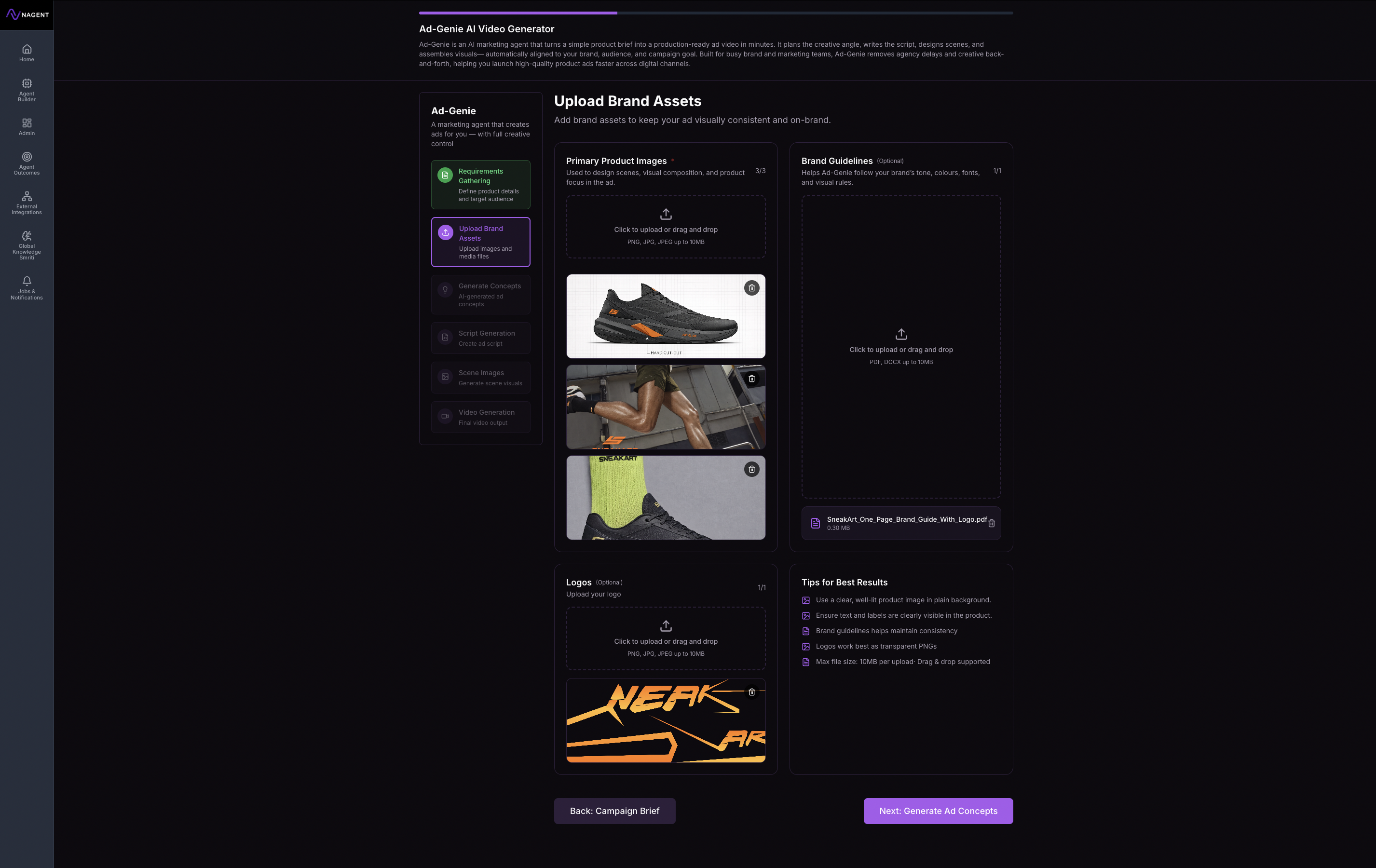
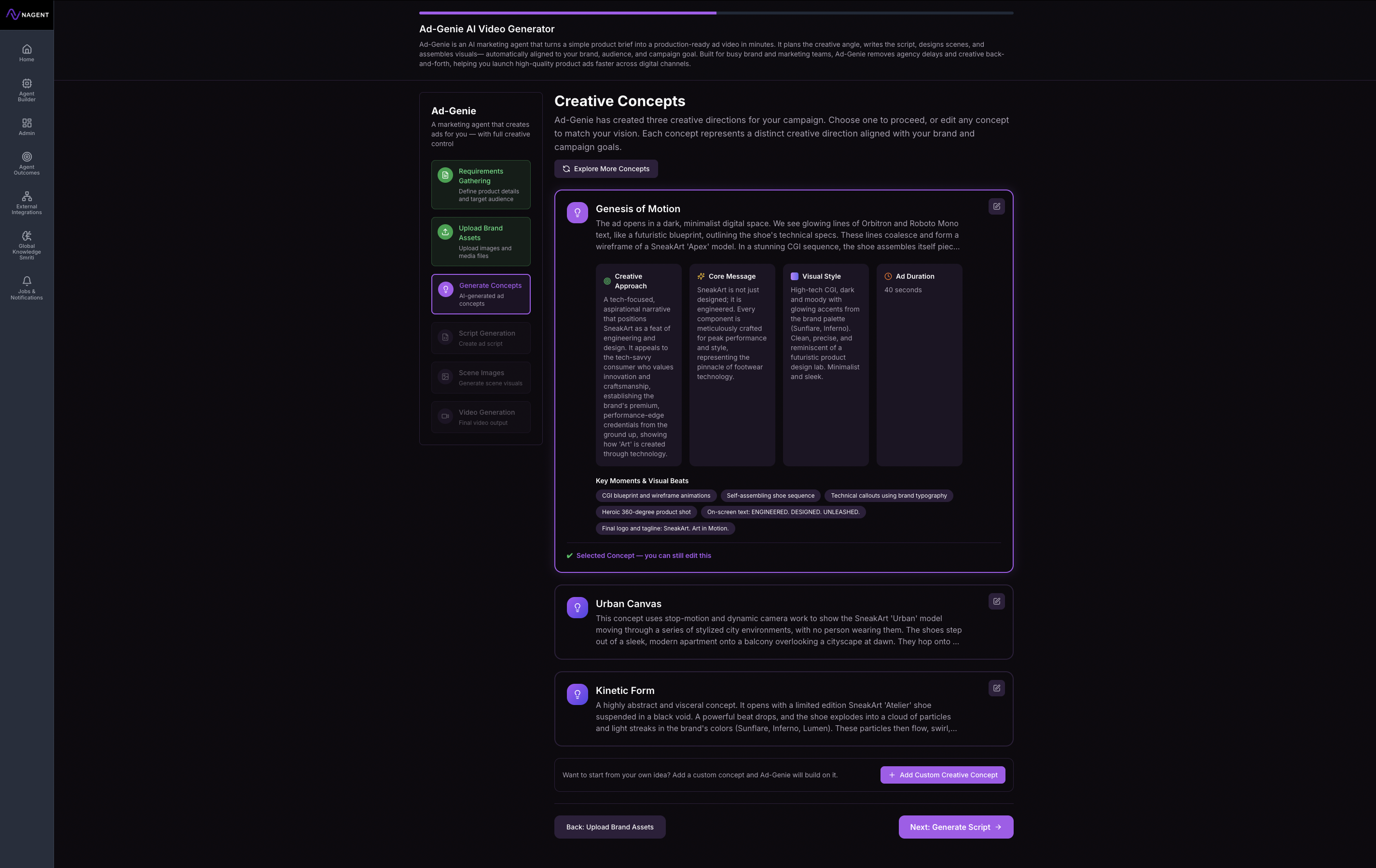
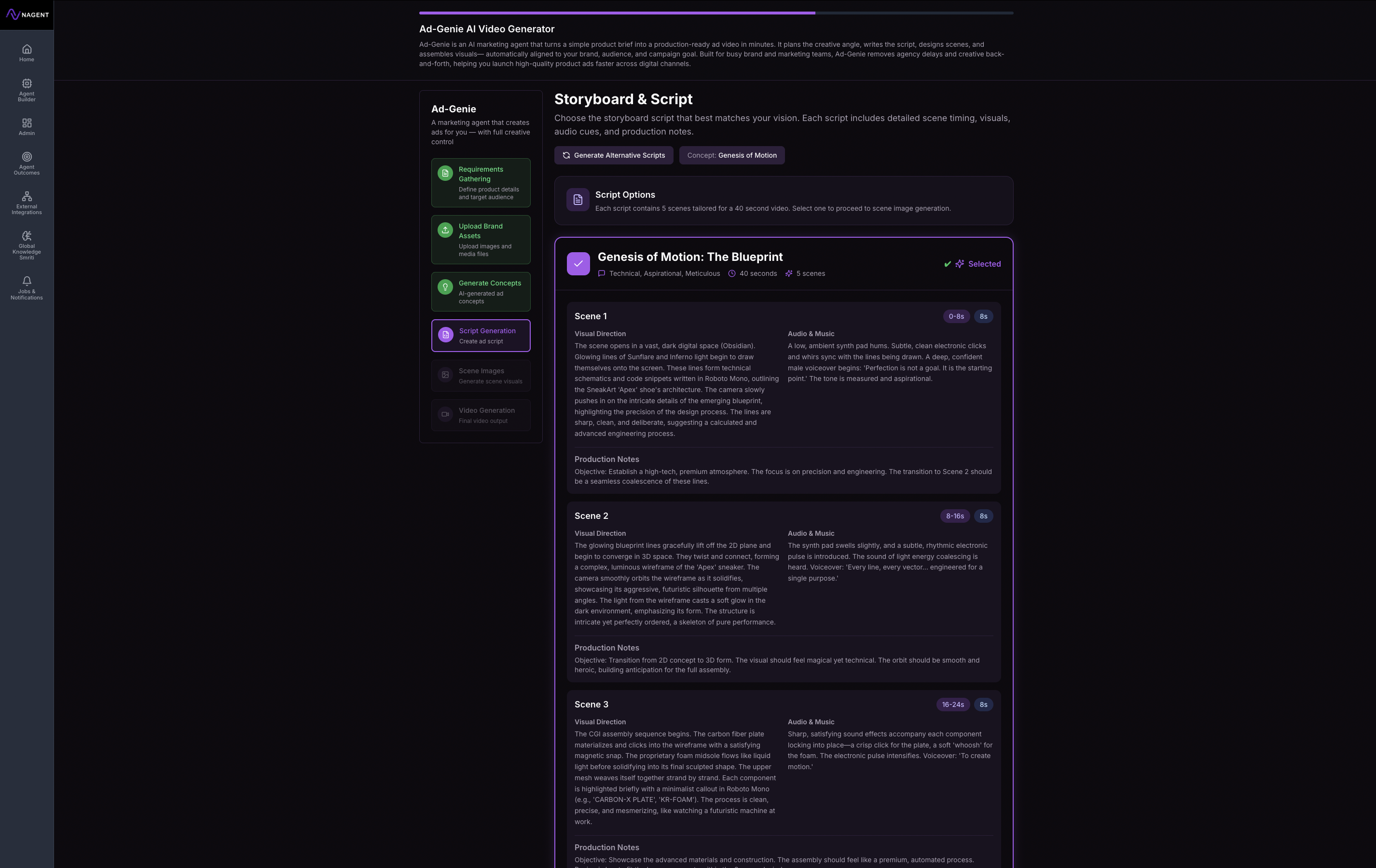
These are not theoretical projections. Nagent's Ad-Genie — a video ad production agent — generates 9 creative variations per brief. A single brief that previously consumed three weeks of agency time now produces a full test matrix in under an hour.
For a CRO managing a $500K annual paid social budget, that compression changes the entire economics of creative testing.
How does faster iteration directly compound ROAS?
Each creative test is a data point. More tests per month means faster signal accumulation.
A brand running 10 creative tests per month needs roughly 6 months to identify a winning creative formula. A brand running 80 tests per month reaches the same statistical confidence in 3–4 weeks. That is not a marginal improvement. That is a structural advantage.
The compounding math works like this:
- More variants → more signals per dollar spent
- Faster signals → faster reallocation to winning creatives
- Faster reallocation → lower blended CPA across the account
- Lower CPA → higher ROAS at the same budget
Teams in this position typically see 2–3× more pipeline with the same headcount once the creative bottleneck is removed. The constraint was never the media budget. It was the creative supply chain.
What is the actual cost-per-creative reduction a CRO should model?
The unit economics shift is significant enough to fund meaningful reinvestment.
Model it this way. A $25K/month agency retainer producing 10 assets equals $2,500 per creative. An AI UGC agent producing 100 assets per month at comparable platform costs equals roughly $15–$40 per creative — a reduction of 95–98% on a per-asset basis.
That delta does not disappear. It redeploys.
Smart CROs are using the freed budget in three ways:
- Reinvesting in media spend — more budget behind proven winners
- Funding creative strategy — keeping one senior creative director in-house to brief and QA the agent output
- Expanding into new formats — Reels, Shorts, carousel, static — without proportional cost increases
UGC Muse, Nagent's short-form video scriptwriting agent, handles the retention-focused hook writing that typically consumes the most senior creative time. It produces TikTok, Reels, and Shorts scripts with platform-native pacing — freeing your human creative talent to focus on strategy, not execution.
The CRO's model should not ask "can AI UGC replace agencies?" It should ask "what is the revenue opportunity cost of keeping a retainer that caps us at 10 creatives per month?"
When does ai ugc vs creator agency become a false choice?
The sharpest revenue operators are not choosing one or the other — they are restructuring the model.
Creator agencies have genuine strengths: authentic talent relationships, cultural fluency, and the ability to produce hero content that earns organic reach. That work has a place. The mistake is using agency retainers to produce the volume content that paid social requires.
The model that wins looks like this:
- Agency or in-house creators → 2–4 hero assets per month. Brand-defining. High production value. Earned media potential.
- AI UGC agents → 80–150 performance variants per month. Test-and-learn fuel. Paid social inventory.
This is not a cost-cutting exercise. It is a capacity expansion. The agency relationship gets better when it is no longer responsible for volume it cannot sustainably produce.
Campaign Hub handles the brief-to-creative pipeline for performance variants — taking a basic campaign brief and producing brand-aligned copy, CTAs, and static creatives at scale. No detailed prompting required. The creative director sets the brief. The agent handles the execution.
How does Nagent's KARMIC loop improve creative performance over time?
Most AI tools produce output and stop. Nagent's KARMIC learning loop closes the feedback cycle.
Every creative run produces a labeled outcome — clicked, converted, skipped, errored. KARMIC feeds those signals back into the agent's decision policy. Over 4–8 weeks, the agent's output aligns to what actually converts for your specific audience, offer, and platform — without a retraining project or a prompt engineering sprint.
This is the mechanism that separates an AI UGC agent from a one-shot generation tool. The system gets smarter with your data, on your timeline.
Agent Smriti — Nagent's cross-session memory layer — means the agent remembers what worked for your Q4 campaign when you brief Q1. It does not start from zero. It starts from your accumulated performance history.
That compounding effect is what makes the ai ugc vs creator agency comparison increasingly asymmetric over time. The agency resets every brief. The agent builds on every result.
What should a CRO do in the next 30 days?
The move is not to fire your agency. The move is to run a parallel test.
Here is a practical 30-day pilot structure:
- Week 1: Brief an AI UGC agent on your top 3 performing offers. Generate 30 variants.
- Week 2: Launch the AI variants alongside your current agency creative in a split test. Match spend.
- Week 3–4: Measure CTR, CPA, and creative fatigue rate (frequency vs. CTR curve).
- Day 30: Compare cost-per-learning between the two tracks.
The output of that test is not a creative opinion. It is a revenue data point. And revenue data points are what CROs use to make allocation decisions.
Nagent's Offer Variation Agent generates dozens of distinct creative angles for a single marketing offer — purpose-built for A/B testing at this scale. It produces headline, body copy, and CTA variants in a structured output ready for your media team to activate.
Start there. The data will make the case better than any retainer review ever could.
Related reading
- Why GTM Agents Are Collapsing the SDR Org
- AI Restructuring Marketing Content Operations
- Product Ad Creative Generator Agent: Scaling Ads From Few Winners to Infinite Performers
- Self-Correcting FMCG Marketing Workflows
Frequently Asked Questions
Does AI UGC actually match the quality of creator agency output?
For performance creative — the variants that run in paid social rotation — AI UGC agents match or exceed agency output on the metrics that matter: CTR, CPA, and creative fatigue rate. Hero content and brand-defining campaigns still benefit from human creative direction. The strongest brands use AI for volume and agencies for flagship work.
How long does it take to deploy an AI UGC agent on Nagent?
Most teams deploy their first agent within 2 hours using Nagent's pre-built marketplace agents. Ad-Genie and UGC Muse require a campaign brief and brand guidelines — no code, no prompt engineering, no implementation project. The first batch of creative variants is typically ready within the same session.
What happens to the agency retainer budget when you shift to AI UGC?
The per-creative cost drops from $800–$2,500 per asset to $15–$40 per asset at AI UGC scale. Most CROs redeploy that delta into media spend, in-house creative strategy, or format expansion — rather than taking it as a cost saving. The goal is more revenue, not a smaller budget.
How does Nagent's KARMIC loop improve creative output over time?
KARMIC captures the outcome of every agent action — clicked, converted, skipped — and feeds those signals back into the agent's decision policy automatically. Over 4–8 weeks, creative output aligns to what converts for your specific audience without any manual retraining. The longer the agent runs, the more precisely it matches your performance data.
Is this approach compliant with platform policies on AI-generated creative?
Meta, TikTok, and Google currently require disclosure of AI-generated content in specific ad formats (primarily political). For standard performance creative — product ads, UGC-style video scripts, offer variants — AI-generated content is permitted under current platform policies. Always verify against the latest platform guidelines before launching, as policies in this area are evolving.
What's next
See how fast your first AI UGC creative batch can move from brief to launch — book a free 30-minute demo at nagent.ai and we will walk through a live build with your offer and audience.
Sources
- Browser Tool _(product doc)_
- CommCare _(product doc)_
- Elasticsearch _(product doc)_