
How AI Is Restructuring Marketing Content Operations

How AI Is Restructuring Marketing Content Operations
AI isn't just accelerating marketing content development, it's restructuring who owns it, how fast it moves, and what "good" looks like. The teams winning right now aren't using AI to write faster. They're using it to run parallel creative operations that would have required three agencies and six weeks twelve months ago. The old model of brief → agency → review → revision is breaking. Here's what's replacing it.
Is AI actually changing marketing content, or just speeding up the same process?
AI is changing the process itself, not just the pace.
Most B2B marketing leaders frame AI as a productivity tool, faster copy, cheaper assets, less time in Canva. That framing is understandable, and it's exactly why most AI content programmes plateau after 90 days.
The real shift is structural. AI makes it economically viable to run 50 creative variations where you previously ran 5. It makes daily content calendars executable by a team of two. It makes high-quality product visuals achievable without a studio booking. When the cost of a creative unit drops by 80%, you don't just do the same thing faster, you do fundamentally different things.
What does the old model actually cost you?
The traditional content pipeline has three failure modes most marketing leaders have learned to live with.
Failure mode 1: Cycle time kills relevance.
A six-week agency cycle means you're responding to market signals from last quarter. In performance marketing, that's not a minor inefficiency, it's a structural disadvantage.
Failure mode 2: Volume constraints force false choices.
When one campaign costs $15,000 and six weeks, you make bets. You pick one audience, one message, one format. You don't test. You hope. When it underperforms, you don't have the data to know why.
Failure mode 3: Creative and performance data live in separate systems.
Your performance team sees what's working. Your creative team is already three briefs deep on the next campaign. The feedback loop is broken by design.
These are structural problems, not process problems. Better briefs, faster approvals, and more Slack channels don't fix structural problems.
How are AI agents actually restructuring the content development workflow?
AI agents replace handoffs, not headcount.
The most effective AI-native content operations aren't built around a single writing tool. They're built around a coordinated set of agents, each owning a specific node in the workflow.
Here's what that looks like in practice:
Strategy and planning. MIRA, the AI chief of staff for Marketing, turns the goal into a content plan with themes, formats and owners, and hands each piece to the teammate who owns it. A strategist reviews and approves the plan instead of building it from scratch.
Campaign brief to copy. CREA's Content team turns a brief into brand-aligned copy and CTAs written from your own Knowledge Hub, and nothing is published until a person approves it.
Angles and copy variation. HOOK (Beta), the AI creative strategy lead for paid social, turns one offer into distinct angles, hooks and scripts, and checks every claim against your proof.
Visual production. RUPA, the AI image teammate, renders product shots, ad stills and social images to a preset with your brand guidelines attached.
Short-form video. Alpha, the AI video teammate, plans video ads and UGC-style videos to a preset, quotes them before anything renders and waits for storyboard approval.
Each teammate owns one part of the work, and they share one context in the team room. Together, they cover work that previously needed a strategist, a copywriter, a designer, a video editor and a project manager, plus three rounds of agency review. People still approve what goes live.
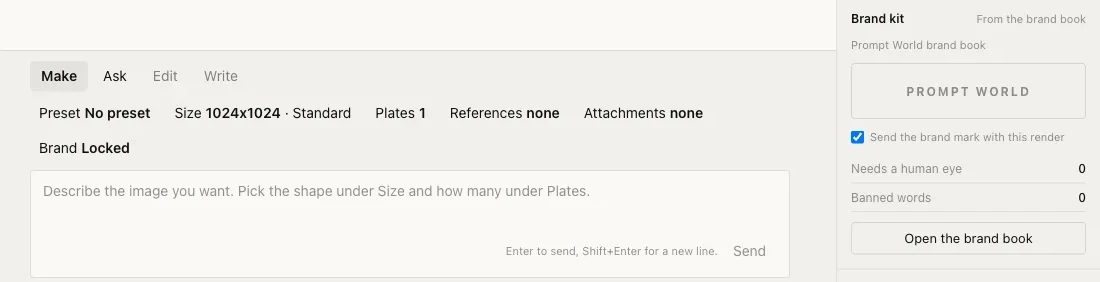
RUPA's composer: a preset, references and the brand kit, with Brand Locked on.

What does this mean for the marketing team's role?
The marketing team's job shifts from production to judgement.
This is where most marketing leaders go wrong when planning their AI rollout. They think about what AI will do. They don't think about what their team will stop doing, and what that frees them to do instead.
When AI handles the production layer, the humans in the workflow become editors, strategists, and decision-makers. That's not a downgrade, it's the job most senior marketers actually want.
"The best creative directors I know don't want to be in Figma at 11pm. They want to be making decisions about what the brand stands for. AI gives them that back."
The risk isn't that AI replaces the marketing team. The risk is that leaders who don't restructure their team's role will find everyone spending the same amount of time on production, just with AI tools inserted into the same broken workflow.
How do you navigate brand consistency at scale?
Brand consistency at scale requires a deliberate architecture, not just guidelines.
This objection surfaces in every enterprise AI content conversation: "We can produce more, but how do we ensure it's all on-brand?" The answer isn't a longer style guide. It's an agent architecture that encodes brand rules at the point of generation, not the point of review.
On Nagent, MIRA is the AI chief of staff for Marketing: brief her with the outcome and she plans it and hands each piece to the teammate who owns it. CREA leads the AI Content team, which writes from your own Knowledge Hub and brand and publishes only when a person approves.
When brand voice, visual guidelines, and tone parameters are built into the agents themselves, consistency becomes a default output, not a review-cycle outcome. For enterprise teams managing multiple brands, markets, or product lines simultaneously, the alternative, manual review of every AI-generated asset, simply doesn't scale.
What's the real competitive risk of waiting?
The competitive risk isn't falling behind on tools. It's falling behind on output velocity.
Here's the uncomfortable maths. If a competitor runs 100 ad variations per month and you run 10, they generate 10× the performance data. In six months, their targeting models are trained on 600 data points. Yours are trained on 60.
AI-native content operations create a compounding advantage. The teams that start now aren't just more efficient today, they're building a data and learning lead that becomes structurally harder to close over time.
On Nagent, video ads are planned by Alpha, the AI video teammate, which quotes each video before anything renders. When a creative unit costs minutes of review instead of a production day, the number of variations you test becomes a decision, not a constraint.
The window to build this advantage without competitive pressure is closing. Mid-market and enterprise teams that treat AI content as a 2025 experiment will find themselves in a 2026 catch-up position.
What's the right way to start?
Start with one workflow, not a platform-wide transformation.
Teams that stall on AI content rollouts almost always make the same mistake: they try to transform everything at once, new tools, new processes, new team structures, new KPIs, all in parallel. Six months later, nothing has shipped.
The teams that succeed pick one high-volume, high-friction workflow and rebuild it with agents: social content calendars, ad creative variation, product photography. One workflow, measurable output, visible ROI. From there, the case for expanding the architecture builds itself.
Start with the AI teammate who owns your team's biggest bottleneck: CREA for content, RUPA for images, Alpha for video or HOOK (Beta) for ad angles.
Related reading
Frequently Asked Questions
How is AI changing marketing content development?
AI is restructuring the content development workflow by replacing multi-step agency handoffs with coordinated agents that handle strategy, copy, visuals, and distribution in parallel. The result isn't just faster content, it's a fundamentally different operating model that makes high-volume, high-variation content economically viable for the first time.
Will AI replace marketing teams?
AI replaces production tasks, not marketing judgement. Teams that deploy AI agents effectively shift their focus from asset creation to strategy, brand governance, and performance decision-making. The risk isn't replacement, it's teams that insert AI tools into an unchanged workflow and see no structural benefit.
How do you maintain brand consistency when using AI to generate content at scale?
Brand consistency at scale requires encoding brand parameters into the work itself, not relying on post-production review. On Nagent, CREA's Content team writes from your Knowledge Hub and brand, and MIRA routes each piece to the teammate who owns it, with a person approving what goes live.
What's the biggest mistake companies make when adopting AI for content?
The most common mistake is attempting a platform-wide transformation before proving value in a single workflow. Teams that succeed start narrow, one content type, one team, one measurable outcome, and expand from a position of demonstrated ROI.
How do AI agents handle different content formats and channels?
On Nagent, one brief in the Marketing team room can produce copy from CREA's Content team, images from RUPA and video plans from Alpha, each adapted to its channel, with a person approving each piece before it goes live.
What's next
Your content operation doesn't need a bigger team, it needs a better architecture. Book a free 30-minute demo at nagent.ai and see exactly which agents fit your current workflow.
Sources
See an AI team at work
Book a 15-minute demo and watch a Nagent team plan, do and hand back real work in its room.