The Autonomous Enterprise (part 1): From Tools to Self-Learning Agentic Systems
The Autonomous Enterprise: 2026 and Beyond (A 5-Part Series)
Enterprise software is at an inflection point. We are moving from tools → to agents → to systems that learn, adapt, and improve on their own. This shift will redefine how companies are built, how teams operate, and how value is created.
In this 5-part series, we’ll break down what’s changing, why it matters, and how enterprises can prepare for a world of autonomous, self-learning systems.
What we’ll cover:
Part 1: The Shift — From tools to self-learning systems
Part 2: The Learning Loop — How autonomous systems actually improve
Part 4: Orchestration — From single agents to intelligent systems
Part 5: The Autonomous Enterprise — What this means for orgs and leaders
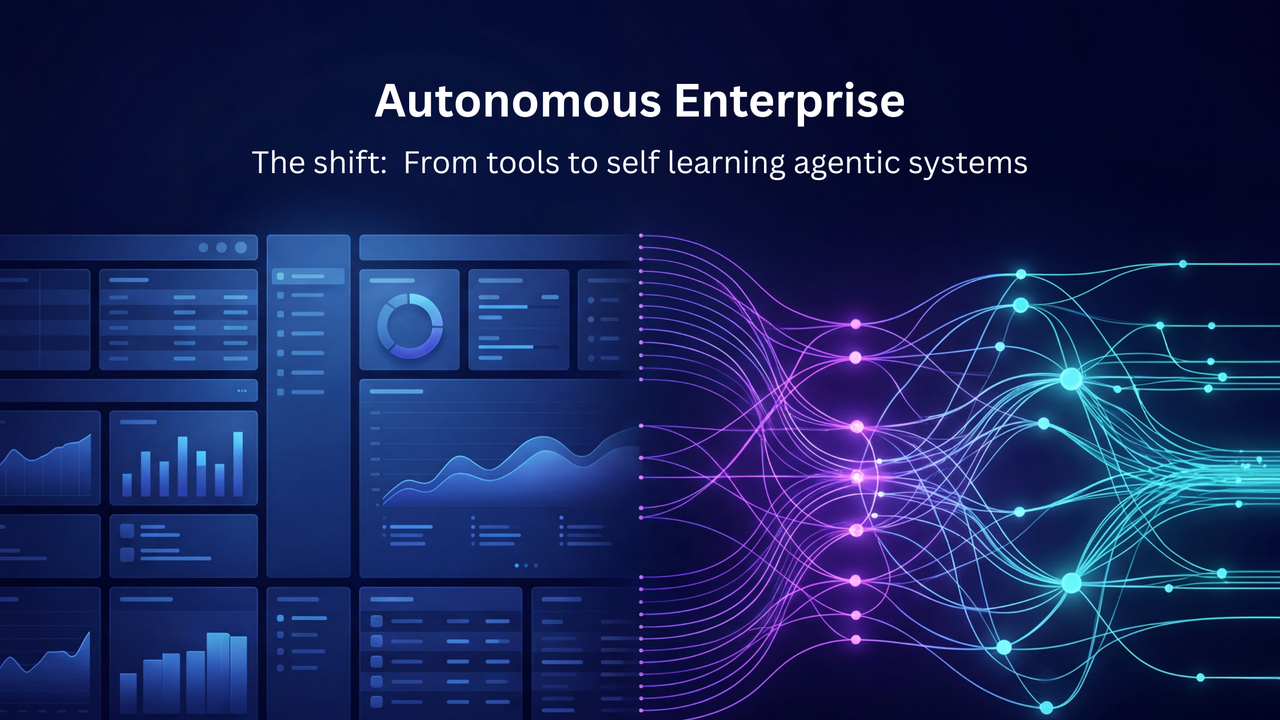
:quality(80) "The shift from tools to self learning agentic systms")
Part 1: The Shift We Are Witnessing- From Tools to Self-Learning Systems
Over the last two decades, enterprise software has evolved in layers. Each one solves a fundamental limitation of the previous generation.
We started with systems of record or databases that captured and stored information reliably. This was the era of ERP, CRM, and structured data. The problem being solved was simple: digitize the enterprise.
Then came systems of insight or analytics platforms, dashboards, and business intelligence tools. These systems helped us interpret the data we had accumulated. The question shifted from “What happened?” to “Why did it happen?”
Next came systems of execution or automation platforms, workflows, and SaaS tools that allowed businesses to act on insights at scale. This was the promise of efficiency. The idea was that if we could codify processes, we could scale them infinitely.
Each of these waves delivered massive value.
But beneath all this progress, one fundamental limitation remained unchanged.
Enterprise software never learned.
The Ceiling of Traditional Enterprise Systems
No matter how advanced our systems became, they all shared the same constraint:
They executed what they were told.
They didn’t evolve.
A workflow automation tool doesn’t improve unless someone updates it.A dashboard doesn’t get smarter unless someone redefines the query.A CRM doesn’t optimize your sales process unless a human redesigns it.
This created a hidden tax on every organization.
Every improvement required human intervention.Every inefficiency persisted until someone noticed and fixed it.Every mistake was repeatable.
In other words, enterprise systems scaled execution—but not intelligence.
And over time, this became the ceiling.
The Arrival of AI Agents and the False Dawn
When AI agents started gaining traction, it felt like we had finally broken through that ceiling.
For the first time, software could reason.It could generate.It could respond dynamically.
There was a sense that we had moved from static systems to intelligent ones.
But what most organizations deployed in the early wave of agent adoption was not true intelligence.
It was a simulation of intelligence.
These early agents were:
Prompt-driven
Stateless
Isolated
Non-learning
They operated like highly advanced calculators with language interfaces.
Every time you ran an agent, it started from scratch. It had no memory of what worked before. It had no awareness of past failures. It had no mechanism to improve.
This led to a critical disconnect.
From the outside, it looked like the system was getting smarter.
From the inside, nothing was actually changing. Every run was a reset. Every output was disposable. Every insight was lost.
This is why many early enterprise AI deployments felt impressive in demos—but disappointing in production.
They didn’t compound.
2026: The Real Inflection Point
The defining shift of 2026 is not the rise of AI agents.
It is the emergence of self-learning systems.
This is a much deeper transition than most people realize.
We are moving from:
Tools → that execute
Agents → that assist
Systems → that learn and evolve
This shift changes the competitive landscape entirely.
Because once execution becomes commoditized and it already is. The advantage moves elsewhere.
Today, anyone can:
Generate content at scale
Automate workflows
Build agents on top of APIs
These are no longer differentiators.
The real question now is:
Does your system get better over time?
Because in a world of self-learning systems:
Speed is not the moat
Scale is not the moat
Even intelligence is not the moat
Learning is the moat.
The companies that win this decade will be the ones whose systems:
Learn faster from real-world outcomes
Adapt continuously without human intervention
Improve performance with every execution cycle
Rethinking Intelligence: It’s Not in the Model
One of the biggest misconceptions in the current AI wave is the idea that intelligence lives inside the model.
That if you just use a better LLM, you get a better system.
This is fundamentally flawed.
A model is just one component.
True intelligence is not a property of the model. It is a property of the system.
It emerges from the interaction of three core elements:
Context × Learning × Action
Let’s break this down.
Context gives the system memory and awareness. Without context, every decision is made in isolation.
Learning allows the system to evolve based on outcomes. Without learning, mistakes repeat indefinitely.
Action connects the system to the real world. Without action, intelligence has no impact.
If any one of these is missing, the system breaks.
Context without learning becomes static memory
Learning without action becomes theoretical
Action without context becomes chaotic
Only when all three work together do you get something that resembles true intelligence.
The “Brain in a Jar” Fallacy
Early agentic architectures made a critical mistake.
They tried to centralize everything inside a single LLM.
The model was expected to:
Plan
Execute
Validate
Learn
This approach, often referred to as the “Brain in a Jar” was seductive because it was simple. But it was also fundamentally unsafe and unsustainable.
Recent research and enterprise deployments have now clearly shown that this model does not work in production environments
Why?
Because LLMs are probabilistic by design.
They are excellent at generating possibilities—but not at enforcing correctness.
When you allow a probabilistic system to directly control execution, you introduce risk:
Inconsistent outputs
Logical errors
Unpredictable behavior
Lack of auditability
In low-stakes scenarios, this might be acceptable.
In enterprise environments, it is not.
The Rise of Neuro-Symbolic Architectures
To solve this, a new architectural paradigm has emerged: Neuro-Symbolic Systems.
Instead of treating intelligence as a monolith, these systems decompose it into layers.
A useful mental model here is the 60/20/20 architecture😀
:quality(80))
1. The Agentic Skeleton (60%) — Deterministic Layer This is the foundation of the system.
It includes:
Rules
Workflows
Guardrails
Safety constraints
This layer ensures that execution is reliable, auditable, and predictable.
2. The Agentic Brain (20%) — Probabilistic Layer This is where the LLM operates.
Its role is to:
Generate ideas
Propose plans
Interpret context
But critically, it does not execute directly.
3. The Orchestrator (20%) — Control Layer This layer manages:
State
Task sequencing
Decision routing
It acts as the bridge between thinking and doing.
Why This Architecture Matters
This separation is not just a technical detail but also the foundation of safe and scalable intelligence.
It allows enterprises to achieve something that was previously impossible:
Flexibility without losing control
The system can:
Think creatively (via the LLM)
Act reliably (via deterministic systems)
Adapt continuously (via orchestration and learning loops)
Without any one layer overpowering the others.
This is what makes self-learning systems viable in production.
From Execution Engines to Learning Systems
If you zoom out, what we are witnessing is not just a technology shift.
It is a redefinition of what software is.
For decades, software has been:
A tool that humans operate.
Now, it is becoming:
A system that operates and improves on its own.
This changes everything.
It changes how products are built. It changes how teams operate. It changes how value is created.
We are moving from:
Static systems → Dynamic systems
Manual optimization → Autonomous improvement
Human-driven iteration → System-driven evolution
And once this shift happens, there is no going back.
A New Competitive Reality
In the world that is emerging:
The best product is not the one with the most features
It is the one that improves the fastest
The best team is not the one that works the hardest
It is the one that leverages learning systems most effectively
The best company is not the one with the most resources
It is the one with the most adaptive intelligence
This is the foundation of the Autonomous Enterprise.
What Comes Next
If Part 1 is about the shift…
Then Part 2 is about the mechanism.
Because the obvious question is:
How do these systems actually learn?
We’ll go deeper into:
Why traditional approaches like SFT and RLHF fall short
The rise of Read-Write Reflective Learning
How systems evolve without retraining models
And how learning becomes a continuous loop, not a periodic event
Coming next: Part 2 — The Learning Loop: How Autonomous Systems Actually Improve
TL;DR FAQs : The Shift from tools to self learning agentic systems
What is the big shift happening in enterprise software?
From tools → to agents → to self-learning systems.Why are traditional systems limited?
They execute but don’t learn or improve.What’s wrong with early AI agents?
They are stateless, isolated, and non-learning.What defines 2026?
The rise of systems that learn from outcomes.What is the real competitive advantage?
Learning speed, not model size.Is intelligence inside the model?
No—it’s a property of the system.What are the core components of intelligence?
Context × Learning × Action.What is the “Brain in a Jar” problem?
Using one model for everything—unsafe and unreliable.What replaces it?
Neuro-symbolic architectures (separation of thinking and execution).What’s the takeaway?
Software is evolving from execution engines to learning systems.