The Autonomous Enterprise (part 5): The Future of Work
The Autonomous Enterprise: 2026 and Beyond (A 5-Part Series)
Enterprise software is at an inflection point.
We are moving from tools → to agents → to systems that learn, adapt, and improve on their own. This shift will redefine how companies are built, how teams operate, and how value is created.
In this 5-part series, we break down what’s changing, why it matters, and how enterprises can prepare for a world of autonomous, self-learning systems.
What we’ll cover:
Part 2: The Three Layers of Context — What turns AI into a digital coworker
Part 3: Memory & Continuity — Why most agents fail without it
Part 4: Orchestration — From single agents to intelligent systems
Part 5: The Autonomous Enterprise — What this means for orgs and leaders
As we conclude this series, it’s important to clarify one thing: the rise of autonomous systems is not about replacing humans; it’s about redefining their role. Execution is moving to systems, but direction, judgment, and accountability remain human. The future belongs to those who can design, orchestrate, and guide intelligent systems - not compete with them.
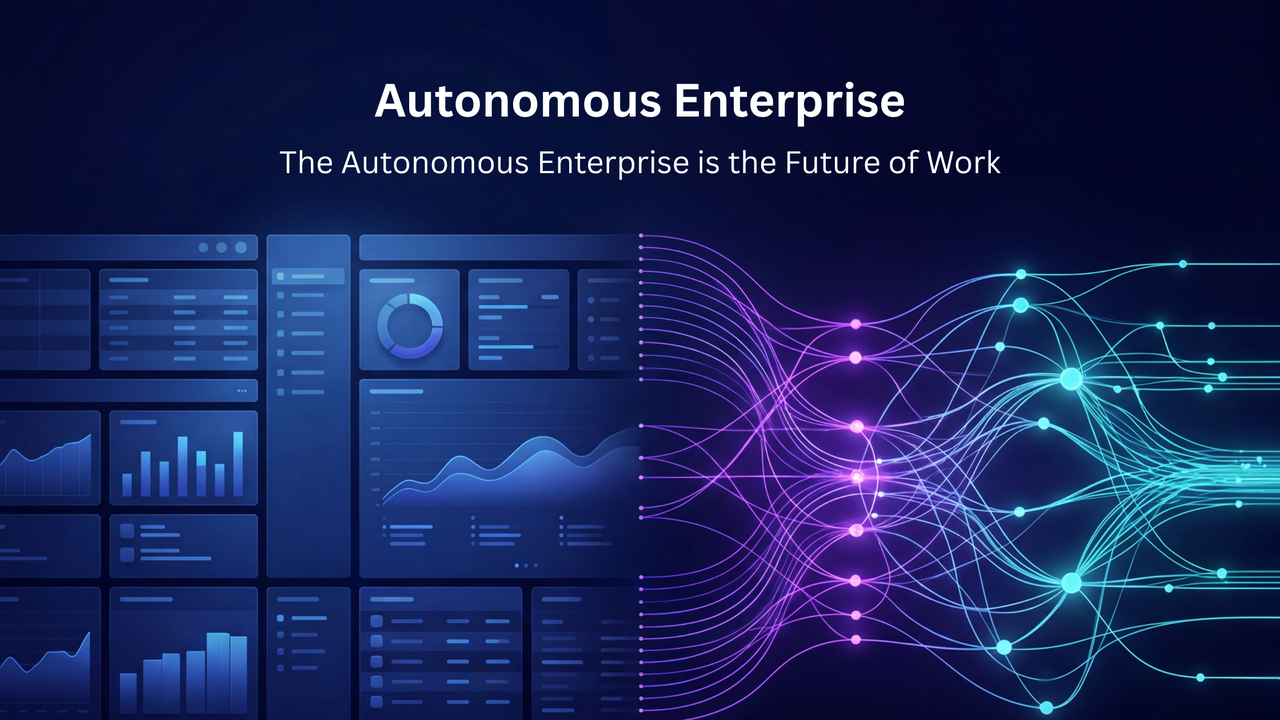
:quality(80) "Autonmous Enterprise and the future of work")
Part 5: The Restructuring of Work, Workplace, and Worker
If Part 4 was about orchestration…
This is where it all lands.
What happens when software doesn’t wait for instructions; but operates on its own?
The Beginning of the End for SaaS
For the last 20 years, enterprise software has been built around one assumption:
Humans are at the center of execution.
So we built:
Dashboards to view data
Interfaces to trigger actions
Workflows to guide execution
Every system required:
Logging in
Clicking through
Manually driving outcomes
This is the SaaS era.
But that era is ending.
From Software You Use → Systems That Operate
Autonomous systems don’t need dashboards.
They don’t:
Navigate interfaces
Click buttons
Wait for instructions
They:
Call APIs
Execute workflows
Make decisions
Learn from outcomes
This changes everything.
The interface is no longer the product.The system is.
Why SaaS Breaks
SaaS was built on:
Seat-based pricing
Human workflows
UI-driven interactions
But in an agentic world:
Agents don’t need seats
Workflows don’t need humans
Interfaces don’t drive value
Outcomes do.
The Shift Is Already Visible
Agents resolving majority of routine work
Reduced dependence on human-operated tools
Significant drop in seat-based licensing
What once required teams… now requires systems.
What once required tools… now requires intelligence.
This Is Not a Software Shift. It’s a Work Shift.
And it changes three things fundamentally:
1. Work: From Execution → Orchestration
Work is no longer about doing tasks.
It becomes:
Designing and overseeing systems that do the work
Before:
Humans executed workflows
AI assisted
Now:
Agents execute workflows
Humans validate outcomes
The New Nature of Work
Less doing
More deciding
Less execution
More direction
Work becomes:
Outcome-driven, not activity-driven
2. Workplace: From Hierarchies → Intelligent Pods
The traditional org structure:
Large execution layers
Multiple management tiers
Rigid reporting lines
This model was built for human-driven execution.
Now, That Foundation Is Gone
As agents take over execution:
The pyramid collapses
Teams become smaller
Structures become fluid
In its place, we see:
AI-augmented pods
From Org Charts → Work Charts
Teams form around outcomes
Agents act as team members
Work flows dynamically
Organizations evolve into:
Networks of humans and intelligent systems
3. Worker: From Executor → Orchestrator
This is the biggest shift of all.
The Old Model
Experience = more tasks completed
Growth = managing more people
The New Model
Value = ability to orchestrate systems
Leverage = ability to use AI effectively
The Rise of the High-Leverage Individual
A single person, with the right system, can now:
Execute at the level of a team
Move at the speed of systems
Own outcomes end-to-end
Early-career talent is no longer limited by execution capacity.
They are amplified by intelligence.
The End State: The Autonomous Enterprise
When you combine everything from this series:
Context → Systems understand
Learning → Systems improve
Orchestration → Systems coordinate
You get:
The Autonomous Enterprise
What It Looks Like
Systems that operate continuously
Agents that execute across workflows
Intelligence that compounds over time
Humans focused on direction, not execution
This is not automation.
This is evolution.
The Real Competitive Advantage
In the next decade:
Everyone will have access to AI
Everyone will deploy agents
Everyone will automate workflows
But very few will build:
Systems that learn faster than everyone else
And that is the only moat that will matter.
:quality(80))
The real competitive advantage in the age of autonomous enterprises will not come from better tools, larger teams, or even superior models—it will come from how effectively an organization designs and orchestrates its intelligence. This is where the A.S.S.E.T Framework (Autonomous Systems Shaping Enterprise Transformation) becomes foundational. It reframes the enterprise across three dimensions: work becomes autonomous, executed by goal-driven agent systems; the workplace becomes system-centric, powered by an orchestrated SYSTEM of agents rather than fragmented tools; and the worker evolves into a SYSTEM manager, responsible for defining outcomes, guiding intelligence, and governing decisions. In this model, advantage is no longer built through execution efficiency alone, but through the ability to continuously design, deploy, and refine autonomous systems that outperform traditional workflows.
What makes this shift truly defensible is that these systems are not static—they are self-learning, self-correcting, and compounding over time. Enterprises adopting the A.S.S.E.T framework move from linear scaling with human effort to exponential scaling through intelligence loops, where every action feeds back into improvement. This is where platforms like Nagent AI create a structural edge, enabling organizations to embed evolution into execution itself. The result is a new kind of enterprise—one that doesn’t just operate efficiently, but adapts faster, learns continuously, and reinvents itself ahead of the market. In the future of work, the winners will not be those who work harder, but those who build systems that learn and evolve faster than everyone else.
This Shift Is Already Underway
Quietly.
Inside companies that are:
Moving beyond tools
Rethinking workflows
Designing for systems, not interfaces
Building for learning, not just execution
The Question Is No Longer “Should You Adopt AI?”
That question is already obsolete.
The real question is:
Are you building systems that learn—or just tools that execute?
Because one leads to incremental improvement.
The other leads to exponential advantage.
Every major shift redefines the enterprise:
Industrial era → Machines scaled labor
Software era → Systems scaled execution
Cloud era → Infrastructure scaled globally
And now:
The Autonomous Enterprise → Systems that scale intelligence
What This Means for You
This is not a trend you can observe from the sidelines.
It is a shift you have to design for.
If you’re:
A CMO rethinking how marketing operates
A business leader trying to scale without headcount
A company looking to move from tools → to systems
Then the question is:
Where do you start?
Let’s Build Your Autonomous System
At Nagent AI, we are working with enterprises to:
Design agentic systems for real workflows
Implement closed-loop learning (KARMIC framework)
Build orchestration layers across marketing and operations
Move teams from execution → to intelligence
👉 Book a Working Session
If you want to explore how this applies to your business:
Book a working session with us
We’ll help you:
Identify the highest-leverage use cases
Map your current workflows to agentic systems
Define a roadmap to become an autonomous enterprise
From tools → to agents → to systems that learn.
This is not just the future of software.
This is the future of how work gets done.
Read about the Nagent AI Thesis on Future of work.
TL;DR FAQs : Autonomous Enterprise is the future of work
Is SaaS really ending?
It’s evolving into agent-driven systems.What replaces “software you use”?
Systems that operate autonomously.Why don’t agents need dashboards?
They interact via APIs and workflows.How does work change?
From execution → to orchestration.How does the workplace change?
From hierarchies → to AI-augmented pods.How does the worker change?
From executor → to orchestrator.What happens to early-career talent?
They gain massive leverage through AI.What is the autonomous enterprise?
A system that understands, acts, learns, and improves continuously.What is the new competitive advantage?
Learning speed and system intelligence.What’s the takeaway?
The future belongs to those who build systems—not just use tools.