Missing primitive in autonomous Enterprise (part 3) : Closed-Loop Learning Systems
The Autonomous Enterprise: 2026 and Beyond (A 5-Part Series)
Enterprise software is at an inflection point.
We are moving from tools → to agents → to systems that learn, adapt, and improve on their own. This shift will redefine how companies are built, how teams operate, and how value is created.
In this 5-part series, we break down what’s changing, why it matters, and how enterprises can prepare for a world of autonomous, self-learning systems.
What we’ll cover:
Part 2: The Three Layers of Context — What turns AI into a digital coworker
Part 3: Memory & Continuity — Why most agents fail without it
Part 4: Orchestration — From single agents to intelligent systems
Part 5: The Autonomous Enterprise — What this means for orgs and leaders
:quality(80))
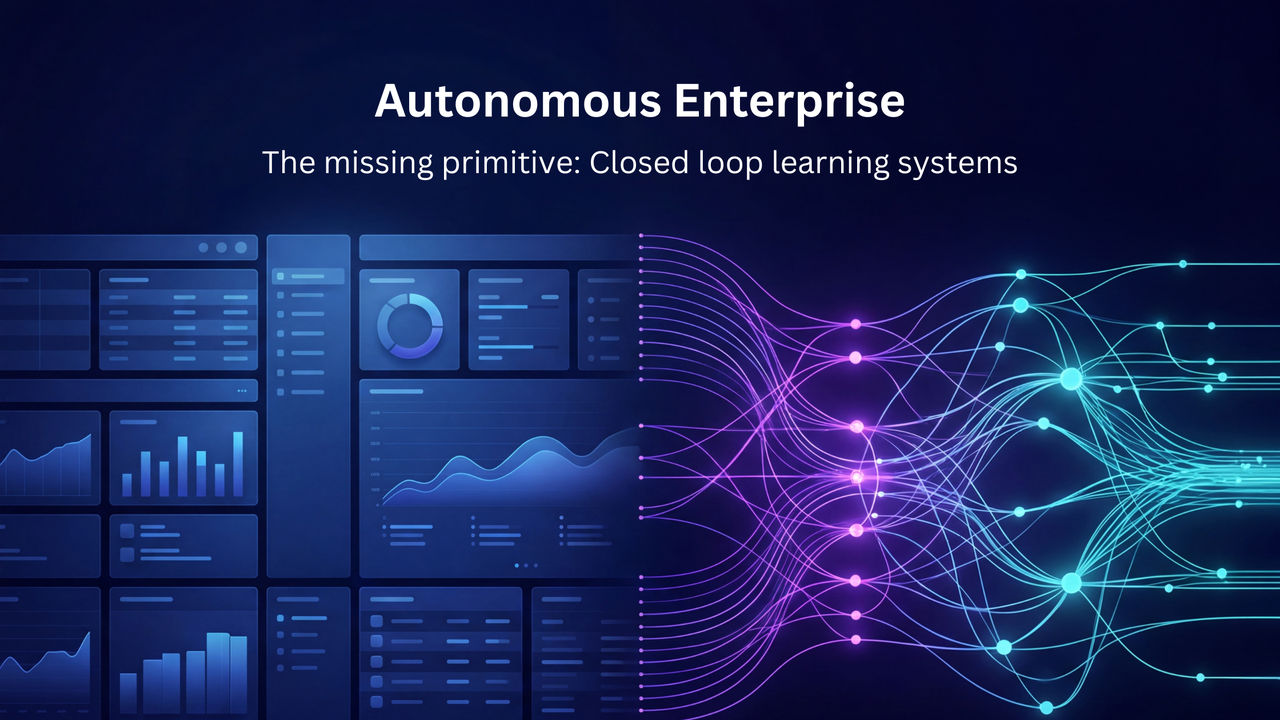
Part 3: The Missing Primitive — Closed-Loop Learning Systems
If Part 2 was about context…
Part 3 is about the engine that makes everything come alive:
Learning.
Because without learning, even the most advanced systems hit a ceiling.
You can have:
Rich context
Powerful models
Sophisticated orchestration
But if your system does not improve with every cycle…
It is not intelligent. It is just automated.
The Hidden Limitation of Today’s AI Systems
Most enterprise AI systems still operate in a linear flow:
Input → Output
You provide instructions. The system generates a result. And then the cycle ends.
There is:
No memory of past outcomes
No understanding of failure patterns
No mechanism to improve future performance
Every execution is isolated.
Which means:
Mistakes repeat
Quality stagnates
Intelligence does not compound
This is the biggest gap in enterprise AI today.
Why Traditional Learning Falls Short
Historically, improving AI meant updating the model itself.
Through:
Supervised Fine-Tuning (SFT)
Reinforcement Learning from Human Feedback (RLHF)
But these approaches are fundamentally misaligned with enterprise needs.
They are:
Slow and batch-driven
Dependent on human intervention
Expensive to scale
Detached from real-time execution
In a dynamic business environment, this doesn’t work.
Because enterprises don’t operate in training cycles.
They operate in continuous feedback loops.
The Shift: Learning Moves to the System Layer
The most important shift happening right now is this:
Learning is no longer inside the model. It is inside the system.
Instead of retraining weights, systems are now designed to:
Observe outcomes
Evaluate performance
Learn from feedback
Adapt behavior
In real time.
This transforms AI from:
Static intelligence → Adaptive intelligence
Periodic updates → Continuous evolution
The Closed-Loop Learning System
At the core of this transformation is a new primitive:
Closed-Loop Learning
Unlike traditional systems, which are linear, closed-loop systems operate in a continuous cycle:
Action → Evaluation → Feedback → Reformation
This loop is what enables systems to improve autonomously.
Breaking Down the Loop
1. Action The system executes a task—generates output, calls tools, or completes workflows.
2. Evaluation The outcome is assessed—did it meet the objective? Was it correct? Efficient?
3. Feedback The system identifies what worked and what didn’t—pinpointing failure modes and success patterns.
4. Reformation The system improves itself—rewriting prompts, adjusting logic, refining workflows.
And most importantly:
It ensures the same mistake is not repeated.
From Execution to Evolution
This loop changes the nature of software itself.
From:
One-time execution → Continuous improvement
Static behavior → Adaptive behavior
Outputs → Outcomes
Over time, the system doesn’t just perform tasks.
It becomes better at performing them.
Introducing the KARMIC Framework
To operationalize this in enterprise systems, we introduce:
KARMIC — Knowledge Acquisition and Reformation for Multi-Agent Iterative Correction
KARMIC is a structured approach to building self-learning systems that evolve through continuous feedback.
The Core Idea Behind KARMIC
Every action taken by a system generates a consequence.
Instead of discarding that outcome, KARMIC ensures:
The system captures it
Evaluates it
Learns from it
And reforms itself accordingly
Inspired by the principle of cause and effect:
Every action informs the next. Every outcome improves the system.
How KARMIC Works in Practice
KARMIC operates across multi-agent systems through iterative correction loops.
:quality(80) "KARMIC feedback loop by Nagent AI")
At a high level:
Knowledge Acquisition
Capture execution data
Store outcomes, decisions, and traces
Build a structured understanding of what happened
Evaluation & Feedback
Analyze success vs failure
Identify gaps, inefficiencies, and edge cases
Use human or automated evaluators
Reformation
Update prompts, workflows, or logic
Refine agent behavior
Improve decision pathways
Iterative Correction
Apply improvements in the next cycle
Continuously refine across multiple agents
Build a compounding system of intelligence
Why Multi-Agent Systems Need KARMIC
In a multi-agent environment:
One agent’s output becomes another’s input
Errors can propagate
Small failures can compound
Without a structured learning loop, this creates instability.
KARMIC solves this by:
Introducing feedback at every stage
Enabling localized correction
Ensuring system-wide improvement over time
From Stateless Agents to Learning Systems
Early agents were:
Stateless
Isolated
Non-learning
KARMIC transforms them into systems that:
Remember
Reflect
Improve
Evolve
This is the shift from:
Agents that act → Systems that learn
The Emergence of Compounding Intelligence
Closed-loop learning introduces a powerful advantage:
Compounding intelligence
Every cycle improves the next.
Better actions → Better outcomes
Better outcomes → Better learning
Better learning → Better systems
This creates a flywheel effect.
Why This Becomes the True Moat
In the near future:
Models will commoditize
Tools will standardize
Infrastructure will equalize
But systems that learn?
They compound.
The more they operate:
The more they improve
The more they differentiate
The harder they are to replicate
From Software to Living Systems
This is the defining shift of the autonomous enterprise.
From:
Systems that execute → Systems that evolve
Software that responds → Software that learns
Automation → Intelligence
And once this loop is in place:
Software is no longer static. It becomes a living, evolving system.
What Comes Next
If Part 3 is about learning…
Then Part 4 is about coordination.
Because learning systems don’t operate alone.
They operate as multi-agent systems.
We’ll explore:
How agents coordinate at scale
Why orchestration is the real bottleneck
And how intelligence emerges at the system level
Coming next: Part 4 — Orchestration: From Single Agents to Intelligent Systems
TL;DR FAQs : The Missing Primitive — Closed-Loop Learning Systems
What is the biggest gap in enterprise AI?
Lack of structured learning.
Why don’t current systems improve?
They follow a linear Input → Output flow.
Why are SFT and RLHF insufficient?
They are slow, manual, and non-continuous.
Where does learning happen now?
At the system level, not the model level.
What is a closed-loop learning system?
A cycle of Action → Evaluation → Feedback → Reformation.
What does “reformation” mean?
The system updates itself based on outcomes.
What is KARMIC?
A framework for Knowledge Acquisition and Reformation through iterative correction.
Why is KARMIC important?
It enables continuous, autonomous improvement.
What is compounding intelligence?
Systems that get better with every cycle.
What’s the takeaway?
Learning—not execution—is the true differentiator.