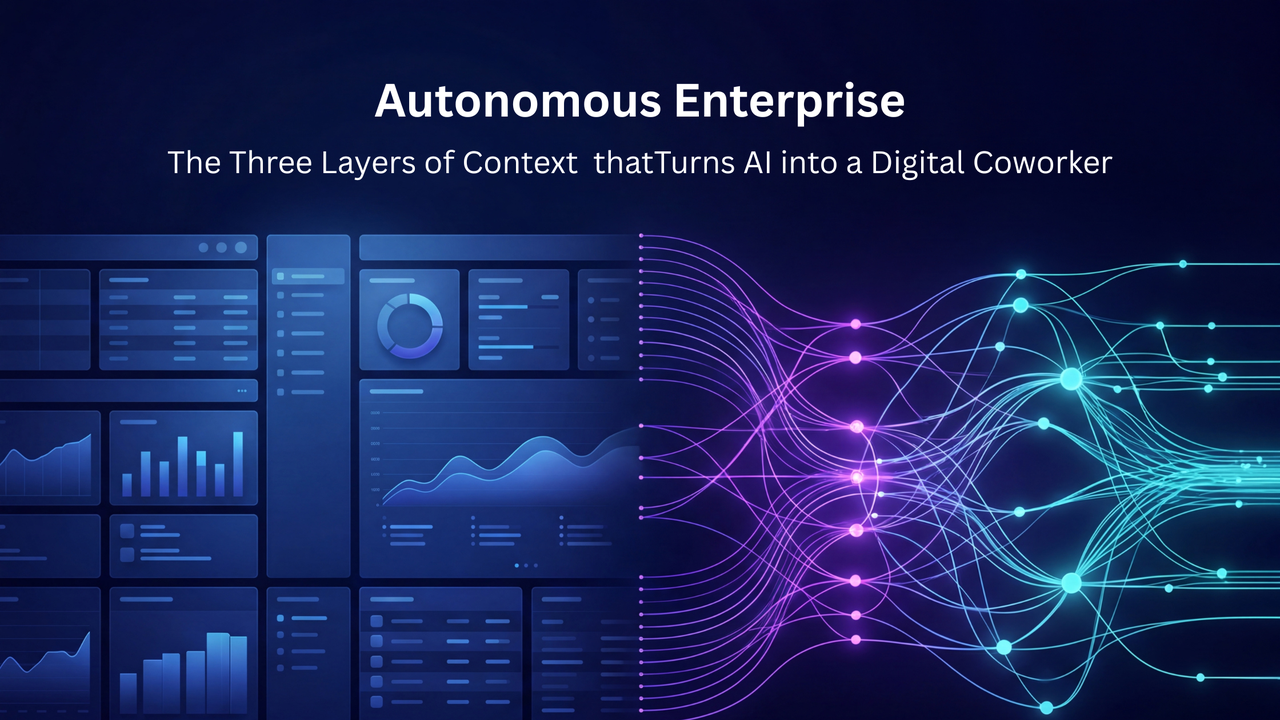
The Autonomous Enterprise (part 2): The Three Layers of Context Powering Digital Coworkers
The Autonomous Enterprise: 2026 and Beyond (A 5-Part Series)
Enterprise software is at an inflection point.
We are moving from tools → to agents → to systems that learn, adapt, and improve on their own. This shift will redefine how companies are built, how teams operate, and how value is created.
In this 5-part series, we break down what’s changing, why it matters, and how enterprises can prepare for a world of autonomous, self-learning systems.
What we’ll cover:
Part 2: The Three Layers of Context — What turns AI into a digital coworker
Part 3: Memory & Continuity — Why most agents fail without it
Part 4: Orchestration — From single agents to intelligent systems
Part 5: The Autonomous Enterprise — What this means for orgs and leaders
:quality(80))
Part 2: The Three Layers of Context that Turns AI into a Digital Coworker
If Part 1 was about the shift…
Part 2 is about the foundation that makes that shift possible.
Because here’s the uncomfortable truth most enterprises discover quickly:
AI without context doesn’t fail loudly—it fails subtly.
It produces answers.
It completes tasks.
It even looks intelligent.
But it doesn’t align.
It doesn’t adapt.
And most importantly—it doesn’t improve in the right direction.
The Real Problem Isn’t Intelligence. It’s Context.
Over the last few years, we’ve focused heavily on models.
Bigger models.
Better models.
Faster models.
But inside enterprises, model capability is not the bottleneck.
Context is.
Because enterprise work is not generic.
It is shaped by:
People
Systems
History
Decisions
Trade-offs
And unless AI is grounded in all of this, it remains an assistant—not a coworker.
From AI Assistants to Digital Coworkers
A true digital coworker is not just capable.
It is context-aware.
It understands:
Who is making the decision
How the organization operates
What has happened before
What it has learned over time
This requires a new mental model.
Not prompts.
Not workflows.
Not even agents in isolation.
But layers of context.
The Three Layers of Context
To operate effectively in an enterprise, autonomous systems must master three distinct layers:
Operator Context → How humans think and decide
Enterprise Context → How the business operates
Agent Context → What the system itself has learned
Only when all three come together does AI become truly intelligent.
:quality(80) "The three layers of context for the autonmous enterprise of 2026 and beyong")
Layer 1: Operator Context — Understanding Human Decision-Making
Every enterprise runs on people.
And every decision-maker brings their own:
Judgment
Experience
Risk appetite
Strategic bias
Preferences
Two leaders can look at the same dashboard and make completely different decisions.
Because decisions are not just data-driven.
They are contextual and human.
Why Operator Context Matters
If AI ignores operator context, it creates misalignment.
It may recommend actions that are:
Logically correct
But strategically wrong
For example:
A system might push aggressive growth
While the operator prioritizes profitability
Or:
It might optimize for efficiency
While the operator values brand perception
Without understanding how decisions are made, AI becomes unusable.
What Learning Operator Context Looks Like
A self-learning system must observe and adapt.
It should learn:
What decisions get approved vs rejected
What signals are prioritized
What trade-offs are consistently chosen
What patterns repeat over time
Eventually, it should be able to answer:
“Given this situation, how would this operator decide?”
That is the moment AI becomes aligned.
Layer 2: Enterprise Context — Understanding How the Business Works
If operator context is about people…
Enterprise context is about the system.
Every organization operates as a complex web of:
Workflows
Tools
Data systems
Dependencies
Historical actions
And this system is not static.
It evolves continuously.
The Hidden Complexity of Enterprise Context
Enterprise knowledge is:
Distributed across tools
Embedded in workflows
Locked inside APIs
Captured in documents and conversations
But more importantly:
It is temporal and relational
What happened matters.
When it happened matters.
What led to it matters.
Why Traditional Approaches Failed
The industry tried to solve this using:
Retrieval-Augmented Generation (RAG)
Vector databases
While useful, these approaches have a fundamental limitation:
They treat knowledge as isolated chunks.
They can retrieve relevant information.
But they cannot understand:
Causality
Sequence
Dependency
This leads to context drift—where the system retrieves the right information but applies it incorrectly.
The Shift to Temporal Knowledge Graphs
Modern systems are moving toward:
Temporal Knowledge Graphs (TKGs)
These systems store:
Entities (customers, campaigns, transactions)
Relationships (connected to, triggered by, dependent on)
Time (when events occurred)
This creates a living, evolving memory of the enterprise.
What This Enables
With enterprise context properly modeled, agents can:
Understand cause-and-effect
Track decision history
Learn from outcomes
Maintain continuity across workflows
This unlocks a new category:
Ambient Agents
Ambient Agents: Always-On Intelligence
Unlike traditional agents, ambient agents:
Run continuously
Observe systems passively
Learn from real-time signals
Act proactively
They don’t wait for prompts.
They operate within the enterprise fabric.
And they rely on enterprise context as their grounding layer.
Layer 3: Agent Context — Learning From Experience
This is the most overlooked layer—and the most important one.
Because even with operator and enterprise context…
If the system itself doesn’t learn, nothing compounds.
What Is Agent Context?
Agent context is the system’s own memory of experience.
It includes:
Past actions
Successes and failures
Learned strategies
Evolved workflows
Optimized behaviors
It is what allows the system to improve over time.
Why Agent Context Matters
Without agent context:
Every run is stateless
Every mistake repeats
Every improvement is manual
This is exactly what we saw in early AI agents.
They looked intelligent—but they didn’t learn.
From Stateless to Self-Learning Systems
With agent context, the system begins to:
Reflect on outcomes
Identify failure patterns
Adapt strategies
Improve future performance
Over time, it builds its own internal playbook.
And this is where the shift happens:
From execution → to evolution
Agent Context as the Learning Engine
Agent context turns AI into a system that:
Doesn’t just act
But learns how to act better
It becomes:
More accurate
More aligned
More efficient
More autonomous
With every cycle.
Connecting the Three Layers
Individually, each layer is powerful.
But the real magic happens when they work together.
Operator Context ensures alignment with human intent
Enterprise Context ensures grounding in business reality
Agent Context ensures continuous improvement
Together, they create:
A system that understands, operates, and evolves
Why This Changes Everything
Once these three layers are in place:
AI is no longer reactive
It becomes proactive
It no longer depends on instructions
It understands intent
It no longer repeats mistakes
It learns from them
This is what transforms:
AI from a tool → into a digital coworker → into a self-learning system
Context Is the New Moat
Models will commoditize.
Tools will standardize.
Execution will become cheap.
But context?
Context compounds.
The more your system learns:
Your operators
Your enterprise
Itself
The more valuable it becomes.
And the harder it is to replace.
What Comes Next
If Part 2 is about context…
Then Part 3 is about something even deeper:
Memory
Because context without structured memory doesn’t scale.
We’ll break down:
Working vs Episodic vs Semantic memory
Why most agents fail without persistent memory
How memory enables true learning systems
Coming next: Part 3 — Memory & Continuity: Why Most Agents Fail Without It
TL;DR FAQs — Context
Why does AI fail in enterprises?
Because it lacks context.What turns AI into a digital coworker?
Deep contextual grounding.What are the three layers of context?
Operator, Enterprise, and Agent context.What is operator context?
How humans think, decide, and prioritize.What is enterprise context?
How the business actually operates over time.What is agent context?
What the system itself has learned from experience.Why is RAG not enough?
It lacks causality and temporal understanding.What replaces it?
Temporal Knowledge Graphs (TKGs).What are ambient agents?
Always-on systems that observe and act proactively.What’s the takeaway?
Context is the foundation of intelligence—and the real moat.