
Salesforce Agentforce vs Adobe Agent Orchestrator
Salesforce Agentforce and Adobe Agent Orchestrator compared on the same dimensions, with Nagent beside them: role, pricing, governance evidence, screenshots and the demonstration to ask for.
Salesforce Agentforce is agents embedded in an existing customer or enterprise system; Adobe Agent Orchestrator is agents embedded in an existing customer or enterprise system. Nagent is multiplayer AI for growth: agent teams for marketing, sales and CX in one shared workspace, from $29.99 a month, with autonomy earned on approved work.
Verdict
Salesforce Agentforce and Adobe Agent Orchestrator both sit in the Suite-native category. Salesforce Agentforce covers Marketing, Sales and CX; Adobe Agent Orchestrator covers Marketing and CX. Salesforce publishes several Agentforce buying models, including Flex Credits, conversations and employee add-ons. Adobe describes an AI Assistant, reasoning engine, knowledge base and Agent Composer.
| Difference | Salesforce Agentforce | Adobe Agent Orchestrator |
|---|---|---|
| Published price | $500 / 100,000 Flex Credits. Standard action: 20 credits, or $0.10. Conversation pricing at $2 is an alternative model. Source ↗ | Enterprise quote. Experience Platform / application entitlements and implementation must be scoped. Source ↗ |
| Governance evidence | Ask how action authorization, escalation and audit map to existing Salesforce permissions. Include Data 360 and other metered services in the estimate. Source ↗ | Brand governance, consent context and agent boundaries are documented themes. Confirm policy enforcement across third-party extensions. Source ↗ |
| Growth scope | Marketing, Sales and CX Source ↗ | Marketing and CX Source ↗ |
At a glance
| Dimension | Nagent ↗ | Salesforce Agentforce ↗ | Adobe Agent Orchestrator ↗ |
|---|---|---|---|
| Stack role | Control plane / Horizontal AI | Suite / Suite-native | Suite / Suite-native |
| Maturity | scaling | established | established |
| Growth scope | Marketing, Sales, CX | Marketing, Sales, CX | Marketing, CX |
| Price | From $29.99 per month | $500 / 100,000 Flex Credits | Enterprise quote |
| Billing basis | Published plans with seats and monthly credits; annual billing saves 33%. Enterprise adds VPC deployment, BYO model and BYO key. | Standard action: 20 credits, or $0.10. Conversation pricing at $2 is an alternative model. | Experience Platform / application entitlements and implementation must be scoped. |
| Documented statements | Nagent runs a shared workspace for people and agents, a Knowledge Hub that every agent reads before it works, a record of each agent's outcomes and governance history, and composable skills, tools, agents and workflows. 12 offerings ship today: the platform and AI agent teams for marketing, sales and content. Agents run on 19 model providers and 61 models and connect to hundreds of tools through Composio, plus your own API. MIRA, SERA and CREA, the AI Marketing, Sales and Content Chiefs of Staff, each lead a department of team leads; N, in Beta, heads the growth org. 4 patents filed, 3 published. | Salesforce publishes several Agentforce buying models, including Flex Credits, conversations and employee add-ons. Foundations is listed at $0; that does not make every deployed action or related data service free. | Adobe describes an AI Assistant, reasoning engine, knowledge base and Agent Composer. Promoted domains include audiences, content, journeys, planning and data insights. |
| Governance evidence | Every action is fired, queued for approval or refused. Approval sits before the irreversible step, destructive changes always ask first, and each agent carries a budget cap and a kill switch. 6 workspace roles (Admin, Sales, Approver, Editor, Writer, Viewer), tenant isolation and an append-only audit trail. Autonomy runs L1 Observe to L5 Lead and is promoted on approved work, never automatically. ISO/IEC 27001:2022 certified by InterCert; SOC 2 Type II programme underway; tenant isolation, RBAC, append-only audit and private VPC available today. | Ask how action authorization, escalation and audit map to existing Salesforce permissions. Include Data 360 and other metered services in the estimate. | Brand governance, consent context and agent boundaries are documented themes. Confirm policy enforcement across third-party extensions. |
| Promoted use cases | Run marketing, sales and CX agent teams with the people who own the number; Give every agent one shared memory and one ledger of decisions; Raise each agent from observe to lead on approved work, with approval before anything irreversible; Bring in forward deployed engineers and Growth Pods for custom delivery | Execute CRM-grounded service actions; Assist sales and revenue teams; Deploy customer-facing conversational agents | Coordinate campaign planning and content; Build and optimize customer journeys; Apply brand and audience context across marketing work |
| Review status | Customer stories are published separately on nagent.ai, each on its own page. They are vendor-published; ask for a reference in your function and the baseline behind any figure. | A G2 video-review page exposes one critical review by Jonathan F. questioning use-case breadth and ROI. This is one visible reviewer, not a representative sample. No aggregate rating is asserted. Salesforce’s own G2 award page is vendor-hosted evidence. | No independent review sample was verified in this research pass. Vendor-hosted testimonials are selection-biased customer evidence, not an aggregate rating. |
| Editorial fit | Nagent is the option for teams that want agents and people in one workspace rather than a tool beside the work: shared memory, autonomy that is earned and enforced, published pricing from $29.99 per month, and a delivery team that owns the outcome with you. Evaluate it on the same evidence you would ask of any vendor: shared context, human control and a safe improvement loop. | Agentforce has a natural advantage where Salesforce is the system of record and workflow owner. A separate platform needs to justify added operational complexity through measurable flexibility or delivery value. | Adobe is a serious marketing orchestration comparator for enterprises invested in its experience stack. Existing content and audience infrastructure can outweigh generic flexibility. |
| Priority question | Can two colleagues join the same live agent task, change its direction, inspect the memory it used, approve or reject an action and export the audit trail? Nagent demonstrates this in a team room. | Give a trace and bill for one real workflow, including retries, data retrieval and all billable actions. | Where can an agent change a live audience or journey without review, and how is consent checked? |
| Facts checked | 4 October 2026 | 12 November 2026 | 20 November 2026 |
| Detailed guide | All Nagent comparisons ↗ | Nagent vs Salesforce Agentforce ↗ | Nagent vs Adobe Agent Orchestrator ↗ |
Screenshots and source context
Nagent in detail
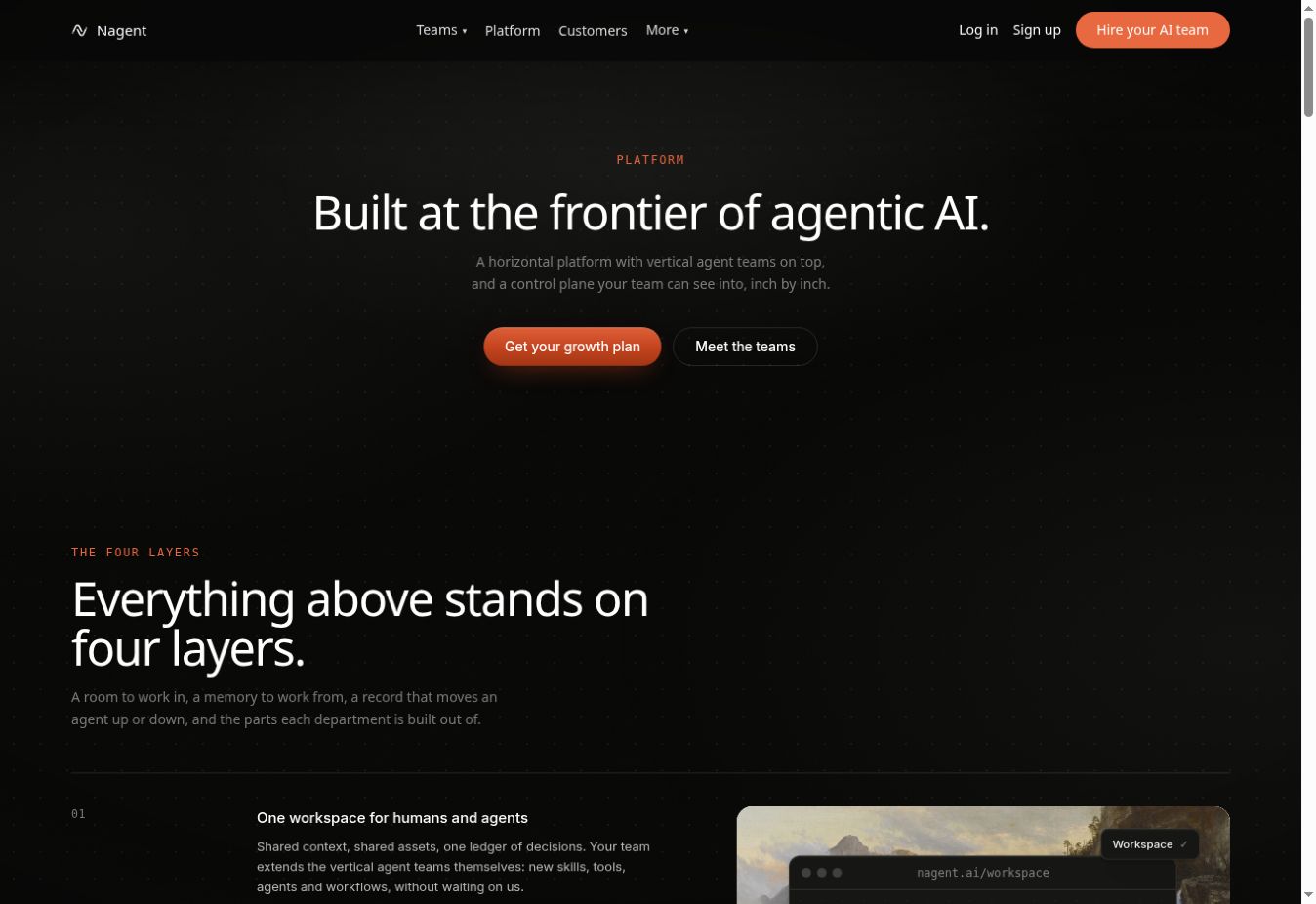
Multiplayer AI platform for growth: AI agent teams for marketing, sales and CX work with people in one shared workspace, with one Knowledge Hub every agent reads and autonomy that is earned, not deployed.
What the vendor documents
Nagent runs a shared workspace for people and agents, a Knowledge Hub that every agent reads before it works, a record of each agent's outcomes and governance history, and composable skills, tools, agents and workflows. 12 offerings ship today: the platform and AI agent teams for marketing, sales and content. Agents run on 19 model providers and 61 models and connect to hundreds of tools through Composio, plus your own API. MIRA, SERA and CREA, the AI Marketing, Sales and Content Chiefs of Staff, each lead a department of team leads; N, in Beta, heads the growth org. 4 patents filed, 3 published.
From $29.99 per month
Published plans with seats and monthly credits; annual billing saves 33%. Enterprise adds VPC deployment, BYO model and BYO key.
Check current commercial source ↗Collaboration and governance
Every action is fired, queued for approval or refused. Approval sits before the irreversible step, destructive changes always ask first, and each agent carries a budget cap and a kill switch. 6 workspace roles (Admin, Sales, Approver, Editor, Writer, Viewer), tenant isolation and an append-only audit trail. Autonomy runs L1 Observe to L5 Lead and is promoted on approved work, never automatically. ISO/IEC 27001:2022 certified by InterCert; SOC 2 Type II programme underway; tenant isolation, RBAC, append-only audit and private VPC available today.
Promoted use cases
- Run marketing, sales and CX agent teams with the people who own the number
- Give every agent one shared memory and one ledger of decisions
- Raise each agent from observe to lead on approved work, with approval before anything irreversible
- Bring in forward deployed engineers and Growth Pods for custom delivery
Review and customer evidence
Customer stories are published separately on nagent.ai, each on its own page. They are vendor-published; ask for a reference in your function and the baseline behind any figure.
Editorial fit
Nagent is the option for teams that want agents and people in one workspace rather than a tool beside the work: shared memory, autonomy that is earned and enforced, published pricing from $29.99 per month, and a delivery team that owns the outcome with you. Evaluate it on the same evidence you would ask of any vendor: shared context, human control and a safe improvement loop.
Priority question for the demo: Can two colleagues join the same live agent task, change its direction, inspect the memory it used, approve or reject an action and export the audit trail? Nagent demonstrates this in a team room.
Salesforce Agentforce in detail
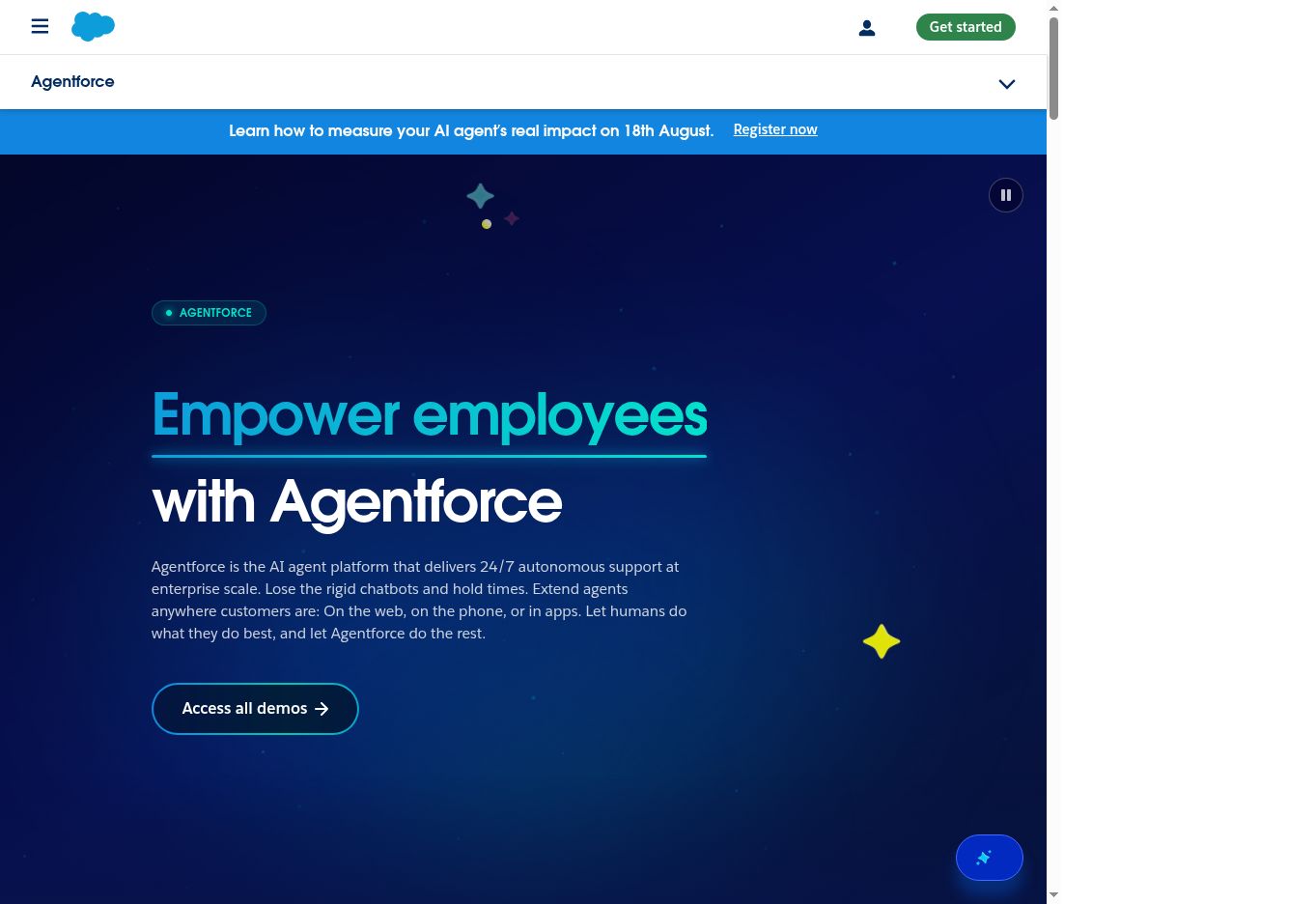
Agent platform tied to Salesforce customer data and workflows across revenue and service.
What the vendor documents
Salesforce publishes several Agentforce buying models, including Flex Credits, conversations and employee add-ons. Foundations is listed at $0; that does not make every deployed action or related data service free.
$500 / 100,000 Flex Credits
Standard action: 20 credits, or $0.10. Conversation pricing at $2 is an alternative model.
Check current commercial source ↗Collaboration and governance
Ask how action authorization, escalation and audit map to existing Salesforce permissions. Include Data 360 and other metered services in the estimate.
Promoted use cases
- Execute CRM-grounded service actions
- Assist sales and revenue teams
- Deploy customer-facing conversational agents
Review and customer evidence
A G2 video-review page exposes one critical review by Jonathan F. questioning use-case breadth and ROI. This is one visible reviewer, not a representative sample. No aggregate rating is asserted. Salesforce’s own G2 award page is vendor-hosted evidence.
Editorial fit
Agentforce has a natural advantage where Salesforce is the system of record and workflow owner. A separate platform needs to justify added operational complexity through measurable flexibility or delivery value.
Priority question for the demo: Give a trace and bill for one real workflow, including retries, data retrieval and all billable actions.
Adobe Agent Orchestrator in detail
Customer-experience agent orchestration grounded in Adobe data, content, journeys and brand context.
What the vendor documents
Adobe describes an AI Assistant, reasoning engine, knowledge base and Agent Composer. Promoted domains include audiences, content, journeys, planning and data insights.
Enterprise quote
Experience Platform / application entitlements and implementation must be scoped.
Check current commercial source ↗Collaboration and governance
Brand governance, consent context and agent boundaries are documented themes. Confirm policy enforcement across third-party extensions.
Promoted use cases
- Coordinate campaign planning and content
- Build and optimize customer journeys
- Apply brand and audience context across marketing work
Review and customer evidence
No independent review sample was verified in this research pass. Vendor-hosted testimonials are selection-biased customer evidence, not an aggregate rating.
Editorial fit
Adobe is a serious marketing orchestration comparator for enterprises invested in its experience stack. Existing content and audience infrastructure can outweigh generic flexibility.
Priority question for the demo: Where can an agent change a live audience or journey without review, and how is consent checked?
How to run the evaluation
Run the same bounded pilot on Salesforce Agentforce and Adobe Agent Orchestrator and on Nagent, with the inputs, the required output and the measure fixed before the first demo. Ask each vendor to show who can propose, approve, execute, interrupt and audit the action, and keep the evidence.
A lead becomes a governed opportunity
Give the agent a new lead with an existing account, a territory rule, a suppression flag and an open opportunity. Ask it to recommend an owner, draft a response and propose CRM changes. The test should reveal whether the agent understands existing state or simply creates more records and activity.
Measure: duplicate records, routing accuracy, accepted updates and time to first useful response.
Campaign and service context converge
Use a customer currently receiving marketing messages who also has an unresolved service issue. Ask the workflow to adjust the planned contact and route the case to its human owner. Require a clear explanation of which customer state and permission rule influenced the decision.
Measure: contact-policy consistency, service context retention and incorrect sends.
Extend beyond the native application
Select one workflow that must use a system outside the suite, such as an external content repository or a separate customer portal. Test identity propagation, write permissions and failure recovery across the boundary. Measure integration ownership as well as the agent’s apparent intelligence.
Measure: integration effort, successful handoffs and recoverable failures.
The evaluation owner should be the CRM or business-application owner. Use correctly completed customer workflows as the business target.
Frequently asked questions
Salesforce Agentforce vs Adobe Agent Orchestrator: what is the difference?
Salesforce Agentforce is agents embedded in an existing customer or enterprise system; Agent platform tied to Salesforce customer data and workflows across revenue and service. Adobe Agent Orchestrator is agents embedded in an existing customer or enterprise system; Customer-experience agent orchestration grounded in Adobe data, content, journeys and brand context. Both sit in the same stack role, so delivery scope, commercial basis and governance decide.
How do Salesforce Agentforce and Adobe Agent Orchestrator compare on price?
Salesforce Agentforce: $500 / 100,000 Flex Credits. Standard action: 20 credits, or $0.10. Conversation pricing at $2 is an alternative model. Adobe Agent Orchestrator: Enterprise quote. Experience Platform / application entitlements and implementation must be scoped. Nagent publishes 4 plans, from $29.99 a month, with monthly credits as the unit of agent work.
Which has stronger governance: Salesforce Agentforce or Adobe Agent Orchestrator?
Salesforce Agentforce: Ask how action authorization, escalation and audit map to existing Salesforce permissions. Include Data 360 and other metered services in the estimate. Adobe Agent Orchestrator: Brand governance, consent context and agent boundaries are documented themes. Confirm policy enforcement across third-party extensions. Nagent puts approval before any irreversible action, gives each agent a budget cap and a kill switch, and keeps an append-only audit trail.
Is Nagent an alternative to Salesforce Agentforce or Adobe Agent Orchestrator?
Nagent is a multiplayer AI platform where agent teams for marketing, sales and CX work with people in one shared workspace. It overlaps with Salesforce Agentforce and Adobe Agent Orchestrator where a growth team wants agents to do the work, and differs in operating model, governance and delivery; many teams run it beside a agents embedded in an existing customer or enterprise system.
What should I ask Salesforce Agentforce and Adobe Agent Orchestrator in a demo?
Salesforce Agentforce: Give a trace and bill for one real workflow, including retries, data retrieval and all billable actions. Adobe Agent Orchestrator: Where can an agent change a live audience or journey without review, and how is consent checked? For Nagent, ask to see a team room with several people, an approval taken in the Inbox and the audit entry it leaves.
Sources and research notes
- Nagent · product ↗
- Nagent · commercial / feature reference ↗
- Nagent · platform, workspace and security ↗
- Nagent · customer results ↗
- Salesforce Agentforce · product ↗
- Salesforce Agentforce · commercial / feature reference ↗
- Sales agent licensing and pricing FAQ ↗
- Agentforce Sales Management · official documentation ↗
- Official AI Sales Agents documentation ↗
- Agentforce Marketing product page ↗
- Official Fin acquisition close ↗
- Official Agentforce trust and permissions ↗
- Independent review surface · G2 ↗
- Adobe Agent Orchestrator · product ↗
- Official Agent Composer product page ↗
- Official CX Enterprise Coworker trial ↗
- Official Experience Platform overview ↗
- Nagent · security and compliance ↗