
The Agentic Marketing Thesis
Marketing was built for broadcast because conversation did not scale
Marketing was organised around one constraint: a brand could not afford to talk with each customer. Agents remove it, and three shifts follow. Work becomes multiplayer, with people and agents in one team. Machines intermediate the channel on both sides. The conversation, not the campaign, becomes the unit. Every marketing function reorganises around them.
Overview
Every marketing function, from brand to measurement, was designed around one constraint: a company could not afford to talk with each customer. Agents remove that constraint. This paper sets out what Nagent believes follows for each function, where the argument sits against Kotler and Prahalad, what the research from Harvard, MIT, Stanford, Wharton, INSEAD, the analyst houses, the venture firms and the model labs says, what the competitors we profile are selling, and what two years of building agent teams for marketing has shown in practice. It covers twelve functions and cites 149 sources, all listed at the end. It is the fifth paper in the Nagent thesis series, after The Nagent Thesis and State of Agent Governance.
- Shift one: multiplayer AI. People and agents in one team.
- Shift two: intermediated channels. A machine on both sides of the sale.
- Shift three: one to one, two way. The conversation becomes the unit.
The thesis
Broadcast was a workaround. The constraint it worked around has gone. Everything below follows from that sentence.
Marketing as a discipline is organised around an economic fact so old that it stopped being visible: a brand could not afford to talk with each of its customers. Segments, reach, frequency, funnels, campaigns, channels, the media plan, the creative brief, the quarterly calendar. Every one of these is a technology for talking at people in bulk, invented because talking with them one at a time cost too much. Gartner put the median cost of an assisted service contact at 13.50 US dollars in 2024, against 1.84 dollars for self-service (Gartner, Benchmarks to Assess Your Customer Service Costs, February 2024). At that price, a learning relationship with every customer was a slogan, and the discipline built itself around the slogan's impossibility.
That constraint has gone. Not softened, gone. A conversation with a customer now costs a fraction of a dollar, runs in any language, and improves with every correction. Klarna's assistant carried 2.3 million conversations in its first month and two thirds of all service chats, resolving in under two minutes where humans took eleven (Klarna and OpenAI, February 2024). Meta's business AIs were handling ten million conversations a week by April 2026, from one million at the start of the year (TechCrunch, 30 April 2026). The point is what a discipline does when the thing it was built to avoid becomes the cheapest thing it can do.
Nagent's thesis is that three shifts follow, and that every marketing function reorganises around them.
Marketing work becomes multiplayer. The unit of work is no longer a person with tools, or a person with an assistant. It is a team in which humans and agents are both members, share one context, and divide the work by judgement rather than by seniority. The strongest field evidence, from 776 Procter and Gamble professionals, found that an individual with AI matched the quality of a two-person team without it (Dell'Acqua et al., HBS and NBER, April 2025).
The channels are intermediated. An agent now sits between the brand and the customer on both sides of the transaction: the customer's answer engine and shopping assistant on one side, the platform's automated buying system on the other. Gartner's January 2026 forecast called this the end of channel-based marketing as it has been known. A brand that is not legible to machines is not present in the conversation.
Marketing becomes one to one, two way. Salesforce's 2026 survey of 4,450 marketers found 83 % saying customers expect a back-and-forth conversation, while 84 % admitted to sending generic campaigns and only around half could reliably reply to an email or a text (Salesforce, State of Marketing, February 2026). The gap between what customers expect and what marketing can deliver is the market.
The first shift changes who does the work. The second changes where the work lands. The third changes what the work is. A campaign was the unit of marketing because a conversation was unaffordable. When the conversation is affordable, the conversation becomes the unit, and the campaign becomes one of the ways to start one.
The campaign was the unit of marketing because the conversation was unaffordable. When the conversation is affordable, the conversation becomes the unit.
Nagent's position on what this means in practice is specific, because it has been built: a marketing department in which the chief of staff is an agent, the team leads are agents that each own a number, humans hold the outcome and the approvals, autonomy is earned per agent against a record, and the record of every conversation and every correction is the asset the department accumulates. The sections that follow set out the argument and place it against the two frameworks most marketing leaders were trained on, Kotler's and Prahalad's, because the thesis is less a break with them than the moment their assumptions finally hold. Then the research behind it, and how each of twelve marketing functions changes, with the Nagent agent that carries the function where one exists and an honest note where one does not yet.
Two things this document is not. It is not a claim that agents replace marketers; the evidence on human-agent teams points towards fewer people doing more consequential work. And it is not a claim that the conversation can be handed to an agent and left. Klarna's 2025 decision to rehire humans after leaning too hard on automation is treated here as a finding, and it shapes the whole design.
The promise
One-to-one marketing was promised in 1993. The economics refused it for thirty years.
The idea that marketing should be a relationship with each customer rather than a message to a segment is not new. Stan Rapp and Tom Collins called 1990 the age of the individual and set out ten turnarounds from mass marketing to individualised marketing (Rapp and Collins, The Great Marketing Turnaround, 1990). Don Peppers and Martha Rogers gave the idea its name three years later, arguing for share of customer over share of market and for learning relationships in which a company discovers what each customer wants today and will want tomorrow (Peppers and Rogers, The One to One Future, 1993). The Cluetrain Manifesto opened in 1999 with the line that markets are conversations, and its fourteenth thesis complained that companies addressing those markets sounded hollow, flat and literally inhuman (Levine, Locke, Searls and Weinberger, 1999).
Every one of those authors was right about the destination and wrong about the timing, and the reason is arithmetic. Peppers and Rogers assumed a database plus a human or a scripted interaction. Cluetrain assumed humans talking to humans. Neither worked at the scale of a consumer brand, because the only way to hold a two-way conversation was to pay a person to hold it. Gartner counted 17 million contact-centre agents worldwide in 2022, with labour as much as 95 % of contact-centre cost and 1.6 % of interactions automated (Gartner, August 2022). At 13.50 dollars per assisted contact, a brand with ten million customers faced a bill of 135 million dollars for one conversation with each of them. So the discipline did what it could afford: it personalised the salutation, cut the list into a few thousand cells, and called the result one to one.
By 2022 the most sophisticated version of the promise was the intelligent experience engine described by David Edelman and Mark Abraham, which depended on capturing and using personalised customer data at scale (Edelman and Abraham, Harvard Business Review, March 2022). It was a better funnel. It was still a funnel.
What changed is the price of a turn
The economic fact that changed between 2023 and 2026 is the cost of one conversational turn with a customer, and the evidence that the turn can be good. Erik Brynjolfsson, Danielle Li and Lindsey Raymond studied 5,172 customer support agents given an AI assistant and found issues resolved per hour rose 14 % on average and 34 % for the least experienced, with better customer sentiment and lower attrition (Brynjolfsson, Li and Raymond, Quarterly Journal of Economics, April 2025). Klarna's assistant did the work of 700 full-time agents in its first month and, by the third quarter of 2025, the equivalent of 853, with cost per transaction down from 0.32 dollars in early 2023 to 0.19 in early 2025 (CX Dive, May and November 2025). Thomas Davenport and Jim Sterne's 2025 book carries the argument in its subtitle: delivering the one-to-one promise with AI (Davenport and Sterne, The New Science of Customer Relationships, 2025).
Then Klarna reversed. In May 2025 its chief executive said the company had gone too far in the wrong direction with AI, that a cost focus had produced lower quality, and that it would recruit humans again, while the assistant kept handling two thirds of inquiries (CX Dive, 9 May 2025). The line he used is the most useful sentence in this document: AI gives speed, talent gives empathy.
What the Klarna arc establishes. Cost is no longer the constraint on one-to-one marketing. Judgement is. A conversation that is cheap and wrong is worse than no conversation, and the customer decides which it was. The design problem is therefore not how to automate the conversation but how to decide, per agent and per action, how much of it an agent may hold alone. That is an organisational question, and it is why the rest of this thesis is about org design before it is about models.
| Year | What happened | Why it matters |
|---|---|---|
| 1990 | The age of the individual | Rapp and Collins name the turn from mass to individualised marketing |
| 1993 | The One to One Future | Peppers and Rogers: share of customer, learning relationships. Assumes a database and a person |
| 1999 | Markets are conversations | Cluetrain. Right about the market, silent on who pays for the talking |
| 2008 | N=1, R=G | Prahalad and Krishnan: one consumer experience at a time, from resources drawn across a global ecosystem. The destination, with the vehicle still missing |
| 2022 | The last pre-agentic attempt | Edelman and Abraham's intelligent experience engines: personalised data at scale, still one directional |
| 2024 | The price of a turn collapses | Klarna's first month: 2.3 million conversations, two thirds of chats, resolution under two minutes |
| 2025 | The quality floor asserts itself | Klarna rehires humans. AI gives speed, talent gives empathy. Judgement becomes the constraint |
| 2026 | The expectation moves | 83 % of marketers say customers expect a back-and-forth (Salesforce). Gartner forecasts 60 % of brands using agents for one-to-one interaction by 2028 |
Kotler and Prahalad
Kotler drew the map of the broadcast era. Prahalad drew the map of the one that replaces it. This is where the thesis sits against the two frameworks every marketing leader was trained on.
Kotler's grammar was a theory of the constraint
Philip Kotler's Marketing Management gave the discipline its grammar: the four Ps of product, price, place and promotion, drawn from McCarthy and made canonical by Kotler, and the sequence of segmentation, targeting and positioning that every marketing plan since has followed (Kotler and Keller, Marketing Management, Pearson, successive editions). Segmentation is worth reading for what it assumes. A firm segments because it cannot serve each customer individually, so it groups them into cells large enough to be worth a message and small enough to share a need. Targeting chooses the cells. Positioning writes a message that survives being broadcast to a cell. The whole spine of the discipline is a set of elegant answers to the question of how to talk at people in bulk, and it was the right answer for as long as talking with them was unaffordable.
Kotler kept the spine and added a rung each decade. Marketing 3.0 in 2010 moved the centre from the product to the customer to the human spirit and made values part of the offer (Kotler, Kartajaya and Setiawan, Marketing 3.0, Wiley, 2010). Marketing 4.0 in 2016 redrew the funnel as the customer path of five As, aware, appeal, ask, act, advocate, and put a conversation at the centre of it: at the ask stage the customer consults friends, reviews and a search box, and the brand's job is to be findable and worth recommending (Kotler, Kartajaya and Setiawan, Marketing 4.0, Wiley, 2016). Marketing 5.0 in 2021 was subtitled technology for humanity and named five components: data-driven marketing and agile marketing as disciplines, predictive, contextual and augmented marketing as applications (Kotler, Kartajaya and Setiawan, Marketing 5.0, Wiley, 2021). Augmented marketing, humans working with machines on the customer interface, is the closest a marketing textbook came to naming what this document calls multiplayer AI. Marketing 6.0 in 2023 added immersion across physical and digital space (Kotler, Kartajaya and Setiawan, Marketing 6.0, Wiley, 2023). Marketing 7.0, published in April 2026, is subtitled a guide for thinking marketers in the age of AI, proposes mind-centric marketing as a shift away from AI-driven performance optimisation towards how people think, connect and buy, and carries a chapter on how performance marketing and AI obsessions kill authenticity (Kotler, Kartajaya and Setiawan, Marketing 7.0, Wiley, April 2026).
The thesis treats Kotler's ladder as accurate and incomplete. Each rung added a technology; none removed the constraint that segmentation was built to work around. What agents do to the ladder is specific. The five As collapse into one conversation: an agent can take a customer from aware to advocate inside a single thread, and the ask stage, which Kotler placed in the customer's hands, is now held by the customer's own agent as much as by the brand's. The five components of Marketing 5.0 map one for one onto an agent department: data-driven is the record, agile is a loop that runs continuously rather than in sprints, predictive is the funnel and the trust score, contextual is a conversation per customer, and augmented is a team of humans and agents. And Marketing 7.0's warning is the Klarna lesson stated by the discipline's founder: the more the machine optimises, the more the human must hold authenticity, which is why every function chapter below ends with what stays human.
Prahalad wrote the destination in 2008 and lacked the vehicle
C.K. Prahalad and M.S. Krishnan published The New Age of Innovation in 2008 with a claim compressed into two equations. N=1: value is built on the unique, personalised, co-created experience of one customer at a time. R=G: the resources to deliver it are drawn from a global ecosystem of many vendors rather than owned by one firm (Prahalad and Krishnan, The New Age of Innovation, McGraw-Hill, 2008). Prahalad's own gloss was that N=1 means one consumer experience at a time, that R=G means all the resources that need to be tapped from multiple vendors and around the world to satisfy that one experience, and that co-creation is about experience and experience is always contextual and personal (Prahalad, Business Today interview, May 2008). The book's opening line is that the industrial system as it is known has been morphing for some time and may have reached an inflection point. It had not, quite. It has now.
N=1 is the demand side of this thesis and R=G is the supply side. N=1 was unaffordable in 2008 for the same reason Peppers and Rogers was unaffordable in 1993: Prahalad's vehicle was the flexible business process and the analytics layer, and neither can hold a conversation. Agents supply the conversation, which is why the one-to-one shift is the first thing this document describes and the customer experience chapter is where it is tested. R=G describes an agent department exactly. On Nagent, an agent reaches 998 tools through managed integrations, runs on a model chosen per agent from 61 models across 19 providers, works through skills written as documented procedures, and can be reached by outside systems through webhooks and MCP client tokens under the same governance (connecting tools, triggers and webhooks). The resource base is global and rented; the experience is one at a time. Prahalad's pairing was not a slogan. It was a description of an architecture that nobody could build until the resources learned to talk to each other.
The earlier co-creation work gives the thesis an acceptance test. Prahalad and Ramaswamy set out four building blocks of co-creation in 2004: dialogue, access, risk assessment and transparency (Prahalad and Ramaswamy, The Future of Competition, Harvard Business School Press, 2004). Read against an agent holding a customer conversation, they are a specification. Dialogue: the exchange is two way, and the agent listens before it speaks. Access: the customer sees the same knowledge the agent is reading, which is what a citation in an answer provides. Risk assessment: the customer knows what the agent may and may not do on their behalf, which is what the approval gate and the disclosed autonomy level provide. Transparency: the customer knows they are talking to an agent, which is the disclosure position the social chapter takes. A conversation that fails any of the four is not co-creation; it is automation with a friendly voice.
An Indian frame for an Indian company. The counter-case later in this document notes that peer-reviewed research from the Indian business schools on agents in marketing is thin. The theory the thesis rests on is not. N=1 and R=G were written by a professor from Coimbatore who built the argument on Indian cases, and the framework reads more naturally in a market of hundreds of millions of customers and thousands of vendors than it did in the markets it was first sold to.
| Framework | What it assumed | What agents change | Where it lives on Nagent |
|---|---|---|---|
| Four Ps and STP | One message per segment, because one per customer was unaffordable | The segment of one; positioning written in two registers, for the person and for the model | ICP segments in the Knowledge Hub; Brand Lock |
| Marketing 4.0, the five As | At ask, the customer consults friends, reviews and search | Ask is held by agents on both sides; the five As collapse into one thread | DRIS on the customer's agent; the brand's own conversation, through Convexa, Nagent's conversation product |
| Marketing 5.0 components | Augmented marketing: humans plus machines at the interface | The team, the record, the continuous loop | Team rooms; Smriti memory; the Karmic loop |
| Marketing 7.0 | Mind-centric marketing against performance obsession | The human seats: editor, operator, strategist, arbiter of results | What stays human, in every chapter |
| N=1 | One consumer experience at a time, co-created | Affordable, for the first time, because the conversation is cheap | The Agentic CRM and the record per customer |
| R=G | Resources tapped from a global ecosystem, not owned | Tools, models, skills and external agents under one governance | 998 tools; a model per agent; webhooks and MCP |
| DART | Dialogue, access, risk assessment, transparency | An acceptance test for any agent conversation | Two-way thread; cited sources; confirm cards and autonomy level; disclosure |
Three shifts
Who does the work, where it lands, and what it is.
Multiplayer AI
Marketing work moves from a person with tools to a team in which humans and agents are both members, sharing one context and one record.
The most important marketing experiment of the last two years was not run by a marketing team. Fabrizio Dell'Acqua, Ethan Mollick, Karim Lakhani and colleagues ran a randomised field experiment with 776 Procter and Gamble professionals doing real product-innovation work, alone or in pairs, with or without a frontier model. Individuals with AI matched the quality of two-person teams without it, spent 16.4 % less time, and stopped producing work shaped by their function: without AI, commercial staff proposed commercial solutions and technical staff technical ones; with AI, both produced balanced proposals (Dell'Acqua et al., The Cybernetic Teammate, HBS working paper and NBER 33641, April 2025). The silo dissolved because the expertise became portable.
The second experiment was run on marketing work directly. Harang Ju and Sinan Aral at MIT had 2,234 participants create 11,024 advertisements in human-human and human-agent pairs. Human-agent teams produced 50 % more ads per worker, delegated 17 % more and made 62 % fewer direct text edits. Their output was also more homogeneous, and when the ads ran on X against roughly five million impressions, text quality raised click-through while image quality lowered cost per click (Ju and Aral, MIT Sloan, arXiv 2503.18238, 2025 to 2026). Productivity went up. Diversity went down. Both are design inputs.
Executives already see the agent as a colleague: in a survey of 2,102 executives, 35 % were using agentic AI, 44 % planned to, and 76 % described it as a coworker rather than a tool (Ransbotham et al., MIT Sloan Management Review and BCG, November 2025). Trust is thin: among 603 leaders, 6 % fully trusted agents to run core processes autonomously and 43 % trusted them only with routine tasks (HBR Analytic Services, 2025, via Fortune). Stefano Puntoni at Wharton put the resolution simply: not human alone or AI alone, but human and AI (Knowledge at Wharton, May 2026).
What Nagent takes from this is the shape of the workspace. Work happens in a team, so the software has to hold humans and agents as peers on one thread, with one repository, one decisions log and one memory. The agent's productivity is real; so is its tendency to converge. The team is the corrective, and the human's job in it is judgement, taste and the decision.
The intermediated channel
An agent now sits between brand and customer on both sides: the customer's answer engine and shopping assistant, and the platform's automated buying system.
The click is leaving search. Pew tracked 68,879 searches by 900 US adults and found people clicked a traditional result 8 % of the time when an AI summary was shown, against 15 % without, and clicked a link inside the summary 1 % of the time (Pew Research Center, July 2025). By early 2026, 68.01 % of US Google searches ended without a click, up from 60.45 % in 2024 (SparkToro with Similarweb, June 2026). Google's search revenue grew 17 % in the same quarter and its AI Mode passed a billion monthly users (Alphabet, second quarter 2026 results). Queries did not fall, as Gartner had predicted in 2024 they would; the click did.
The traffic that does arrive from AI converts. Similarweb counted 770.7 million average monthly AI referral visits to the top thousand domains, up 117 % year on year, with ChatGPT above 80 % of that share (Similarweb, September 2026). Adobe found AI-referred traffic to US retail sites up 693 % over the 2025 holidays, converting 31 % better than other sources (Adobe Analytics via Digital Commerce 360, January 2026). McKinsey expects agents to mediate three to five trillion dollars of global consumer commerce by 2030 and found 38 % of European consumers already using AI to research products and decide what to buy (McKinsey, January and March 2026).
The brand is being read by a machine that does not read like a person. INSEAD's David Dubois and colleagues found three frontier models unmoved by the visual cues luxury brands rely on, explicit descriptors beating implicit ones, and roughly 80 % of a model's citations coming from third-party sources (Dubois, Hess, Dawson and Jaiswal, INSEAD Knowledge, August 2026). Kartik Hosanagar's warning is that retailers risk becoming back-end fulfilment centres to AI systems (Hosanagar, HBR, June 2026). Puntoni's is shorter: if the models ignore a brand, the brand is not part of the conversation.
The other intermediary is the seller's. Meta's stated goal is that by the end of 2026 a business gives it a product image and a budget and the platform produces the imagery, video, text, targeting and allocation; in Mark Zuckerberg's words, no creative, no targeting demographic, no measurement needed (Marketing Dive reporting the Wall Street Journal, June 2025). OpenAI reached a billion dollars of annualised advertising revenue within 200 days of launching ads inside ChatGPT (OpenAI, August 2026).
What Nagent takes from this is that a brand needs agents of its own on both sides: legible to the customer's agent, through consistent facts, explicit claims and presence in the sources engines cite; and independent of the platform's agent, keeping its own creative judgement, measurement and record, or the platform holds all three. Neither is a job for a person with a dashboard. Both are jobs for an agent under a person.
One to one, two way
The conversation replaces the campaign as the unit of marketing, because it is now affordable, expected, and measurably better than the broadcast it replaces.
The demand side has moved. Among 4,450 marketers, 83 % said customers expect a back-and-forth conversation, 69 % said they struggle to respond promptly, and 84 % admitted their campaigns are still generic (Salesforce, State of Marketing, February 2026). Gartner forecasts 60 % of brands using agentic AI for one-to-one interactions by 2028 (Gartner, January 2026). Salesforce's holiday data put AI and agents behind 262 billion dollars, a fifth of global online holiday sales, with retailers running their own agents growing 59 % faster (Salesforce, January 2026).
The economics of personal creative have inverted. Madhav Kumar and Anuj Kapoor ran a field experiment with 21,328 customers and found avatar videos personalised to purchase history lifted click-through by six to nine percentage points over personalised image ads, at about 13 dollars per ad against about 120 (Kumar and Kapoor, MIT Initiative on the Digital Economy, 2025). A hundred thousand personalised videos for roughly 220,000 dollars, where the same run would have cost around 12 million, is not an efficiency. It is a different medium.
The conversation itself does commercial work. Turn-taking and grounding in conversational AI raise perceived humanness, brand intimacy, recommendation acceptance, price premium and loyalty (Bergner, Hildebrand and Häubl, Journal of Consumer Research, 2023). Amazon's Rufus reached around 12 billion dollars of incremental annualised sales in 2025, with users 60 % more likely to complete a purchase (Amazon fourth quarter 2025 results, via PPC Land). Bain found consumers trust a retailer's own agent three times more than a third party's (Bain, May 2026), the strongest argument available for a brand running its own conversation rather than renting one.
What Nagent takes from this is that the conversation is the unit, and that a conversation held by an agent needs a quality floor the customer can feel. So autonomy on the conversational surface is earned per agent and per action, the escalation to a human is designed in, and a rising handoff rate is treated as a signal about the agent, not about the customer.
The three shifts are one shift, seen from three sides
When the cost of a conversation falls, the brand can hold one with every customer (shift three); the customer, having an agent of their own, expects to be spoken to through it (shift two); and the only way to hold millions of conversations to a standard is a team in which agents carry the volume and humans carry the judgement (shift one). A marketing function that adopts any one without the other two ends up with volume it cannot govern, presence it cannot measure, or a team it cannot scale. That is why the argument runs through the organisation first and the functions second. The functions change in ways the research already describes. The organisation is the part that has to be designed.
The marketing org
A department where the chief of staff is an agent and the chief marketing officer still decides. What Nagent has built: the structure, the room, the autonomy ladder and the record.
Michelle Taite, John Winsor and Will Fernandez argued in May 2026 that the sequential, siloed marketing organisation cannot keep pace with agents, and proposed a machine-readable brand code used by humans and agents alike, layered specialised agents for content, experimentation, distribution and reporting, and marketers who move from execution to direction and judgement (Taite, Winsor and Fernandez, HBR, May 2026). That is a fair description of the department Nagent had already built, and of how it has changed since.
The structure follows the numbers a marketing team already owns
A human chief marketing officer owns the outcome. Under the people sit three departments, each led by a chief of staff agent and each owning one outcome: Marketing owns reach and pipeline cost, Content owns output and the brand line, and Sales owns qualified meetings (prebuilt teams).
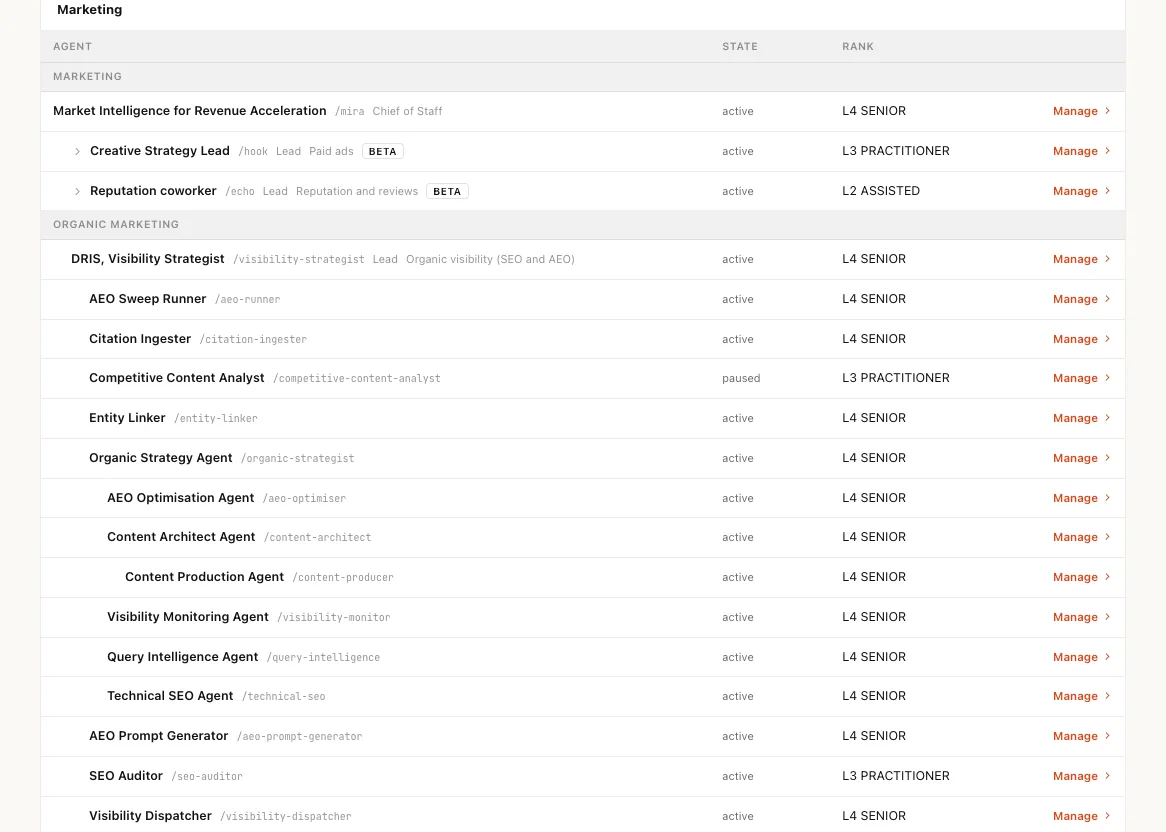
MIRA is the Marketing chief of staff (public page). She works out what a brief needs, passes it to the teammate who owns it and keeps the thread together, and on the org chart the Marketing team leads report to her. She is also Nagent's coordinator across the three departments. DRIS owns organic visibility across search and answer engines (public page). NIA owns paid advertising (public page). HOOK leads the creative bench for ads (public page). MOXA leads the social team. Echo handles reputation and reviews (public page). CREA leads Content as its own department (public page), with RUPA on images (public page), FOLIO on long-form publications (public page) and Alpha on video (public page). SERA leads Sales (public page), with NORA on outbound (public page), DEXA on deals and RIVA on revenue operations, and CORA leads the Agentic CRM team and reports to SERA.
The department mirrors the split most marketing teams already have: someone owns the plan, someone owns organic, someone owns spend, someone owns the creative, someone owns social, someone owns content, someone owns the pipeline. The difference is that each of those someones is an agent with its own page showing the number it owns, and that the human above them is looking at the same page.
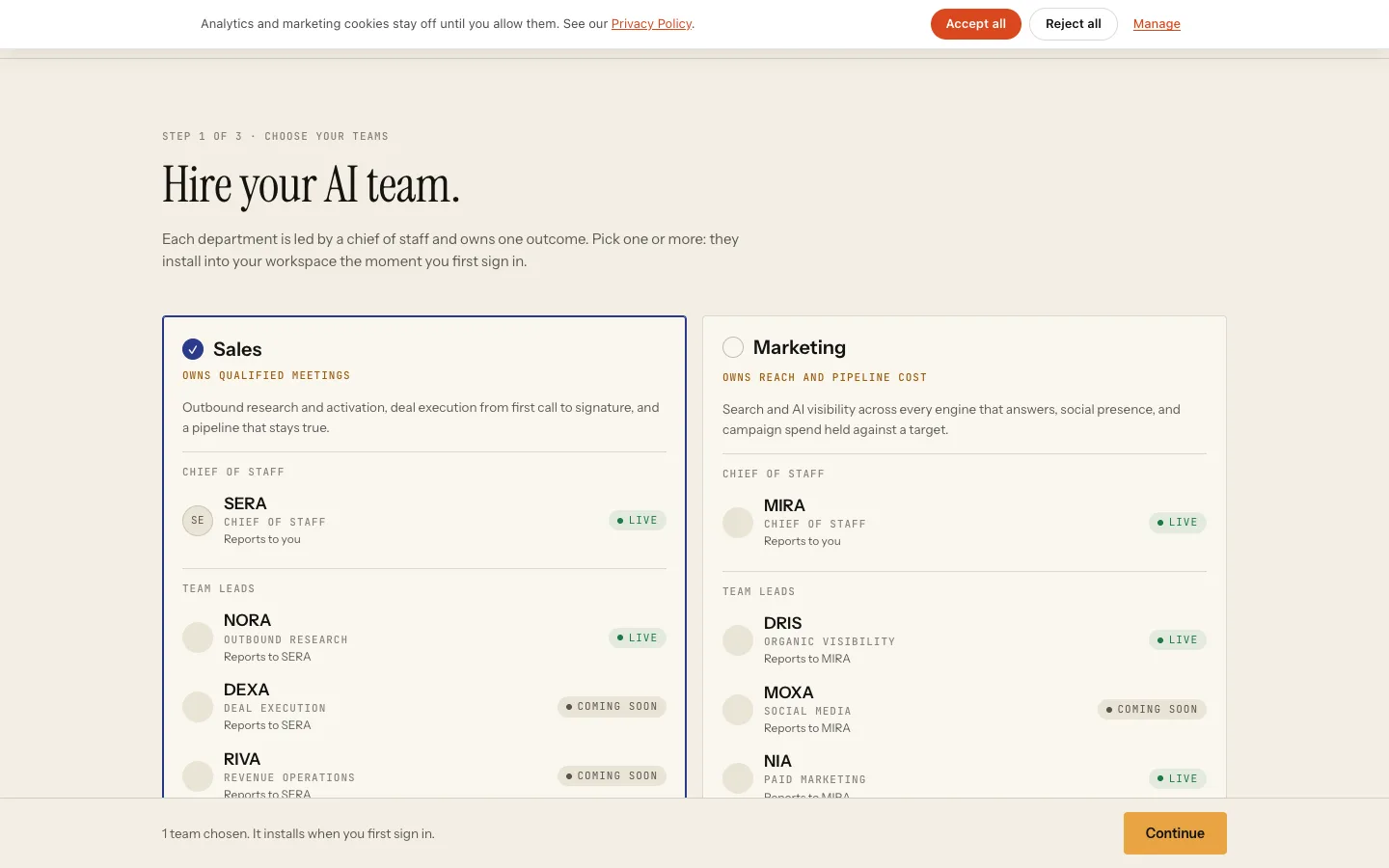
The leads hand work to each other through actions a person can see. HOOK's production brief goes to RUPA for images and to Alpha for video; GATE checks what comes back; a finished Google pack goes to NIA, who builds the campaign paused. MOXA hands work to RUPA, CREA and Alpha, and a post MOXA proposes to boost is run by NIA after one of MOXA's named approvers signs it. Echo hands a page fix to DRIS and a post to MOXA. Every one of those hand-offs is logged, budgeted and scoped to the agent that fired it.
Convexa and Kinetiq are Nagent's own products, sold separately, not agents on this platform. Convexa holds customer conversations in chat, voice and video; the Customer Experience card at sign-up links to it, and nothing installs in the workspace when it is chosen. Kinetiq is our motion video product, which Alpha uses to compose motion video. Both have their own sign-up.
The room is the main surface
The department runs in team rooms. A room is one conversation that colleagues and agents share; everything said in it is attributed and kept, so the room is also the team's record, and corrections are new entries, never edits. Addressing an agent asks it to answer. An instruction becomes a task only when a person confirms it. A question is answered in a thread beside the room, with the sources the answer came from.
Each team lead's own page opens inside its room. The Marketing room carries one view per lead it seats, and DRIS, HOOK, MOXA, Echo, NORA and the CRM team each have a lead room of their own that seats the lead and every agent under it. Each team keeps its record as files every member can read: charter.md, roster.md, tasks.md, pending.md, log.md, smriti.md, access.md and events.log (anatomy of a team). Membership of the team is the access boundary. When a question needs several agents, the lead can call a meeting with a fixed budget that ends with decisions and tasks on the board (meetings in the team room, Beta).
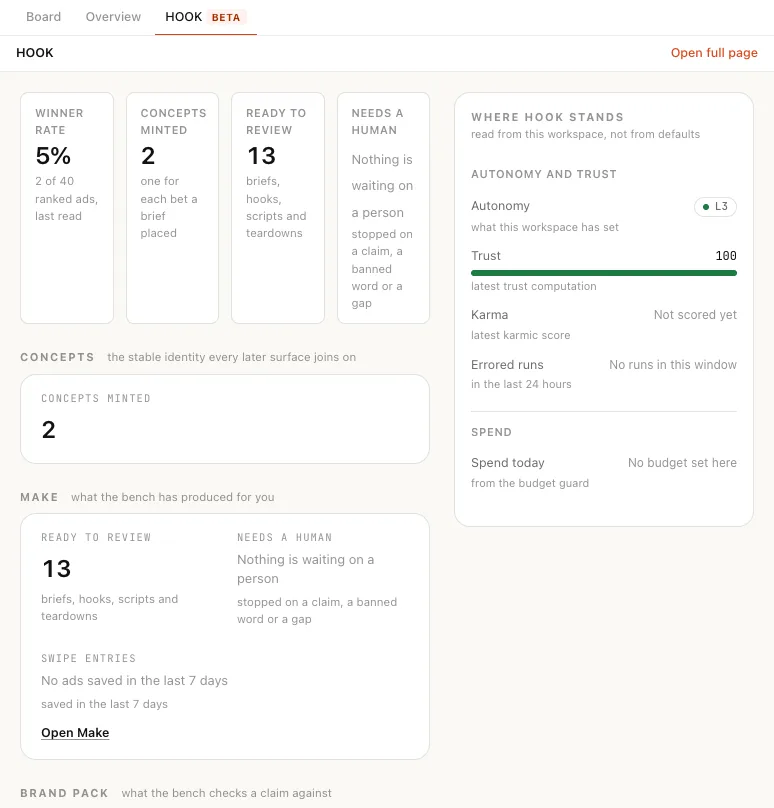
Work that needs a person waits rather than proceeding. A held action shows in the room as a card headed Confirm before it runs: it names the agent, the action, what it runs on, its cost, risk and side effects, and who can approve it. Only the buttons approve it; typing "approve" does not. On any other agent message a person can press Good answer or Not what I wanted, and both feed the Karmic loop that moves an agent's trust. This is the multiplayer layer, and it is the direct product of the evidence in shift one: the Procter and Gamble study found expertise becomes portable when an agent is in the room, and the team room is that room.
Autonomy is earned per agent, against a record
Every agent works at a level, and the level decides which of its actions run on their own and which wait for a person. Nagent numbers the rungs in the product from L1 Observer, read only, through L2 Assisted, L3 Practitioner and L4 Senior to L5 Principal, and shows each agent's rung and trust record on its page (autonomy and governance). Each action an agent can take declares the level it needs to run unattended; below it, the action is held. Pure reads always run. A prebuilt team arrives at L4 Senior so it can work from its first message, and what keeps that safe is that some actions are gated separately from the rung: on a new workspace every outbound email waits for a person, every live change NIA proposes to an ad account waits for approval, a campaign NIA builds arrives paused, and HOOK cannot pause, launch or change an ad at all. A workspace admin can raise or lower any agent, and every change is recorded with who made it. The full framework is published as The Earned Autonomy Ladder.
Guardrails are per agent and drawn from a template library, each with a severity, a category and an enforcement action: never quoting pricing in writing, capping daily model spend with an automatic pause, requiring approval before any external email, citing only published content, matching brand voice against a banned-phrase list. Budgets are a daily and monthly cap per agent, enforced by the runtime rather than requested of the model. Memory, called Smriti, is layered: operator-authored rules and brand voice above, the agent's own observed tendencies and recent failures beneath, with every run's assembled context kept for replay. The Karmic loop converts outcomes and human corrections into trust movement. Together these are Taite, Winsor and Fernandez's brand code, held as a live configuration rather than a document (anatomy of an agent).
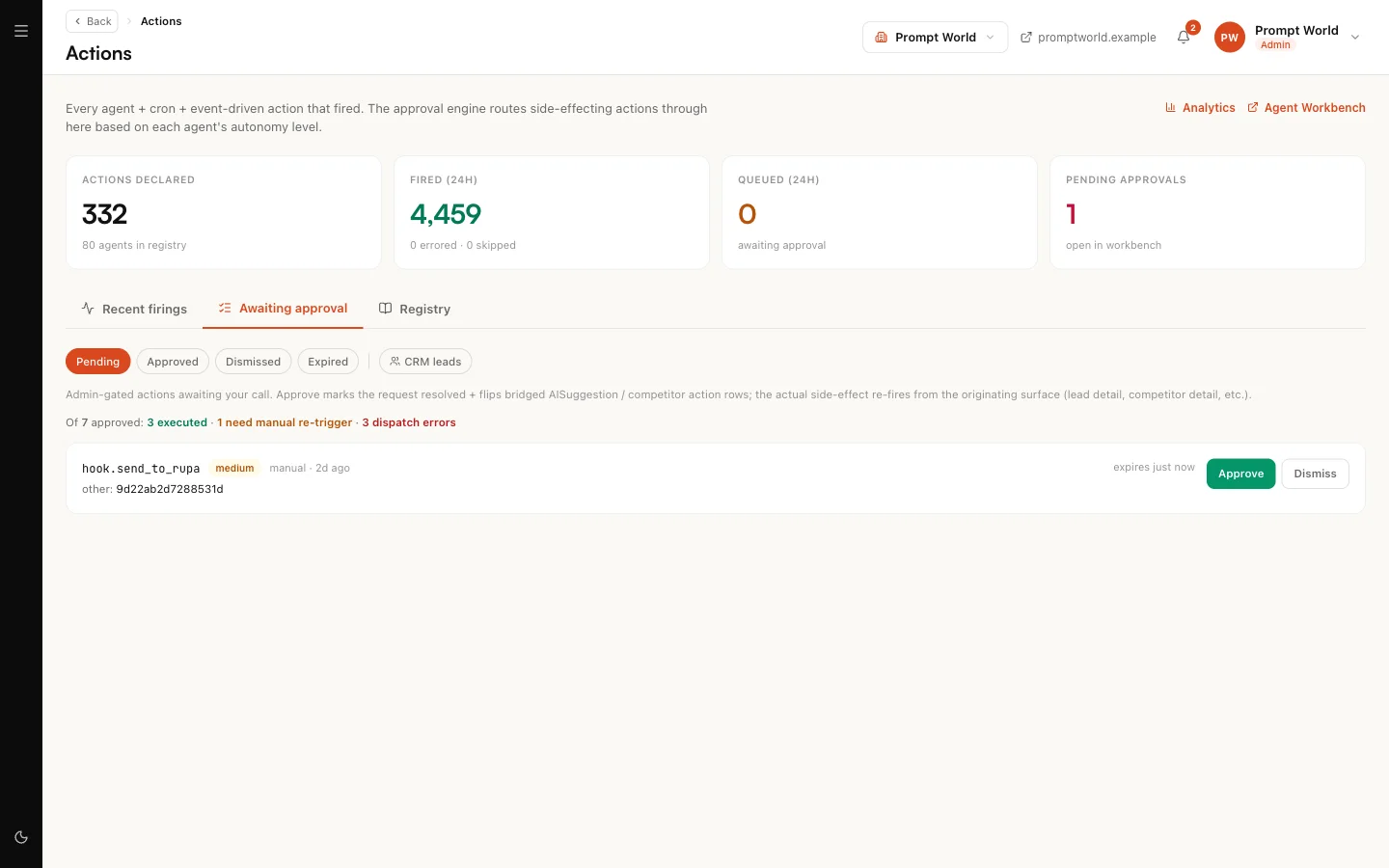
Why this is an org design, not a tooling choice. A marketing team can buy a dozen point tools that each contain an agent. What it cannot buy that way is a single approval queue across all of them, one memory of the brand that all of them read, one trust score per agent that a human can see, and one record of what was proposed, approved, corrected and learned. Those four things are what make it safe to raise a conversation from one rung to the next, and they only exist if the agents share a platform. The department is the product; the platform is what makes the department governable.
The roster
The roster as it stands in October 2026, with the honest state of each seat. Beta means the screen says so: new, and rough in places.
| Agent | Role | Reports to | What it owns | State |
|---|---|---|---|---|
| MIRA | Chief of staff, Marketing | A person | The plan, and passing work to the lead who owns it | Live |
| DRIS | Organic visibility, search and answer engines | MIRA | Share of AI answers against a declared objective, with fifteen named specialists in its room | Beta |
| NIA | Paid advertising | MIRA | Google Ads campaigns and proposed changes, each live change held for approval | Live |
| HOOK | The creative bench for ads | MIRA | Angles, hooks, scripts and the brief, through eight seats from SCOUT to VAULT | Beta |
| MOXA | The social team | MIRA | The week of posts, listening and insights, every post approved by a named person | Beta |
| Echo | Reputation and reviews | MIRA | Reviews read into cases, and AI answers checked against approved facts | Beta, reads and checks, does not yet reply |
| CREA | Chief of staff, Content | A person; MIRA coordinates | Blog posts grounded in the Knowledge Hub, nothing live until approved | Live |
| RUPA | Images | CREA | Plates rendered to a preset with the brand attached | Beta |
| FOLIO | Long-form publications | CREA | Documents turned into publications, with its own working agents | Seated with Content |
| Alpha | Video | CREA | A plan shot by shot and a quote in credits before anything renders, across seven desks | Beta, render lanes still arriving |
| SERA | Chief of staff, Sales | A person; MIRA coordinates | Qualified meetings | Live, forecast and scoreboard not built |
| NORA | Outbound research and activation | SERA | Qualified meetings handed to a person, with a lead-generation bench of five | Live |
| DEXA | Deal execution | SERA | The deal room after a person has taken the deal | Live |
| RIVA | Revenue operations | SERA | A pipeline that stays true; she never edits an amount, stage or owner | Live |
| CORA, the Agentic CRM | CRM team lead | SERA | Deals from first touch to a kept customer, with a bench for retention, expansion and data health | In every workspace |
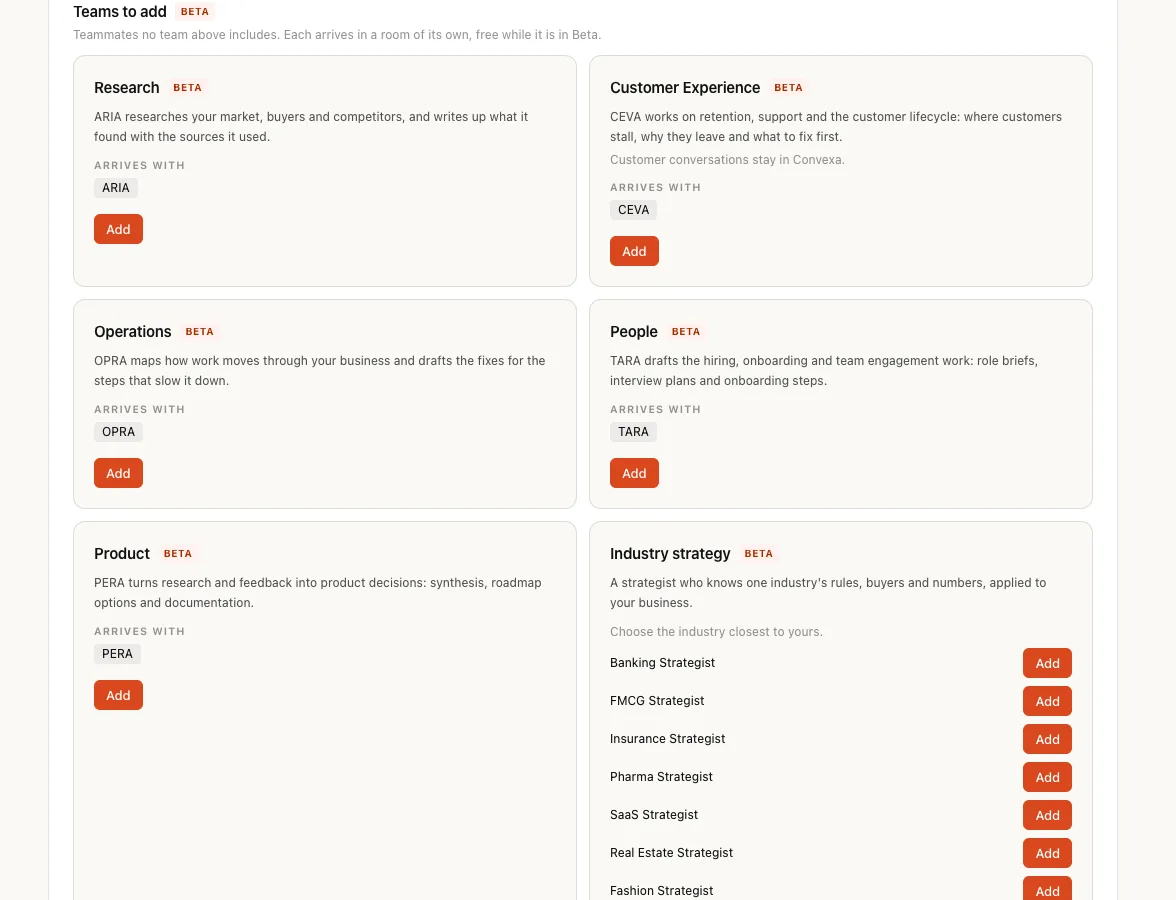
Two email writers, LIPI and VANI, sit on the Sales team in Beta: LIPI writes to people you already know, VANI to people you do not. Beside the three prebuilt departments, a workspace can add teams in Beta: Research with ARIA, Customer Experience with CEVA, Operations, People, Product, and eight industry strategists.
Twelve functions
Each function was built on the broadcast constraint. Each one moves. The map is the argument in miniature: what moves, and which agent carries it.
| Function | What moves | Carried by on Nagent |
|---|---|---|
| Brand and positioning | The brand becomes a knowledge base read by machines that ignore the cues built for people | Brand Lock, the Knowledge Hub, Smriti, Echo |
| Organic and answer engines | The unit of visibility moves from a ranked link to a citation inside an answer | DRIS |
| Paid media | The buyer's job becomes objectives, constraints and creative inputs to a platform that runs the rest | NIA, HOOK |
| Creative production | Production becomes selection. The brief is the product and the human is the editor | HOOK, RUPA, Alpha, CREA |
| Social | Listening becomes agentic, posting becomes a governed stream, and disclosure becomes the constraint | MOXA |
| Lifecycle and CRM | The scheduled flow gives way to a decision per customer, and the message gives way to a reply | The Agentic CRM, LIPI |
| Customer experience | The conversation becomes the commercial surface, and the escalation becomes the design | CEVA (Beta), with Convexa, Nagent's own conversation product |
| Insight and research | Research becomes a simulate-then-validate loop, and the panel becomes a check on the simulation | ARIA (Beta), ICP segments |
| Measurement | Measurement returns to experiments and mix models, run continuously, and the question becomes who owns the loop | Each lead's page, PULSE, the Karmic loop |
| Earned and PR | Earned media is re-priced by whether an answer engine cites it | DRIS, Echo, CREA |
| Go-to-market | The buyer arrives with a shortlist a model formed, and marketing and sales become one loop | ICP segments, NORA, the Sales team |
| Operations and the org | Budget moves to AI, headcount flattens, agencies contract, and the operating model becomes a small team directing agents | MIRA, team rooms, the Agent Workbench, Growth Pods |
Brand and positioning
The brand is now read by a machine that ignores everything built for a person. Brand strategy was the function least worried by earlier waves of marketing technology. Programmatic changed how media was bought; brand still decided what was said. Agents change who does the reading, and that is a change brand cannot delegate.
What moves
A brand's positioning now has two audiences: the person and the model the person asks, and the two read differently. INSEAD's finding that three frontier models did not respond to the height, spaciousness and minimalism cues that raise perceived value for people, and drew about 80 % of their citations from third-party material, means a positioning built entirely out of connotation is invisible to the reader that increasingly forms the shortlist (Dubois et al., INSEAD Knowledge, August 2026). The model's reading is also unstable: when 600 volunteers ran twelve identical prompts across three assistants, ChatGPT and Google returned the same list of brands in under one response in a hundred (SparkToro, via MediaPost, January 2026), and a study of 14,000 model calls found brand consistency lowest for purchase-intent prompts, at 40 % (Conductor, July 2026). The prompts where money changes hands are the ones where the model is least sure who to name.
The reader is now the customer of record for some purchases. Marko Sarstedt, Susanne Adler and Monika Imschloss argue that as consumers delegate decisions to assistants, those systems become AI customers marketers must recognise as such (Journal of Marketing Analytics, 2026). Oguz Acar and David Schweidel found two thirds of Gen Z already researching products with models, and model data on brands often incomplete or incorrect, including a Scotch brand placed in a prestige tier it does not occupy (Acar and Schweidel, HBR, March 2026). BCG found 96 % of CMOs saying AI is changing marketing end to end while 31 % had moved agentic execution beyond the basics, and consumers meeting fifteen or more touchpoints before purchase against about five a decade ago (BCG, July 2026). The investors have drawn the same conclusion from the other side: one of a16z's ideas for 2026 is creating for agents rather than for humans, as agents become the primary consumers of content (a16z, Big Ideas 2026, December 2025), and Vinod Khosla's essay imagines a personal agent for every individual, designed to shield them from manipulative marketing (Khosla Ventures, September 2024).
What it looks like on Nagent
The brand lives on the platform as a machine-readable record before it lives anywhere else. Brand Lock holds the voice: a personality, a writing style, the words to avoid and examples, extracted from the website and applied only after a person confirms it. The Knowledge Hub holds products and services, who you sell to, the website's pages, the brand and the assets as first-class records, and every marketing agent draws its claims from there. RUPA sends the workspace's brand guidelines with every render unless someone turns it off; HOOK's brand pack is the list of what HOOK may say, and its GATE seat checks every claim and line of copy against it and can block. CREA's drafts are built from the Knowledge Hub, and where it has nothing on a topic the draft is written without it rather than inventing detail.
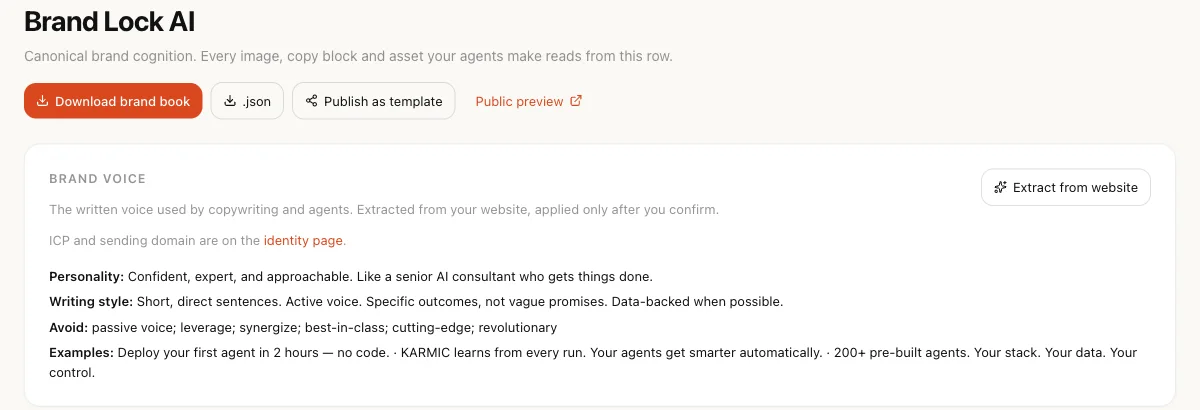
That is the internal half. The external half is Echo's AI reputation view, which samples what answer engines say and checks each claim against the facts a person has approved, reporting claim issues, observed inclusion and source coverage as separate measures rather than one AI score. Unilever's Brand DNAi, restricting its models to approved brand voices across eighteen markets, is the same idea built in-house at a scale few companies can afford (Digiday, July 2025).
What stays human
Deciding what the brand stands for. An agent can report that models describe a brand as mid-market when it prices as premium; it cannot decide whether the answer is to change the price, the claim or the evidence. The strategist's new job is to write the brand in two registers, one for the person and one explicit enough for the model, and keep them from contradicting each other.
| Broadcast era | Conversation era | |
|---|---|---|
| Unit of work | The guidelines document and the campaign idea | The brand as a live voice record and a knowledge base every agent reads |
| Who reads it | Customers, through media | Customers and the models they ask, which read explicit claims and third-party sources |
| What is measured | Awareness, consideration, share of voice | Share of answer, accuracy of what models say, and the sources they cite |
| Where the human sits | Author of the guidelines | Author of the claims and arbiter of the contradictions the audit surfaces |
Organic visibility and answer engines
The unit of visibility moved from the ranked link to the citation in the answer. Search optimisation was the purest broadcast-era function: publish, rank, receive traffic, repeat. The rank was the outcome and the click was the proof. Both are now in question, and the discipline that replaces them is being invented in public. The full argument is in The Answer Layer.
What moves
The click numbers are in shift two. What they add up to is a 34.5 % fall in position-one click-through where AI Overviews appear (Ahrefs, April 2025), 80 % of consumers relying on zero-click results at least 40 % of the time (Bain, February 2025), and business buyers further along still: 94 % using large language models somewhere in the buying journey, first vendor contact moving from 69 % to 61 % of the way through, and 76 % of the shortlist known before any contact (6sense, November 2025).
What replaces the rank is the citation, and citations come from somewhere specific. Across 230,000 prompts and more than a hundred million citations, Semrush found ChatGPT's sources shifting sharply within weeks, Reddit falling from around 60 % of responses to around 10 % in a month (Semrush, November 2025). A separate audit put Wikipedia at 13.15 % and Reddit at 11.97 % of US ChatGPT citations, with the Wall Street Journal, the New York Times, Bloomberg and the Financial Times absent from the top twenty (5W Public Relations, May 2026). Answer engines assemble answers from whatever is most extractable and most consistent. The traffic that survives is worth more: AI-referred visitors to US retail sites over the 2025 holidays converted 31 % better and produced 254 % more revenue per visit (Adobe Analytics via Digital Commerce 360, January 2026). Marketers know this and have not reorganised for it: four in ten companies report using generative engine optimisation (The CMO Survey, Duke Fuqua, March 2026), and 73 % of PR professionals call AI search visibility the next frontier while 29 % say nobody owns it (Muck Rack, July 2026).
What it looks like on Nagent
DRIS owns this number (public page). DRIS asks the answer engines the questions a company's buyers ask, naming ChatGPT, Claude, Gemini, Perplexity and Grok in its run profiles, and records whether each answer cites the company's site and which other sources it relies on. Alongside that it reads Google Search Console and Google Analytics, audits pages, sees which AI crawlers read the site and watches competitors. Work starts from an objective a person declares, a number and a date, and Today grades it every month as ahead, on target or behind.
DRIS does not work alone. Its room seats fifteen named specialists, among them an AEO Prompt Generator that writes the buyer questions, an AEO runner that asks them, a Citation Ingester that records the sources, a Competitive Content Analyst, a Technical SEO agent that watches crawler access, an AEO Optimisation agent for answer blocks and machine readability, and an Editorial QA agent that can stop a publish. What they find lands in one ranked Queue, weighted by contribution to the objective, severity, effort and age. Approving a proposal clears the step to run; it never publishes. In DRIS's own words, it never edits a live page on its own: publishing stays a human decision.

Nagent publishes its own comparisons at /comparisons, dated and sourced, for the same reason this function changed: engines and the listicles built on them extract tables, and a brand that is not in the table is not in the set the engines draw from.
What stays human
The claim, and the disclosure. DRIS can show that a category page is unextractable and propose the rewrite; a person decides whether the brand wants to be found for that category at all, and anything a company ranks itself in is published under a byline that says who ranked it.
| Broadcast era | Conversation era | |
|---|---|---|
| Unit of work | The page, optimised to rank | The extractable claim, placed where engines cite |
| Who does it | An SEO specialist and an agency with a tool subscription | DRIS and its fifteen specialists, and a person who approves the proposals |
| What is measured | Rank, sessions, click-through | Share of AI answers across a prompt set, citations, accuracy, and conversion of the traffic that still arrives |
| Where the human sits | Writing and building links | Declaring the objective, deciding the claims and signing the changes |
Paid media
The platform now runs the campaign. The buyer's job is what goes in and what comes out. Performance marketing was already the most automated function in the department, which is why the shape of the change is clearest here. The platforms are not adding an agent to the media buyer's toolkit. They are becoming the agent, and asking the buyer for three things: an objective, a set of constraints, and creative inputs.
What moves
Meta's Advantage+ suite passed a 75 billion dollar annual revenue run rate in the second quarter of 2026, its ranking models delivered 8.3 % more clicks and 15.7 % more conversions on Facebook, and more than nine million small businesses now use at least one of its AI creative tools (Meta, second quarter 2026 earnings call, July 2026). Against roughly 238 billion dollars of annualised advertising revenue, that run rate suggests about a third of Meta's ad business already runs through the automated suite; the ratio is a calculation from the two reported figures, not a Meta statement. Earlier generative ranking work had already delivered a 14 % improvement in ad quality on Facebook (Marketing Brew, April 2026). Google's answer has the same shape: AI Max for Search, advisor agents that plan and manage campaigns in conversation, ads inside AI Overviews and AI Mode, and a commerce protocol that runs checkout inside the answer with Walmart, Target, Shopify, Nike and Sephora among the partners (Google Marketing Live 2025 and 2026, via Search Engine Land). Two thirds of US ad buyers say they are focused on agentic AI for buying and execution (IAB, January 2026), and TikTok has gone a step further than an advisor by releasing a Model Context Protocol server and a set of skills so that an advertiser's own agents can operate its ad platform directly (TikTok World 2026, May 2026).
The unresolved question is who holds the loop. When the platform generates the creative, sets the targeting, allocates the budget and reports the result, the advertiser's independent view shrinks to the objective it typed in. Agencies report clients wary of Meta's generative creative on legal grounds (Marketing Brew, April 2026). A buyer with no creative judgement and no measurement of its own is a wallet with an objective field.
What it looks like on Nagent
Two agents divide the function. NIA owns spend (public page). She reads the connected Google Ads account, answers questions about it in plain English, builds new Search campaigns from a brief and proposes changes to live ones: pausing a campaign that wastes spend, moving budget, tuning bids, adding or pausing keywords. Every one of those changes is held for a person, and a campaign she builds arrives paused. On Meta she runs one thing today: boosting a published post MOXA proposed, approved by one of MOXA's named approvers and refused outright if it would cross the ad account's hard cap. She is the brand's own agent facing the platform's agent, and she exists because the platform's advisor will never volunteer that a campaign should be paused.
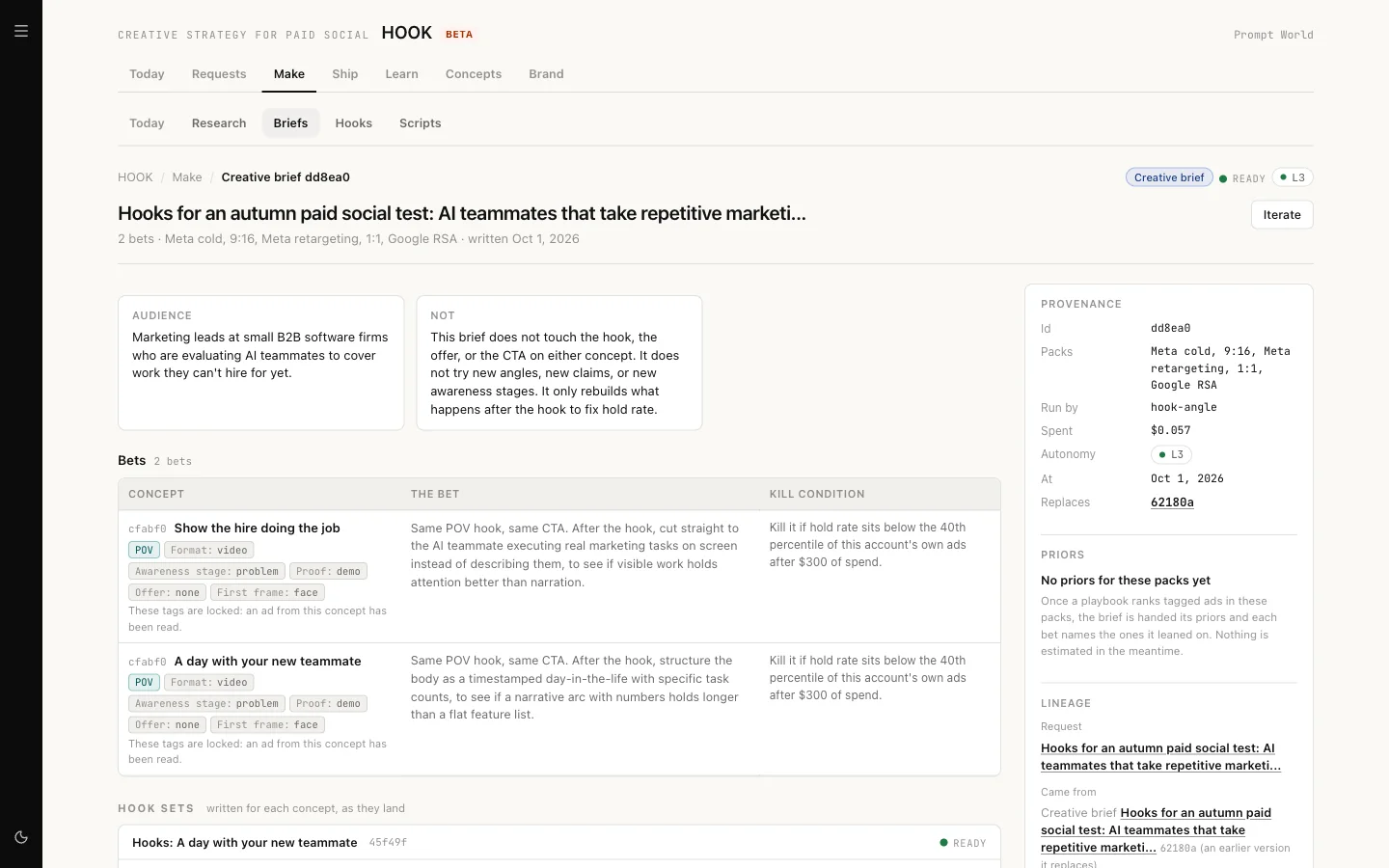
HOOK owns the creative input and the read-back (public page). It frames a brief and spreads the work across a bench of eight: SCOUT builds the swipe library, MINE reads what makes an ad work, ANGLE writes the brief and the bets with a kill condition for each, SCRIPT writes hooks and scripts, GATE checks every claim and can block, PACK builds the campaign package, PULSE reads results and plans refreshes, and VAULT keeps what has worked as the brand's playbook. HOOK never renders an ad: it stops at a structured production brief that RUPA or Alpha builds against. A finished pack downloads for Meta Ads Manager, or for Google goes to NIA, who builds it paused and asks for approval first. PULSE reads results back under a hold-rate convention, ThruPlay over three-second views, so creative is compared on how long it held attention rather than on the platform's preferred metric. For channels without a connection, which in India include the marketplace ad panels, the design is deliberately plain: an export from the platform uploaded as a CSV or Excel file, rather than a robotic layer that breaks when the panel changes.
What stays human
The objective, the constraint, and the go-live. An agent can find the hook, write the brief, gate the asset and build the campaign paused. A person decides what the campaign is for, how much it may spend, and presses the button. HOOK cannot pause an ad; a person pauses it in the ad manager. The day that person reviews the record afterwards rather than each item beforehand is the day the function has actually changed.
| Broadcast era | Conversation era | |
|---|---|---|
| Unit of work | The campaign, with ad sets and bids | The objective, the constraints and the creative inputs; the platform runs the rest |
| Who does it | A media buyer and an agency | NIA against the platform's agent, HOOK on the inputs, a person on the go-live |
| What is measured | Return on ad spend as the platform reports it | Hold rate and winners in the brand's own record, beside the platform's number |
| Where the human sits | In the ad manager | Setting the caps and reviewing the record |
Creative production
Production became selection. The brief is the product and the human is the editor. This is the function where Nagent started and where the evidence is most settled. The cost of making a good asset has fallen by an order of magnitude; the cost of choosing the right one has not. That asymmetry reorganises the whole chain.
What moves
Unilever's Beauty AI Studio runs in eighteen markets and produces around 400 assets per product where the previous process produced about twenty, 30 % faster, with video completion and click-through rates that doubled (Digiday, July 2025). Coca-Cola's 2025 Christmas film was made by five AI specialists selecting from more than 70,000 generated clips in about thirty days, and scored the maximum 5.9 stars on System1's effectiveness test (TheWrap and System1, November 2025). Klarna cut annual marketing costs by ten million dollars and took image turnaround from six weeks to seven days (Marketing Dive, May 2024). Mondelez invested more than forty million dollars in an in-house platform targeting half the content cost (Reuters and CNBC via Yahoo Finance, October 2025). Among 27 multinationals with 71 billion dollars of combined ad spend, 78 % use AI-generated or AI-enhanced content in consumer-facing marketing (World Federation of Advertisers, April 2026), and Bessemer's predictions for 2026 put generative video into the mainstream of marketing (Bessemer Venture Partners, The State of AI 2025, August 2025).
The academic record says the assets are not just cheaper. In a live campaign, AI-generated visuals achieved a 0.98 % click-through rate against 0.65 % for the human designer's, with the advantage holding eighteen months later (Daviet and Nishimura, Marketing Science, August 2026). Across 2.2 million ad-day observations, AI-made ads that did not look AI-made outperformed human-made ones, while those that looked artificial underperformed (Exner, Hartmann, Netzer and Zhang, January 2025). And the caution from Ju and Aral stands: more ads, more alike. The scarce input is no longer production capacity but the brief and the edit; Unilever's marketing lead described the change as moving from sending briefs off and getting content back to an agile, iterative approach.
What it looks like on Nagent
Nagent's own discovery moment was here. A summer 2026 campaign for Emami, on the Navratna brand, built eight AI personas, produced more than twenty films and passed 24.5 million views in total, with a single film above 11 million (The Nagent Thesis; Nagent customer stories). Production was close to routine. What was not routine was the decision load: brand fit on every asset, go-live on every variant, double down or retire on every signal. The engine produced a hundred options a day and the organisation absorbed a dozen decisions. That is why the production agents are built around the brief and the gate rather than the render.
HOOK writes the brief. RUPA renders a sheet of plates to a preset, a Meta feed ad, a story cover, a LinkedIn image, a carousel, with the workspace's brand guidelines attached, then reads the brief back against the brand book so a person can see what she was told before using what she made. Alpha plans a video shot by shot across seven desks, quotes it in credits and waits: nothing renders until a person has approved the storyboard and its price. Alpha is in Beta, with planning, quotes and approvals working and render lanes still arriving, and it reaches Kinetiq, our motion video product, as one of its production partners. CREA leads the written work: her team researches, drafts, edits, reviews, illustrates and links a blog post, then stops and waits for a person; FOLIO turns documents into publications. GATE checks that RUPA's images are the right size and that each video Alpha returns can be read and matches the pack, and a blocked video goes back to Alpha.
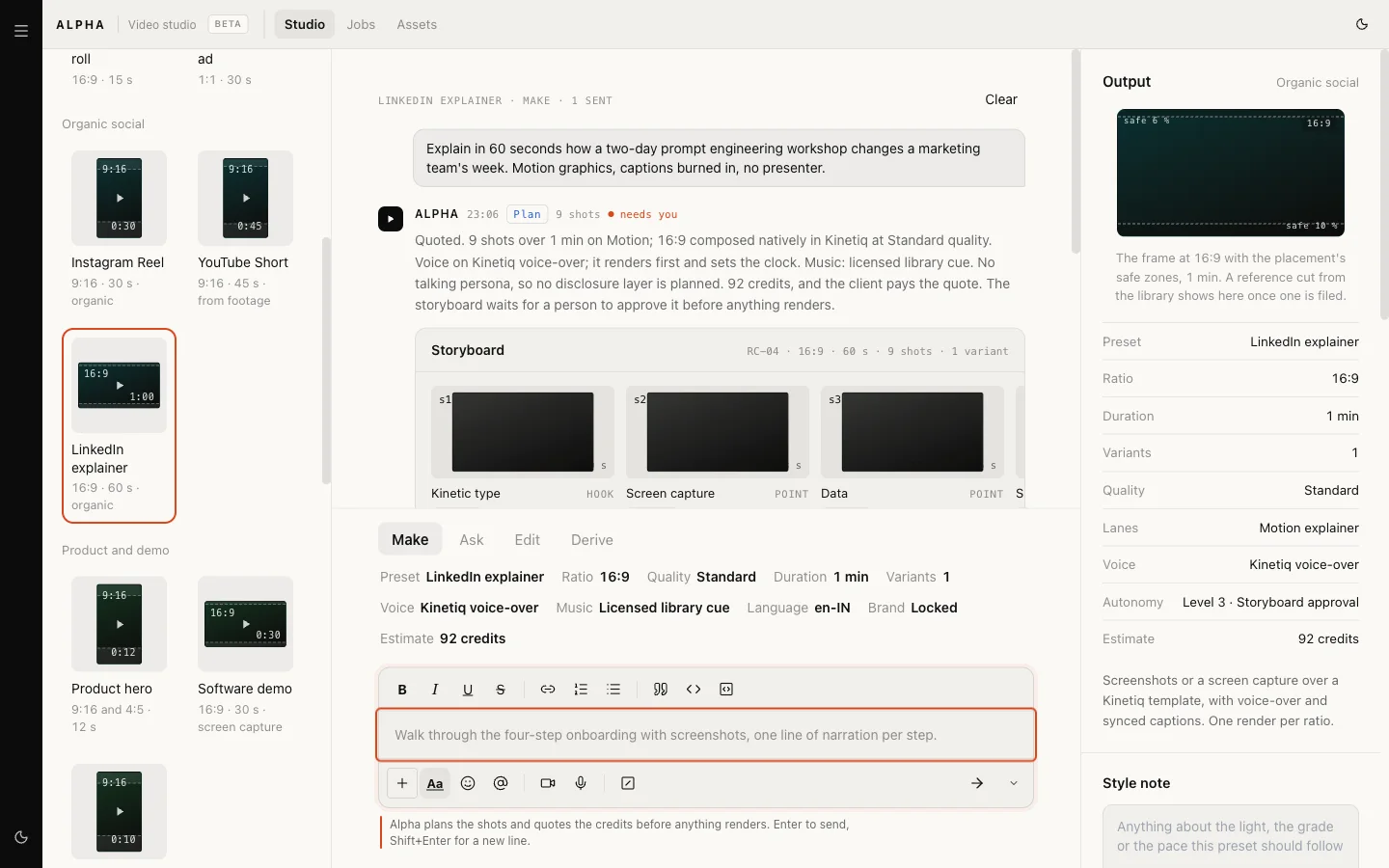
The homogeneity finding is handled structurally rather than hoped away: VAULT keeps the record of which angles an account has already run, so a new brief is checked against the history rather than last week's winner; each brief carries bets with an explicit kill condition; and PULSE rewards the variant that held attention rather than the one that most resembles what worked before. The human in the chain is Coca-Cola's five specialists: the editor who selects, and the gate that says whether it ships.
What stays human
Taste, and the gate. The evidence that AI-made assets perform is strong; the evidence that they converge is equally strong. A person who can tell the hundredth variant from the first, and who can say no, is the most valuable seat in the function.
| Broadcast era | Conversation era | |
|---|---|---|
| Unit of work | The asset, briefed and delivered | The brief, the set of variants it produces, and the edit |
| Who does it | An agency production line | HOOK on the brief, RUPA and Alpha on production, CREA on text, a person as editor and gate |
| What is measured | Cost per asset and delivery time | Assets per brief, hold rate per variant, and diversity of angle across the playbook |
| Where the human sits | Writing the brief and waiting | Selecting from the set and approving what renders and what ships |
Lifecycle, CRM and retention
The scheduled flow gives way to a decision per customer, and the message gives way to a reply. Lifecycle marketing is where the one-to-one promise was supposed to be kept, and where it was quietly downgraded into flows: welcome series, abandoned cart, win-back, each a scheduled broadcast to a segment that happened to be small. The technology to hold a conversation instead now exists, and the customer noticed before the marketer did.
What moves
The gap is in the Salesforce figures in shift three, with one more: marketers with unified data are 60 % more likely to be using agents, and only 26 % are satisfied with their data connectivity (Salesforce, State of Marketing, February 2026). Retention has moved up the agenda, with the share of ad buyers focused on repeat purchase doubling from 13 % to 25 % in a year (IAB, January 2026). The vendors have shipped agents into the category: Braze's operator and decisioning studio, with vendor-reported results such as an 81 % fall in unsubscribes at one fintech and a 90 % rise in booking conversion at one travel brand (Braze, April 2026); Klaviyo's marketing and customer agents, in beta across a base of 196,000 paying customers (Klaviyo, June 2026). The channels are changing underneath: WhatsApp's paid messaging passed a two billion dollar annual run rate (Meta, fourth quarter 2025 results), and business RCS traffic is forecast to rise from 70 billion messages in 2025 to more than 200 billion in 2027 (Juniper Research, April 2026). The Kumar and Kapoor experiment is the lifecycle result that matters most: the medium that was too expensive for a segment is now affordable for a customer.
One of a16z's ideas for 2026 is titled the year of me, on the argument that the biggest companies of the next century will win by finding the individual inside the average (a16z, Big Ideas 2026, December 2025). The design change is that the flow is replaced by a decision. A flow asks, on day three after signup, what message this segment receives. An agent asks, for this customer, right now, whether to say anything, and if so what, in which channel, and whether to wait for a reply before saying more. The constraint on doing that is the state of the customer data, not the model. An agent with a fragmented view of the customer is a flow with better copy.
What it looks like on Nagent
Nagent ships the customer record inside the platform, so a client does not need a third-party licence to run lifecycle work. The Agentic CRM is where leads live, and a rep and an agent look at the same lead, the same stage and the same email thread; when an agent moves something the record says so, and when it wants to write to a lead the draft waits for a person first. Every workspace gets a CRM team room led by CORA, whose charter carries deals "from first touch to a kept customer", with a bench that includes retention, expansion, enrichment, scoring and data health. LIPI writes to people the company already knows: the personalised draft on a lead's page, nurture sequence steps and follow-ups. Email to a lead is sent from a rep's own connected mailbox, so sending reputation stays with the client.
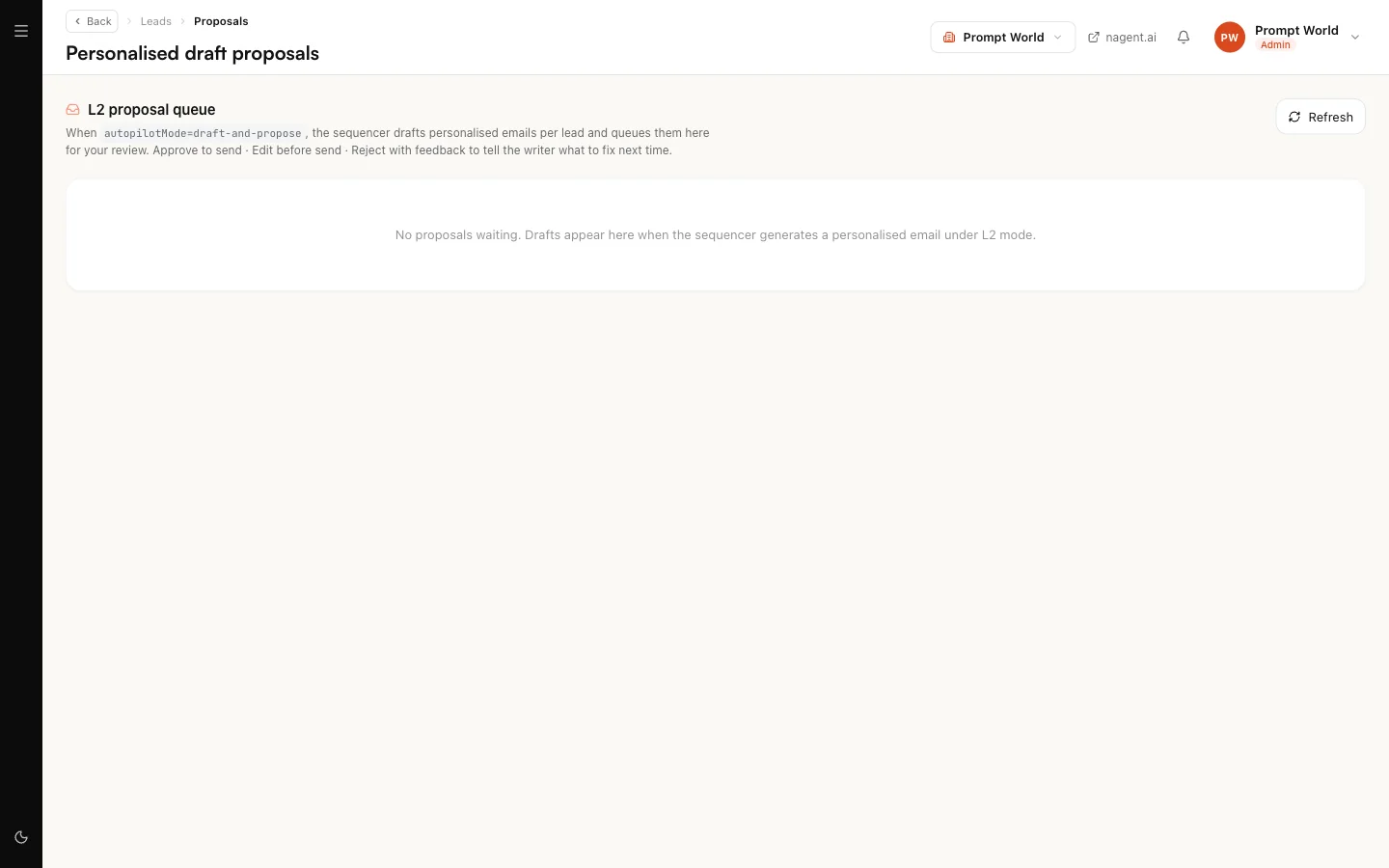
An honest note on the roster: Nagent still does not name a lifecycle lead under MIRA. The function is carried today on the Sales side, by CORA's CRM team under SERA and by LIPI, and inside a workspace by CEVA, the Customer Experience teammate added in Beta, who works on retention and the customer lifecycle: where customers stall, why they leave and what to fix first. Messaging beyond email, WhatsApp and voice among it, is not part of the product we document today. The design position is that lifecycle should not be a separate campaign tool at all. The agent that holds the inbound conversation should hold the outbound one, reading the same record, citing the same knowledge, and bound by the same guardrails, which for outbound include approval before any external send and a hard rule against quoting pricing in writing. Approval moves from every message to every batch to a review of the record as an agent earns its rung, and the batch boundary is where most teams first feel the leverage.
What stays human
The rule for when to stop. An agent that can send is an agent that can over-send, and the retention function's most valuable guardrail is the one that says silence is an action. The person sets that rule and reads the unsubscribe number.
| Broadcast era | Conversation era | |
|---|---|---|
| Unit of work | The flow, scheduled by segment | The decision, per customer, per moment, including the decision to wait |
| Who does it | A CRM manager in a marketing automation tool | Agents reading one record; a person on the send rules and the approvals |
| What is measured | Open, click, unsubscribe | Replies, conversations continued, and revenue per customer conversation |
| Where the human sits | Building flows | Setting when to speak and when to stop; approving at the rung earned |
Customer experience
The conversation is the commercial surface, and the escalation is the design. Customer experience is the function where the thesis is either true or it is not, because it is where the customer meets the agent directly. The evidence here is the richest in the document and the most contradictory, and both halves are needed.
What moves
The volume has moved to agents: Klarna's two thirds of inquiries and 40 % cost reduction, Meta's ten million business conversations a week, Amazon's twelve billion dollars through Rufus, all set out earlier. Sierra, which sells nothing but conversational agents priced per resolution, reached 200 million dollars of annual recurring revenue by May 2026 from 26 million at the end of 2024, with voice overtaking text (Sacra, May 2026; research firm estimates). Gartner forecasts agents autonomously resolving 80 % of common service issues by 2029 (Gartner, March 2025). The conversation sells: AI-search traffic converted nine times better than social over the 2025 holidays (Salesforce, January 2026); journeys including Microsoft's Copilot produced 53 % more purchases within thirty minutes (Microsoft Advertising, January 2026; vendor-reported); Meta reports a Brazilian car rental company resolving 85 % of its WhatsApp conversations entirely through its business agent with daily bookings up 44 % (Meta, second quarter 2026 earnings call, July 2026); and Anthropic's commerce agent blueprint, built with Visa, Mastercard and Shopify, reports pilot carts up to 35 % larger and shoppers 60 % more likely to complete a purchase (Anthropic, Building Commerce Agents with Claude, September 2026; vendor-reported).
And the customer is wary. Around half are not comfortable letting an agent complete a purchase end to end, and they trust a retailer's own agent three times more than a third party's (Bain, May 2026). Some 72 % trust companies less than a year earlier and about three quarters want to know whether they are talking to an agent (Salesforce, State of the AI Connected Customer, October 2024). Nathan Furr and Andrew Shipilov argue that agents are not yet ready for consumer-facing work, which is complex, messy and unforgiving of errors, while a European telecom cut resolution time 60 % with agents behind the scenes (Furr, Shipilov, Gaarlandt and Mohan, HBR, November 2025). Forrester expects a third of brands to erode trust by deploying self-service AI prematurely (Forrester, October 2025). Walmart ended its in-chat checkout with OpenAI after five months, reportedly because in-chat conversion was around three times worse than click-through even as the channel doubled the new-customer rate (TheStreet, March 2026; secondary figures).
The resolution of the contradiction is the Klarna sentence. Speed is solved; empathy is the floor. The function's design problem is where the floor sits, per conversation type, and how the agent knows when it has reached it.
What it looks like on Nagent
This is the chapter where the roster has changed most since the first draft of this thesis. The live customer conversation, in chat, voice and video, is held by Convexa, Nagent's own product for customer conversations, sold with its own sign-up, not as an agent on this platform. Choosing Customer Experience at sign-up links out to it, and nothing installs in the workspace. Inside a Nagent workspace, the Customer Experience team can be added in Beta and arrives with CEVA, who works on retention, support and the customer lifecycle; the conversations themselves stay in Convexa (prebuilt teams). Echo reads what customers say in public, turning Google Business reviews into cases with a named owner; it does not yet reply to anyone.
The design positions hold whoever holds the conversation. An agent on the customer-facing surface should draw on the company's knowledge for what is true, on the brand record for how to say it, and on the customer profile for who it is talking to, and should not make a claim without a source on file. Its escalations to a person should be logged as handoffs in the same record as everything else, and a rising handoff rate should be read as a signal about the agent rather than about the customer. That is the answer to Furr and Shipilov: the agent may sit on the customer-facing surface, but the floor is measured, and when it is breached the record shows it before the customer does. A conversational agent in an enterprise is also a data processing question long before it is a conversation quality question. Bain's three-to-one trust finding is the commercial reason a brand should run its own agent rather than rent one, and the reason the memory of a customer belongs to the tenant.
What stays human
The conversation the agent hands over, and the decision about which conversations it never gets. A complaint that has become a relationship problem, a customer whose history says they will leave, a question whose honest answer is unfavourable: these are designed as handoffs, and the person who takes them is the function.
| Broadcast era | Conversation era | |
|---|---|---|
| Unit of work | The ticket, deflected or resolved | The conversation, held to a floor, continued or handed over |
| Who does it | A contact centre at 13.50 dollars a contact | A conversational agent at a fraction of a dollar a turn; people on the conversations designed for them |
| What is measured | Containment, handle time, satisfaction | Handoff rate as an agent signal, revenue per conversation, and whether the customer thought it worth having |
| Where the human sits | In the queue | At the floor, taking what the agent hands over |
Insight and research
Research becomes a simulate-then-validate loop, and the panel becomes a check on the simulation. Consumer insight is the function with the longest cycle time in marketing, and the one where the temptation to replace the customer with a model of the customer is strongest. The evidence says the model is good enough to change the order of work, and not good enough to end it.
What moves
Stanford's generative agents, built from two-hour interviews with 1,052 people, replicated their subjects' survey answers at 85 % of the subjects' own two-week test-retest consistency and reproduced four of five experimental findings (Stanford HAI, January 2025). A method developed with Colgate-Palmolive reached 90 % of human test-retest reliability on purchase intent across 57 surveys and 9,300 responses (Maier et al., arXiv, October 2025). At Harvard, a model's estimate of willingness to pay for a toothpaste attribute came within cents of the human figure in under fifteen minutes, against a conventional study's twenty thousand dollars and three to six months, with the warning that some estimates come out wrong-signed (Brand, Israeli and Ngwe, HBS Working Knowledge, May 2023). The human-model hybrid outperforms either alone (Arora, Chakraborty and Nishimura, Journal of Marketing, March 2025).
The industry's verdict is split by use. Research leaders call synthetic data the single biggest shift in the field and also not fit for purpose as a standalone decision input; the consensus use is early ideation and concept screening (Research Live, January 2026). A review of 28 earlier studies found a quarter showing strong alignment between synthetic and human respondents, with failures concentrated on emotional and cultural nuance and on subgroups (PyMC Labs, February 2026). Omnicom's leadership describes testing fifty concepts synthetically before any media is bought (The Drum, February 2026). The largest usage datasets now come from the labs themselves: OpenAI's study of 700 million weekly users found 73 % of usage outside work, and shopping for purchasable products a category of its own at roughly 2 % of messages (Chatterji et al., How People Use ChatGPT, NBER, September 2025), and Google's 21-country study found 62 % of people had used an AI assistant, up from 38 % in 2023 (Google and Ipsos, Our Life with AI, January 2026). The change in order of work is the point. Research used to be commissioned once, late, at cost. It is now run first, cheaply and often, to narrow the question, and the panel validates what the simulation proposed. The panel's job becomes the one thing the model cannot do: say when the model is wrong.
What it looks like on Nagent
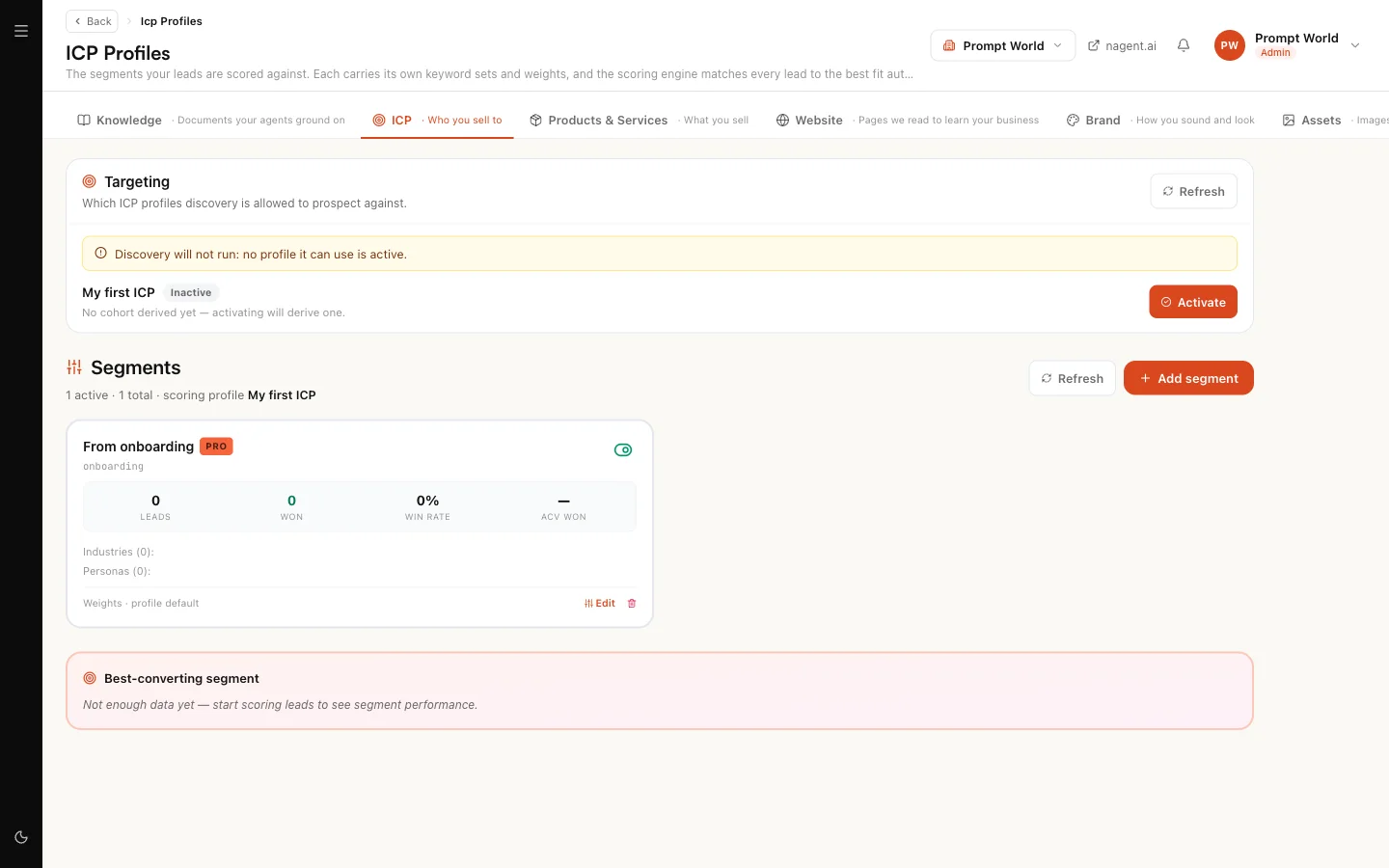
Research is a habit of every agent rather than a separate product: a question asked in a room is answered in a thread with the sources it came from, and an agent with no source asks rather than invents. A workspace that wants a researcher of its own can add the Research team in Beta, which arrives with ARIA, who researches the market, buyers and competitors and writes up what she found with the sources she used. The ideal customer profile lives in the Knowledge Hub as ICP profiles and scoring segments, each with its own keyword sets and weights, and a switch for selling to other businesses or to consumers; DRIS adds personas with their situation, goals and what stops them. Those records are what DRIS asks questions for, NIA bids against, HOOK writes for and NORA prospects from, so the insight function's output is a record every other agent reads rather than a deck. Where synthetic respondents are used, the rule follows the literature: they screen and narrow, what they produce is labelled synthetic, and a person validates before a decision is made against them.
What stays human
The question, and the disbelief. An agent can run fifty concepts through a simulation overnight. A person decides which question was worth asking and refuses to believe an answer that is too neat.
| Broadcast era | Conversation era | |
|---|---|---|
| Unit of work | The study, commissioned once | The loop: simulate, narrow, validate, record |
| Who does it | An insight manager and a research agency | Agents that cite their sources, ARIA for standing research; a person on the question and the validation |
| What is measured | Sample size and confidence interval | Agreement between simulation and panel, and cycle time from question to decision |
| Where the human sits | Reading the report | Choosing the question and disbelieving the tidy answer |
Measurement
Measurement returns to experiments and mix models, run continuously, and the question becomes who owns the loop. Measurement was the function the broadcast era built last and trusted least. Attribution never worked as advertised; signal loss finished it. What replaces it is older than digital marketing: experiments and mix models, run by agents, continuously, with the important question being whose agents.
What moves
Marketers are moving back to mix modelling: 46.9 % plan to invest more in it and 27.6 % rate it the most reliable method available (eMarketer with TransUnion, October 2025). Incrementality testing is used by 52 %, with 36.2 % planning to increase it (eMarketer, November 2025). Google has put its open-source Bayesian mix model inside Analytics 360 and is piloting a metric that projects future conversions from current spend, at a time when 54.1 % of marketers report no improvement in their confidence in measurement (PPC Land, May 2026). Marketers deploying AI well report a 20 % increase in return and a 19 % reduction in cost (Salesforce, State of Marketing, 2026).
The structural risk is easy to state. When the platform generates the creative, sets the targeting, allocates the budget, reports the result and now hosts the mix model, the loop closes inside the media seller. Meta's framing is that businesses pay only when results are achieved (Meta, second quarter 2026 earnings call), which is a fine deal until the definition of a result is also the seller's. More agents reporting more numbers produce no more confidence unless someone independent holds the experiment. So the function changes twice: measurement becomes continuous and agentic rather than quarterly and manual, and it becomes a question of custody, which experiments the brand runs for itself, in its own record, against the platform's reported number.
What it looks like on Nagent
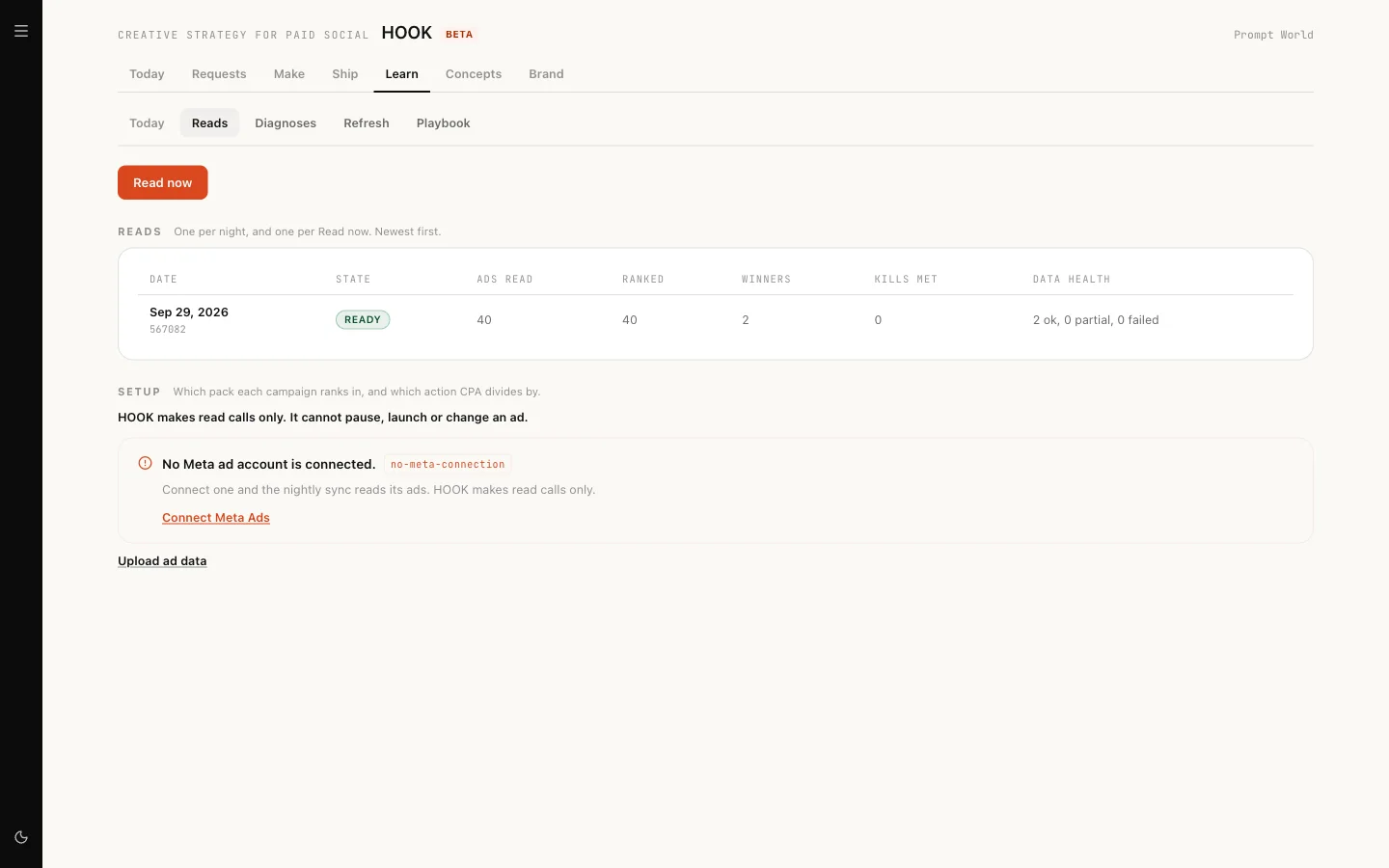
Measurement is distributed across the department rather than held in a reporting tool, and the record is the instrument. Every room sets its growth number on its set-up card, a metric, a target and a period, and every lead's page shows the number it owns: DRIS's share of AI answers against the declared objective, graded monthly, and its Monday report; HOOK's winner rate; NORA's funnel. PULSE reads ad results back nightly from a connected Meta account or from an uploaded export, ranks them, names the winners and the kill conditions met, and writes a Kill, Iterate, Next plan, so creative is measured on a metric the brand chose rather than the one the platform prefers. NIA's answers come from the brand's own Google Ads data, stored in the workspace.
The Karmic loop is the second instrument, and it measures the agents rather than the media. Outcomes and human corrections move each agent's trust score in both directions; the score is rebuilt every night from operator overrides, escalations, tool errors, governance violations and negative feedback, and a score that drifts down pulls the agent's autonomy down with it. Home counts every recorded rise and drop in autonomy over ninety days, so a person's decisions about the agents are on the record beside the agents' behaviour. Mix modelling and incrementality are, honestly, a workflow on the platform rather than a named agent today: an experiment is a workflow with a holdout branch and a join, and the weekly reconciliation against the system of record is a role the sales side already carries in RIVA and the marketing side is adopting.
What stays human
The definition of a result. An agent can run the holdout and reconcile the numbers. A person decides whether the number the platform reports is the number the business needs, and whether the experiment is worth the revenue it withholds.
| Broadcast era | Conversation era | |
|---|---|---|
| Unit of work | The attribution report, quarterly | The running experiment and the mix model, refreshed continuously |
| Who does it | An analyst and the platform's dashboard | Each lead's page, PULSE, the Karmic loop, and a person on the definition of a result |
| What is measured | Last-click and reported return | Incrementality in the brand's own record, hold rate, and the agents' own trust trajectories |
| Where the human sits | Assembling the deck | Holding custody of the experiment |
Earned media and PR
Earned media is re-priced by whether an answer engine cites it, and the number is only now getting an owner. Public relations most resembled a conversation in the broadcast era, because it was conducted with people, one journalist at a time. The people are still there. The reader that matters has changed, and the profession has noticed before it has reorganised.
What moves
Adoption of generative tools in PR has levelled off at 76 %, but only 12 % use agents, and 90 % would be more comfortable with agents if a human had to approve their work (Muck Rack, State of AI in PR, January 2026). A later survey of 971 practitioners found 73 % calling AI search visibility the next frontier, 29 % saying nobody owns it, 39 % not measuring it, and 61 % working from shrinking media lists (Muck Rack, July 2026). Muck Rack's own claim is that 99 % of AI citations come from unpaid sources, which if it holds makes earned media the principal input to the answer engines; it is a vendor claim. Which earned media is the unsettling part: the major mastheads absent from ChatGPT's top twenty cited domains while Wikipedia and Reddit account for more than a quarter of citations (5W Public Relations, May 2026). A placement the profession spent thirty years courting may count for less, in the answer the customer reads, than a well-structured comparison page or a forum thread. The function's change is a re-pricing rather than a replacement: earned coverage is worth what it contributes to the answer, monitoring means watching what the models say and not only what the press says, and the work of being cited has landed on PR by default with no budget and no owner.
What it looks like on Nagent
Nagent treats the PR question and the answer-engine question as one function with three agents. DRIS measures: its runs record which sources each answer cites, its Citation Ingester keeps them, and its competitor pages show the answers that cited a rival and the pages they used. Echo checks accuracy: what sampled answers say about the company, whether each claim matches an approved fact, and which cited sources the company can see and, where it owns them, change. CREA produces the extractable material, long-form pages, comparisons and research, written from the company's own knowledge with no invented detail. The ownership question that 29 % of PR professionals cannot answer is answered on the org chart: the number is DRIS's, the accuracy is Echo's, the material is CREA's. That does not make the relationship work disappear. It gives it a scoreboard.
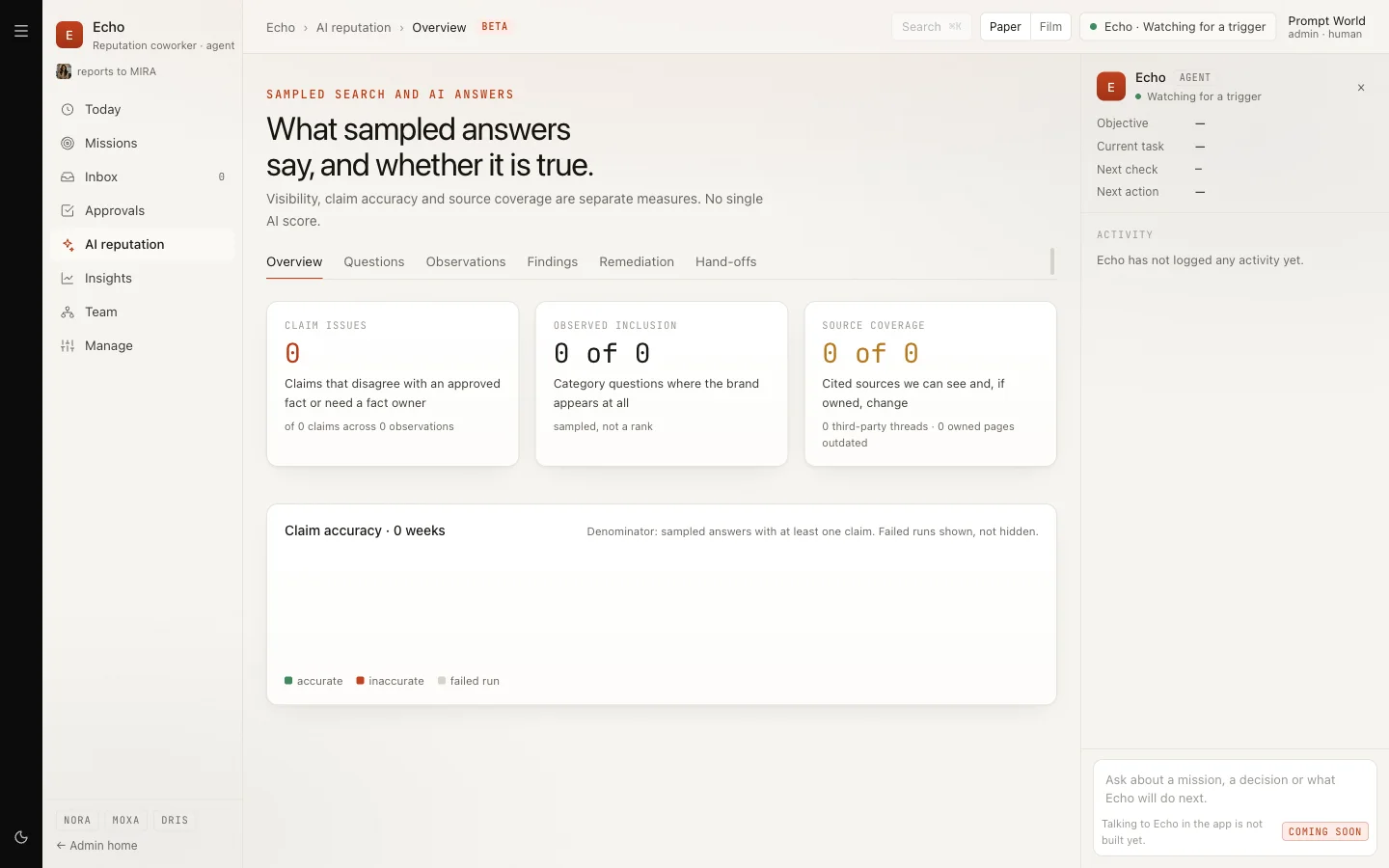
What stays human
The relationship and the crisis. An agent can draft the pitch, monitor the models and structure the page. A person calls the journalist, decides what the company will say when something has gone wrong, and signs the disclosure on anything the company ranks itself in.
| Broadcast era | Conversation era | |
|---|---|---|
| Unit of work | The placement, in a masthead | The citation, in an answer, from whichever source the engine reads |
| Who does it | A communications team and an agency with a media list | DRIS on the number, Echo on accuracy, CREA on the material; a person on the relationships and the crisis |
| What is measured | Coverage, reach, sentiment | Share of answer, citations by source, and accuracy against approved facts |
| Where the human sits | Pitching | Owning the disclosure and the conversation that cannot be delegated |
Go-to-market
The buyer arrives with a shortlist a model formed, and marketing and sales become one loop. Go-to-market depends on the handoff between marketing and sales, and the handoff is what agents dissolve. The buyer no longer moves from one department's content to the other's calls. The buyer asks a model, forms a shortlist, and arrives already decided about most of it.
What moves
In the 6sense survey, buyers reached out about three and a half weeks earlier than before, 58 % of that early engagement was to validate what the model had told them, and 76 % of the eventual shortlist was known before any contact (6sense, November 2025). Forrester predicts one in five B2B sellers engaging in agent-led quote negotiations and 61 % of purchase influencers using private generative engines in 2026 (Forrester, B2B Predictions 2026, October 2025). Gartner expects 15 trillion dollars of B2B purchases to be intermediated by agents by 2028 (Gartner, 2025, via Digital Commerce 360). Doug Chung and colleagues from McKinsey argue that most companies deploy agents separately in marketing and in sales, and that shared data and shared agents let the two run as a continuous loop, at the cost of new workflows, metrics and incentives (Chung et al., HBR, September 2026). On the business side, ICONIQ found AI used for lead generation by 75 % of software companies and for lead scoring by 63 %, with conversion from lead to qualified lead 11 % higher where more than half of pipeline was AI-influenced (ICONIQ, The State of Go-to-Market in 2026, March 2026). Launches get faster because research, positioning drafts and asset variants are agent-produced; no large-sample study of launch cycle time was found, so velocity claims are treated as directional. The change is in where marketing's work ends: it used to end at the lead, and it now ends where the model's shortlist is formed, upstream of any form, then continues into the conversation the buyer has with the brand's own agent to check what the model said.
What it looks like on Nagent
The marketing and sales departments share one workspace and one Knowledge Hub, which is the concrete form of Chung's loop. The ICP profiles are the same records DRIS asks questions for, NIA bids against, HOOK writes for and NORA prospects from; a segment edited by marketing changes what sales discovers next, and NORA's Qualify board reports cohort drift, so it says when a score was earned against a profile that has since been retired. Products, services and competitors are held once and cited by both departments, so a positioning claim in a comparison page and the same claim in an outbound message are the same claim.
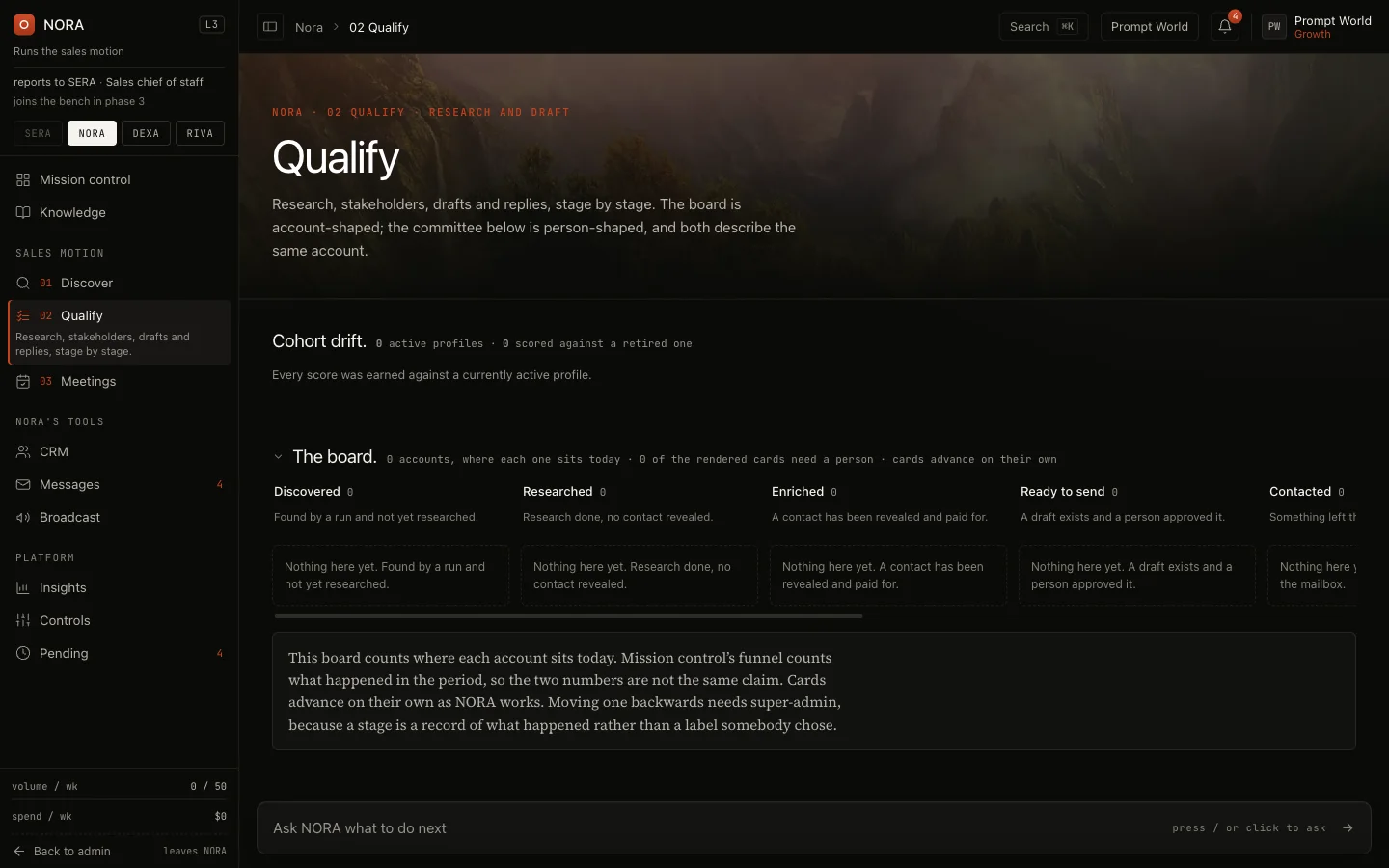
Where the buyer is a business, the handoff is to the Sales team: SERA as chief of staff, NORA finding and researching accounts and handing a qualified meeting to a named person, a handoff nobody acknowledges within 36 hours escalated, DEXA keeping the deal room once a person has taken the deal, and RIVA keeping the pipeline true. Every send and every write to the record passes through the same approval gate the marketing agents use. The validation conversation the 6sense buyers describe, the visitor checking a model's summary, is held where the company holds its customer conversations, which for Nagent customers is Convexa, our own conversation product. A dated, sourced comparison is product marketing in its new form: it exists because the model reads the table and the buyer reads the model.
What stays human
Positioning, pricing and the promise. An agent can tell the team where the shortlist is formed and what the model says. A person decides what the product is for, what it costs and what the company will stand behind, and a guardrail on every agent forbids promising a feature or a date.
| Broadcast era | Conversation era | |
|---|---|---|
| Unit of work | The launch and the lead | The shortlist the model forms, and the conversation that validates it |
| Who does it | Product marketing hands to sales development | One Knowledge Hub, marketing and sales agents in one loop; a person on positioning and price |
| What is measured | Leads and pipeline sourced | Presence in the model's shortlist, qualified meetings, pipeline that reconciles to the record |
| Where the human sits | At the handoff | At the promise |
Operations and the org
Budget moves to AI, headcount flattens, agencies contract, and the operating model becomes a small team directing agents. Marketing operations is where the other eleven functions land as a budget, a headcount and an org chart. The numbers here are the ones a chief marketing officer will be asked about first.
What moves
Budgets are 7.8 % of revenue on average, 15.3 % of marketing budget goes to AI, rising to 21.3 % in AI-mature organisations, and only 30 % of marketing organisations report the maturity to scale AI, with 70 % citing immature processes (Gartner, 2026 CMO Spend Survey, May 2026). AI use in marketing more than doubled in two years while marketing headcount growth halved year on year (The CMO Survey, Duke Fuqua, March 2026). Among 1,500 marketers, 86.4 % of teams use AI somewhere, around two thirds save ten or more hours a week, and team sizes are fairly flat (HubSpot, April 2026). Menlo Ventures counted 660 million dollars of enterprise spend on AI for marketing in 2025, 9 % of departmental AI spend, with customer success close behind at 630 million, and found only 16 % of enterprise deployments to be true agents rather than fixed workflows (Menlo Ventures, The State of Generative AI in the Enterprise, December 2025). OpenAI's enterprise report found 85 % of marketing and product users reporting faster campaign execution (OpenAI, The State of Enterprise AI, December 2025). Enterprise agent maturity is thin: 11 % of organisations have agents in production and 38 % are piloting (Deloitte, December 2025); 40 % of billion-dollar enterprises are scaling agents against 20 % overall (McKinsey, August 2026); and Gartner expects more than 40 % of agentic projects cancelled by the end of 2027 (Gartner, 2025).
The agency model is contracting and re-forming at once. WPP is investing 300 million pounds a year in AI with a 500 million pound savings target by 2028 (Futureweek, February 2026); Publicis is spending 300 million euros over three years (InfotechLead, April 2026); Omnicom and IPG cut 8,200 roles and plan around 15,000 more, and 91 % of senior US agency leaders expect AI to reduce headcount (eMarketer, February 2026); Forrester expects agency workforces down 15 % in 2026 (Forrester, Predictions 2026: Marketing Agencies, October 2025). Among AI-building software companies, 78 % are rethinking workforce planning and a third plan smaller teams, while almost half say their agents still need human intervention on more than 30 % of tasks (ICONIQ, State of AI: The Builder's Economy, July 2026). The in-house factory is the counter-move: Unilever, Mondelez and Klarna each built one. The operating model that emerges is described in practitioner shorthand as a team of one plus agents. What the evidence supports is narrower: fewer people, each directing several agents, with the approval gates 90 % of practitioners say they want, budget moving from headcount and agency fees to platform and model spend, and the CMO's role becoming, in BCG's word, more consequential.
What it looks like on Nagent
The org chart in the marketing org section is the operating model, and the workspace is its tooling. Welcome counts the people, agents, teams and runs, and its Waiting on you row counts five kinds of thing a person owes the department: actions awaiting approval, agents ready to move up a rung, work held in team rooms, escalations and blocked decisions. The Agent Workbench counts the workspace's agents at each rung and is where a workspace admin raises or lowers one, with the change recorded. Actions lists every action that fired and every one waiting. Each agent carries its own daily and monthly budget, and each lead's page shows its spend today, so a marketing operations lead can answer what the department spent on thinking today (credits and budgets). Behind the workspace, Nagent's own control plane reads every agent through the same record, its topology, governance, the Karmic loop, anomalies and replay, and is run by Nagent's staff to operate the service.

The people side is the delivery team. Plans are published on the pricing page, with credits per month as the unit of agent work. Growth Pods add human growth experts on the Business and Enterprise plans: each engagement carries one outcome, a timebox and a binary definition of done, and is billed separately from the subscription; forward deployed engineers build what a team needs that the prebuilt teams do not carry. The client buys an outcome; the mix of agents and people behind it shifts towards agents as trust is earned. That is the team of one plus agents made contractual.
What stays human
The outcome, the approvals the ladder requires, and the decision to raise or lower an agent's autonomy. Everything the operations function did that was assembly, reconciliation and reporting is now the record. What is left is management, which turns out to be most of the job.
| Broadcast era | Conversation era | |
|---|---|---|
| Unit of work | The headcount plan and the agency retainer | The agent roster, its rungs and budgets, plus the people who direct it |
| Who does it | A marketing operations team across a dozen tools | The workspace, MIRA, and Growth Pods where the client wants them |
| What is measured | Budget variance and utilisation | Approvals pending, trust trajectories, model spend per agent, outcome per plan |
| Where the human sits | Reconciling | Managing: raising and lowering autonomy on the evidence |
What client work taught
What two years of building marketing agents taught, in the order it was learned. The thesis above was not reasoned out first and built second. It was arrived at in reverse, by building the wrong thing several times for real clients and noticing what broke. The sequence matters, because each step contradicts a reasonable assumption a marketing leader might still be holding.
| When | What happened | What it taught |
|---|---|---|
| 2024 | Services first, because that is where the customers were: a prompt-driven workflow repository and a services practice doing AI-led content by hand | The assumption was that the tooling would be the product. Clients bought outcomes and did not care what produced them |
| 2025 | Content solved end to end, from brief to finished asset, with clients onboarded on it | Production capacity outran the organisation's ability to decide what to do with it |
| 2025 to 2026 | A builder nobody asked for, then a control plane nobody asked for | Anyone could build an agent from a description; target customers did not engage with building. Governance was the missing layer, but not the entry point |
| Summer 2026 | The Navratna campaign: eight personas, more than twenty films, 24.5 million views | Generation was routine. Decision-making, not generation, was the bottleneck |
| Mid 2026 | The pivot to a multiplayer workspace with agent team leads | Work happens in a team. The department became the product rather than the tools inside it |
| September 2026 | Agent teams for specific outcomes: named agents with numbers to own and a chief of staff | A growth suite of agents and a multiplayer workspace, usable together or apart |
| October 2026 | Team rooms became the main surface: each lead's page opens inside its room, every action an agent takes shows as a card a person confirms, and each department is seated under its chief of staff | The approval belongs in the same room as the conversation, or people stop reading either |
Four lessons that shaped every function above
The approval path is the product. Output nobody ships has a measured value of zero, and most agent pilots fail there rather than on quality. Every marketing agent on Nagent was designed from its approval path outward: what it may propose, who signs it, at what rung the signature becomes a batch, and when it becomes a review of the record. The confirm card in the room is that lesson made into a screen.
The brief is where the value lives. HOOK never renders an ad. It was scoped down to angles, hooks, scripts and a structured brief because the brief is the part that compounds: the playbook of what was tried and what held attention is what makes the next campaign better. Production is a commodity that RUPA and Alpha carry, with Kinetiq, Nagent's own motion video product, behind them.
Team leads have to trigger each other. A marketing department is a set of handoffs, and an agent that cannot put work into another agent's queue is a tool with a name. HOOK's brief landing with RUPA, Alpha's video checked by GATE, a Google pack handed to NIA, a page fix Echo sends to DRIS and a boost MOXA sends to NIA are the department working.
The platform is the runtime, not the agent. Every marketing agent runs on the same platform and is governed in the same place. Each lead has its own page, which opens inside its room, but rungs, budgets and guardrails for every agent are set in one Agent Workbench, and every action any of them takes is in one Actions list. The product surface is the department.
The evidence base
The clients behind this record span consumer goods, commerce, software and services; thirteen brands are named on our customer stories page, Emami and Flipkart among them, and we describe the rest by sector rather than by name. Four patents have been filed on orchestration and memory management, and three published. Enterprise deployment is available in a private cloud. Nagent is certified to ISO/IEC 27001:2022 by InterCert, and a SOC 2 Type II programme is underway, not complete. The claims in this document about what Nagent has built are made against that record and checked against the product as it stands in October 2026, and the claims about what it has not yet built are made in the same place.
The capital and the labs
The investors say the money is moving to agents. The labs say the work already has. The academic record in this document measures agents in experiments and the analyst record measures them in surveys. Two other sources see the same change from different seats: the venture firms, who see where the money is going before it shows up in revenue, and the model providers and platforms, who see what people actually do with agents in the usage logs. Both are quoted below with the caveat that each has a position to sell. Read together, they corroborate the three shifts and add a fourth thing the academic record cannot: the state of the market this autumn. For how the surveys reconcile, see The Agentic Adoption Curve.
Where the money is going
Menlo Ventures put enterprise spending on generative AI at 37 billion US dollars in 2025, 3.2 times the previous year, of which 7.3 billion was departmental spend: coding took 55 %, marketing 660 million dollars or 9 %, and customer success 630 million, while only 16 % of enterprise deployments were what the firm would call true agents rather than fixed-sequence or routing-based workflows (Menlo Ventures, The State of Generative AI in the Enterprise, December 2025). ICONIQ's survey of around 300 AI-building software companies found internal AI spend rising from 11 % of revenue in 2025 to a projected 16 % in 2026 and 19 % in 2027, with almost half saying their agents still need human intervention on more than 30 % of tasks, 78 % rethinking workforce planning and a third planning smaller teams (ICONIQ, State of AI: The Builder's Economy, July 2026). Its go-to-market survey found AI used for lead generation by 75 % of B2B software companies and for lead scoring by 63 %, higher adopters running leaner teams at every revenue band, 20 go-to-market staff against 35 at 10 to 25 million dollars of revenue, and conversion from lead to qualified lead 11 % higher where more than half of pipeline was AI-influenced (ICONIQ, The State of Go-to-Market in 2026, March 2026).
Bessemer's 2025 report drew the two shapes an AI company now takes, a supernova reaching around 40 million dollars of revenue in its first year on thin margins and a shooting star compounding more slowly on 60 % margins, and among its predictions for 2026 put generative video into the mainstream of marketing (Bessemer Venture Partners, The State of AI 2025, August 2025). Its roadmap on what it calls systems of action argues that 400 billion dollars of annual spend on systems of record, the CRM among them, is the target, because AI-native products are showing a ten times better experience than the incumbents (Bessemer, Roadmap: AI Systems of Action, May 2025). Foundation Capital sized the service-as-software opportunity at 4.6 trillion dollars, of which 1.1 trillion is the annual salary bill of sales and marketing, on the argument that bots become brains (Foundation Capital, via Forbes, April 2024), and later warned that the model provider that powers a company can also steamroll it, so the defence is capturing data no one else sees and learning from every interaction (Foundation Capital, November 2025). That last sentence is the record argument in this document, made by an investor.
Andreessen Horowitz described the path in 2024 as three phases, marketing copilots, then marketing agents, then autonomous marketing teams (a16z, Say Hello to My New AI Marketer, June 2024, updated March 2025); its 2026 ideas include creating for agents rather than humans as agents become the primary consumers of content, and finding the individual inside the average as the winning move of the next century (a16z, Big Ideas 2026, December 2025); and its consumer app census puts ChatGPT at 900 million weekly users, with an app directory of 220 applications and a Claude directory of around 210 connectors that overlap by only 41 (a16z, The Top 100 Gen AI Consumer Apps, sixth edition, March 2026). Sequoia called 2026 the year of agents, with models, tools and harnesses as the three ingredients, and in one partner's phrase, not faster horses but cars (Sequoia Capital, AI Ascent 2026, May 2026); its earlier investment note on a sales agent reported account executives reclaiming more than eight hours a week while increasing customer activity by more than 35 % (Sequoia, November 2024). Vinod Khosla's essay imagines tens of billions of agents representing consumers, running around the clock against the well-oiled marketing machines that attempt to co-opt the human psyche (Khosla Ventures, AI: Dystopia or Utopia, September 2024), which is the customer's-agent half of shift two stated as an investment thesis. Y Combinator's current requests for startups include one titled Multiplayer AI, asking for products where anyone on a team can drop into the same live agent session, watch it work and redirect it (Y Combinator, Requests for Startups, Fall 2026), and its summer list asked for AI-native service companies that skip the human entirely and just do the work (Y Combinator, Requests for Startups, Summer 2026, via secondary coverage). About 60 % of its spring 2026 batch pitched AI or agents, and one observer's summary was that they are shipping coworkers rather than features (New Economies, June 2026, secondary).
What the labs and platforms measure
Anthropic's Economic Index gives the cleanest split between agents doing work and agents helping with it: 77 % of business usage through the API follows automation patterns, against about half in the consumer product (Anthropic Economic Index, September 2025), a split that had settled at 52 % augmentation and 45 % automation in the consumer product by early 2026 (Anthropic Economic Index, January 2026). Its March report named an explicit business cluster of sales enablement, lead qualification, data enrichment and cold-email drafting (Anthropic Economic Index, March 2026), and its June report found 86 % of surveyed users reporting speed gains, 57 % saying AI had made their skills more valuable, and about 36 % expecting AI to handle most of their tasks within a year (Anthropic Economic Index, June 2026). Anthropic's agent survey of more than 500 technical leaders found 80 % reporting measurable economic returns, 46 % expecting agents to affect marketing and sales in 2026, and 42 % trusting agents to lead work with human oversight (Anthropic, The 2026 State of AI Agents Report, 2026). Its commerce agent blueprint, released with Visa, Mastercard, Shopify and Klaviyo among others, reports pilot carts up to 35 % larger and shoppers 60 % more likely to complete a purchase, and its merchant agent drafts marketing campaigns and recommends promotions (Anthropic, Building Commerce Agents with Claude, September 2026). And Project Vend, in which an agent ran small shops and was later given a chief executive agent above it, is worth reading as a governance experiment: discounts fell by about 80 % and free gifts halved once the supervising agent arrived, and the lab's own conclusion was that the chief executive needs to be well calibrated (Anthropic, Project Vend phase two, December 2025).
OpenAI's usage study with the National Bureau of Economic Research covers 700 million weekly users sending around 2.5 billion messages a day: 73 % of usage is now outside work, 49 % of messages are asking, 40 % doing and 11 % expressing, and shopping for purchasable products is a category in its own right at roughly 2 % of messages (Chatterji et al., How People Use ChatGPT, NBER, September 2025). Its enterprise report found 85 % of marketing and product users reporting faster campaign execution and workers saving 40 to 60 minutes a day (OpenAI, The State of Enterprise AI, December 2025). Its advertising policy states that ads do not influence the answers the assistant gives and that advertisers see aggregate data only (OpenAI, Testing Ads in ChatGPT, February 2026), and secondary reporting has it discontinuing in-chat checkout in March 2026 in favour of purchases through merchant apps inside the assistant (WebInterpret, June 2026, secondary).
Google's consumer study across 21 countries found 66 % of people had used an AI tool in the past year and 62 % an AI assistant, up from 38 % in 2023 (Google and Ipsos, Our Life with AI, January 2026); its own marketing publication describes the change as the end of the tool operator and the age of the agent manager (Think with Google, February 2026); its cloud survey of 3,466 senior leaders found 52 % of organisations using agents, marketing among the top use cases at 46 %, and 74 % seeing a return within a year (Google Cloud, The ROI of AI, September 2025); and its marketing conference this year put the position in one line: the only way to win in the age of AI is with AI (Google Marketing Live, May 2026). Meta's second-quarter call, read from the primary transcript, confirms the figures used earlier in this document: Advantage+ above 75 billion dollars of annual run rate, more than a million businesses using its business agents every week to talk to customers or complete sales, nine million small businesses using at least one AI creative tool, the ranking gains of 8.3 % more clicks and 15.7 % more conversions on Facebook, and a Brazilian car rental company resolving 85 % of its WhatsApp conversations entirely through the agent with daily bookings up 44 % (Meta, second quarter 2026 earnings call, July 2026). TikTok's trend report opens with the line that the era of passive consumption is over (TikTok, Next 2026, January 2026); its automation announcements report 70 % of users discovering brands on the platform and 61 % buying after viewing (TikTok Newsroom, October 2025); and at its 2026 conference it released an ads server for the Model Context Protocol and a set of skills so that AI agents can operate its ad platform directly (TikTok World 2026, May 2026).
What Nagent takes from the capital and the labs
Agents are supervised, everywhere. Sixteen percent of enterprise deployments are true agents. Half of AI builders say their agents need human intervention on more than 30 % of tasks. Forty-two percent of technical leaders trust agents to lead with oversight. The industry sits on the lower rungs of the ladder, and the ladder is where the market is, not where it might be.
The platforms are becoming agent-addressable. TikTok ships an ads server for agents. Google ships an advisor agent across Ads, Analytics and Merchant Center. Meta ships business agents a million businesses use weekly. R=G is arriving as protocol: the brand's agent will shortly talk to the platform's agent directly, and NIA's job becomes negotiation.
The customer's agent is small, which is the time to prepare. Shopping is 2 % of ChatGPT messages and AI is under 1 % of most retailers' traffic. Khosla's tens of billions of consumer agents are a thesis, not a fact. A brand that becomes legible now, while the citation is cheap and the record is short, is the one the customer's agent finds when the number moves.
The field, against the thesis
We profile 66 competitors at /comparisons, each with dated sources and, where we could capture them, the vendor's own pages. Read against the three shifts, the field sorts into three shapes, and the shape says more than the feature list. What follows is what those profiles record from each vendor's own pages; we have not run their products against ours.
Most sell a single worker. 11x sells two named digital workers: Alice for outbound and Julian for phone conversations (11x, Alice pricing; Nagent vs 11x). Artisan sells Ava, one AI BDR that runs the whole outbound loop and decides from escalation rules when to involve a person (Artisan pricing; Nagent vs Artisan). Profound now presents itself as an AI marketing platform built around one AI Marketer and the agents it creates (Profound pricing; Nagent vs Profound). Regie.ai is a self-serve sales engagement platform a rep can start on free and grow by seat, with shared workspaces and shared agents reserved for Enterprise (Regie.ai pricing; Nagent vs Regie.ai). A single worker can own one outcome well. It cannot hold the handoffs between outcomes, which is where the thesis says marketing now lives.
Many sell a measurement layer with an action list. Peec AI is a focused measurement layer and says so: it tells a team where it stands, why, and what to do next (Peec AI pricing; Nagent vs Peec AI). Writesonic leads with AI search visibility and an Action Center, which its Growth plan includes only as a trial of five off-page and five on-page actions (Writesonic pricing; Nagent vs Writesonic). AthenaHQ pairs prompt-volume estimates and monitoring with an Action Center and a model it says predicts whether content will be cited (AthenaHQ plans; Nagent vs AthenaHQ). Scrunch adds an Agent Experience Platform that serves a parallel version of a site to visiting agents, which Nagent does not claim to do (Scrunch pricing; Nagent vs Scrunch AI). These are strongest at telling a team what to fix; the question each leaves open is who does the fixing. A team that already runs one can keep it as an independent measure of what DRIS changes.
A few sell a team. Buzz, from Block, puts people and named agents in the same channels, groups agents into teams and keeps a hash-chained audit log; it is open source and self-hosted, pre-1.0 by its own account, and its agents are general coding and operations agents a company writes itself (Buzz on GitHub; Nagent vs Buzz). Dust markets multiplayer collaboration between people and agents in shared spaces (Dust; Nagent vs Dust). Shift one is the rarest thing in the field, and the rarer thing still is a team that arrives already formed for growth work.
Governance is uneven, and usually a tier. 11x documents three outbound modes, reviewing each message, a named-person approval step, and autopilot without per-message approval. Artisan lets a team run Ava in approval mode or allow sending, and lists SOC 2 Type II, single sign-on and audit logs. AthenaHQ reserves its organisation audit log and single sign-on for Enterprise, as Scrunch reserves single sign-on. Buzz states that its workflow approval gates are only partially built. For Peec, the pages we reviewed did not establish an enterprise control plane, which is a gap in evidence, not proof of absence. Few put the approval in the same room as the people, with the rung each agent holds visible beside it.
Against the thesis, the field confirms the second shift, which every measurement vendor is built on, and half-confirms the third, which every outbound worker sells. The first shift, a team of people and agents sharing one record and one approval path, is where the field is thinnest, and it is the one Nagent was built around.
The counter-case
The best arguments against this thesis, and what each one changes in the design. A thesis that cannot name its own counter-evidence is a pitch. The arguments below are the strongest available, drawn from the same sources as the rest of the document, and each one has changed something in how Nagent builds.
Customers do not want to talk to agents
Half of consumers are not comfortable letting an agent complete a purchase end to end (Bain, May 2026). Three quarters want to know when they are talking to one (Salesforce, October 2024). Forrester expects a third of brands to erode trust with premature self-service AI (Forrester, October 2025), and Furr and Shipilov argue agents belong behind the scenes for now (HBR, November 2025). Walmart withdrew from in-chat checkout when the conversion was worse than the click (TheStreet, March 2026).
What it changes: the escalation is designed in, the handoff rate is an agent metric, disclosure is in the org design, and checkout is not assumed to belong inside the conversation. Discover in the conversation, buy where it converts. It is also why Nagent's own agents work mostly behind the customer, on the brand's record and its approvals, and why the live customer conversation sits with a partner product built for it.
Agents make marketing more of the same
Ju and Aral's human-agent teams produced 50 % more ads and more homogeneous ones, and edited 62 % less. Stefano Puntoni's caution is that an unread brand is absent; the corollary is that a brand read by one model is described one way to everyone.
What it changes: the playbook records angles already run, hold rate rewards attention rather than resemblance, the human seat in creative is the editor, and diversity is a thing the department checks rather than hopes for. That correction is a design commitment, not a solved problem.
Most agentic projects will fail
Only 11 % of organisations have agents in production (Deloitte), 6 % fully trust them (HBR Analytic Services), 30 % of marketing organisations are ready to scale AI (Gartner), and Gartner expects more than 40 % of agentic projects cancelled by 2027. Klarna itself reversed.
What it changes: everything about earned autonomy. Side effects wait behind a confirm card until the record says otherwise, sends and live ad changes are gated separately from the rung, and a delivery team exists because software alone does not get an organisation far enough to see the record compound. The cancellation rate is a statement about ungoverned pilots, and it is the reason the platform was built before the department.
The platforms will own all of it
Meta's stated goal is that an advertiser needs no creative, no targeting and no measurement. Google is putting the mix model inside its own analytics product. OpenAI sells the ads inside the answer. The brand's agents may be redundant on both sides.
What it changes: the brand's agents exist to hold what the platform will not hold for it. NIA carries the objective and the cap, HOOK carries the creative judgement and the playbook, PULSE carries the metric the brand chose, and the record belongs to the tenant. If the platforms do own all of it, the brand with no agents of its own is the one that finds out last.
The search apocalypse did not arrive
Gartner predicted a 25 % fall in search volume by 2026. Google's search revenue grew 17 % in the second quarter of 2026 and its AI Mode passed a billion users. AI tools still send under 1 % of outbound referrals (SparkToro, June 2026), and AI is under 1 % of total traffic for most retailers (Bain, May 2026).
What it changes: the thesis is about the click and the citation, not about the query. DRIS measures share of AI answers beside Search Console's clicks and the conversion of the traffic that still arrives. A function that watches volume would have concluded nothing had changed.
The academic record on India is thin
No peer-reviewed research from IIM Ahmedabad, IIM Bangalore, IIM Calcutta or the Indian School of Business on agents in marketing surfaced in the search for this document; what exists is executive education and conference programmes, and an ISB interview arguing that managers who use AI will replace those who do not. The evidence base above is largely American and European.
What it changes: Nagent's client work in India is offered as the evidence the literature lacks, described plainly and with permission, and the research in this series is designed to be citable by the institutions that have not yet written on it.
Monday morning
What a marketing leader does with this in the first ninety days. The order is deliberate: each step produces the record the next one needs. The functions above were presented in the order a marketing department is usually drawn. They are adopted in a different order, because some produce the inputs others depend on and because trust has to be earned somewhere before it can be spent anywhere.
Weeks one to two: make the brand legible
Load the knowledge: point the Knowledge Hub at the website, then add products, services, who you sell to, competitors and the brand voice through Brand Lock. Declare DRIS's objective and let it take its first reading before touching anything else, because it produces the baseline for share of AI answers and the first list of what the models say that the brand does not. Teams arrive at L4 Senior so they can work from their first message, while sends and live ad changes still wait for a person; a leader who wants a fortnight with no external output at all can lower the leads to L2 Assisted in the Agent Workbench. This fortnight is the most important in the programme.
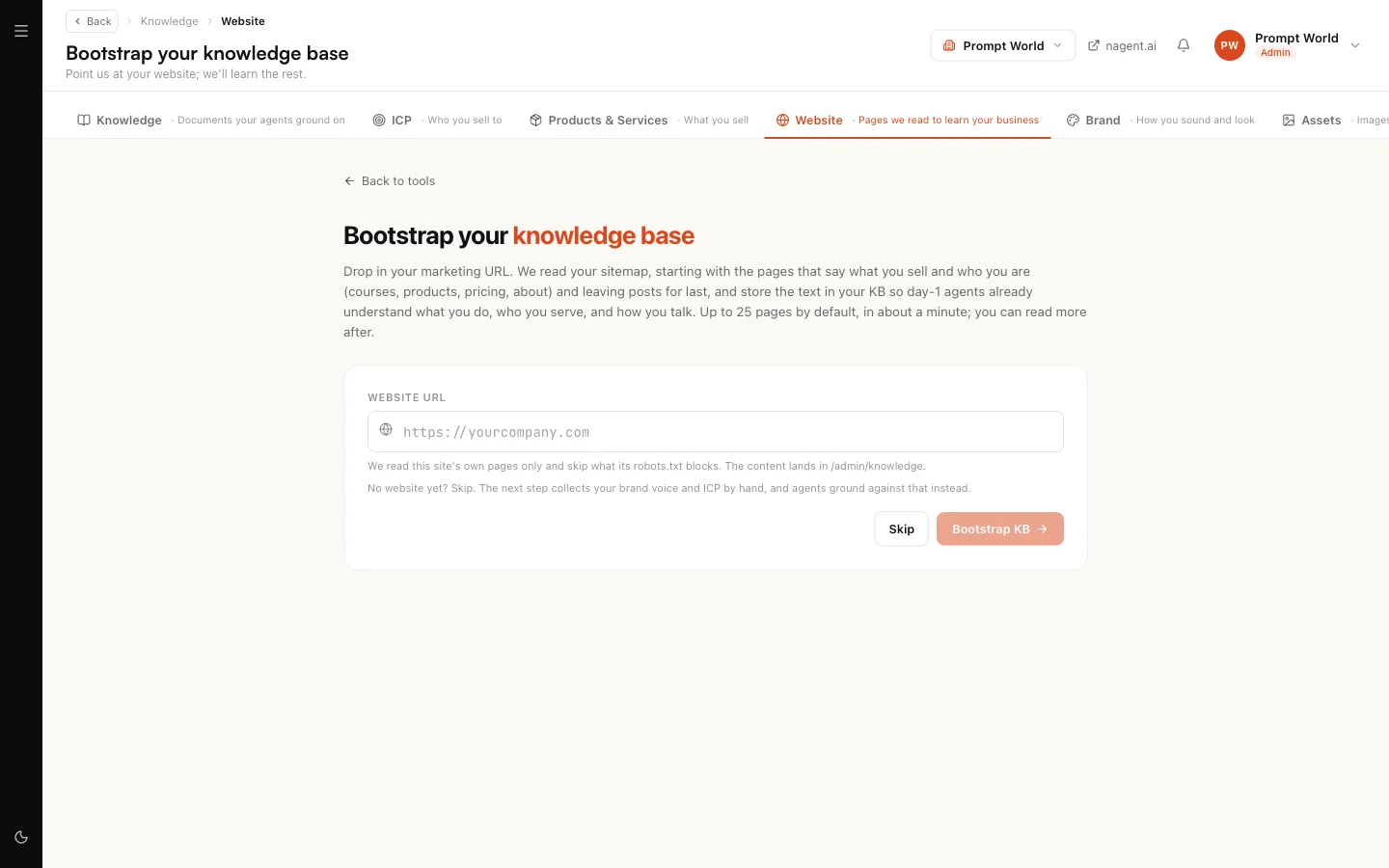
Weeks three to six: run the creative loop with a gate
HOOK, RUPA, Alpha and CREA on one account, with a person as editor and gate on every item. The output that matters is not the assets but the playbook: what was tried, what held, what the editor rejected and why. Trust starts moving here, because the corrections are the training signal, and this is where the first raise in autonomy should be earned, on the record.
Weeks five to eight: put spend behind the loop
NIA on one channel with the caps set low and approval required for every live change. PULSE reading results back beside the platform's number. The point of this phase is to establish the brand's own measurement beside the platform's before the budget is large enough for the difference to matter.
Weeks seven to twelve: open the conversation
MOXA on the company channels with every post approved by a named person, and the founder stream left to the founder until they invite MOXA in. LIPI's drafts to known customers reviewed in their queue. If the company holds customer conversations on Convexa, Nagent's own conversation product, put it on one surface, chat first, with the handoff to a named person designed in and the handoff rate on the dashboard from day one. By week twelve the department has a record: what was proposed, what was approved, what was corrected, what each agent's trust says. That record is what the second quarter runs on.
The numbers to watch
- Share of AI answers across the prompt set, by engine, weekly. The organic function's replacement for rank.
- Hold rate per variant and per brief, beside the platform's reported figure.
- Approvals pending and time to approve, per agent. The constraint is visible here first.
- Handoff rate for the conversational agent, treated as a signal about the agent.
- Trust per agent and its direction, and the rung each agent has earned.
- Model spend per agent per day, against the cap, in the same frame as the approvals.
- Revenue per customer conversation, once the conversation is open, against revenue per campaign.
The seats that change
A marketing leader will not staff this department by replacing roles one for one. The seats that appear are an editor who selects from sets and says no, an operator who raises and lowers autonomy on the evidence and takes the escalations, a strategist who writes the brand in two registers, and a person who owns the definition of a result. The seats that shrink are assembly, reconciliation, production and reporting. A Growth Pod can carry a defined outcome while the client's team learns the operator seat.
The bet
Whoever holds the record of the conversation holds the customer. Media spend was the moat of broadcast marketing. A brand that could outspend its competitors on reach owned the segment, and everything else, creative, research, measurement, existed to make the spend work harder. The platforms are now offering to make the spend work harder without the brand's help, and the customer's own agent is deciding what the spend reaches. Media as a moat is being drained from both ends.
The moat that replaces it is the record, which is what N=1 becomes when it is kept. Not the customer data, which every competitor can buy in some form, and not the model, which will converge. The accumulated, tenant-specific account of every conversation the brand has held with every customer, every correction a human made to what an agent proposed, every hook that held attention and every one that did not, every claim the models were found to have got wrong and what fixed it. That record cannot be bought, cannot be reconstructed from a platform's reports, and grows with every approval. It is what makes the department in year two better than the same department in year one, and it is the only thing in marketing that compounds.
Nagent's position is that the record has to be a first-class product surface rather than a log: readable as files in a team's repository, replayable run by run, scored into trust that moves in both directions, and legible to the person accountable for the number. The team room exists to produce it. The agent departments exist to make marketing organisations willing to start producing it. The delivery team exists to get them far enough in to see it compound.
Broadcast bought the customer's attention. The conversation earns the customer's memory, and the record of it is the only marketing asset that grows when it is used.
What the first draft said was missing, and where it stands
- Alpha finished and on the roster. Alpha is now seated under CREA, in Beta: planning, quotes and storyboard approvals work, and render lanes are still arriving.
- A named lifecycle lead under MIRA. Still not under MIRA. Lifecycle is carried on the Sales side by CORA's CRM team and LIPI, and inside a workspace by CEVA, in Beta.
- WhatsApp beyond its first phase, and voice in Indian languages. Neither is part of the product we document today.
- Meeting presence, and agents with their own email addresses. Agents now meet in team rooms, on a fixed budget, in Beta. Email still leaves from a person's connected mailbox, not from an agent's own address.
- A view of the department scoped to the client. Each workspace now has its own Welcome, Waiting on you, Actions and Agent Workbench; Nagent's control plane stays with Nagent's staff.
- Research on the autonomy gap, published with data. State of Agent Governance, The Earned Autonomy Ladder and The Agentic Adoption Curve are published; a dataset of our own approvals is not yet.
The commercial shape
Marketing organisations buy the department as published plans with credits per month as the unit of agent work, from a single seat to an enterprise engagement, with Growth Pods on Business and Enterprise for outcomes a team wants delivered with people beside the agents (pricing). The first team has to earn the second on the record. That is the same bet the customer is being asked to make, at the same scale.
Reading list
Every source this document leans on, by who wrote it. Figures quoted in the text were read on the cited page unless marked as secondary or vendor-reported. The vendor pages behind the section on the field are listed with each profile at /comparisons.
Universities and journals
- The Cybernetic Teammate, Dell'Acqua, Mollick, Lakhani et al., Harvard Business School, April 2025. 776 Procter and Gamble professionals; individuals with AI matched teams without it; silos dissolved. nber.org
- Collaborating with AI Agents, Ju and Aral, MIT Sloan, 2025 to 2026. 2,234 participants, 11,024 ads; human-agent teams 50 % more productive, and more homogeneous. arxiv.org
- The Emerging Agentic Enterprise, Ransbotham et al., MIT Sloan Management Review and BCG, November 2025. 2,102 executives; 76 % see the agent as a coworker. sloanreview.mit.edu
- Generative AI at Work, Brynjolfsson, Li and Raymond, Quarterly Journal of Economics, April 2025. 5,172 support agents; 14 % more issues resolved per hour, 34 % for novices. academic.oup.com
- Generative AI and Personalized Video Advertisements, Kumar and Kapoor, MIT Initiative on the Digital Economy, 2025. 21,328 customers; personalised video lifted click-through at about a tenth of the cost. ide.mit.edu
- How Do You Market to an AI Customer?, Hosanagar, Harvard Business Review, June 2026. Agents as gatekeepers of discovery. hbr.org
- Preparing Your Brand for Agentic AI, Acar and Schweidel, Harvard Business Review, March 2026. Two thirds of Gen Z research with models; brand data often wrong. hbr.org
- Redesigning Your Marketing Organization for the Agentic Age, Taite, Winsor and Fernandez, Harvard Business Review, May 2026. A machine-readable brand code; layered agents. hbr.org
- AI Is Blurring the Line Between Sales and Marketing, Chung and McKinsey co-authors, Harvard Business Review, September 2026. Shared agents run marketing and sales as one loop. hbr.org
- AI Agents Aren't Ready for Consumer-Facing Work, Furr and Shipilov, Harvard Business Review, November 2025. Agents behind the scenes for now. hbr.org
- Enterprise agentic AI survey, HBR Analytic Services, 2025, via Fortune. 603 leaders; 6 % fully trust agents autonomously. fortune.com
- Using LLMs for Market Research, Brand, Israeli and Ngwe, HBS Working Knowledge, May 2023. Willingness-to-pay estimates in minutes; some wrong-signed. library.hbs.edu
- Can Brands Desired by Humans Appeal to AI Too?, Dubois et al., INSEAD Knowledge, August 2026. Models ignore luxury cues; about 80 % of citations third party. knowledge.insead.edu
- How AI Agents Are Transforming Marketing Strategy, Puntoni, Knowledge at Wharton, May 2026. Human and AI, not either alone. knowledge.wharton.upenn.edu
- AI agents simulate 1,052 individuals' personalities, Park et al., Stanford HAI, January 2025. 85 % of subjects' own test-retest consistency. hai.stanford.edu
- The 2026 AI Index Report, Stanford HAI, 2026. Wide AI use by function; scaled agent use in single digits. hai.stanford.edu
- Leveraging Generative AI to Create Visual Content in Digital Advertising, Daviet and Nishimura, Marketing Science, August 2026. AI visuals at 0.98 % against 0.65 % click-through. eurekalert.org
- AI in Disguise, Exner, Hartmann, Netzer and Zhang, working paper, January 2025. AI ads that look human outperform. columbia.edu
- AI-Human Hybrids for Marketing Research, Arora, Chakraborty and Nishimura, Journal of Marketing, March 2025. The hybrid outperforms either alone. journals.sagepub.com
- Machine Talk, Bergner, Hildebrand and Häubl, Journal of Consumer Research, 2023. Turn-taking raises brand intimacy and price premium. academic.oup.com
- Machine Marketing, Sarstedt, Adler and Imschloss, Journal of Marketing Analytics, 2026. Assistants become AI customers. link.springer.com
- LLMs Reproduce Human Purchase Intent, Maier et al. with Colgate-Palmolive, arXiv, October 2025. 90 % of human test-retest reliability. arxiv.org
Analysts and consultancies
- Gartner, 2022 to 2026: contact-centre costs and the 2028 one-to-one forecast (August 2022; February 2024; January 2026), service resolution by 2029 (March 2025), cancelled agentic projects (June 2025) and the 2026 CMO Spend Survey (May 2026).
- McKinsey, 2026: agentic commerce (January and March 2026) and the state of AI (August 2026).
- BCG, Agentic AI Will Make the CMO's Role More Consequential, July 2026. bcg.com
- Bain, zero-click search (February 2025) and agentic AI in retail (May 2026).
- Forrester, Predictions 2026 for B2C marketing and CX (investor.forrester.com), B2B (forrester.com) and agencies (forrester.com), October 2025.
- Deloitte, Tech Trends 2026, December 2025. 11 % with agents in production. deloitte.com
- IAB, 2026 Outlook Study, January 2026. iab.com
- World Federation of Advertisers, AI labelling research, April 2026. wfanet.org
- The CMO Survey, Duke Fuqua, Spring 2026. fuqua.duke.edu
- Salesforce, State of Marketing (February 2026), holiday shopping data (January 2026) and State of the AI Connected Customer (October 2024).
- HubSpot, 2026 State of Marketing, April 2026. blog.hubspot.com
- 6sense, The Impact of GenAI and LLMs on B2B Buyer Research, November 2025. 6sense.com
- Search and citation studies: Pew Research Center (July 2025); SparkToro with Similarweb (June 2026); Similarweb (September 2026); Ahrefs (April 2025); Semrush (November 2025); 5W Public Relations (May 2026); SparkToro via MediaPost (January 2026); Conductor (July 2026).
- Muck Rack, State of AI in PR (January 2026) and the AI search visibility study (July 2026).
- eMarketer, mix modelling (October 2025), measurement trends (November 2025) and agency cuts (February 2026); PPC Land on Meridian (May 2026).
- Synthetic research: Research Live (January 2026); PyMC Labs (February 2026); The Drum on Omnicom (February 2026).
- Juniper Research, business RCS traffic, April 2026. juniperresearch.com
Platforms and companies
- Meta: automated ads by the end of 2026 (Marketing Dive, June 2025); business AI conversations (TechCrunch, April 2026); fourth quarter 2025 (transcript) and second quarter 2026 results (transcript); Marketing Brew on generative ads (April 2026).
- Alphabet and Google: second quarter 2026 results (blog.google); Google Marketing Live (Search Engine Land; blog.google).
- OpenAI: Klarna (February 2024); advertising revenue (August 2026); ads policy (February 2026); in-chat checkout, secondary (WebInterpret).
- Amazon, Rufus results via PPC Land, February 2026. ppc.land
- Klarna, via CX Dive, May and November 2025, and Marketing Dive, May 2024. customerexperiencedive.com; marketingdive.com
- Unilever, Coca-Cola and Mondelez: Digiday (July 2025); TheWrap and System1 (November 2025); Yahoo Finance (October 2025).
- Adobe, via Digital Commerce 360, January 2026. digitalcommerce360.com
- Lifecycle and social vendors: Braze (April 2026); Klaviyo (June 2026); Sprout Social (May 2026; Marketing Dive, September 2024); Emplifi (December 2025).
- Agencies: WPP (Futureweek); Publicis (InfotechLead).
- Conversational commerce: Sierra estimates (Sacra); Walmart, secondary (TheStreet); Copilot, vendor-reported (Microsoft Advertising).
- Nagent: customer stories, The Nagent Thesis, and the product documentation at the docs, against which every claim about the product here was checked.
Investors and labs
- Menlo Ventures, The State of Generative AI in the Enterprise, December 2025. menlovc.com
- ICONIQ, State of AI: The Builder's Economy (July 2026) and The State of Go-to-Market in 2026 (March 2026).
- Bessemer Venture Partners, The State of AI 2025 (August 2025) and Roadmap: AI Systems of Action (May 2025).
- Andreessen Horowitz, Say Hello to My New AI Marketer (2024), Big Ideas 2026 (December 2025) and The Top 100 Gen AI Consumer Apps (March 2026).
- Sequoia Capital, AI Ascent 2026 (May 2026) and Every Seller Needs an Agent Swarm (November 2024).
- Khosla Ventures, AI: Dystopia or Utopia?, September 2024. khoslaventures.com
- Foundation Capital, service as software (Forbes, April 2024) and When Model Providers Eat Everything (November 2025).
- Y Combinator, Requests for Startups (ycombinator.com), with secondary coverage of the summer list (The VC Corner) and the spring batch (New Economies).
- Anthropic, Economic Index reports (September 2025; January 2026; March 2026; June 2026), The 2026 State of AI Agents Report (resources.anthropic.com), Building Commerce Agents with Claude (claude.com) and Project Vend phase two (anthropic.com).
- OpenAI and NBER, How People Use ChatGPT, September 2025 (cdn.openai.com); OpenAI, The State of Enterprise AI, December 2025 (openai.com).
- Google, Our Life with AI with Ipsos (January 2026), Think with Google (February 2026) and The ROI of AI (September 2025).
- TikTok, Next 2026 (January 2026), automation updates (October 2025) and TikTok World 2026 (May 2026).
Lineage
- Marketing Management, Kotler and Keller, successive editions. pearson.com
- Marketing 3.0 to 7.0, Kotler, Kartajaya and Setiawan, 2010 to 2026 (3.0; 4.0; 5.0; 6.0; 7.0).
- The New Age of Innovation, Prahalad and Krishnan, 2008 (mhprofessional.com), with Prahalad's Business Today interview (businesstoday.in).
- The Future of Competition, Prahalad and Ramaswamy, 2004. store.hbr.org
- The Great Marketing Turnaround, Rapp and Collins, 1990. books.google.com
- The One to One Future, Peppers and Rogers, 1993. books.google.com
- The Cluetrain Manifesto, Levine, Locke, Searls and Weinberger, 1999. cluetrain.com
- Customer Experience in the Age of AI, Edelman and Abraham, March 2022. hbr.org
- The New Science of Customer Relationships, Davenport and Sterne, 2025. entrepreneurship.babson.edu
Verification notes carried from the research: Meta's second-quarter 2026 figures were confirmed against the primary earnings call transcript; Coca-Cola's team size varies between five AI specialists and around a hundred people overall depending on the source; Sierra's revenue figures are a research firm's estimates; no primary 2025 to 2026 figures were found for the personalisation programmes at Sephora, Nike, Starbucks, Netflix or Spotify, so none are cited.
Frequently asked questions
What is the agentic marketing thesis?
It is Nagent's argument that marketing's segments, campaigns and media plans were workarounds for one constraint, the cost of talking with each customer, and that agents have removed it. Each of twelve marketing functions therefore reorganises around a conversation per customer, held by a team of people and agents under earned autonomy.
What are the three shifts in agentic marketing?
First, the work becomes multiplayer: people and agents share one team, one context and one record. Second, the channels are intermediated: the customer's answer engine and the platform's buying system both sit between brand and customer. Third, marketing becomes one to one and two way, so the conversation replaces the campaign as the unit.
Do AI agents replace marketers?
No. The field evidence points to fewer people doing more consequential work. The seats that appear are an editor who selects and says no, an operator who raises and lowers autonomy on the record, a strategist who writes the brand for people and for models, and an owner of the definition of a result.
What does Klarna's reversal teach about AI agents?
Klarna's assistant took two thirds of service chats, then in 2025 the company said a cost focus had lowered quality and began hiring people again. The lesson is that cost is no longer the constraint on one-to-one marketing; judgement is, so how much of a conversation an agent may hold alone has to be decided per agent and per action.
How is a marketing department organised on Nagent?
Three departments each have a chief of staff agent: MIRA leads Marketing with DRIS, NIA, HOOK, MOXA and Echo; CREA leads Content with RUPA, FOLIO and Alpha; SERA leads Sales with NORA, DEXA, RIVA and the Agentic CRM team. Work happens in team rooms, and every held action waits on a card a person confirms.
What stays human when agents run marketing functions?
The decisions that carry the brand's name: what the brand stands for, the objective and budget of a campaign, the go-live, taste and the gate on creative, the founder's own voice, the conversations designed as handoffs, the definition of a result, and the decision to raise or lower an agent's autonomy.
How do AI marketing vendors differ in what they sell?
Across the 66 competitors Nagent profiles, most sell a single worker that owns one outcome, such as an outbound agent, or a measurement layer that tells a team what to fix. Few sell a team of people and agents sharing one record and one approval path, and governance is usually reserved for an enterprise tier.
Sources
- Gartner, Benchmarks to Assess Your Customer Service Costs, February 2024 https://www.gartner.com/en/documents/5164231
- Klarna and OpenAI, February 2024 https://openai.com/index/klarna/
- TechCrunch, 30 April 2026 https://techcrunch.com/2026/04/30/meta-says-its-business-ai-now-facilitates-10-million-conversations-a-week/
- Dell'Acqua et al., HBS and NBER, April 2025 https://www.nber.org/papers/w33641
- Salesforce, State of Marketing, February 2026 https://www.salesforce.com/news/stories/state-of-marketing-2026/
- Rapp and Collins, The Great Marketing Turnaround, 1990 https://books.google.com/books/about/The_Great_Marketing_Turnaround.html?id=8Z7lM7LYXkwC
- Peppers and Rogers, The One to One Future, 1993 https://books.google.com/books/about/The_One_to_One_Future.html?id=yd3wFcBKFu0C
- Levine, Locke, Searls and Weinberger, 1999 https://www.cluetrain.com/
- Gartner, August 2022 https://www.gartner.com/en/newsroom/press-releases/2022-08-31-gartner-predicts-conversational-ai-will-reduce-contac
- Edelman and Abraham, Harvard Business Review, March 2022 https://hbr.org/2022/03/customer-experience-in-the-age-of-ai
- Brynjolfsson, Li and Raymond, Quarterly Journal of Economics, April 2025 https://academic.oup.com/qje/article/140/2/889/7990658
- CX Dive, May and November 2025 https://www.customerexperiencedive.com/news/klarna-reinvests-human-talent-customer-service-AI-chatbot/747586/
- Davenport and Sterne, The New Science of Customer Relationships, 2025 https://entrepreneurship.babson.edu/book/the-new-science-of-customer-relationships-delivering-the-one%E2%80%90to%E2%80%90one-promise-with-ai/
- Kotler and Keller, Marketing Management, Pearson, successive editions https://www.pearson.com/en-us/subject-catalog/p/marketing-management/P200000005996
- Kotler, Kartajaya and Setiawan, Marketing 3.0, Wiley, 2010 https://www.wiley.com/en-us/Marketing+3+0:+From+Products+to+Customers+to+the+Human+Spirit-p-9780470598825
- Kotler, Kartajaya and Setiawan, Marketing 4.0, Wiley, 2016 https://www.wiley.com/en-us/Marketing+4.0:+Moving+from+Traditional+to+Digital-p-9781119341208
- Kotler, Kartajaya and Setiawan, Marketing 5.0, Wiley, 2021 https://www.wiley.com/en-us/Marketing+5.0:+Technology+for+Humanity-p-9781119668541
- Kotler, Kartajaya and Setiawan, Marketing 6.0, Wiley, 2023 https://www.wiley.com/en-us/Marketing+6.0:+The+Future+Is+Immersive-p-9781119835219
- Kotler, Kartajaya and Setiawan, Marketing 7.0, Wiley, April 2026 https://www.wiley.com/en-us/Marketing+7.0-p-9781394329861
- Prahalad and Krishnan, The New Age of Innovation, McGraw-Hill, 2008 https://www.mhprofessional.com/the-new-age-of-innovation-driving-cocreated-value-through-global-networks-9780071598286-usa
- Prahalad, Business Today interview, May 2008 https://www.businesstoday.in/magazine/60-minutes/story/its-now-the-era-of-microinnovators-ck-prahalad-129201-2008-05-02
- Prahalad and Ramaswamy, The Future of Competition, Harvard Business School Press, 2004 https://store.hbr.org/product/the-future-of-competition-co-creating-unique-value-with-customers/8543
- Ju and Aral, MIT Sloan, arXiv 2503.18238, 2025 to 2026 https://arxiv.org/abs/2503.18238
- Ransbotham et al., MIT Sloan Management Review and BCG, November 2025 https://sloanreview.mit.edu/projects/the-emerging-agentic-enterprise-how-leaders-must-navigate-a-new-age-of-ai/
- HBR Analytic Services, 2025, via Fortune https://fortune.com/2025/12/09/harvard-business-review-survey-only-6-percent-companies-trust-ai-agents/
- Knowledge at Wharton, May 2026 https://knowledge.wharton.upenn.edu/podcast/this-week-in-business/how-ai-agents-are-transforming-modern-marketing-strategy/
- Pew Research Center, July 2025 https://www.pewresearch.org/short-reads/2025/07/22/google-users-are-less-likely-to-click-on-links-when-an-ai-summary-appears-in-the-results/
- SparkToro with Similarweb, June 2026 https://sparktoro.com/blog/in-2026-less-than-one-third-of-google-searches-still-send-a-click/
- Alphabet, second quarter 2026 results https://blog.google/company-news/inside-google/message-ceo/alphabet-earnings-q2-2026/
- Similarweb, September 2026 https://aisearch.similarweb.com/blog/ai-referral-traffic-by-industry/
- Adobe Analytics via Digital Commerce 360, January 2026 https://www.digitalcommerce360.com/2026/01/13/generative-ai-online-holiday-shopping-traffic-2025/
- McKinsey, January and March 2026 https://www.mckinsey.com/capabilities/quantumblack/our-insights/the-automation-curve-in-agentic-commerce
- Dubois, Hess, Dawson and Jaiswal, INSEAD Knowledge, August 2026 https://knowledge.insead.edu/marketing/can-brands-desired-humans-appeal-ai-too
- Hosanagar, HBR, June 2026 https://hbr.org/2026/06/how-do-you-market-to-an-ai-customer
- Marketing Dive reporting the Wall Street Journal, June 2025 https://www.marketingdive.com/news/meta-plans-to-enable-fully-ai-automated-ads-by-2026/749613/
- OpenAI, August 2026 https://openai.com/index/expanding-access-to-ai-with-chatgpt-ads/
- Gartner, January 2026 https://www.gartner.com/en/newsroom/press-releases/2026-01-15-gartner-predicts-60-percent-of-brands-will-use-agentic-ai-to-deliver-streamlined-one-to-one-interactions-by-2028
- Salesforce, January 2026 https://www.salesforce.com/news/stories/2025-holiday-shopping-data/
- Kumar and Kapoor, MIT Initiative on the Digital Economy, 2025 https://ide.mit.edu/wp-content/uploads/2025/07/RB-DRAFT__7-8-25.pdf
- Bergner, Hildebrand and Häubl, Journal of Consumer Research, 2023 https://academic.oup.com/jcr/article/50/4/742/7067749
- Amazon fourth quarter 2025 results, via PPC Land https://ppc.land/amazons-ai-shopping-assistant-drove-12-billion-in-sales-for-2025/
- Bain, May 2026 https://www.bain.com/insights/agentic-ai-in-retail-how-autonomous-shopping-redefining-customer-journey/
- Taite, Winsor and Fernandez, HBR, May 2026 https://hbr.org/2026/05/redesigning-your-marketing-organization-for-the-agentic-age
- SparkToro, via MediaPost, January 2026 https://www.mediapost.com/publications/article/412364/ai-brand-recommendations-chaotic-inconsistent.html
- Conductor, July 2026 https://www.conductor.com/academy/ai-recommendation-consistency-analysis/
- Journal of Marketing Analytics, 2026 https://link.springer.com/article/10.1057/s41270-026-00521-y
- Acar and Schweidel, HBR, March 2026 https://hbr.org/2026/03/preparing-your-brand-for-agentic-ai
- BCG, July 2026 https://www.bcg.com/publications/2026/how-agentic-ai-transforms-marketing
- a16z, Big Ideas 2026, December 2025 https://www.a16z.news/p/big-ideas-2026-part-1
- Khosla Ventures, September 2024 https://www.khoslaventures.com/posts/ai-dystopia-or-utopia
- Digiday, July 2025 https://digiday.com/marketing/inside-unilevers-ai-beauty-marketing-assembly-line-and-its-implications-for-agencies/
- Ahrefs, April 2025 https://ahrefs.com/blog/ai-overviews-reduce-clicks/
- Bain, February 2025 https://www.bain.com/insights/goodbye-clicks-hello-ai-zero-click-search-redefines-marketing/
- 6sense, November 2025 https://6sense.com/guides/how-genai-and-llms-are-changing-b2b-buyer-research-and-how-to-respond/
- Semrush, November 2025 https://www.semrush.com/blog/most-cited-domains-ai/
- 5W Public Relations, May 2026 https://www.prnewswire.com/news-releases/wikipedia-and-reddit-now-drive-over-25-of-chatgpt-citations-in-the-us-new-5w-research-finds--wsj-nyt-and-bloomberg-do-not-appear-in-the-top-20-302768339.html
- The CMO Survey, Duke Fuqua, March 2026 https://www.fuqua.duke.edu/duke-fuqua-insights/CMOs-Face-Headwinds-Even-as-Marketing-Value-and-AI-impact-grow
- Muck Rack, July 2026 https://www.globenewswire.com/news-release/2026/07/09/3324897/0/en/New-Muck-Rack-Study-73-of-PR-Professionals-See-AI-Search-Visibility-as-the-Next-Frontier-But-Who-Owns-It.html
- Meta, second quarter 2026 earnings call, July 2026 https://s21.q4cdn.com/399680738/files/doc_financials/2026/q2/META-Q2-2026-Earnings-Call-Transcript.pdf
- Marketing Brew, April 2026 https://www.marketingbrew.com/stories/2026/04/07/meta-ai-ad-creation
- Google Marketing Live 2025 and 2026, via Search Engine Land https://searchengineland.com/google-expands-universal-commerce-protocol-and-launches-new-agentic-shopping-tools-478113
- IAB, January 2026 https://www.iab.com/news/outlook-study-forecasts-9-5-growth-in-u-s-ad-spend/
- TikTok World 2026, May 2026 https://newsroom.tiktok.com/tiktok-world-26-eu?lang=en-150
- TheWrap and System1, November 2025 https://www.thewrap.com/coca-cola-ai-christmas-ad-2025/
- Marketing Dive, May 2024 https://www.marketingdive.com/news/klarna-gen-ai-openai-cut-marketing-spend-efficiency/717332/
- Reuters and CNBC via Yahoo Finance, October 2025 https://finance.yahoo.com/news/mondelez-turns-generative-ai-cut-111623798.html
- World Federation of Advertisers, April 2026 https://wfanet.org/knowledge/item/2026/04/02/global-brands-call-for-clearer-consensus-on-ai-labelling-as-usage-accelerates-wfa-research
- Bessemer Venture Partners, The State of AI 2025, August 2025 https://www.bvp.com/atlas/the-state-of-ai-2025
- Daviet and Nishimura, Marketing Science, August 2026 https://www.eurekalert.org/news-releases/1141025
- Exner, Hartmann, Netzer and Zhang, January 2025 https://www.columbia.edu/~on2110/Papers/AI_in_disguise.pdf
- Nagent customer stories https://nagent.ai/resources/customers
- Emplifi, December 2025 https://www.businesswire.com/news/home/20251203754108/en/
- Sprout Social, May 2026 https://sproutsocial.com/insights/press/sprout-social-unveils-its-ai-powered-social-intelligence-platform-and-the-expansion-of-its-proprietary-ai-agent-trellis/
- Sprout Social via Marketing Dive, September 2024 https://www.marketingdive.com/news/virtual-influencers-gain-traction/728150/
- Braze, April 2026 https://www.braze.com/press-releases/braze-agentic-ai-capabilities-customer-experience
- Klaviyo, June 2026 https://www.klaviyo.com/newsroom/CRM-agents
- Meta, fourth quarter 2025 results https://www.fool.com/earnings/call-transcripts/2026/01/28/meta-meta-q4-2025-earnings-call-transcript/
- Juniper Research, April 2026 https://www.juniperresearch.com/press/business-rcs-traffic-to-surpass-200-billion-messages-globally-by-2027-despite-uneven-market-growth/
- Sacra, May 2026; research firm estimates https://sacra.com/c/sierra/
- Gartner, March 2025 https://www.gartner.com/en/newsroom/press-releases/2025-03-05-gartner-predicts-agentic-ai-will-autonomously-resolve-80-percent-of-common-customer-service-issues-without-human-intervention-by-20290
- Microsoft Advertising, January 2026; vendor-reported https://about.ads.microsoft.com/en/blog/post/january-2026/conversations-that-convert-copilot-checkout-and-brand-agents
- Anthropic, Building Commerce Agents with Claude, September 2026; vendor-reported https://claude.com/blog/claude-for-commerce-agents
- Salesforce, State of the AI Connected Customer, October 2024 https://www.salesforce.com/news/stories/ai-customer-research/
- Furr, Shipilov, Gaarlandt and Mohan, HBR, November 2025 https://hbr.org/2025/11/ai-agents-arent-ready-for-consumer-facing-work-but-they-can-excel-at-internal-processes
- Forrester, October 2025 https://investor.forrester.com/news-releases/news-release-details/forresters-2026-b2c-marketing-cx-digital-business-predictions
- TheStreet, March 2026; secondary figures https://www.thestreet.com/retail/walmart-fires-openai-in-playbook-changing-move
- Stanford HAI, January 2025 https://hai.stanford.edu/news/ai-agents-simulate-1052-individuals-personalities-with-impressive-accuracy
- Maier et al., arXiv, October 2025 https://arxiv.org/abs/2510.08338
- Brand, Israeli and Ngwe, HBS Working Knowledge, May 2023 https://www.library.hbs.edu/working-knowledge/can-ai-predict-whether-shoppers-would-pick-crest-over-colgate
- Arora, Chakraborty and Nishimura, Journal of Marketing, March 2025 https://journals.sagepub.com/doi/abs/10.1177/00222429241276529
- Research Live, January 2026 https://www.research-live.com/article/features/preview-of-2026-synthetic-data/id/5145656
- PyMC Labs, February 2026 https://www.pymc-labs.com/blog-posts/synthetic-consumers-a-practical-guide
- The Drum, February 2026 https://www.thedrum.com/news/omnicom-says-talent-will-be-the-differentiator-as-it-plans-1bn-in-labor-cuts
- Chatterji et al., How People Use ChatGPT, NBER, September 2025 https://cdn.openai.com/pdf/a253471f-8260-40c6-a2cc-aa93fe9f142e/economic-research-chatgpt-usage-paper.pdf
- Google and Ipsos, Our Life with AI, January 2026 https://www.gstatic.com/marketing-cms/22/3a/8f03111647be9654686573326c43/our-life-with-ai-2026.pdf
- eMarketer with TransUnion, October 2025 https://www.emarketer.com/content/marketers-double-down-on-mmm
- eMarketer, November 2025 https://www.emarketer.com/content/mmm--incrementality--other-measurement-trends-that-will-define-2026
- PPC Land, May 2026 https://ppc.land/meridian-lands-inside-analytics-360-as-google-links-ad-spend-to-future-sales/
- Muck Rack, State of AI in PR, January 2026 https://www.globenewswire.com/news-release/2026/01/21/3222759/0/en/Muck-Rack-Report-Finds-Generative-AI-Adoption-in-PR-Has-Leveled-Off.html
- Forrester, B2B Predictions 2026, October 2025 https://www.forrester.com/press-newsroom/forrester-b2b-marketing-sales-product-2026-predictions/
- Gartner, 2025, via Digital Commerce 360 https://www.digitalcommerce360.com/2025/11/28/gartner-ai-agents-15-trillion-in-b2b-purchases-by-2028/
- Chung et al., HBR, September 2026 https://hbr.org/2026/09/ai-is-blurring-the-line-between-sales-and-marketing
- ICONIQ, The State of Go-to-Market in 2026, March 2026 https://www.iconiq.com/growth/reports/state-of-go-to-market-2026
- Gartner, 2026 CMO Spend Survey, May 2026 https://www.gartner.com/en/newsroom/press-releases/2026-05-11-gartner-2026-cmo-spend-survey-finds-cmos-allocate-15-point-3-percent-of-marketing-budgets-to-ai-but-only-30-percent-are-ready-to-scale-ai-capabilities
- HubSpot, April 2026 https://blog.hubspot.com/marketing/hubspot-blog-marketing-industry-trends-report
- Menlo Ventures, The State of Generative AI in the Enterprise, December 2025 https://menlovc.com/perspective/2025-the-state-of-generative-ai-in-the-enterprise/
- OpenAI, The State of Enterprise AI, December 2025 https://openai.com/index/the-state-of-enterprise-ai-2025-report/
- Deloitte, December 2025 https://www.deloitte.com/us/en/insights/topics/technology-management/tech-trends.html
- McKinsey, August 2026 https://www.mckinsey.com/capabilities/quantumblack/our-insights/the-state-of-ai
- Gartner, 2025 https://www.gartner.com/en/newsroom/press-releases/2025-06-25-gartner-predicts-over-40-percent-of-agentic-ai-projects-will-be-canceled-by-end-of-2027
- Futureweek, February 2026 https://futureweek.com/wpp-to-restructure-and-cut-500m-in-face-of-ai/
- InfotechLead, April 2026 https://infotechlead.com/cio/publicis-groupe-q1-2026-coreai-platform-e300-mn-ai-investment-and-epsilon-data-drive-digital-growth-95250
- eMarketer, February 2026 https://www.emarketer.com/content/omnicom-ipg-cut-8-200-roles-pre-merger-with-more-come
- Forrester, Predictions 2026: Marketing Agencies, October 2025 https://www.forrester.com/blogs/predictions-2026-marketing-agencies-resign-their-agency/
- ICONIQ, State of AI: The Builder's Economy, July 2026 https://www.iconiq.com/growth/reports/state-of-ai-2026
- Bessemer, Roadmap: AI Systems of Action, May 2025 https://www.bvp.com/atlas/roadmap-ai-systems-of-action
- Foundation Capital, via Forbes, April 2024 https://www.forbes.com/sites/joannechen/2024/04/29/ai-leads-a-service-as-software-paradigm-shift/
- Foundation Capital, November 2025 https://foundationcapital.com/ideas/when-model-providers-eat-everything-a-survival-guide-for-service-as-software-startups
- a16z, Say Hello to My New AI Marketer, June 2024, updated March 2025 https://a16z.com/ai-marketer-how-gen-ai-based-software-is-advancing-marketing-and-sales/
- a16z, The Top 100 Gen AI Consumer Apps, sixth edition, March 2026 https://a16z.com/100-gen-ai-apps-6/
- Sequoia Capital, AI Ascent 2026, May 2026 https://sequoiacap.com/article/ai-ascent-2026
- Sequoia, November 2024 https://sequoiacap.com/article/partnering-with-rox-every-seller-needs-an-agent-swarm
- Y Combinator, Requests for Startups, Fall 2026 https://www.ycombinator.com/rfs
- Y Combinator, Requests for Startups, Summer 2026, via secondary coverage https://www.thevccorner.com/p/yc-summer-2026-requests-for-startups-ideas
- New Economies, June 2026, secondary https://www.neweconomies.co/p/y-combinator-spring-2026-batch
- Anthropic Economic Index, September 2025 https://www.anthropic.com/research/anthropic-economic-index-september-2025-report
- Anthropic Economic Index, January 2026 https://www.anthropic.com/research/anthropic-economic-index-january-2026-report
- Anthropic Economic Index, March 2026 https://www.anthropic.com/research/economic-index-march-2026-report
- Anthropic Economic Index, June 2026 https://www.anthropic.com/research/economic-index-june-2026-report
- Anthropic, The 2026 State of AI Agents Report, 2026 https://resources.anthropic.com/2026-state-of-ai-agents
- Anthropic, Project Vend phase two, December 2025 https://www.anthropic.com/research/project-vend-2
- OpenAI, Testing Ads in ChatGPT, February 2026 https://openai.com/index/testing-ads-in-chatgpt/
- WebInterpret, June 2026, secondary https://webinterpret.com/en/blog/openai-abandons-instant-checkout
- Think with Google, February 2026 https://business.google.com/us/think/ai-excellence/agentic-marketing-ai-strategy/
- Google Cloud, The ROI of AI, September 2025 https://www.googlecloudpresscorner.com/2025-09-04-Google-Cloud-Study-Reveals-52-of-Executives-Say-Their-Organizations-Have-Deployed-AI-Agents,-Unlocking-a-New-Wave-of-Business-Value,1
- Google Marketing Live, May 2026 https://blog.google/products/ads-commerce/google-marketing-live-2026-collection/
- TikTok, Next 2026, January 2026 https://ads.tiktok.com/business/library/TikTok_Next_2026_Trend_Report.pdf
- TikTok Newsroom, October 2025 https://newsroom.tiktok.com/en-us/tiktok-announces-new-automation-updates-for-advertisers
- 11x, Alice pricing page https://www.11x.ai/products/alice/pricing
- Artisan pricing https://www.artisan.co/pricing
- Profound pricing https://www.tryprofound.com/pricing
- Regie.ai pricing https://regie.ai/pricing
- Peec AI pricing https://peec.ai/pricing
- Writesonic pricing https://writesonic.com/pricing
- AthenaHQ plans https://athenahq.ai/plans
- Scrunch pricing https://origin.scrunchai.com/pricing/
- Buzz on GitHub https://github.com/block/buzz
- Dust, product site https://dust.tt/
- Stanford HAI, The 2026 AI Index Report https://hai.stanford.edu/ai-index/2026-ai-index-report
Cite this page
Plain:
Nagent AI. The Agentic Marketing Thesis. Nagent thesis series, no. 4. 2026. https://nagent.ai/artefacts/agentic-marketing-thesis
BibTeX:
@misc{nagent2026agenticmarketingthesis,
  author = {Nagent AI},
  title = {The Agentic Marketing Thesis},
  series = {Nagent thesis series},
  year = {2026},
  url = {https://nagent.ai/artefacts/agentic-marketing-thesis},
  note = {Published 2026-10-07, updated 2026-10-07}
}
The direct answer at the top of this page is written to be quoted as one sentence with this URL as its source.
About Nagent
Nagent is Multiplayer AI for end to end growth: a team of AI coworkers and your own people, working together in one workspace across marketing, sales and customer experience. Three things make it different. You approve the AI coworkers' work until they earn the right to act on their own. They carry the work all the way to pipeline and customers, not just content. And where your plan includes it, a Nagent marketer joins your team and owns the number with you. Founded in Bengaluru in 2024, Nagent is an Anthropic partner, holds four filed patents on orchestration and memory, and deploys in the customer's private cloud.
Published 7 October 2026. All rights reserved. Quote with attribution to Nagent AI and a link to this page.
Social and community
Listening becomes agentic, posting becomes a governed stream, and disclosure becomes the constraint. Social was the first marketing function that was two way by construction, and the one that most exhausted the people running it. It is also where the difference between a governed agent and an ungoverned one is most public, because the mistake is visible to everyone within a minute. The longer argument is in The Audition Layer.
What moves
The labour problem is documented: 52 % of social marketers report burnout sometimes or very often, and 47 % prioritise user-generated content because it is what audiences trust (Emplifi, December 2025). The tooling is moving from dashboards to agents: Sprout Social's Trellis spans publishing, listening, inbox and reporting, and 71 % of marketing directors expect social data to overtake traditional research in shaping strategy by 2029 (Sprout Social, May 2026). The constraint is trust rather than capacity. Some 83 % of consumers want disclosure when AI is used (Emplifi, December 2025); 78 % told Gartner that explicit labelling of AI content was very important or the most important factor for their trust, and Gartner forecasts half of influencer budgets moving to authenticity initiatives by 2027 (Gartner, January 2026). Virtual influencers book luxury contracts, but audiences split evenly, 37 % open to them and 37 % not (Sprout Social via Marketing Dive, September 2024).
The shift is not that an agent posts instead of a person. It is that listening becomes continuous and agentic, detecting a narrative shift, drafting a response and routing it to a human; that posting becomes a stream with a calendar, a voice and an approval rather than a person's evening; and that the disclosure question is answered in the org design rather than post by post.
What it looks like on Nagent
MOXA leads the social team, in Beta. It plans a week of posts from the company's programme, its pillars and the share of the week each gets, across the channels the workspace connects; writes each post; runs its checks; and puts it in front of a named person. It publishes only what that person approved, then reads back how the post did and listens for comments, mentions and direct messages. Where something is missing, MOXA says why with a short state code, such as
channel-not-connected, rather than leaving a blank. It hands work to RUPA, CREA and Alpha, and passes a post worth boosting to NIA.The founder stream has its own consent. A leader invited on MOXA's People page agrees, in words they read before agreeing, that MOXA may draft posts for their own LinkedIn and X from what they give it, that nothing goes out under their name unless they or someone they name approve those exact words, and that MOXA never comments, likes, follows or connects for them. That is the disclosure position in practice: an agent drafts as an agent, and a person's name goes only on what that person signed. Gartner's labelling finding supports it, and it produces better content, because an agent writing as itself has a point of view and an agent pretending to be a person has a disguise.
What stays human
The voice, the disclosure decision, and the reply that matters. The founder still writes, or signs, the post that will be read as the founder, and a person still answers the customer whose complaint has become a thread.