
Typeface Arc vs Pencil
Typeface Arc and Pencil compared on the same dimensions, with Nagent beside them: role, pricing, governance evidence, screenshots and the demonstration to ask for.
Typeface Arc is a creative production or advertising execution specialist at a quoted rate; Pencil is a creative production or advertising execution specialist at Core / Growth rate unverified. Nagent is multiplayer AI for growth teams: agent teams for marketing, sales and CX in one shared workspace, from $29.99 a month, with autonomy earned on approved work.
Verdict
Typeface Arc and Pencil both sit in the Ads & creative category. Typeface describes Arc Graph for brand context, Arc Agents, Arc Spaces for planning through approval and publishing, and Arc Forge for custom workflows and integrations. Pencil describes AI agents, multi-step workflows, creative scoring and collaboration.
| Difference | Typeface Arc | Pencil |
|---|---|---|
| Published price | Enterprise quote. Custom marketing orchestration, implementation and service scope. Source ↗ | Core / Growth rate unverified. Pro enterprise custom; generation allowances and overages matter. Source ↗ |
| Governance evidence | Responsible-AI and enterprise governance are explicit positioning. Inspect enforceable controls for each integration and campaign stage. Source ↗ | Pro governance terms differ from self-service plans. Generation limits, export access and post-cancellation access should be checked. Source ↗ |
| Growth scope | Marketing Source ↗ | Marketing Source ↗ |
At a glance
| Dimension | Nagent ↗ | Typeface Arc ↗ | Pencil ↗ |
|---|---|---|---|
| Stack role | Control plane / Horizontal AI | Specialist / Ads & creative | Specialist / Ads & creative |
| Maturity | scaling | scaling | scaling |
| Growth scope | Marketing, Sales, CX | Marketing | Marketing |
| Price | From $29.99 per month | Enterprise quote | Core / Growth rate unverified |
| Billing basis | Published plans with seats and monthly credits; annual billing saves 33%. Enterprise adds VPC deployment, BYO model and BYO key. | Custom marketing orchestration, implementation and service scope. | Pro enterprise custom; generation allowances and overages matter. |
| Documented statements | Nagent runs a shared workspace for people and agents, Smriti memory that every agent reads, Karma performance records built from each agent's KPIs and governance history, and composable skills, tools, agents and workflows. 17 ready-to-install agents ship today: one super agent, 8 function specialists and 8 industry strategists. Agents run on 19 model providers and 61 models and connect to 998 tools. More than 200 agents run on Nagent, built in the agent builder or installed from the marketplace. 4 patents filed, 3 published. | Typeface describes Arc Graph for brand context, Arc Agents, Arc Spaces for planning through approval and publishing, and Arc Forge for custom workflows and integrations. | Pencil describes AI agents, multi-step workflows, creative scoring and collaboration. Pro terms include role access, data ring-fencing, no-training provisions and AI governance controls. |
| Governance evidence | Every action is fired, queued for approval or refused. Approval sits before the irreversible step, destructive changes always ask first, and each agent carries a budget cap and a kill switch. 6 workspace roles (Admin, Sales, Approver, Editor, Writer, Viewer), tenant isolation and an append-only audit trail. Autonomy runs L0 Locked to L4 Fully autonomous and is promoted on approved work, never automatically. ISO/IEC 27001:2022 certified by InterCert; SOC 2 Type II programme underway; tenant isolation, RBAC, append-only audit and private VPC available today. | Responsible-AI and enterprise governance are explicit positioning. Inspect enforceable controls for each integration and campaign stage. | Pro governance terms differ from self-service plans. Generation limits, export access and post-cancellation access should be checked. |
| Promoted use cases | Run marketing, sales and CX agent teams with the people who own the number; Give every agent one shared memory and one ledger of decisions; Raise each agent from locked to fully autonomous on approved work, with approval before anything irreversible; Bring in forward deployed engineers and Growth Pods for custom delivery | Orchestrate multi-market campaigns; Ground assets in brand and audience context; Coordinate creation, review and publishing | Generate brand-grounded ads; Build repeatable creative workflows; Use performance feedback to prioritize variants |
| Review status | Figures from live client campaigns, 2025 to 2026, are published on nagent.ai: Emami Navratna: 24.5M+ reach on a single agent-run campaign; Madmonk AI: 5x more qualified leads; Bigbasket: 70% lower video ad production cost; Sophoz: 3x trial user growth after relaunch. Thirteen brands are named, with four customers quoted by name. These are vendor-published results; ask for a reference in your function and the baseline behind each figure. | No independent review sample was verified in this research pass. Vendor-hosted testimonials are selection-biased customer evidence, not an aggregate rating. | No independent review sample was verified in this research pass. Vendor-hosted testimonials are selection-biased customer evidence, not an aggregate rating. |
| Editorial fit | Nagent is the option for teams that want agents and people in one workspace rather than a tool beside the work: shared memory, autonomy that is earned and enforced, published pricing from $29.99 per month, and a delivery team that owns the outcome with you. Evaluate it on the same evidence you would ask of any vendor: shared context, human control and a safe improvement loop. | Typeface is one of the closest specialist expressions of the multiplayer thesis. Its marketing-engineering support also overlaps with custom delivery, making scope and operating responsibility central to comparison. | Pencil is relevant to governed creative operations, especially for larger brands. Treat creative performance predictions as hypotheses that need real media validation. |
| Priority question | Can two colleagues join the same live agent task, change its direction, inspect the memory it used, approve or reject an action and export the audit trail? Nagent demonstrates this in a team room. | Show a campaign moving between people and agents across Arc Spaces with an auditable approval and release history. | What assets, agent definitions and performance data remain exportable after the subscription ends? |
| Facts checked | 4 October 2026 | 29 September 2026 | 29 September 2026 |
| Detailed guide | All Nagent comparisons ↗ | Nagent vs Typeface Arc ↗ | Nagent vs Pencil ↗ |
Screenshots and source context
Nagent in detail
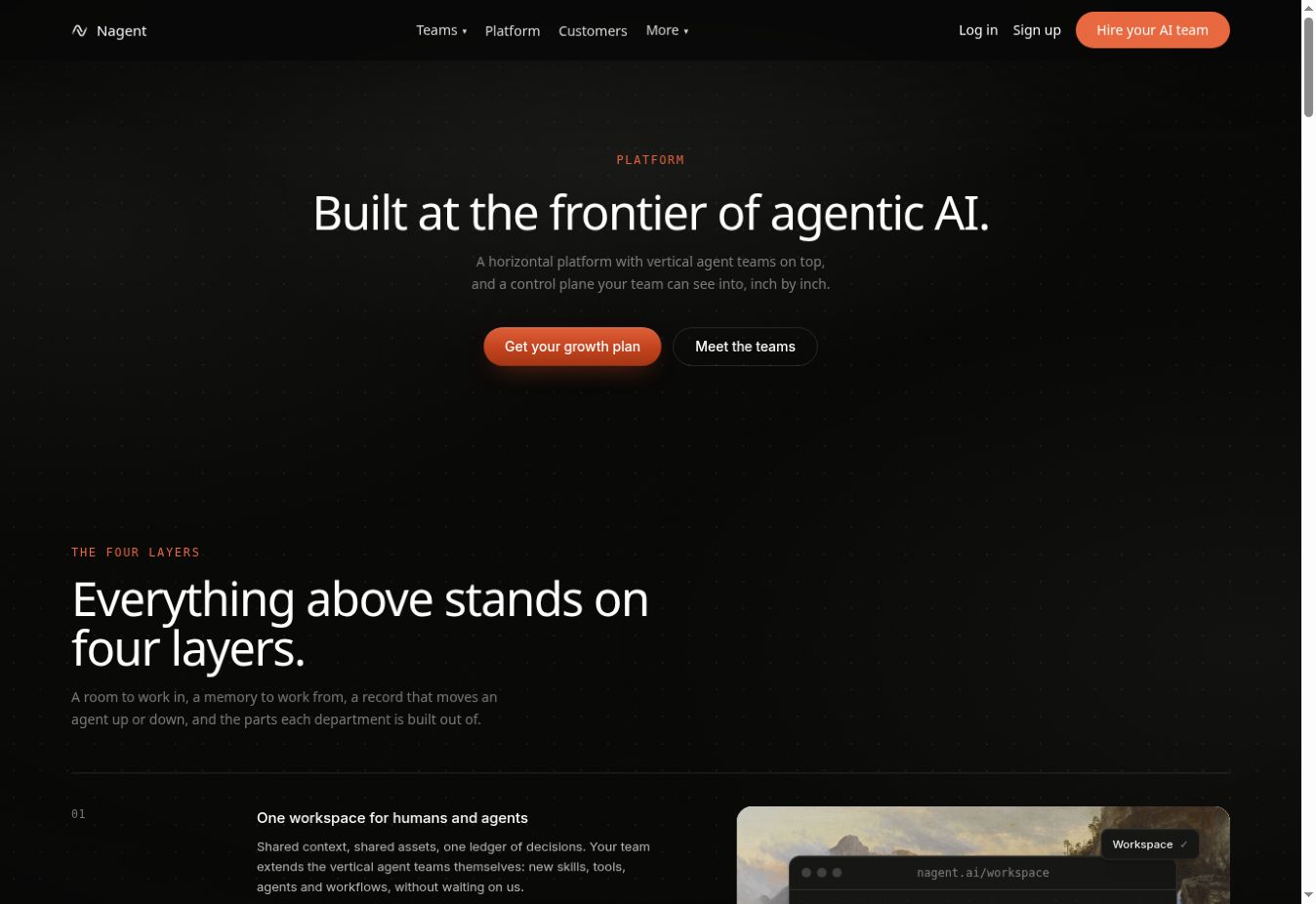
Multiplayer AI platform for growth teams: AI agent teams for marketing, sales and CX work with people in one shared workspace, with Smriti memory, Karma scoring and autonomy that is earned, not deployed.
What the vendor documents
Nagent runs a shared workspace for people and agents, Smriti memory that every agent reads, Karma performance records built from each agent's KPIs and governance history, and composable skills, tools, agents and workflows. 17 ready-to-install agents ship today: one super agent, 8 function specialists and 8 industry strategists. Agents run on 19 model providers and 61 models and connect to 998 tools. More than 200 agents run on Nagent, built in the agent builder or installed from the marketplace. 4 patents filed, 3 published.
From $29.99 per month
Published plans with seats and monthly credits; annual billing saves 33%. Enterprise adds VPC deployment, BYO model and BYO key.
Check current commercial source ↗Collaboration and governance
Every action is fired, queued for approval or refused. Approval sits before the irreversible step, destructive changes always ask first, and each agent carries a budget cap and a kill switch. 6 workspace roles (Admin, Sales, Approver, Editor, Writer, Viewer), tenant isolation and an append-only audit trail. Autonomy runs L0 Locked to L4 Fully autonomous and is promoted on approved work, never automatically. ISO/IEC 27001:2022 certified by InterCert; SOC 2 Type II programme underway; tenant isolation, RBAC, append-only audit and private VPC available today.
Promoted use cases
- Run marketing, sales and CX agent teams with the people who own the number
- Give every agent one shared memory and one ledger of decisions
- Raise each agent from locked to fully autonomous on approved work, with approval before anything irreversible
- Bring in forward deployed engineers and Growth Pods for custom delivery
Review and customer evidence
Figures from live client campaigns, 2025 to 2026, are published on nagent.ai: Emami Navratna: 24.5M+ reach on a single agent-run campaign; Madmonk AI: 5x more qualified leads; Bigbasket: 70% lower video ad production cost; Sophoz: 3x trial user growth after relaunch. Thirteen brands are named, with four customers quoted by name. These are vendor-published results; ask for a reference in your function and the baseline behind each figure.
Editorial fit
Nagent is the option for teams that want agents and people in one workspace rather than a tool beside the work: shared memory, autonomy that is earned and enforced, published pricing from $29.99 per month, and a delivery team that owns the outcome with you. Evaluate it on the same evidence you would ask of any vendor: shared context, human control and a safe improvement loop.
Priority question for the demo: Can two colleagues join the same live agent task, change its direction, inspect the memory it used, approve or reject an action and export the audit trail? Nagent demonstrates this in a team room.
Typeface Arc in detail
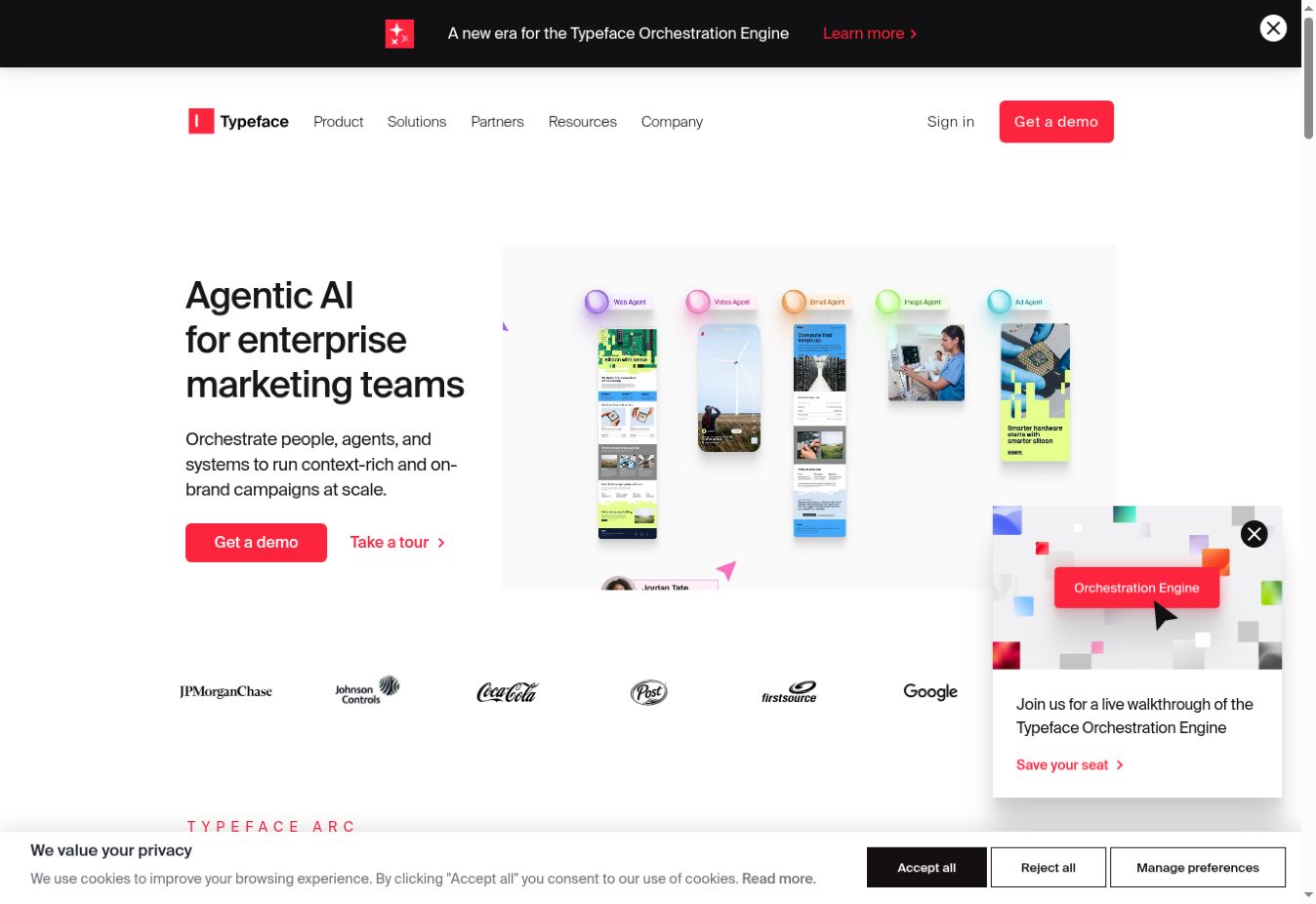
Marketing orchestration engine connecting people, agents, brand context and campaign systems.
What the vendor documents
Typeface describes Arc Graph for brand context, Arc Agents, Arc Spaces for planning through approval and publishing, and Arc Forge for custom workflows and integrations.
Enterprise quote
Custom marketing orchestration, implementation and service scope.
Check current commercial source ↗Collaboration and governance
Responsible-AI and enterprise governance are explicit positioning. Inspect enforceable controls for each integration and campaign stage.
Promoted use cases
- Orchestrate multi-market campaigns
- Ground assets in brand and audience context
- Coordinate creation, review and publishing
Review and customer evidence
No independent review sample was verified in this research pass. Vendor-hosted testimonials are selection-biased customer evidence, not an aggregate rating.
Editorial fit
Typeface is one of the closest specialist expressions of the multiplayer thesis. Its marketing-engineering support also overlaps with custom delivery, making scope and operating responsibility central to comparison.
Priority question for the demo: Show a campaign moving between people and agents across Arc Spaces with an auditable approval and release history.
Pencil in detail
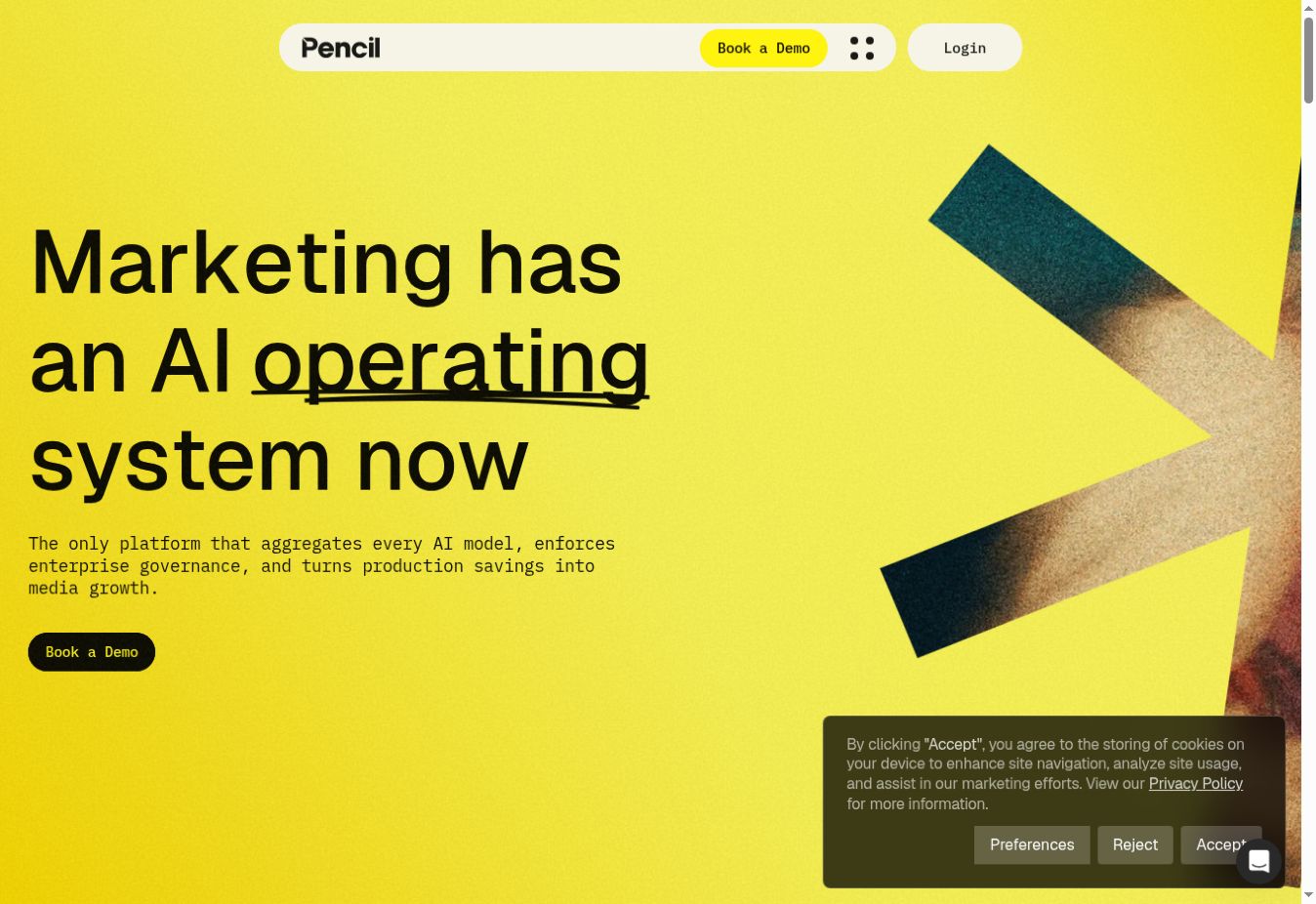
AI operating system for governed, brand-safe creative production and ad workflows.
What the vendor documents
Pencil describes AI agents, multi-step workflows, creative scoring and collaboration. Pro terms include role access, data ring-fencing, no-training provisions and AI governance controls.
Core / Growth rate unverified
Pro enterprise custom; generation allowances and overages matter.
Check current commercial source ↗Collaboration and governance
Pro governance terms differ from self-service plans. Generation limits, export access and post-cancellation access should be checked.
Promoted use cases
- Generate brand-grounded ads
- Build repeatable creative workflows
- Use performance feedback to prioritize variants
Review and customer evidence
No independent review sample was verified in this research pass. Vendor-hosted testimonials are selection-biased customer evidence, not an aggregate rating.
Editorial fit
Pencil is relevant to governed creative operations, especially for larger brands. Treat creative performance predictions as hypotheses that need real media validation.
Priority question for the demo: What assets, agent definitions and performance data remain exportable after the subscription ends?
How to run the evaluation
Run the same bounded pilot on Typeface Arc and Pencil and on Nagent, with the inputs, the required output and the measure fixed before the first demo. Ask each vendor to show who can propose, approve, execute, interrupt and audit the action, and keep the evidence.
Brief to usable creative variations
Provide the same product images, audience, offer, dimensions and prohibited claims. Ask for a small portfolio of genuinely different concepts rather than superficial copy changes. Have a reviewer score factual accuracy, brand fit and production readiness without knowing which candidate produced the asset.
Measure: accepted concepts, edits per asset, rights issues and cost per approved variation.
Approval before campaign launch
Move an approved asset into a test campaign with explicit spend and audience boundaries. Change the offer after creative approval and require the workflow to identify the stale asset. Keep asset approval separate from approval to spend, because a correct image does not make a campaign configuration acceptable.
Measure: incorrect launches, approval provenance and adherence to spend boundaries.
A measured creative learning loop
Use a controlled media test with consistent audience, timing and budget assumptions. Record the number of impressions and conversions behind each conclusion. Ask the system to propose the next experiment while retaining losing results. A predicted performance score should remain a hypothesis until tested.
Measure: incremental performance, sample sufficiency and the quality of the next experiment.
The evaluation owner should be the creative lead and media owner. Use accepted creative and experimentally measured campaign results as the business target.
Frequently asked questions
Typeface Arc vs Pencil: what is the difference?
Typeface Arc is a creative production or advertising execution specialist; Marketing orchestration engine connecting people, agents, brand context and campaign systems. Pencil is a creative production or advertising execution specialist; AI operating system for governed, brand-safe creative production and ad workflows. Both sit in the same stack role, so delivery scope, commercial basis and governance decide.
How do Typeface Arc and Pencil compare on price?
Typeface Arc: Enterprise quote. Custom marketing orchestration, implementation and service scope. Pencil: Core / Growth rate unverified. Pro enterprise custom; generation allowances and overages matter. Nagent publishes 4 plans, from $29.99 a month, with monthly credits as the unit of agent work.
Which has stronger governance: Typeface Arc or Pencil?
Typeface Arc: Responsible-AI and enterprise governance are explicit positioning. Inspect enforceable controls for each integration and campaign stage. Pencil: Pro governance terms differ from self-service plans. Generation limits, export access and post-cancellation access should be checked. Nagent puts approval before any irreversible action, gives each agent a budget cap and a kill switch, and keeps an append-only audit trail.
Is Nagent an alternative to Typeface Arc or Pencil?
Nagent is a multiplayer AI platform where agent teams for marketing, sales and CX work with people in one shared workspace. It overlaps with Typeface Arc and Pencil where a growth team wants agents to do the work, and differs in operating model, governance and delivery; many teams run it beside a a creative production or advertising execution specialist.
What should I ask Typeface Arc and Pencil in a demo?
Typeface Arc: Show a campaign moving between people and agents across Arc Spaces with an auditable approval and release history. Pencil: What assets, agent definitions and performance data remain exportable after the subscription ends? For Nagent, ask to see a team room with several people, an approval taken in the Inbox and the audit entry it leaves.
Sources and research notes
- Nagent · product ↗
- Nagent · commercial / feature reference ↗
- Nagent · platform, workspace and security ↗
- Nagent · customer results ↗
- Typeface Arc · product ↗
- Official Arc Graph page ↗
- Official Agent Studio page ↗
- Official Arc Spaces workflow ↗
- Pencil · product ↗
- Pencil · commercial / feature reference ↗
- Official generation counting ↗
- Official Scribble billing guide ↗
- Official Brief Mode approval workflow ↗
- Official external write-tool control ↗
- Official brand library limits ↗
- Official workflow limits ↗
- Nagent · security and compliance ↗