
Earned Autonomy: A 5-Level Ladder for AI Agents
How much an AI agent may do alone, decided by its record
Earned autonomy means an AI agent gains freedom to act alone only on its record. The Earned Autonomy Ladder has five levels, L1 Observe to L5 Lead. An agent moves up one level when a person reviews its approved work, drops one when its work slips, and some actions always wait for a person.
Overview
Earned autonomy is the rule that an AI agent may act alone only as far as its record allows. It starts supervised, gains room one step at a time when a person reviews evidence of good work, and loses room when its work slips. Some actions never become its own to take, however good the record.
Most agent platforms decide autonomy with a setting instead. An administrator chooses, per tool or per agent, whether an action runs alone, asks once, or asks every time. The setting is made on the day the agent is switched on, by someone who has not yet seen it work, and it stays until someone remembers to change it. An agent that has done three months of flawless work is trusted exactly as much as one built this morning.
Teams do not run people that way. A new hire starts with everything reviewed, earns room on a record of good calls, and loses it when a call goes wrong. The Earned Autonomy Ladder applies that model to agents. It is the framework Nagent runs on, and it is published here under a Creative Commons Attribution licence so any team can use it, with or without Nagent.
What is earned autonomy?
Earned autonomy has three parts, and a framework needs all three to deserve the name.
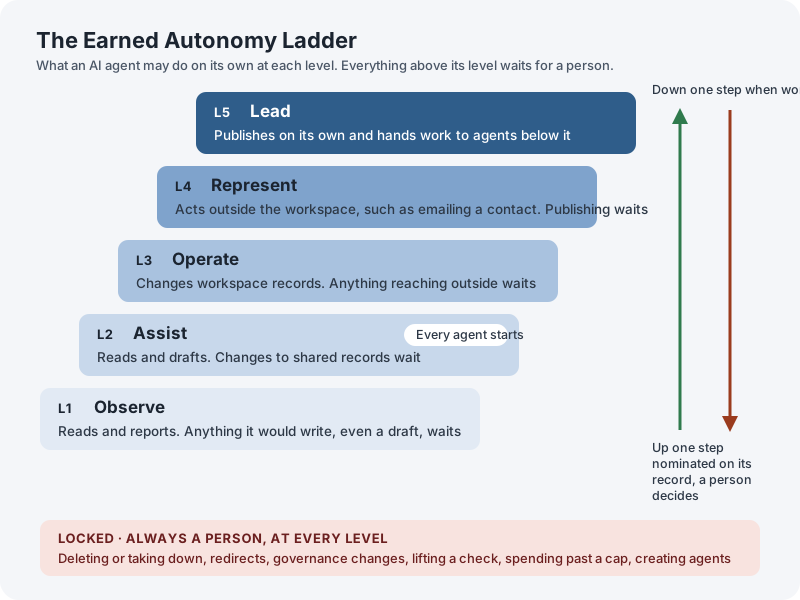
- Levels named by what the agent may do alone. Each level widens the agent's reach by one step: from reading, to drafting, to changing shared records, to acting outside the workspace, to publishing.
- A record that moves the agent. Promotion rests on work people have already reviewed, and a person decides each step. Demotion follows when the record slips, so the level always reflects recent work.
- A list that never moves. Some actions wait for a person at every level. Without that list, a high enough level becomes permission to do anything.
A level that is only configured fails the second test. A level that can only rise fails it too.
Why autonomy is earned, not set
Three things go wrong with autonomy as a setting.
The first is that it cannot express a record. Two agents with the same configuration are trusted identically whatever they have done. The second is that it makes the person the bottleneck or the rubber stamp: either every action waits for a click, or the rules are widened past what any agent has earned so the queue clears. The third is that nothing moves down. A setting that was right in January is still in place in June after the agent has put an unsupported claim on a hundred pages.
A ladder with rungs that are earned and lost answers all three. Trust follows the record, the queue shrinks as agents prove themselves, and a slip has a consequence the record can show.
What are the five levels?
| Level | What the agent may do on its own | Who decides the rest | Example |
|---|---|---|---|
| L1 Observe | Read and report. Anything it would write, even a draft, waits | A person, before anything is drafted or changed | A new visibility agent audits a site and writes the report |
| L2 Assist | Read and draft. Changes to records other people rely on wait | A person approves or rejects each change | The outbound agent drafts first messages; the sales lead reads them before anything is sent |
| L3 Operate | Change workspace records. Anything that reaches outside the workspace waits | The named approver, for anything that leaves the workspace | The CRM agent updates a deal stage and logs the call without asking |
| L4 Represent | Act outside the workspace, such as emailing a contact. Publishing waits | The person who agreed the classes, reviewing the log | The paid ads agent pauses a keyword that is wasting spend and logs why |
| L5 Lead | Publish, and hand work to agents below it. Deleting and governance changes always wait | The guardrails, set by a person | A reporting agent publishes the morning dashboard and hands follow-ups to the agents below it |
The ladder starts an agent at L2 Assist. L1 Observe is for an agent whose output a team wants to read before it drafts anything. An action class a team has decided to keep with people permanently is Locked: it waits for a person at every rung.
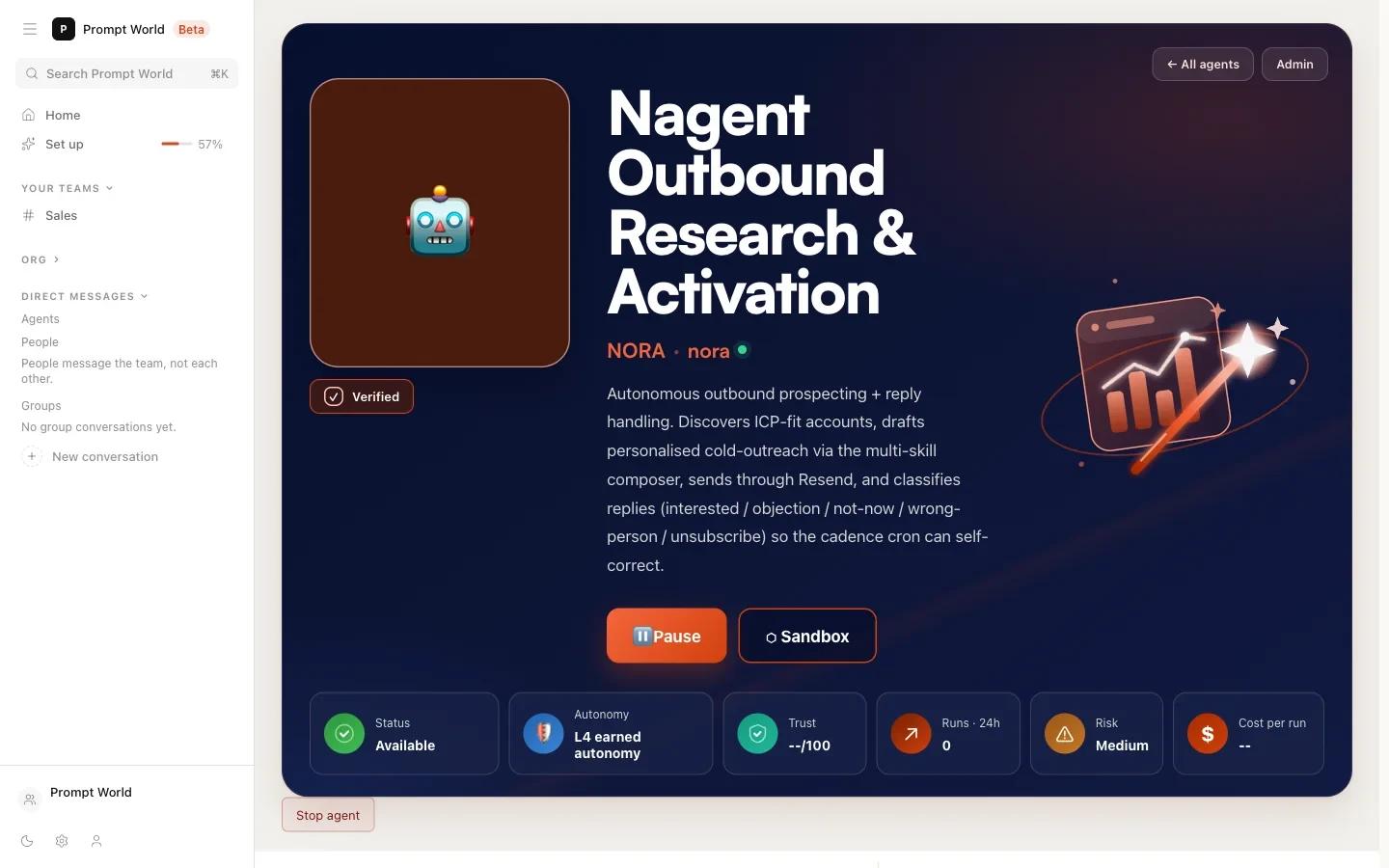
Nagent uses the same five names in the product, L1 Observe up to L5 Lead, and shows each agent's rung and trust record on its page. Its prebuilt teams arrive at the rung each was built for, which can be above the ladder's starting rung so a new team can work from its first message. What keeps that safe is the Locked list below, which waits for a person whatever rung the agent holds (autonomy and governance). Every action Nagent's agents can take, and the rung at which each is done alone, is listed in Earned Autonomy: every agent action by level.
What moves an agent up a level?
Promotion rests on evidence a person has already reviewed:
- Work approved without edits over a window, counted against the work that was changed or rejected.
- Risky calls handed up instead of made alone. An agent that escalates a decision outside its brief is building the case for a wider brief.
- No guardrail breaches in the window.
- A trust score that has stayed above the rung's floor, where the platform keeps one.
The platform recommends the promotion with the evidence attached and a person signs it off. The promotion names exactly what the agent may now do alone, and nothing else changes. Nothing promotes itself.
In Nagent the platform nominates an agent each night once it has spent 30 days at its rung with at least 25 decided approval cards, fewer than 5 per cent of them dismissed, and no automatic drop in that time. The nomination is a "Promote to" card carrying the evidence. A person decides, one rung at a time; L4 and L5 need a further permission, and L5 needs a second person, because the one who asked cannot approve it.

What moves an agent down?
A slip. An unsupported product claim that reached a page. A budget cap touched. A guardrail breached, even in advisory mode, more than once. The agent drops a rung, the record states in plain language what would earn the rung back, and every action in the affected class waits for a person again.
Demotion is the half of the ladder most teams forget, and it is the half that makes the other half believable. A promotion only means something if it can be taken back.
In Nagent a nightly run reads each agent's last 14 days and drops it one rung, never below L1, when too many of its cards were dismissed or edited, too many of its runs failed, several people gave its work a thumbs down, or its outcomes were rated poor. A budget breach, a Locked tool asked for outside a card, or a person taking down what an L5 publisher put out drops it at once. The thresholds are set out in Earned Autonomy: every agent action by level.
Which actions stay with people?
Some actions never climb the ladder, however senior the agent. In Nagent these are Locked:
- Deleting or taking something down.
- Redirects on a live website.
- Changing governance, or who may access what.
- Lifting a check that held something back.
- Spending past a cap a person set.
- Creating agents, skills, workflows or triggers.
These are the actions where a mistake cannot always be undone. Reaching outside the workspace, such as emailing a contact, is done alone only from L4 Represent, and publishing only at L5 Lead and only through the content checks publishing already has. A team that adopts the ladder should write its own list first, before it decides any rung, and may well keep more on it.
In Nagent a held action is decided on a confirm card, in the team room, the agent's chat and the Inbox of everyone who may approve it, and only its buttons decide it; typing "approve" in the conversation does not (approvals and the Inbox).
How does the ladder compare with other autonomy frameworks?
Levels of autonomy are an old idea. Engineers have graded automation since the 1970s, and several frameworks for AI agents have appeared since 2023. Most describe a level a system is designed or configured to run at. A few now tie the level to evidence.
| Framework | Publisher, year | Levels | How the level is set | Demotion | Always-human actions |
|---|---|---|---|---|---|
| Earned Autonomy Ladder | Nagent AI, 2026 | Five: L1 Observe, L2 Assist, L3 Operate, L4 Represent, L5 Lead | Earned on a record of approved work; a person decides each step | Yes, one level, read again every night | Yes, the Locked list |
| SAE J3016 | SAE International, 2014, revised 2021 | Six: 0 No Driving Automation to 5 Full Driving Automation | A design property of the feature engaged | No | Not framed that way |
| Levels of automation | Parasuraman, Sheridan and Wickens, 2000, after Sheridan and Verplank, 1978 | Ten: from the computer offering no help to the computer acting alone and ignoring the human | Allocated when the system is designed | No | No |
| Levels of AGI, autonomy axis | Google DeepMind, 2023 | Six: No AI, AI as a Tool, Consultant, Collaborator, Expert, Agent | A deployment choice, unlocked by capability | No | No |
| Levels of Autonomy for AI Agents | Feng, McDonald and Zhang, Knight First Amendment Institute, 2025 | Five, named for the user's role: Operator, Collaborator, Consultant, Approver, Observer | A design decision, optionally capped by an outside autonomy certificate | The certificate lapses when the setup changes | No |
| Agentic AI Security Scoping Matrix | AWS, 2025 | Four scopes: No agency, Prescribed, Supervised, Full agency | Raised as the organisation's confidence and security mature | Yes, reduced automatically on security events | Approval for actions of consequence in the prescribed scope |
| Agentic Trust Framework | Cloud Security Alliance, 2026 | Four: Intern, Junior, Senior, Principal | Earned through promotion gates, time at level and sign-off by people | Yes, an incident can demote | No fixed list |
| Practices for Governing Agentic AI Systems | OpenAI, 2023 | No levels; seven practices | Set by the deployer, user or developer | An agent can be paused until a person re-authorises it | Raised as an open question |
The Cloud Security Alliance's Agentic Trust Framework shares the central idea: an agent earns its level through demonstrated performance and people sign off each promotion. The Earned Autonomy Ladder adds four things a growth or operations team can run day to day:
- Levels named by scope of action. Each level says exactly what the agent may now do alone, including a Represent level for acting outside the workspace, such as emailing a contact, before any publishing.
- Evidence from decided work. The record is the agent's approval cards, each decided by a person: approved, edited or dismissed.
- A one-step demotion, read every night. A slip drops the agent one level rather than back to the start, so a good record is not wiped by one bad week, and a pattern of slips still walks it down.
- The Locked list. A short, written list of actions that wait for a person at every level, agreed before any level is set.
Running the ladder in your own team
- Write the always-human list. Agree it with whoever owns the budget, the customer relationship and the brand.
- Start every agent at L2 Assist. Resist the pull to configure a capable agent higher on day one.
- Define the promotion window and the evidence. Four weeks and three kinds of evidence (clean approvals, escalations, no breaches) is a workable default.
- Record every promotion and demotion with the evidence and the person who signed it, in a place the whole team can read.
- Review the ladder quarterly. If every agent sits at L2 Assist after six months, the evidence bar is too high or the agents are not ready; if every agent is at L5 Lead, the bar is too low.
A quarterly ladder review template
Review every agent's level once a quarter, in one table the whole team can read. Fill one row per agent from its record.
| Agent | Level now | Days at level | Cards decided | Approved without edits | Dismissed | Breaches | Decision |
|---|---|---|---|---|---|---|---|
| Name and role | L1 to L5 | Since the last change | In the quarter | Share of decided cards | Share of decided cards | Guardrail or budget, with dates | Hold, nominate for the next level, or drop a level |
Then read the table as a whole. If most agents sit at L2 Assist after two quarters, the evidence bar may be too high or the agents are not ready. If most sit at L5 Lead, the bar is too low. If the Locked list has not been read since the last review, read it first.
Using this framework
The Earned Autonomy Ladder is published under the Creative Commons Attribution 4.0 licence. Reuse the rungs, the promotion evidence and the always-human list in your own documents, products and training, with attribution to Nagent AI and a link to this page. Named frameworks travel; product features do not.
Frequently asked questions
Why is autonomy earned rather than configured?
A setting describes what an administrator hoped an agent could handle on the day it was switched on. A record describes what the agent actually did. Promotion on the record means an agent that has done three months of clean, approved work is trusted with more than one that was built this morning, which is how a team treats a new colleague.
What are the five levels?
L1 Observe, where the agent reads and reports and anything it would write, even a draft, waits for a person; L2 Assist, where it drafts on its own and changes to records other people rely on wait; L3 Operate, where it changes workspace records on its own and anything that reaches outside the workspace waits; L4 Represent, where it acts outside the workspace on its own and publishing waits; and L5 Lead, where it publishes on its own and can hand work to agents below it, while deleting and governance changes always wait for a person.
How is earned autonomy different from levels like SAE's driving levels?
Most autonomy scales, from SAE J3016 for cars to recent levels for AI agents, describe a level a system is designed or configured to run at. The Earned Autonomy Ladder describes a level an agent holds because of its record: a person raises it one step on evidence, and it drops a step when the work slips.
What moves an agent up or down a level?
Up: evidence a person reviewed, such as work approved without edits, risky calls handed up instead of made alone, and no guardrail breaches over a window. The platform recommends and a person signs it off. Down: a slip, such as an unsupported claim on a page, a budget cap touched or a guardrail breached. Nothing promotes itself.
Which actions never become autonomous?
Deleting or taking something down, redirects on a live site, changes to governance or to who may access what, lifting a check, spending past a cap a person set, and creating agents, skills, workflows or triggers. These stay with a person at every level, however senior the agent becomes.
Can another team use the ladder?
Yes. This page is published under a Creative Commons Attribution licence. Any team can adopt the five levels, the promotion evidence and the always-human list in its own operating model, with attribution to Nagent AI.
Sources
- Nagent platform page, the control plane and the autonomy ladder https://nagent.ai/platform
- Nagent documentation, autonomy and governance https://nagent.ai/docs/autonomy-and-governance
- State of Agent Governance, Nagent thesis series no. 2 https://nagent.ai/artefacts/state-of-agent-governance
- SAE International, J3016 levels of driving automation (2021 revision) https://www.sae.org/standards/content/j3016_202104/
- Parasuraman, Sheridan and Wickens, a model for types and levels of human interaction with automation (2000) https://doi.org/10.1109/3468.844354
- Google DeepMind, Levels of AGI for operationalizing progress on the path to AGI (2023) https://arxiv.org/abs/2311.02462
- Feng, McDonald and Zhang, Levels of Autonomy for AI Agents, Knight First Amendment Institute (2025) https://knightcolumbia.org/content/levels-of-autonomy-for-ai-agents-1
- AWS, the Agentic AI Security Scoping Matrix (2025) https://aws.amazon.com/blogs/security/the-agentic-ai-security-scoping-matrix-a-framework-for-securing-autonomous-ai-systems
- Cloud Security Alliance, the Agentic Trust Framework (2026) https://cloudsecurityalliance.org/blog/2026/02/02/the-agentic-trust-framework-zero-trust-governance-for-ai-agents
- OpenAI, Practices for Governing Agentic AI Systems (2023) https://cdn.openai.com/papers/practices-for-governing-agentic-ai-systems.pdf
Cite this page
Plain:
Nagent AI. Earned Autonomy: A 5-Level Ladder for AI Agents. Frameworks, no. 1. 2026. https://nagent.ai/artefacts/earned-autonomy-ladder
BibTeX:
@misc{nagent2026earnedautonomyladder,
  author = {Nagent AI},
  title = {Earned Autonomy: A 5-Level Ladder for AI Agents},
  series = {Frameworks},
  year = {2026},
  url = {https://nagent.ai/artefacts/earned-autonomy-ladder},
  note = {Published 2026-10-04, updated 2026-10-23}
}
The direct answer at the top of this page is written to be quoted as one sentence with this URL as its source.
About Nagent
Nagent is multiplayer AI for growth: people and AI agents in one shared context, delivering the number. The product is the multiplayer growth org. N is the one teammate each person talks to, by voice or by text. Under N, an AI Chief of Staff runs each team, MIRA for Marketing, SERA for Sales and CREA for Content, with the team leads who do the work, and your own people work beside them in one workspace. Three things make it different. You approve the AI teammates' work until they earn the right to act on their own. They carry the work all the way to pipeline and customers, not just content. And where your plan includes it, a Nagent marketer joins your team and owns the number with you. Founded in Bengaluru in 2024, Nagent is an Anthropic partner, holds four filed patents on orchestration and memory, and deploys in the customer's private cloud.
Published 4 October 2026, last updated 23 October 2026. Published under the Creative Commons Attribution 4.0 licence: reuse with attribution to Nagent AI and a link to this page.