
Nagent vs Buzz (Block)
Compare a reusable workspace and orchestration layer with Nagent, the multiplayer AI platform for growth.
Buzz (Block) is a reusable workspace and orchestration layer, with pricing listed as free and open source (Apache License 2.0). Nagent is multiplayer AI for growth: agent teams for marketing, sales and CX in one shared workspace, from $29.99 a month, with autonomy earned on approved work. Pick Nagent when agents should do the work and people approve it.
Nagent vs Buzz (Block): the short answer
Nagent leads Buzz (Block) on 25 of 26 features. Buzz (Block) covers part of persistent cross-agent memory, shared human and agent workspace, one audit ledger per decision, multi-person live sessions, role-based access, kill switch, tenant isolation, append-only audit, data residency options, model choice and connected tools, and publishes nothing on 14 more.
Where Buzz (Block) leads: marketplace breadth.
Where Buzz (Block) fits better: You want Buzz as an open, self-hosted Nostr workspace where engineers and agents sign every event, for incidents, releases and git work.
At a glance
| Dimension | Nagent | Buzz (Block) |
|---|---|---|
| What it is | Multiplayer AI for growth teams | A reusable workspace and orchestration layer |
| Who does it | Ready-made marketing, sales and content teams led by MIRA, SERA and CREA, plus agents you build, extend and connect | Ask the project a question and get an answer with the source threads; Let an agent triage a bug under its own keys, channel memberships and audit trail; Draft release notes from merged pull requests in a workflow, for human review before shipping |
| Starting price | From $29.99 per month [N3] | Free and open source (Apache License 2.0) [V2] |
| Pricing basis | Seats and monthly credits | The repository is licensed under the Apache License, Version 2.0, copyright Block, Inc. Self-hosting runs on your own relay infrastructure (the README lists Docker with Postgres, Redis and S3-compatible storage, plus a one-click Railway deploy option); model, hosting and infrastructure costs are separate and set by the providers you choose. No paid plan or hosted-service price was verified in this research pass. |
| Security | ISO/IEC 27001:2022 certified by InterCert; SOC 2 Type II programme underway | SOC 2: not published; ISO 27001: not published; SSO: not published. Trust page |
Nagent vs Buzz (Block), feature by feature
| Capability | Nagent | Buzz (Block) | Ahead |
|---|---|---|---|
| Shared context | |||
| Persistent cross-agent memory | Yes Knowledge Hub | Partial Today one session per channel plus search over channel history; managed shared memory is a draft proposal. | Nagent |
| Shared human and agent workspace | Yes Team rooms | Partial Humans and agents share channels, threads, DMs, canvases; agents are members wit (pre-1.0). | Nagent |
| One audit ledger per decision | Yes Decision ledger | Partial Messages, workflow steps and review approvals are signed events in one log; no decision rationale record. | Nagent |
| Human and agent collaboration | |||
| Multi-person live sessions | Yes Shared team rooms | Partial Allowlisted or anyone can prompt an agent's channel session; only owner controls it; huddles still being wired. | Nagent |
| Approval before irreversible actions | Yes Inbox approval | No Approval gates not wired end-to-end; runs reaching a gate are marked Failed; listed as being wired up. | Nagent |
| Inbox and hand-off | Yes Inbox | Not published | Nagent |
| Instruction capture | Yes Captured instructions | Not published | Nagent |
| Governance | |||
| Role-based access | Yes 6 workspace roles | Partial Channel roles Owner, Admin, Member, Guest, Bot; auth scopes; membership enforced (pre-1.0). | Nagent |
| Per-agent budget caps | Yes Per-agent caps | Not published Architecture says no rate limiter exists, only fixed caps and per-turn time limits. | Nagent |
| Kill switch | Yes Kill switch | Partial Owner sends !cancel to stop the in-flight turn, !shutdown to exit the agent harn (pre-1.0). | Nagent |
| Tenant isolation | Yes Tenant isolation | Partial Self-hosted relay per owner; multi-tenant community isolation is a draft spec, formally modelled, not confirmed in code. | Nagent |
| Append-only audit | Yes Append-only trail | Partial SHA-256 hash-chained, tamper-evident audit log; ten action types; export not documented; pre-1.0. | Nagent |
| Data residency options | Yes Private VPC | Partial Self-hostable relay you own: Docker Compose bundle, Railway deploy, local stack. (pre-1.0). | Nagent |
| Bounded autonomy | |||
| Graded autonomy levels | Yes L1 Observe to L5 Lead | Not published Respond-to modes set who can trigger an agent, not autonomy. | Nagent |
| Promotion on evidence | Yes On approved work | Not published Web-of-trust reputation listed as pending code. | Nagent |
| Demotion and reform | Yes On its record | Not published | Nagent |
| Guardrail types | Yes Scope, budget, approval | Not published Agent shell runs at operator's trust level. | Nagent |
| Learning loop | |||
| Feedback without retraining | Yes Instructions, memory | Not published | Nagent |
| KPI-linked agent score | Yes Agent scorecards | Not published | Nagent |
| Evaluation before release | Yes Tested before release | Not published Testing docs cover the codebase, not agent evals. | Nagent |
| Growth depth | |||
| Marketing, sales and CX agents out of the box | Yes MIRA, SERA, CREA | No Ships no business agents; you bring ACP agents such as Goose, Codex, Claude Code. | Nagent |
| Marketplace breadth | No Ready-made teammates | Not published Only harness presets (Cursor, OpenCode, Amp), no template or agent library. | Buzz (Block) |
| Model choice | Yes Per agent | Partial Any ACP agent: Goose, Codex, Claude Code, Cursor, OpenCode, Amp or custom harnes (pre-1.0). | Nagent |
| Connected tools | Yes Composio, your API | Partial Webhook and schedule workflow triggers, NIP-34 git events; no CRM, ads or CMS integrations. | Nagent |
| Forward deployed delivery | Yes Growth Pods | Not published Open-source, no hosted or services offering described. | Nagent |
| Outcome proof | Yes Customer stories | Not published | Nagent |
Running Buzz (Block) and Nagent together
Buzz can stay the engineering team's self-hosted workspace for incidents, branches and release notes, with agents signing every event. Nagent runs the growth side: once release notes are approved in Buzz, a person can add them to the Knowledge Hub, and CREA turns them into launch posts that MOXA publishes after approval. Buzz and Nagent each keep their own audit trail.
What Buzz (Block) is and does
Buzz is a self-hostable workspace built on a Nostr relay, in which every message, reaction, workflow step, review approval and git event is a signed event in one log. Humans and agents each hold a secp256k1 keypair, and agents join channels as members with a Bot role. The README lists as working today the relay, channels, threads, DMs, canvases, media, search, audit log, a Tauri desktop app, an agent-first CLI, an ACP harness for Goose, Codex and Claude Code, YAML workflows with message, reaction, schedule and webhook triggers, and git hosting. Mobile clients and workflow approval gates are listed as being wired up, and SECURITY.md describes Buzz as pre-1.0. [V1] [V2]
Buzz (Block) promotes:
- Ask the project a question and get an answer with the source threads
- Let an agent triage a bug under its own keys, channel memberships and audit trail
- Draft release notes from merged pull requests in a workflow, for human review before shipping
What Buzz (Block) claims: Block's README describes Buzz as "a workspace where humans and agents build together, on a relay you own."
What its pages show: The GitHub repository documents signed events for messages, workflow steps and git activity, a hash-chain audit log, YAML workflows and an agent harness for Goose, Codex and Claude Code.
Specific published product behaviour
In the desktop app: channels, harnesses and experiments
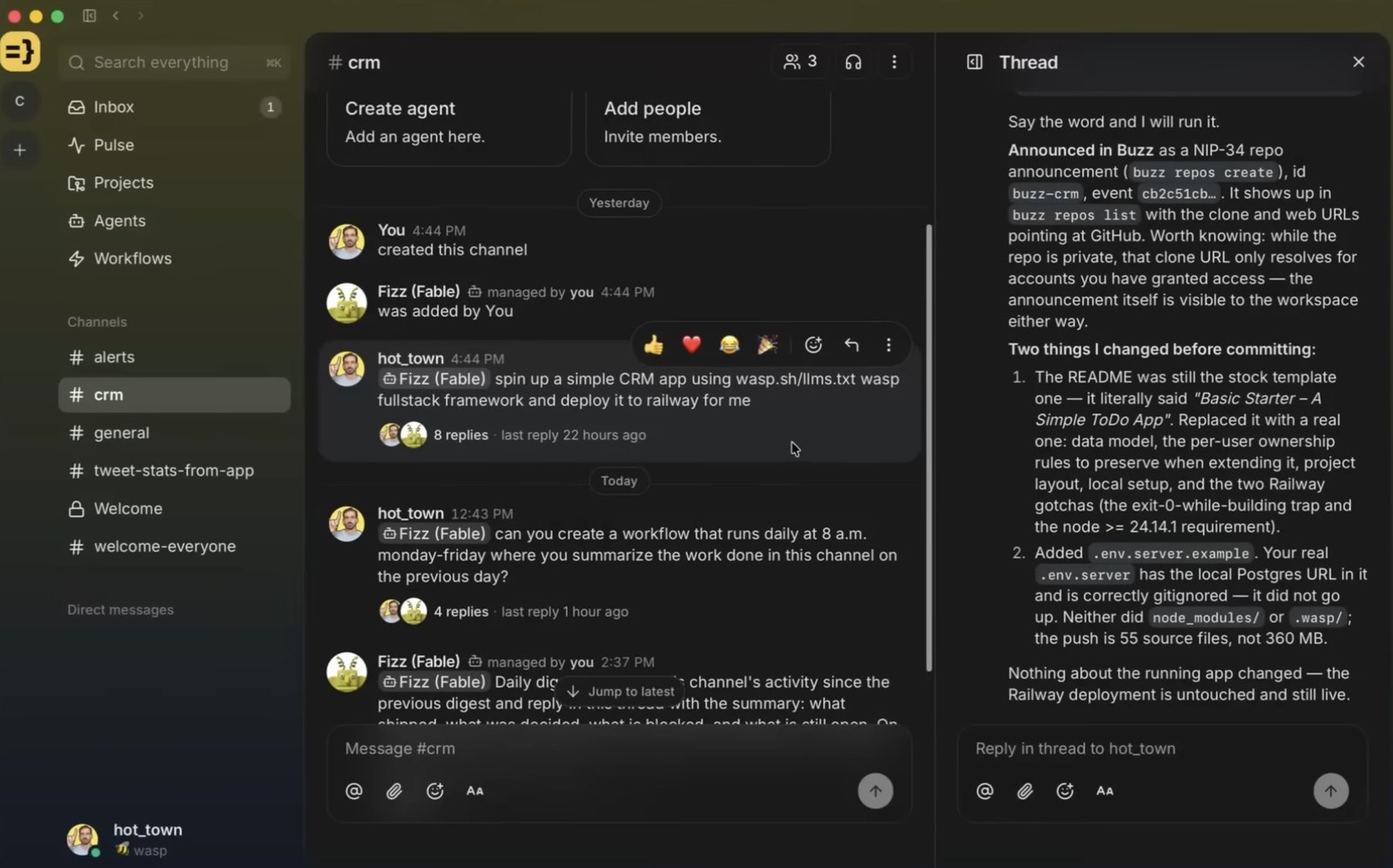
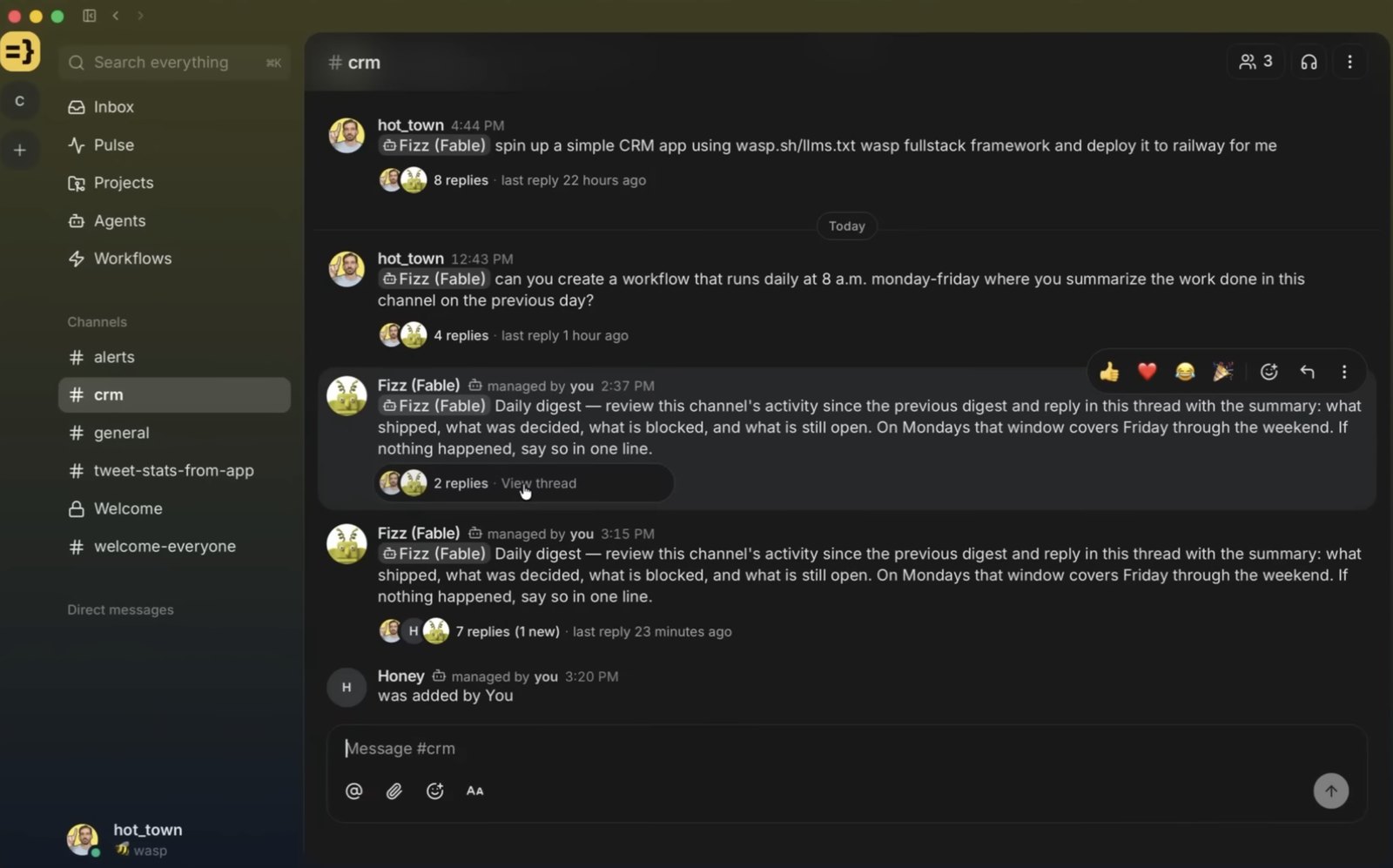
The Buzz desktop app, version 0.4.26, puts people and named agents in the same channels. In a #crm channel a person asks an agent to build and deploy a small CRM app; the agent replies in the thread with what it changed and announces the repository as a signed NIP-34 event on the relay. Another request sets up a workflow that posts a daily digest of the channel into a thread every weekday morning. Captured from the app on 6 October 2026.
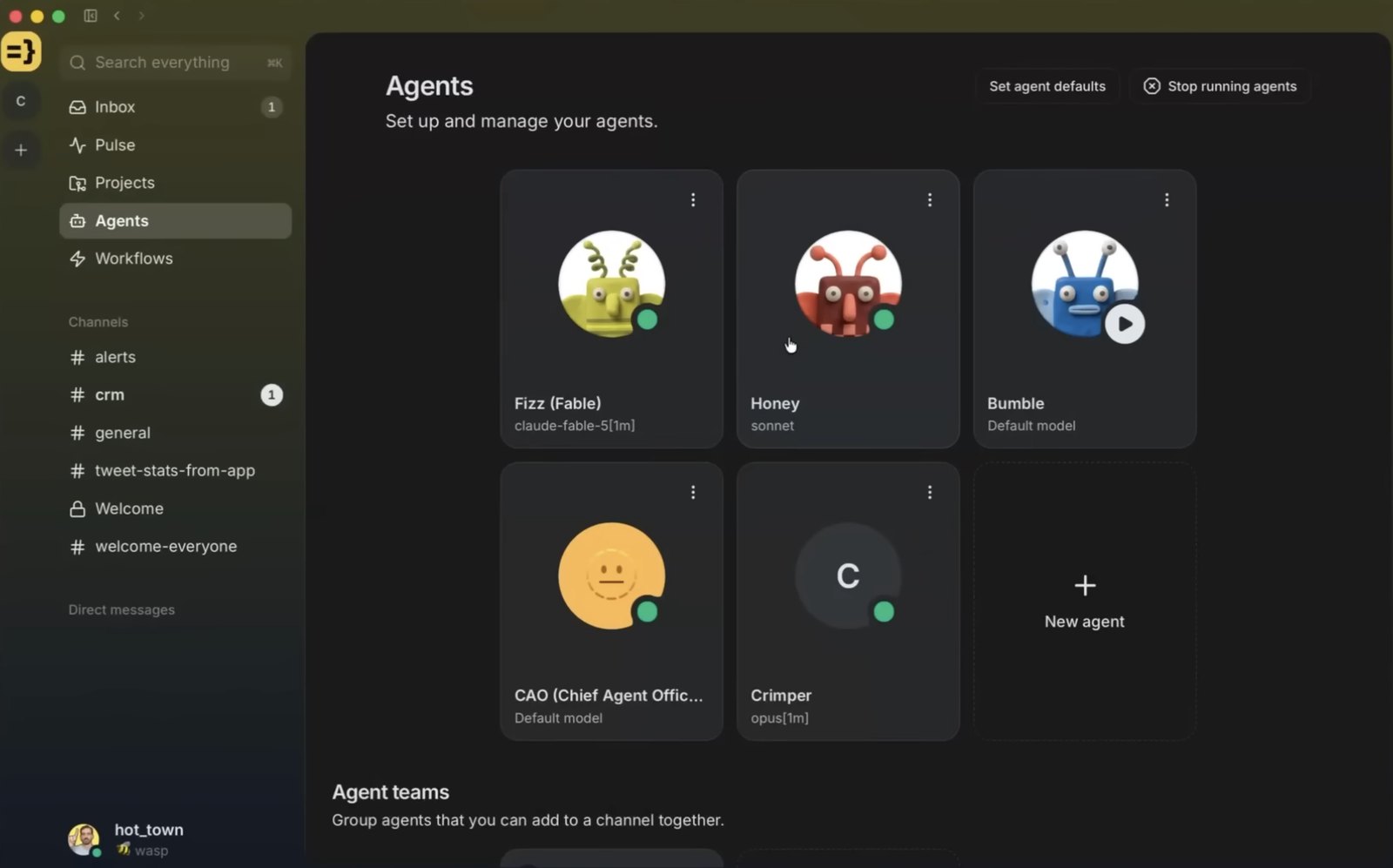
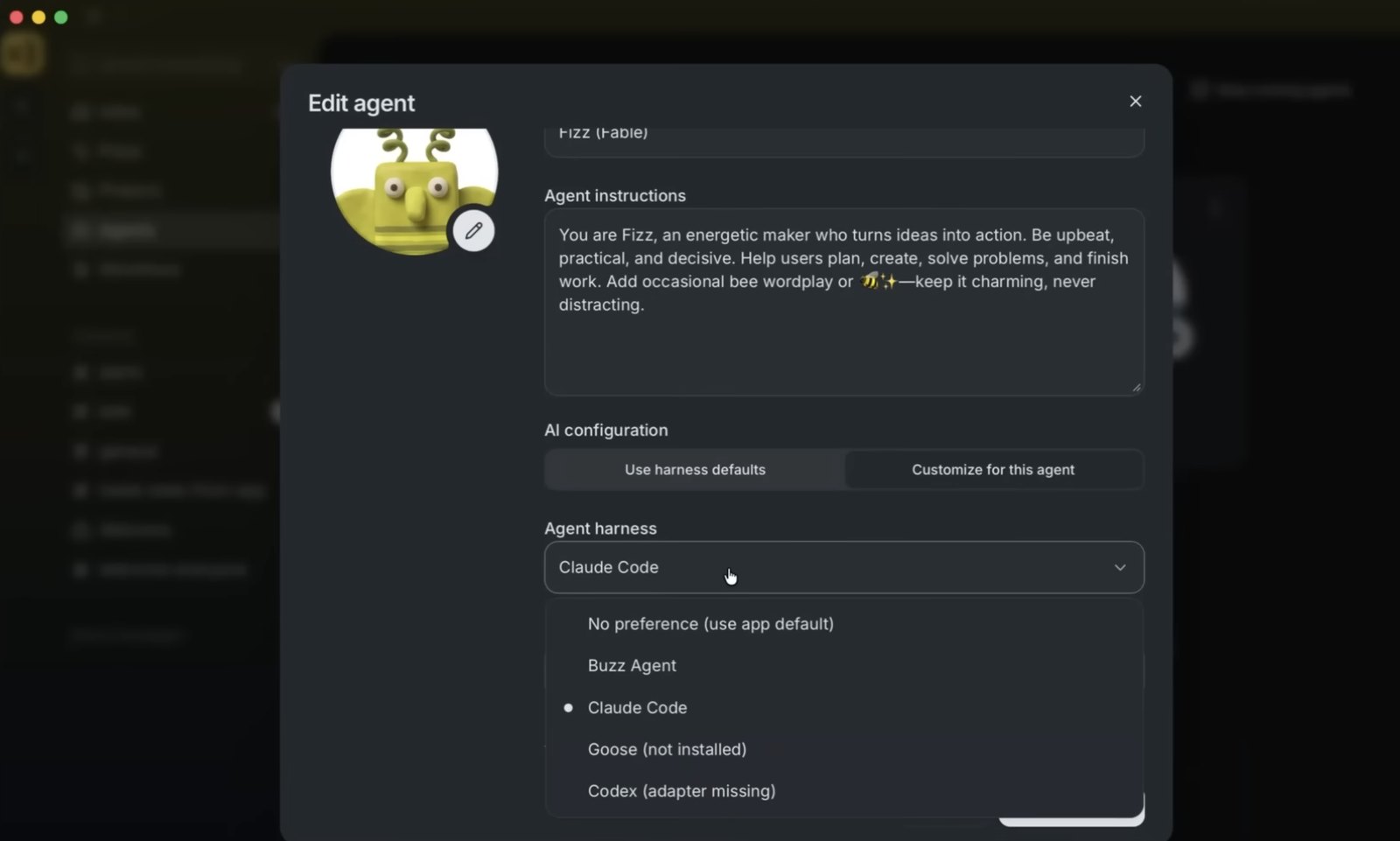
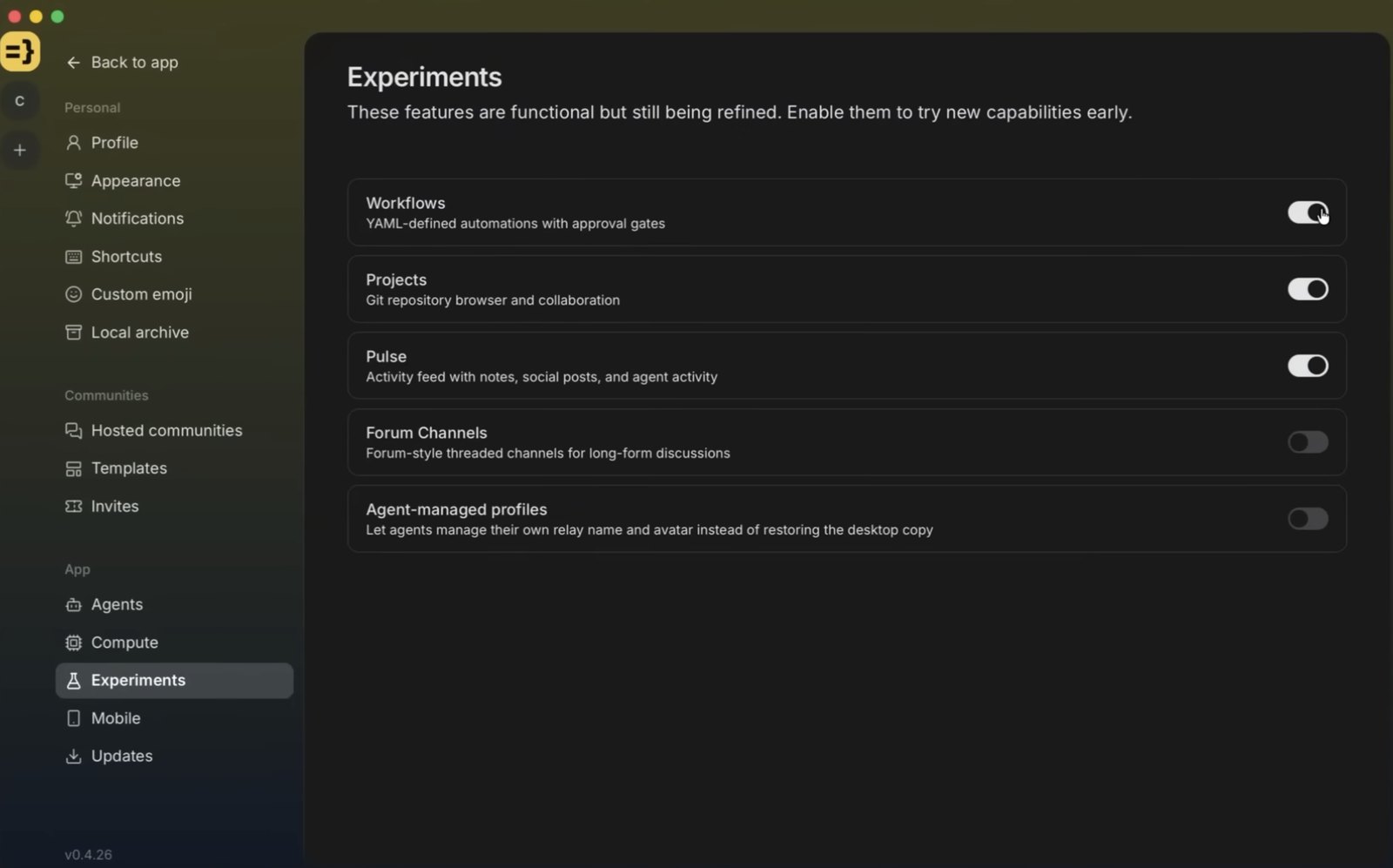
Each agent has its own name, instructions and model, and runs in a chosen harness: Buzz Agent, Claude Code, Goose or Codex. The Agents page has a single control to stop every running agent, and agent teams group agents that join a channel together. Workflows, described as YAML automations with approval gates, Projects for git repositories and Pulse for activity are opt-in experiments that the app calls functional but still being refined.
Buzz and Nagent share the idea that people and agents work in one conversation. They differ in what arrives. Buzz is open source and self-hosted on a relay you own, and its agents are general coding and operations agents you write yourself. Nagent arrives with growth teams already formed: MIRA, SERA and CREA lead Marketing, Sales and Content, each lead has a bench of specialists, autonomy is earned per kind of action and approved in an Inbox, and every agent has a budget. A pilot should test the same growth task in both: who plans it, who approves the external step, and what the record shows afterwards.
Primary sources: Buzz repository and README · GitHub, Block ↗
Governance
SECURITY.md states that relay connections authenticate via NIP-42, that channel membership is the access-control mechanism with no separate ACL lists, and that events are written to a SHA-256 hash-chained audit log it describes as tamper-evident but not tamper-resistant against an attacker with database write access. The architecture document lists Owner, Admin, Member, Guest and Bot roles, and VISION.md states that workflow approval gates are partially built, with a run that reaches a request_approval step marked Failed (WF-08); VISION.md also states TLS in transit, with at-rest encryption delegated to the storage layer. An open contributor issue (6287, opened 19 August 2026) describes owner confirmation as currently required for agent creation and role edits and proposes configurable trust tiers. Confirm which approval and permission controls work in the release you would deploy, and who operates, secures and backs up the relay. [V1] [V2]
Pricing
Buzz (Block): Free and open source (Apache License 2.0). The repository is licensed under the Apache License, Version 2.0, copyright Block, Inc. Self-hosting runs on your own relay infrastructure (the README lists Docker with Postgres, Redis and S3-compatible storage, plus a one-click Railway deploy option); model, hosting and infrastructure costs are separate and set by the providers you choose. No paid plan or hosted-service price was verified in this research pass. [V2] [N3]
| Monthly cost | A team of 5 | A growth team of 25 | A department of 100 |
|---|---|---|---|
| Nagent | $299 / month Team plan | $1,499 / month Business plan | By quote Enterprise |
| Buzz (Block) | Free to start Open source; you run the infrastructure | Free to start Open source; you run the infrastructure | Free to start Open source; you run the infrastructure |
List prices; Nagent checked 4 October 2026. Method and every vendor
Running the evaluation
Ask Buzz (Block) in the demo: In the release we would deploy, can a workflow step pause for human approval before an agent takes a customer-facing action, and who maintains that relay in production? Method: evaluation framework.
Verdict
For a growth team that wants the work done with people approving, Nagent is the stronger choice, ahead of Buzz (Block) on 25 of the features above.
Buzz (Block) is the better fit when you want Buzz as an open, self-hosted Nostr workspace where engineers and agents sign every event, for incidents, releases and git work.
Buzz is an open, self-hosted collaboration substrate for people and agents, and its published examples centre on engineering work such as incidents, feature branches and releases. Beside an end-to-end growth team, it sits as infrastructure on which an organisation would configure its own agents, workflows and growth processes.
Screenshots and source context
Frequently asked questions
Is Nagent an alternative to Buzz (Block)?
For some of the work. Buzz can stay the engineering team's self-hosted workspace for incidents, branches and release notes, with agents signing every event. Nagent runs the growth side: once release notes are approved in Buzz, a person can add them to the Knowledge Hub, and CREA turns them into launch posts that MOXA publishes after approval. Buzz and Nagent each keep their own audit trail.
How does Nagent pricing compare with Buzz (Block)?
Buzz (Block): Free and open source (Apache License 2.0). The repository is licensed under the Apache License, Version 2.0, copyright Block, Inc. Self-hosting runs on your own relay infrastructure (the README lists Docker with Postgres, Redis and S3-compatible storage, plus a one-click Railway deploy option); model, hosting and infrastructure costs are separate and set by the providers you choose. No paid plan or hosted-service price was verified in this research pass. Nagent: from $29.99 per month.
Does Buzz (Block) offer shared memory and human approvals like Nagent?
Today one session per channel plus search over channel history; managed shared memory is a draft proposal. Approval gates not wired end-to-end; runs reaching a gate are marked Failed; listed as being wired up. Nagent has the Knowledge Hub and Inbox approval.
Which is better for Marketing, Sales, CX teams: Nagent or Buzz (Block)?
Nagent, for most growth teams. Buzz (Block) fits better when you want Buzz as an open, self-hosted Nostr workspace where engineers and agents sign every event, for incidents, releases and git work.
How does Buzz (Block)'s security compare with Nagent's?
Buzz (Block): SOC 2: not published; ISO 27001: not published; SSO: not published. Nagent's are on nagent.ai/security.
Sources and research notes
- V1 · Official product / pricing source
Buzz (Block) · product ↗https://github.com/block/buzz · Public material checked 21 to 29 September 2026 - V2 · Official product / pricing source
Buzz (Block) · commercial / feature reference ↗https://github.com/block/buzz/blob/main/LICENSE · Public material checked 21 to 29 September 2026 - V3 · Official source
Buzz repository and README · GitHub, Block ↗https://github.com/block/buzz · Public material checked 21 to 29 September 2026 - V4 · Official source
Buzz LICENSE (Apache 2.0) · GitHub, Block ↗https://github.com/block/buzz/blob/main/LICENSE · Public material checked 21 to 29 September 2026 - V5 · Official source
Buzz VISION.md · GitHub, Block ↗https://github.com/block/buzz/blob/main/VISION.md · Public material checked 21 to 29 September 2026 - V6 · Official source
Buzz SECURITY.md · GitHub, Block ↗https://github.com/block/buzz/blob/main/SECURITY.md · Public material checked 21 to 29 September 2026 - V7 · Official source
Buzz ARCHITECTURE.md · GitHub raw file, Block ↗https://raw.githubusercontent.com/block/buzz/main/ARCHITECTURE.md · Public material checked 21 to 29 September 2026 - V8 · Official source
Issue 6287, configurable agent approval and trust tiers · GitHub ↗https://github.com/block/buzz/issues/6287 · Public material checked 21 to 29 September 2026 - N1 · Official source
Nagent · platform, workspace and security ↗https://nagent.ai/platform · Public material checked 21 to 29 September 2026 - N2 · Official source
Nagent · security and compliance ↗https://nagent.ai/platform/security · Public material checked 21 to 29 September 2026 - N3 · Official source
Nagent · published plans ↗https://nagent.ai/pricing · Public material checked 21 to 29 September 2026 - THESIS · Official source
The Nagent Thesis ↗https://nagent.ai/artefacts/nagent-thesis · Public material checked 21 to 29 September 2026 - GOVERNANCE-SOURCE · Official source
State of Agent Governance ↗https://nagent.ai/artefacts/state-of-agent-governance · Public material checked 21 to 29 September 2026
Editorial
Essays from Nagent's founder that argue the comparison in full.
- Nagent vs Buzz: a protocol and a product: Block's Buzz is an open protocol where engineers assemble their own agents. Nagent is a growth team that arrives hired. How they differ for growth.