
Nagent vs Decagon
Compare a customer-service and resolution operating layer with Nagent, the multiplayer AI platform for growth.
Decagon is a customer-service and resolution operating layer, priced at a quoted rate. Nagent is multiplayer AI for growth: agent teams for marketing, sales and CX in one shared workspace, from $29.99 a month, with autonomy earned on approved work. Pick Nagent when you want agent teams to do the work and your people to approve what goes live.
Nagent vs Decagon: the short answer
Nagent leads Decagon on 17 of 26 features. Decagon covers part of persistent cross-agent memory, shared human and agent workspace, inbox and hand-off, instruction capture, kill switch, append-only audit, kPI-linked agent score and model choice, and publishes nothing on 9 more.
Level: role-based access, guardrail types, feedback without retraining, evaluation before release, marketing, sales and CX agents out of the box, connected tools, forward deployed delivery and outcome proof.
Where Decagon leads: marketplace breadth.
Where Decagon fits better: You need Decagon's Agent Operating Procedures resolving complex support across chat, voice and email, tested and observed by your own CX team.
At a glance
| Dimension | Nagent | Decagon |
|---|---|---|
| What it is | Multiplayer AI for growth teams | A customer-service and resolution operating layer |
| Who does it | Echo for reviews and brand facts, inside the same growth team as marketing and sales | Resolve complex support workflows; Operate a customer concierge across channels; Refine procedures using conversation analytics |
| Starting price | From $29.99 per month [N3] | Sales-led quote [V2] |
| Pricing basis | Seats and monthly credits | No reliable public numeric rate verified. |
| Security | ISO/IEC 27001:2022 certified by InterCert; SOC 2 Type II programme underway | SOC 2: Type II; ISO 27001: not published; SSO: yes. Trust page |
Nagent vs Decagon, feature by feature
| Capability | Nagent | Decagon | Ahead |
|---|---|---|---|
| Shared context | |||
| Persistent cross-agent memory | Yes Knowledge Hub | Partial Agents keep customer context across sessions and channels; memory shared and written across agents not described. | Nagent |
| Shared human and agent workspace | Yes Team rooms | Partial Duet Apprentice works in Slack and Teams and asks for clarity there; builder assistant, not shared agent room. | Nagent |
| One audit ledger per decision | Yes Decision ledger | Not published Docs.decagon.ai returned no readable content. | Nagent |
| Human and agent collaboration | |||
| Multi-person live sessions | Yes Shared team rooms | Not published | Nagent |
| Approval before irreversible actions | Yes Inbox approval | Not published Only agent configuration updates are staged for human review, not customer-facing actions. | Nagent |
| Inbox and hand-off | Yes Inbox | Partial Escalations hand off to human agents via Zendesk, Intercom, Salesforce, voice transfer; no approval queue back. | Nagent |
| Instruction capture | Yes Captured instructions | Partial Duet Autopilot turns human QA feedback and production signals into agent updates staged for review. | Nagent |
| Governance | |||
| Role-based access | Yes 6 workspace roles | Yes Platform access is defined and enforced by role. | Level |
| Per-agent budget caps | Yes Per-agent caps | Not published | Nagent |
| Kill switch | Yes Kill switch | Partial Experiments can be scaled back or fully rolled back; no documented immediate stop of a running agent. | Nagent |
| Tenant isolation | Yes Tenant isolation | Not published Trust centre is JS-only and unreadable. | Nagent |
| Append-only audit | Yes Append-only trail | Partial Tamper-protected logs of key events, logins to unusual activity; customer export of agent actions not documented. | Nagent |
| Data residency options | Yes Private VPC | Not published | Nagent |
| Bounded autonomy | |||
| Graded autonomy levels | Yes L1 Observe to L5 Lead | Not published | Nagent |
| Promotion on evidence | Yes On approved work | Not published | Nagent |
| Demotion and reform | Yes On its record | Not published | Nagent |
| Guardrail types | Yes Scope, budget, approval | Yes Set rules for brand voice, escalations and hallucinations; supervisor model and bad-actor detection on security page. | Level |
| Learning loop | |||
| Feedback without retraining | Yes Instructions, memory | Yes Production signals and QA feedback become tested agent updates; no model retraining described. | Level |
| KPI-linked agent score | Yes Agent scorecards | Partial Every interaction scored on custom rubric; experiments track CSAT and deflection. CX metrics, not revenue KPIs. | Nagent |
| Evaluation before release | Yes Tested before release | Yes Simulations and CI/CD regression tests run on each agent version before launch. | Level |
| Growth depth | |||
| Marketing, sales and CX agents out of the box | Yes MIRA, SERA, CREA | Yes Shipped CX agents for chat, voice, email; sales-style Agent Modules announced without stated availability. | Level |
| Marketplace breadth | No Ready-made teammates | Not published | Decagon |
| Model choice | Yes Per agent | Partial Decagon-managed network of frontier and specialised models; customer model selection not offered. | Nagent |
| Connected tools | Yes Composio, your API | Yes Prebuilt connectors: Salesforce, Zendesk, Intercom, Kustomer, Confluence, Amazon Connect, plus MCP and APIs. | Level |
| Forward deployed delivery | Yes Growth Pods | Yes Agent Development Managers and forward deployed team build and test agents with customers to go-live. | Level |
| Outcome proof | Yes Customer stories | Yes | Level |
Running Decagon and Nagent together
Decagon keeps complex support resolution across chat, voice and email under its Agent Operating Procedures. Nagent stays on the growth side and does not answer Decagon's tickets. Conversation analytics exported from Decagon can go into the Knowledge Hub, where CREA turns frequent questions into help content and DRIS checks how answer engines describe the product.
What Decagon is and does
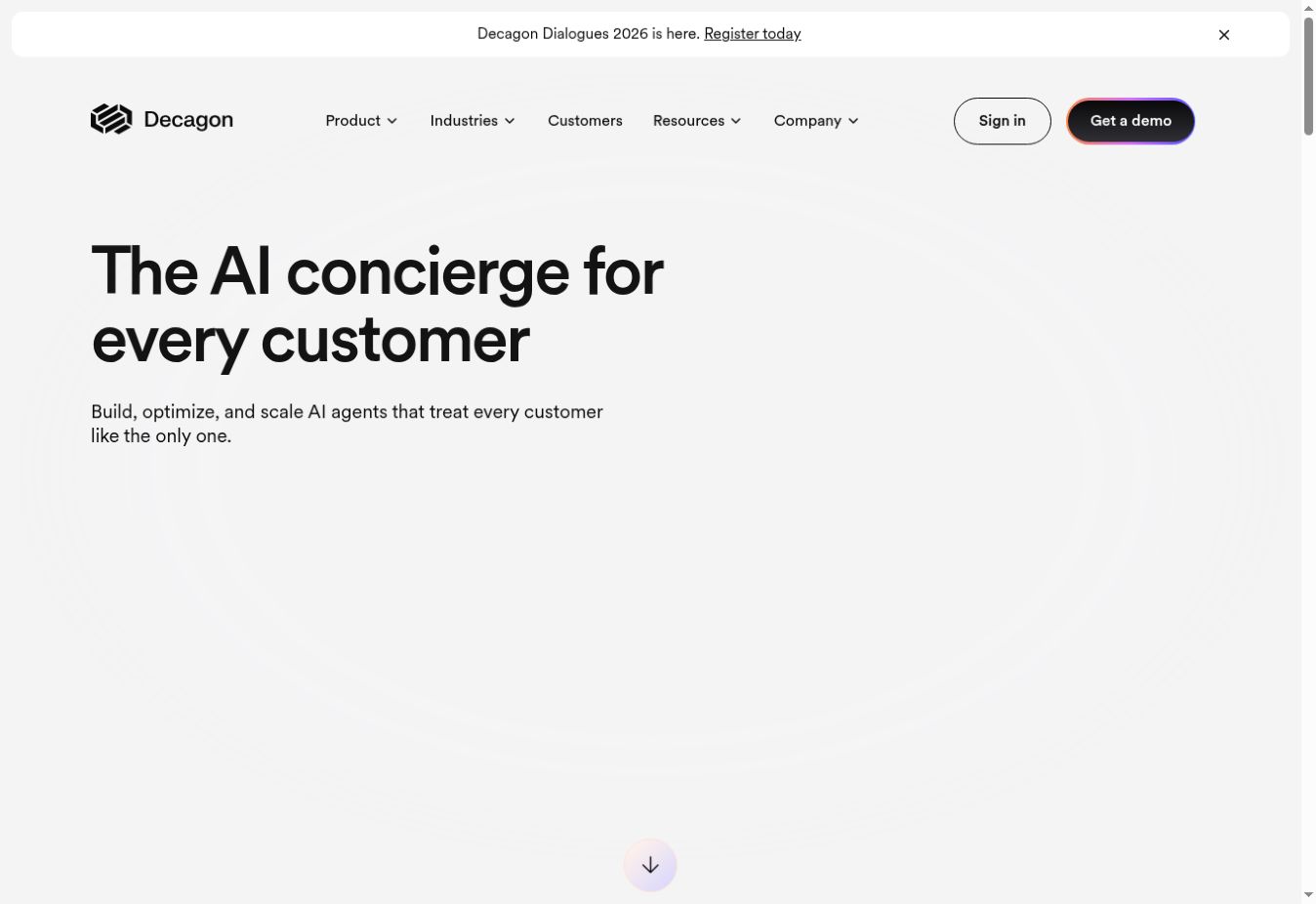
Decagon uses Agent Operating Procedures to specify natural-language workflows. It describes testing, observability and experimentation across chat, voice and email. [V1] [V2]
Decagon promotes:
- Resolve complex support workflows
- Operate a customer concierge across channels
- Refine procedures using conversation analytics
What Decagon claims: Claims AI concierges can resolve complex issues while improving from production data.
What its pages show: Public material shows memory, actions, testing, observability, experimentation and handoff.
Specific published product behaviour
AOPs and approval-gated self-improvement
Decagon’s Agent Operating Procedures let CX teams write inbound and outbound workflows in natural language; its product page says engineering teams can use Git-based version tracking and inspect reasoning, action timing and latency. The page also promotes guardrails across chat, voice and email. These are specific product claims rather than independent tests of how safely a real refund or account update runs.
Its June 2026 Duet Autopilot announcement describes a self-improvement loop: production conversations surface a problem, the system proposes an AOP change, tests it against the originating conversation and a curated golden set, and updates the test set as new issues appear. Every proposed change requires human approval before production, according to Decagon; reviewers see a versioned diff, issues and validation results. That is directly relevant to Nagent’s governance thesis. Verify whether the proposal, test set and approval reflect all channels and whether a reviewer can reject a regression without affecting live traffic.
The reviewed public material did not give a reliable universal numeric rate. Request a scoped quote by channel, conversation volume, integration and human support. Pilot the same difficult cases across the old and proposed AOP, including repeated messages, revoked permissions and a sensitive escalation. Measure independently accepted resolutions and correction effort, and distinguish Decagon’s own benchmark and customer-story results from a controlled buyer comparison.
Primary sources: Official AOP product page ↗ · Official Duet Autopilot announcement ↗
Governance
Pricing
Decagon: Sales-led quote. No reliable public numeric rate verified. [V2] [N3]
| Monthly cost | A team of 5 | A growth team of 25 | A department of 100 |
|---|---|---|---|
| Nagent | $299 / month Team plan | $1,499 / month Business plan | By quote Enterprise |
| Decagon | By quote No public price for a team plan | By quote No public price for a team plan | By quote No public price for a team plan |
List prices; Nagent checked 4 October 2026. Method and every vendor
Running the evaluation
Ask Decagon in the demo: Can we replay the same difficult cases against an old and new AOP before promoting the change? Method: evaluation framework.
Verdict
For a growth team that wants the work done with people approving, Nagent is the stronger choice, ahead of Decagon on 17 of the features above.
Decagon is the better fit when you need Decagon's Agent Operating Procedures resolving complex support across chat, voice and email, tested and observed by your own CX team.
Decagon should be evaluated on complex resolution and operational control, not just conversational fluency. A custom Nagent comparison needs equivalent channels and transaction permissions.
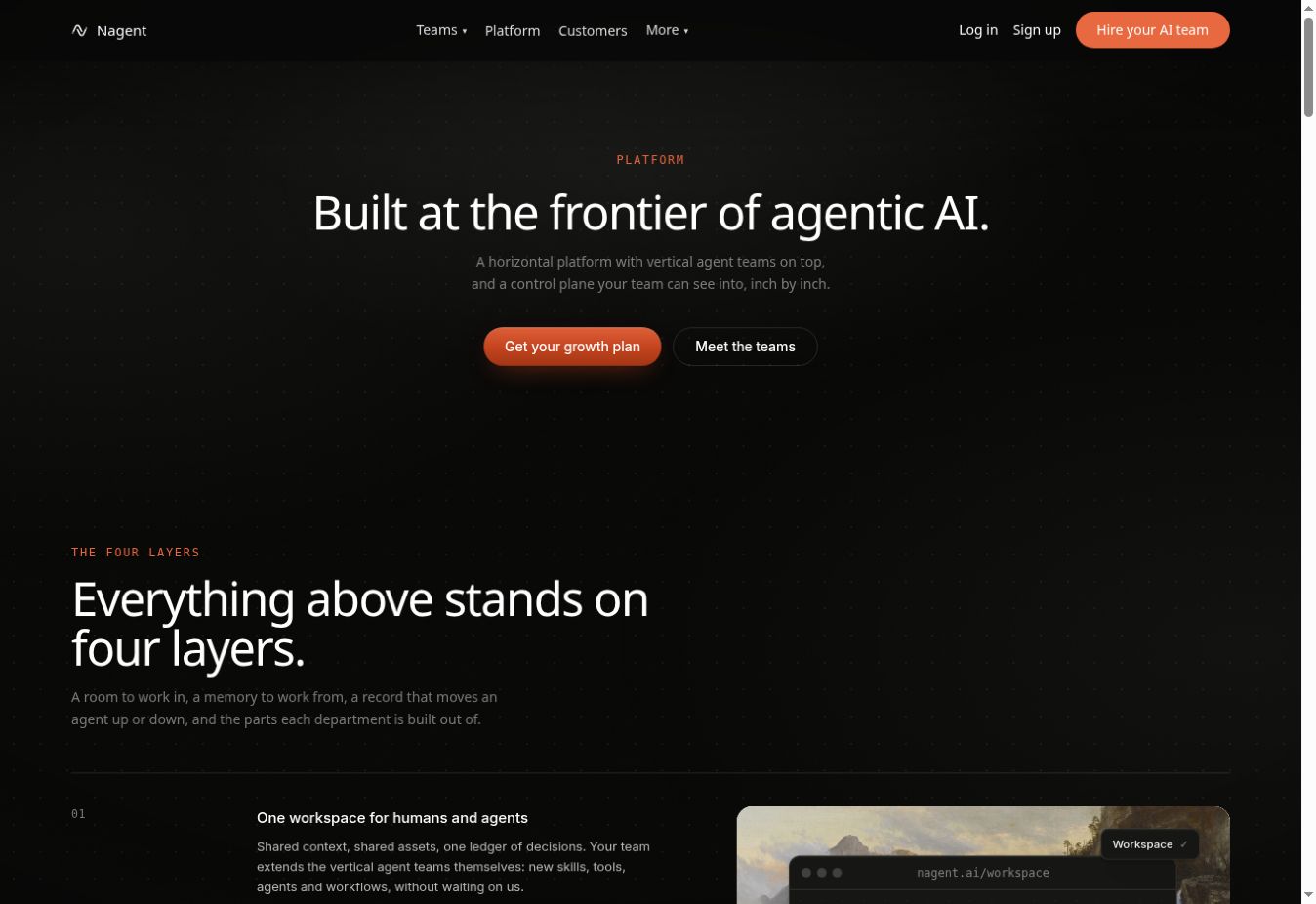
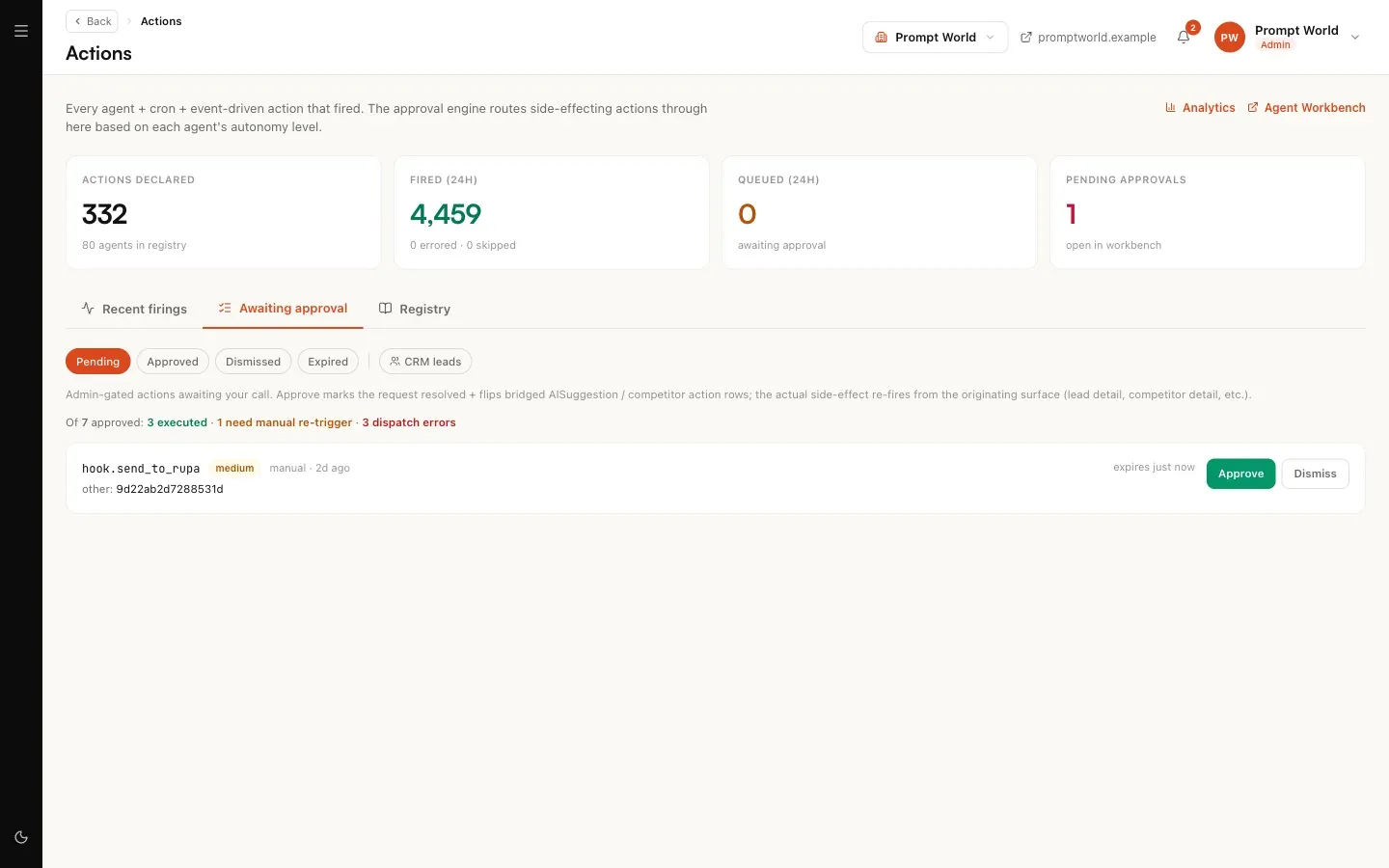
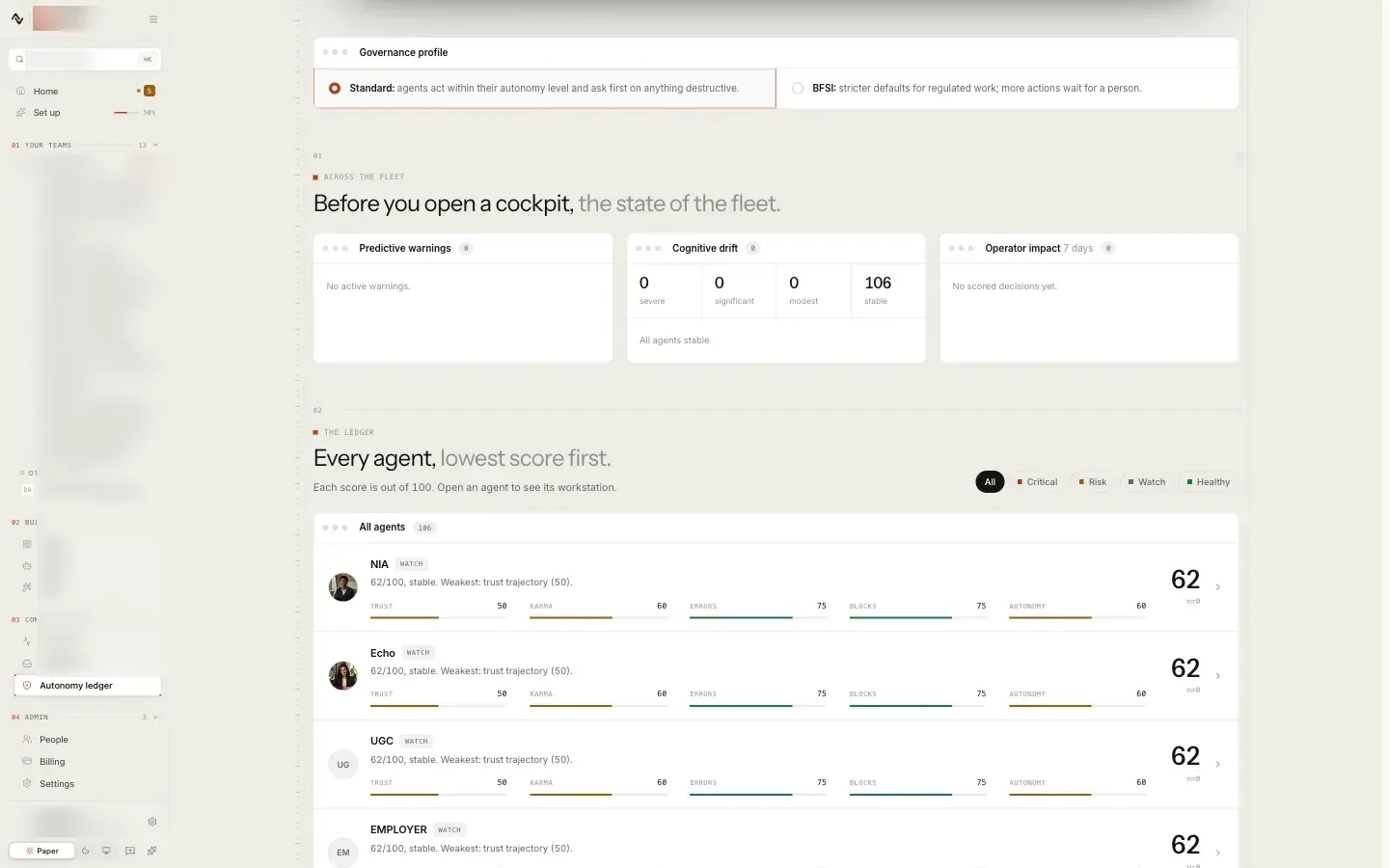
Screenshots and source context
Frequently asked questions
Is Nagent an alternative to Decagon?
For some of the work. Decagon keeps complex support resolution across chat, voice and email under its Agent Operating Procedures. Nagent stays on the growth side and does not answer Decagon's tickets. Conversation analytics exported from Decagon can go into the Knowledge Hub, where CREA turns frequent questions into help content and DRIS checks how answer engines describe the product.
How does Nagent pricing compare with Decagon?
Decagon: Sales-led quote. No reliable public numeric rate verified. Nagent: from $29.99 per month.
Does Decagon offer shared memory and human approvals like Nagent?
Agents keep customer context across sessions and channels; memory shared and written across agents not described. Only agent configuration updates are staged for human review, not customer-facing actions. Nagent has the Knowledge Hub and Inbox approval.
Which is better for CX teams: Nagent or Decagon?
Nagent, for most growth teams. Decagon fits better when you need Decagon's Agent Operating Procedures resolving complex support across chat, voice and email, tested and observed by your own CX team.
How does Decagon's security compare with Nagent's?
Decagon: SOC 2: Type II; ISO 27001: not published; SSO: yes. Nagent's are on nagent.ai/security.
Sources and research notes
- V1 · Official product / pricing source
Decagon · product ↗https://decagon.ai/ · Public material checked 21 to 29 September 2026 - V2 · Official product / pricing source
Decagon · commercial / feature reference ↗https://decagon.ai/ · Public material checked 21 to 29 September 2026 - V3 · Official source
Official AOP product page ↗https://decagon.ai/product/aop · Public material checked 21 to 29 September 2026 - V4 · Official source
Official Duet Autopilot announcement ↗https://decagon.ai/blog/autopilot · Public material checked 21 to 29 September 2026 - N1 · Official source
Nagent · platform, workspace and security ↗https://nagent.ai/platform · Public material checked 21 to 29 September 2026 - N2 · Official source
Nagent · security and compliance ↗https://nagent.ai/platform/security · Public material checked 21 to 29 September 2026 - N3 · Official source
Nagent · published plans ↗https://nagent.ai/pricing · Public material checked 21 to 29 September 2026 - THESIS · Official source
The Nagent Thesis ↗https://nagent.ai/artefacts/nagent-thesis · Public material checked 21 to 29 September 2026 - GOVERNANCE-SOURCE · Official source
State of Agent Governance ↗https://nagent.ai/artefacts/state-of-agent-governance · Public material checked 21 to 29 September 2026