
Nagent vs Dust
Compare a reusable workspace and orchestration layer with Nagent, the multiplayer AI platform for growth.
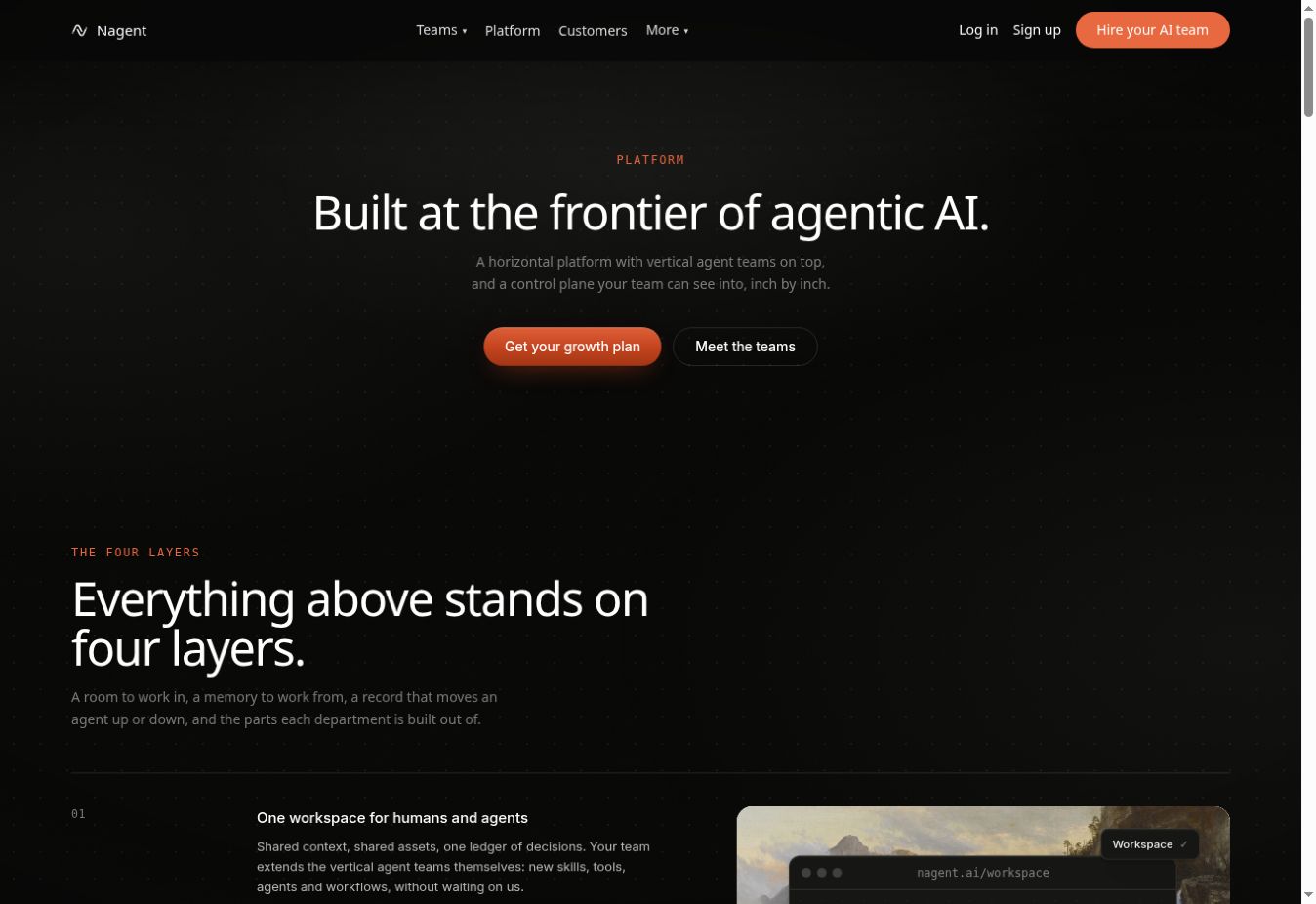
Dust is a reusable workspace and orchestration layer, priced at $30/month. Nagent is multiplayer AI for growth: agent teams for marketing, sales and CX in one shared workspace, from $29.99 a month, with autonomy earned on approved work. Pick Nagent when you want agent teams to do the work and your people to approve what goes live.
Nagent vs Dust: the short answer
Nagent leads Dust on 11 of 26 features. Dust covers part of one audit ledger per decision, per-agent budget caps, tenant isolation, graded autonomy levels, guardrail types, evaluation before release, marketing, sales and CX agents out of the box and forward deployed delivery, and publishes nothing on 3 more.
Level: persistent cross-agent memory, shared human and agent workspace, multi-person live sessions, approval before irreversible actions, inbox and hand-off, instruction capture, role-based access, kill switch, append-only audit, data residency options, feedback without retraining, model choice, connected tools and outcome proof.
Where Dust leads: marketplace breadth.
Where Dust fits better: You want one company-wide Dust workspace where every department builds assistants on connected knowledge, and growth work is only one use among many.
At a glance
| Dimension | Nagent | Dust |
|---|---|---|
| What it is | Multiplayer AI for growth teams | A reusable workspace and orchestration layer |
| Who does it | Ready-made marketing, sales and content teams led by MIRA, SERA and CREA, plus agents you build, extend and connect | Research accounts and prepare proposals; Create campaign briefs and performance narratives; Triage support and synthesize company knowledge |
| Starting price | From $29.99 per month [N3] | $30/month [V2] |
| Pricing basis | Seats and monthly credits | Pro monthly: 8,000 credits. Annual: €24/seat/month equivalent. Excludes VAT; Enterprise custom. |
| Security | ISO/IEC 27001:2022 certified by InterCert; SOC 2 Type II programme underway | SOC 2: Type II; ISO 27001: not published; SSO: yes. Trust page |
Nagent vs Dust, feature by feature
| Capability | Nagent | Dust | Ahead |
|---|---|---|---|
| Shared context | |||
| Persistent cross-agent memory | Yes Knowledge Hub | Yes Pod conversations indexed and shared Files give all Pod agents persistent shared context; memory tool is per user. | Level |
| Shared human and agent workspace | Yes Team rooms | Yes Pods: team and agents share conversations, files and tasks; humans and agents work from same context; available to everyone. | Level |
| One audit ledger per decision | Yes Decision ledger | Partial Agent can close its own task with a short rationale; no per-decision record of approver. | Nagent |
| Human and agent collaboration | |||
| Multi-person live sessions | Yes Shared team rooms | Yes Agent task conversations visible to Pod members, who can follow progress, step in and redirect anytime. | Level |
| Approval before irreversible actions | Yes Inbox approval | Yes Each tool action has a stake level; high stake always asks the user for confirmation before running. | Level |
| Inbox and hand-off | Yes Inbox | Yes Pod Tasks: agents and humans create and assign tasks to named members, filter Mine, start agents on them. | Level |
| Instruction capture | Yes Captured instructions | Yes Nightly analysis of thumbs and user corrections proposes instruction diffs that skill editors approve. | Level |
| Governance | |||
| Role-based access | Yes 6 workspace roles | Yes Admin, Manager, Member roles; group-based permissions, SCIM-provisioned groups, create/publish agent permissions. | Level |
| Per-agent budget caps | Yes Per-agent caps | Partial Caps per user, group, API key and programmatic usage; no per-agent cap described. | Nagent |
| Kill switch | Yes Kill switch | Yes User can stop a running agent mid-run; completed work is kept, upcoming work halted. | Level |
| Tenant isolation | Yes Tenant isolation | Partial Enterprise offers single-tenant deployment; no published description of multi-tenant isolation between customers. | Nagent |
| Append-only audit | Yes Append-only trail | Yes Enterprise audit logs of user and agent/tool actions, tamper-evident, CSV export and SIEM streaming. | Level |
| Data residency options | Yes Private VPC | Yes Host in the EU or US; pricing adds single-tenant deployment on Enterprise. | Level |
| Bounded autonomy | |||
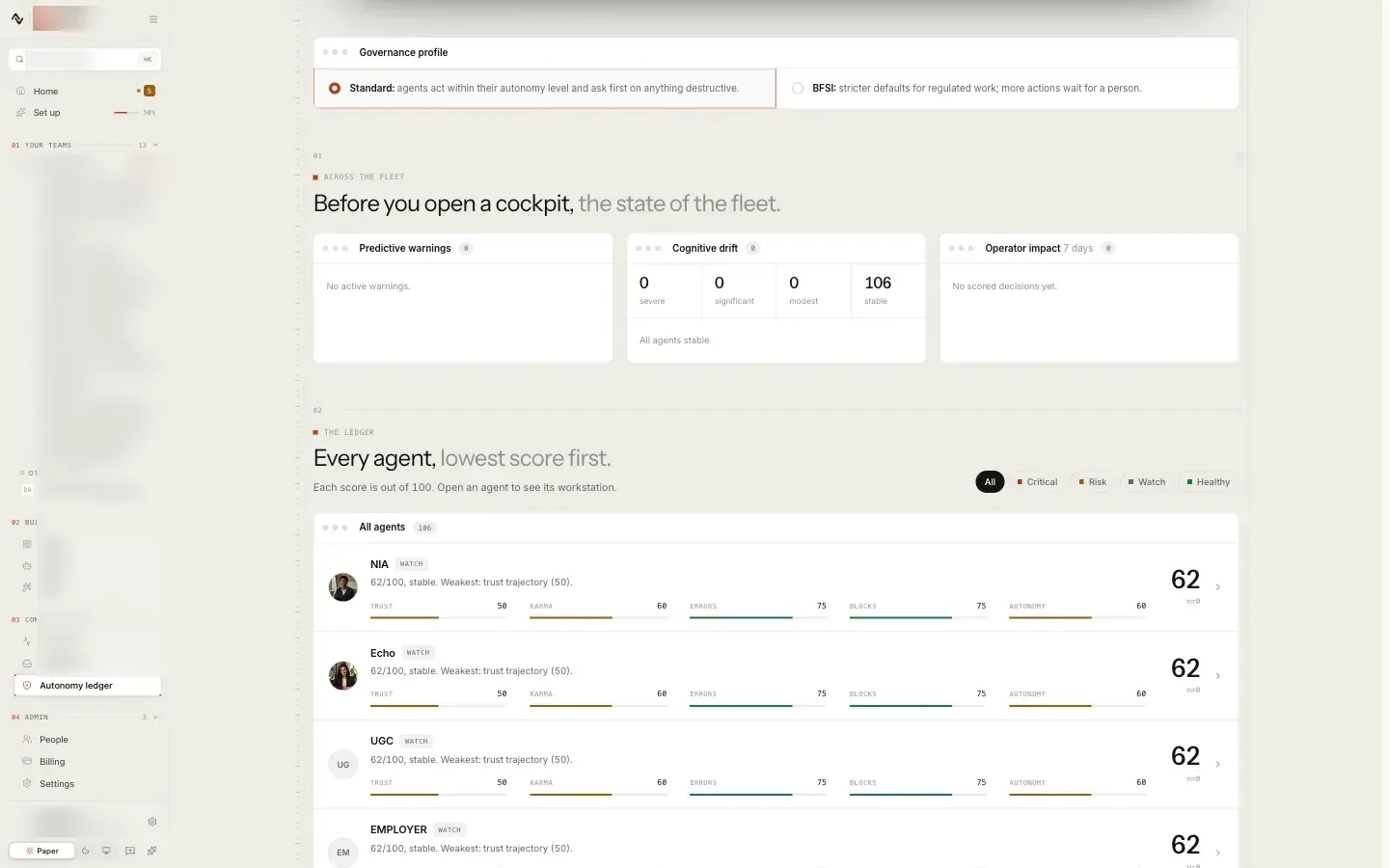
| Graded autonomy levels | Yes L1 Observe to L5 Lead | Partial Four confirmation stake levels set per tool action, not graded autonomy levels per agent. | Nagent |
| Promotion on evidence | Yes On approved work | Not published | Nagent |
| Demotion and reform | Yes On its record | Not published | Nagent |
| Guardrail types | Yes Scope, budget, approval | Partial Per-tool stake levels and space-scoped tool access; no content filters or policy guardrails documented. | Nagent |
| Learning loop | |||
| Feedback without retraining | Yes Instructions, memory | Yes Feedback and corrections become proposed skill instruction and tool changes; no model retraining. | Level |
| KPI-linked agent score | Yes Agent scorecards | Not published Analytics tracks credit consumption only. | Nagent |
| Evaluation before release | Yes Tested before release | Partial Manual preview panel to test an agent before publishing; no eval or regression suite. | Nagent |
| Growth depth | |||
| Marketing, sales and CX agents out of the box | Yes MIRA, SERA, CREA | Partial Sales agent templates (cold emailer, follow-up, account summary) to adapt and connect; not shipped agents. | Nagent |
| Marketplace breadth | No Ready-made teammates | Yes Template library for common use cases opens guided agent creation; count not stated. | Dust |
| Model choice | Yes Per agent | Yes Pick model per agent or per message; Anthropic, OpenAI, Google, Mistral models. | Level |
| Connected tools | Yes Composio, your API | Yes Managed connections incl. Slack, Drive, Notion, Intercom, Zendesk, Gong, Salesforce (beta); MCP tools. | Level |
| Forward deployed delivery | Yes Growth Pods | Partial Enterprise includes dedicated CSM and onboarding; no implementation or managed service described. | Nagent |
| Outcome proof | Yes Customer stories | Yes | Level |
Running Dust and Nagent together
Dust can stay the company-wide assistant layer for support triage and internal knowledge questions, while Nagent runs the growth work itself. Campaign briefs and performance narratives drafted in Dust can be added to the Knowledge Hub, where MIRA plans the campaign and CREA writes against them. Approved outputs then move through the Nagent Inbox rather than through Dust.
What Dust is and does
Dust explicitly markets multiplayer human–agent collaboration. Pro and Max differ in included credits; Max is €150 monthly or €120 on annual billing, with 40,000 credits per seat monthly. Enterprise adds pooled credits, SCIM and audit-log features. [V1] [V2]
Dust promotes:
- Research accounts and prepare proposals
- Create campaign briefs and performance narratives
- Triage support and synthesize company knowledge
What Dust claims: Markets itself as a secure AI operating system for enterprise teams.
What its pages show: Public product material shows multi-user spaces, connectors, model choice, permissions and human review.
Dust Pods versus a Nagent growth team
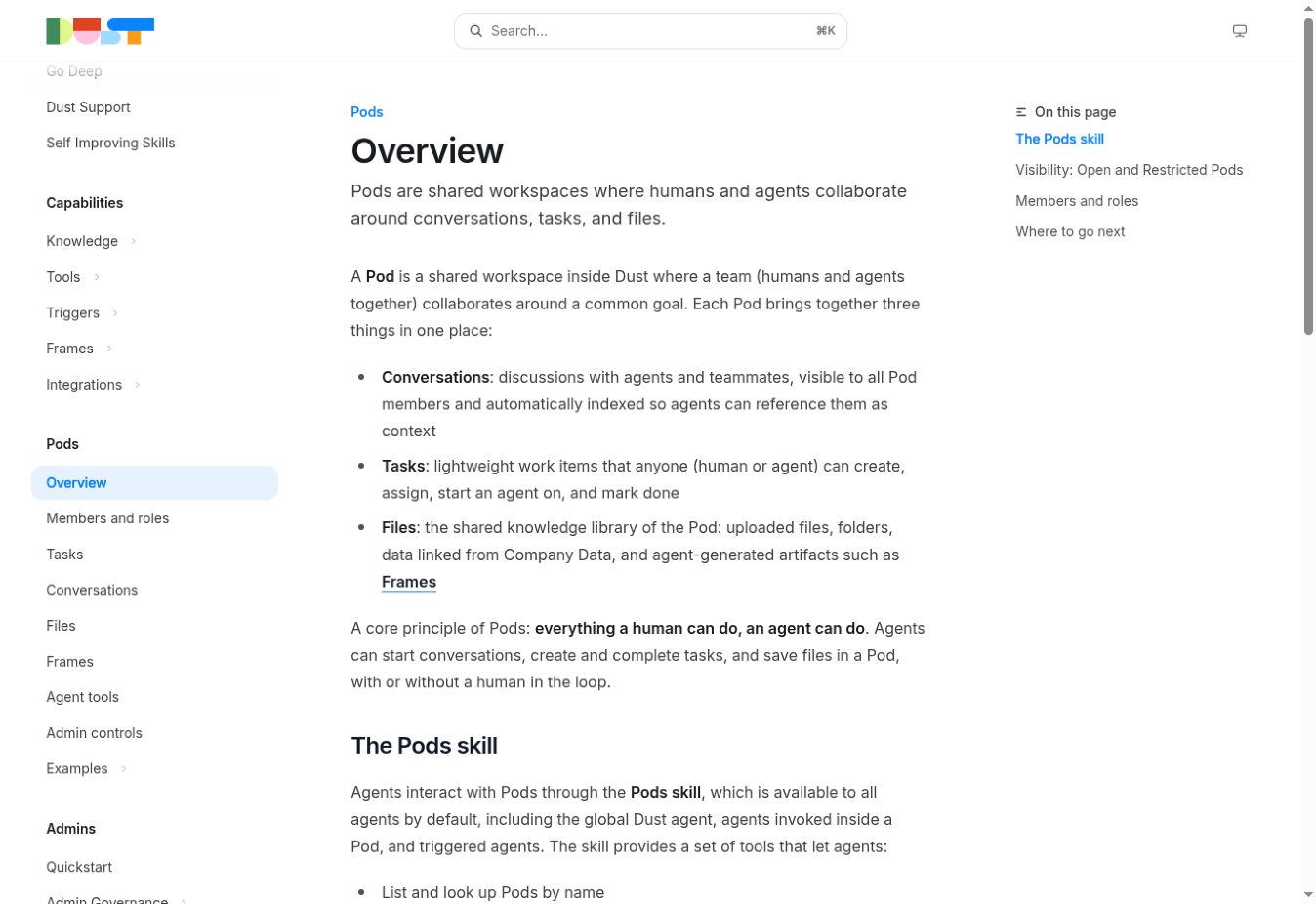
Dust’s current Pods documentation makes the multiplayer overlap concrete. A Pod contains conversations, tasks and files; its members can participate in the same conversation, and conversations are indexed for later agent search. Agents can post updates and operate on tasks through the Pods skill, including from scheduled and externally triggered work. This is evidence of a real shared operating surface on Dust’s side. Nagent's team rooms are the equivalent surface: one conversation shared by colleagues and agents, attributed and kept, with approvals taken in the Inbox.
The Tasks documentation gives a useful workflow test. A human or agent can create and assign a task; starting an agent links a conversation and moves the task into progress. An agent can mark its own task done, and a person can reopen it. Configure a single account-to-campaign task across sales and marketing: attach the account brief, correct an outdated commercial fact, have the agent propose a message, require a human approval for an external action, then reopen the task after a failed send. Inspect whether source correction, task state and decision authority remain clear to both people.
Dust distinguishes Open Pods that workspace members may join from Restricted Pods that require an Editor invitation. That is a substantive collaboration boundary. A marketer adding a sales colleague to a Restricted Pod should test which indexed conversations and linked source files become visible, and what happens to a scheduled agent when that membership is revoked. The published overview alone does not answer every connector-revocation question. Nagent's six workspace roles, tenant isolation and append-only audit trail can be tested under the same conditions.
For ten people, Dust’s published Pro monthly seat component is €300 before VAT; the annual €24 monthly equivalent totals €2,880 for ten seats over a year. Neither number covers every credit, connector, implementation or outcome cost. The relevant commercial comparison includes who designs the workflows, maintains source quality, investigates failures and reviews proposed autonomy changes. Ask Dust for the configured tier and credit forecast, and Nagent for the plan that fits (Team $299 for ten seats, Business $1,499 for fifty) plus a quote for any Growth Pod or Labs engagement.
Dust’s documentation now provides a strong published collaboration baseline. Its fit for a particular growth operation depends on connected permissions, business-process design and operators. Nagent's differentiator is the combination: a shared workspace, agents that earn autonomy, and a forward deployed team that owns the outcome. Evaluate the two with the same approved inputs, roles, exception cases and accepted outcomes; vendor language about intelligence or self-improvement is not a substitute for a replayable release and audit record.
Specific published product behaviour
Pods, the agent builder, self-improving skills and stake levels
Dust documents a Pod as a workspace with conversations, tasks and files. Members can contribute to the same conversations, and those conversations are indexed for later agent context. Agents can post, create or complete tasks, and save files. This supplies concrete evidence for multi-person and human–agent participation in a persistent shared container.
Pods can be open within a workspace or restricted to invited members. A Pod Editor has additional control over members and settings. The documentation does not by itself establish how an external connector reacts when a participant loses access; request a revocation demonstration. Compare that behaviour with Nagent’s actual workspace once its administrative evidence is supplied.
In the Dust app, an agent is built on one screen: written instructions, either standard or a JSON response, then data and access drawn from spaces or Pods, then capabilities and knowledge. Only people who are members of every listed space and Pod can use the agent. A builder assistant, Sidekick, works beside the form, with Preview and Insights tabs. Captured in the Dust app on 6 October 2026.
Dust’s admin settings include Self-Improving Skills. When a workspace switches it on, Dust analyses the workspace’s conversations to improve its skills, and says it does not use conversations to train models. It is priced as programmatic usage, with a monthly credit cap across all skills and a default cap per skill for each improvement run. A batch option lowers the cost but can keep data on the model provider’s servers for several hours; turning it off supports zero data retention at a higher price. Captured in the Dust app on 6 October 2026.
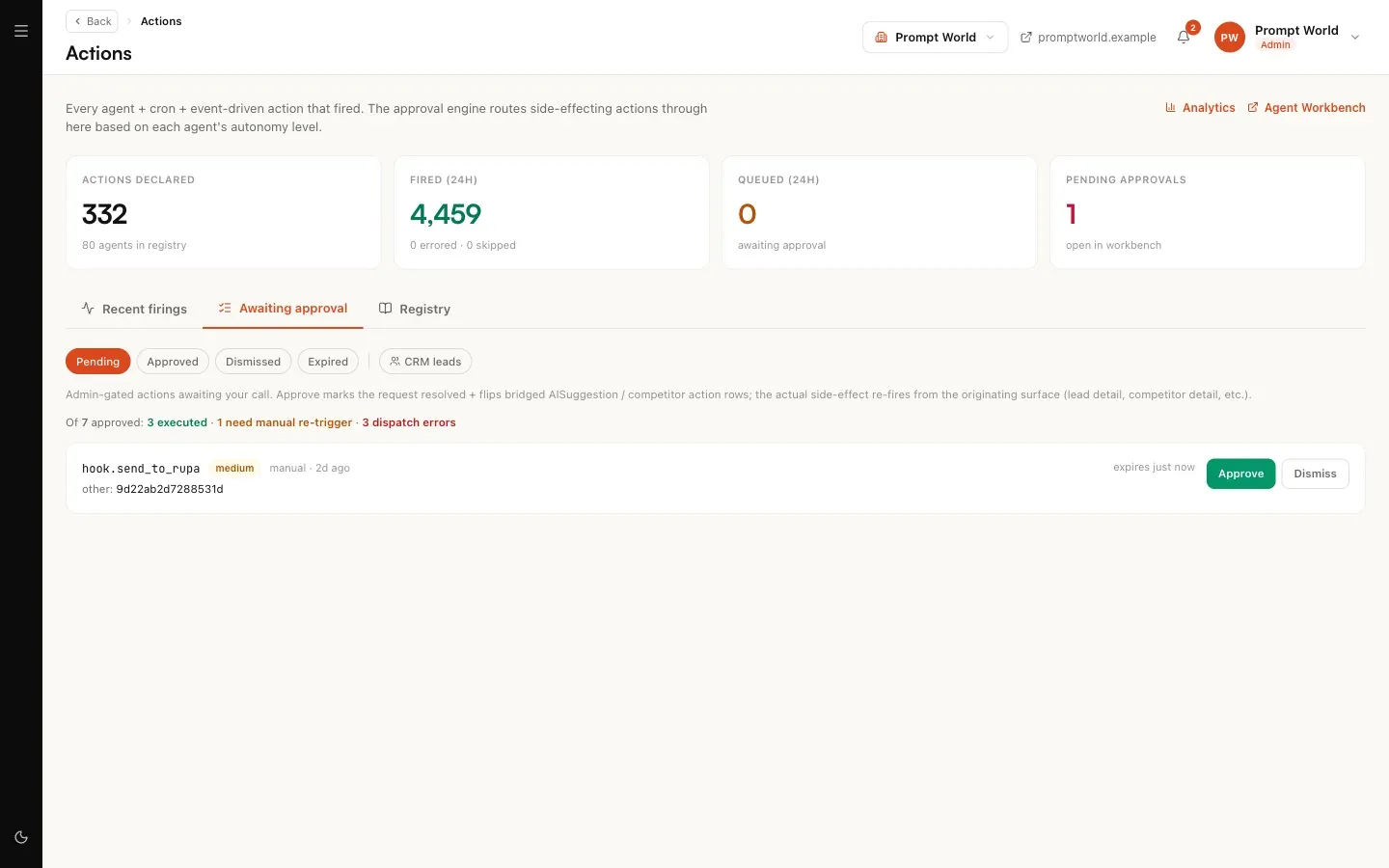
Each tool action carries a stake level. In the Gmail tool documentation, reading messages, attachments and drafts is marked Never ask, creating a draft or a reply draft is Medium, and actions at Medium or High stake require a user’s approval. In a pilot, check who can change a stake level, whether an approval is recorded against the person who gave it, and how a skill change made by self-improvement is reviewed. Nagent’s equivalents are earned autonomy for each kind of action, approvals in the Inbox and team memory that only a person can promote.
Primary sources: Official Pods overview ↗ · Official conversations documentation ↗ · Dust app: agent builder and Self-Improving Skills settings ↗ · Official Dust documentation: Gmail tool stake levels ↗
Governance
Pricing
Dust: $30/month. Pro monthly: 8,000 credits. Annual: €24/seat/month equivalent. Excludes VAT; Enterprise custom. [V2] [N3]
| Monthly cost | A team of 5 | A growth team of 25 | A department of 100 |
|---|---|---|---|
| Nagent | $299 / month Team plan | $1,499 / month Business plan | By quote Enterprise |
| Dust | See current pricing The published price changed after this table was checked | See current pricing The published price changed after this table was checked | See current pricing The published price changed after this table was checked |
List prices; Nagent checked 4 October 2026. Method and every vendor
Reviews and proof
G2’s September 2026 seller-invited review by Thibault G. praises model choice, connected knowledge and scheduled automation. A separate 2025 review sample praises reusable agents and support while raising onboarding, documentation and editing concerns. Those historical complaints require re-testing against today’s product. These are attributed experiences, not a representative benchmark or a verified guarantee of results.
Running the evaluation
Ask Dust in the demo: Show permission propagation and revocation across a shared conversation, a connected source and a scheduled agent. Method: evaluation framework.
Verdict
For a growth team that wants the work done with people approving, Nagent is the stronger choice, ahead of Dust on 11 of the features above.
Dust is the better fit when you want one company-wide Dust workspace where every department builds assistants on connected knowledge, and growth work is only one use among many.
Dust is a direct horizontal workspace comparator. Its self-service, published seat economics are easier to inspect than a custom managed engagement. Whether that workspace covers a particular end-to-end growth process still depends on configuration, connectors and accountable operators.
Screenshots and source context
Frequently asked questions
Is Nagent an alternative to Dust?
For some of the work. Dust can stay the company-wide assistant layer for support triage and internal knowledge questions, while Nagent runs the growth work itself. Campaign briefs and performance narratives drafted in Dust can be added to the Knowledge Hub, where MIRA plans the campaign and CREA writes against them. Approved outputs then move through the Nagent Inbox rather than through Dust.
How does Nagent pricing compare with Dust?
Dust: $30/month. Pro monthly: 8,000 credits. Annual: €24/seat/month equivalent. Excludes VAT; Enterprise custom. Nagent: from $29.99 per month.
Does Dust offer shared memory and human approvals like Nagent?
Pod conversations indexed and shared Files give all Pod agents persistent shared context; memory tool is per user. Each tool action has a stake level; high stake always asks the user for confirmation before running. Nagent has the Knowledge Hub and Inbox approval.
Which is better for Marketing, Sales, CX teams: Nagent or Dust?
Nagent, for most growth teams. Dust fits better when you want one company-wide Dust workspace where every department builds assistants on connected knowledge, and growth work is only one use among many.
How does Dust's security compare with Nagent's?
Dust: SOC 2: Type II; ISO 27001: not published; SSO: yes. Nagent's are on nagent.ai/security.
Sources and research notes
- V1 · Official product / pricing source
Dust · product ↗https://dust.tt/ · Public material checked 21 to 29 September 2026 - V2 · Official product / pricing source
Dust · commercial / feature reference ↗https://dust.tt/home/pricing · Public material checked 21 to 29 September 2026 - V3 · Official source
Pods overview · shared conversations, tasks and files ↗https://docs.dust.tt/docs/user-documentation/pods/overview · Public material checked 21 to 29 September 2026 - V4 · Official source
Pod conversations · participation and search ↗https://docs.dust.tt/docs/user-documentation/pods/conversations · Public material checked 21 to 29 September 2026 - V5 · Independent review surface
Independent reviews · G2, current reviewer index ↗https://www.g2.com/sellers/dust-0a447854-359e-43a8-a905-8d9756c54386 · Public material checked 21 to 29 September 2026 - V6 · Independent review surface
Independent reviews · G2, historical pros and cons ↗https://www.g2.com/products/dust-dust/reviews?page=2&qs=pros-and-cons · Public material checked 21 to 29 September 2026 - V7 · Official source
Dust app: agent builder and Self-Improving Skills settings ↗https://dust.tt/app · Public material checked 21 to 29 September 2026 - V8 · Official source
Official Dust documentation: Gmail tool stake levels ↗https://docs.dust.tt · Public material checked 21 to 29 September 2026 - N1 · Official source
Nagent · platform, workspace and security ↗https://nagent.ai/platform · Public material checked 21 to 29 September 2026 - N2 · Official source
Nagent · security and compliance ↗https://nagent.ai/platform/security · Public material checked 21 to 29 September 2026 - N3 · Official source
Nagent · published plans ↗https://nagent.ai/pricing · Public material checked 21 to 29 September 2026 - THESIS · Official source
The Nagent Thesis ↗https://nagent.ai/artefacts/nagent-thesis · Public material checked 21 to 29 September 2026 - GOVERNANCE-SOURCE · Official source
State of Agent Governance ↗https://nagent.ai/artefacts/state-of-agent-governance · Public material checked 21 to 29 September 2026
Editorial
Essays from Nagent's founder that argue the comparison in full.
- Nagent vs Dust: the room and the ladder: Dust and Nagent both put people and AI agents in one room. Dust lets any team build agents for any job; Nagent ships a growth team that earns trust.