
Nagent vs HubSpot Agent Hub
Compare agents embedded in an existing customer or enterprise system with Nagent, the multiplayer AI platform for growth.
HubSpot Agent Hub is agents embedded in an existing customer or enterprise system, with pricing listed as hub / credit dependent. Nagent is multiplayer AI for growth: agent teams for marketing, sales and CX in one shared workspace, from $29.99 a month, with autonomy earned on approved work. Pick Nagent when agents should do the work and people approve it.
Nagent vs HubSpot Agent Hub: the short answer
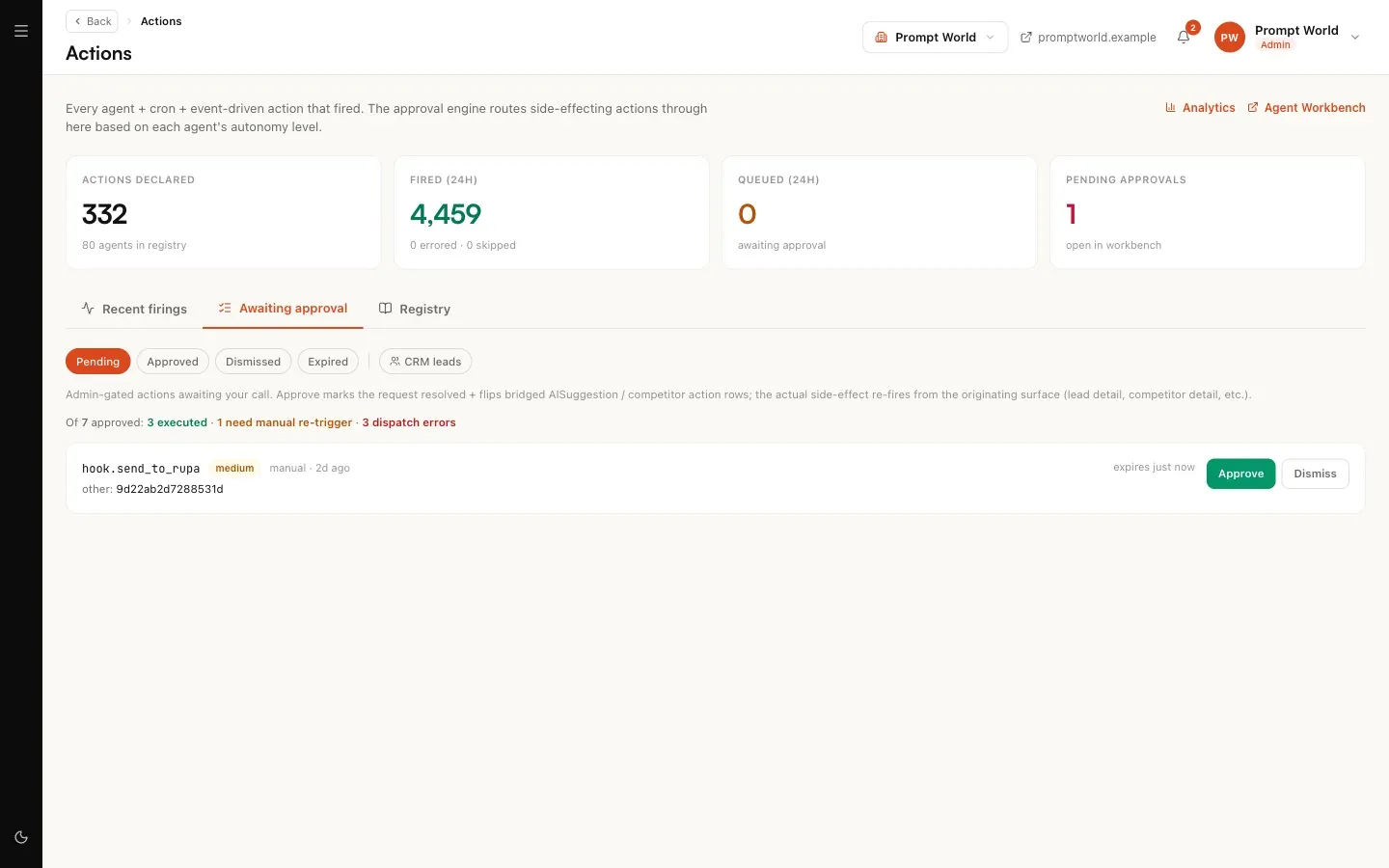
Nagent leads HubSpot Agent Hub on 17 of 26 features. HubSpot Agent Hub covers part of persistent cross-agent memory, shared human and agent workspace, one audit ledger per decision, instruction capture, per-agent budget caps, kill switch, tenant isolation, graded autonomy levels, guardrail types, feedback without retraining, kPI-linked agent score, evaluation before release and forward deployed delivery, and publishes nothing on 4 more.
Level: approval before irreversible actions, inbox and hand-off, role-based access, append-only audit, data residency options, marketing, sales and CX agents out of the box, connected tools and outcome proof.
Where HubSpot Agent Hub leads: marketplace breadth.
Where HubSpot Agent Hub fits better: You run marketing, sales and service entirely in HubSpot, and the Agent Hub campaign, prospecting and customer agents never need context from outside the CRM.
At a glance
| Dimension | Nagent | HubSpot Agent Hub |
|---|---|---|
| What it is | Multiplayer AI for growth teams | Agents embedded in an existing customer or enterprise system |
| Who does it | Agent teams that work across your CRM, ad accounts and content tools, with your people approving | Plan and produce campaigns; Research and nurture prospects; Resolve customer queries using CRM context |
| Starting price | From $29.99 per month [N3] | Hub / credit dependent [V2] |
| Pricing basis | Seats and monthly credits | No comparable Agent Hub price verified; underlying HubSpot subscriptions and usage matter. |
| Security | ISO/IEC 27001:2022 certified by InterCert; SOC 2 Type II programme underway | SOC 2: Type II; ISO 27001: not published; SSO: yes. Trust page |
Nagent vs HubSpot Agent Hub, feature by feature
| Capability | Nagent | HubSpot Agent Hub | Ahead |
|---|---|---|---|
| Shared context | |||
| Persistent cross-agent memory | Yes Knowledge Hub | Partial Context tab and knowledge vaults hold brand, ICP and product info agents read; Breeze Assistant memories are per user. | Nagent |
| Shared human and agent workspace | Yes Team rooms | Partial Breeze Assistant projects can grant access to chosen users; no shared live space where several humans steer agents. | Nagent |
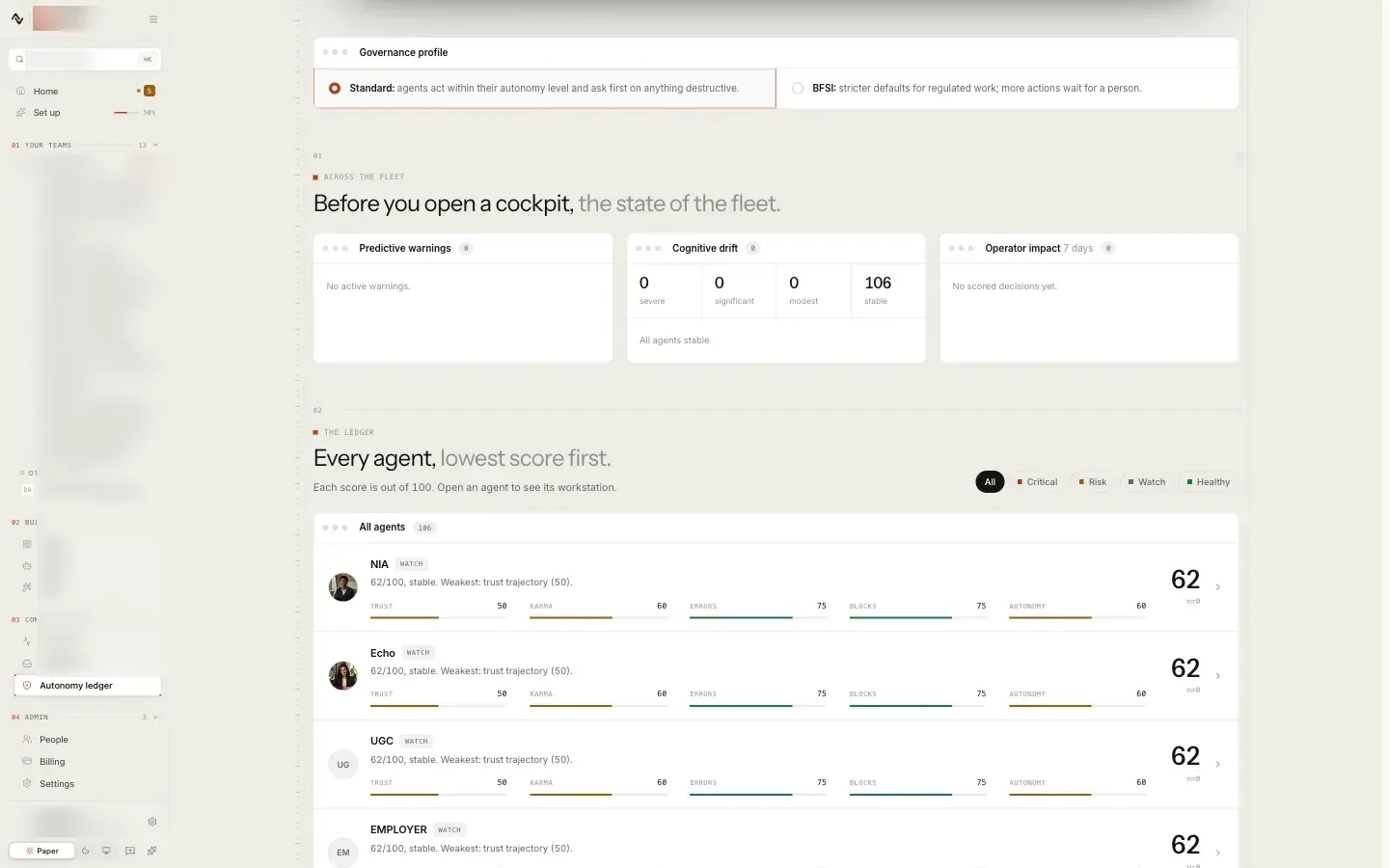
| One audit ledger per decision | Yes Decision ledger | Partial Agent inbox shows each run's sources and thinking steps, exportable as PDF; approver not recorded. | Nagent |
| Human and agent collaboration | |||
| Multi-person live sessions | Yes Shared team rooms | Not published | Nagent |
| Approval before irreversible actions | Yes Inbox approval | Yes Prospecting agent can require review and approval of each email before it is sent. | Level |
| Inbox and hand-off | Yes Inbox | Yes Drafts go to the assigned sender with in-app notifications and daily digest; agent inbox has Needs approval status. | Level |
| Instruction capture | Yes Captured instructions | Partial Breeze Assistant remembers a user's recurring instructions and preferences; per user, not shared agent instructions. | Nagent |
| Governance | |||
| Role-based access | Yes 6 workspace roles | Yes User permissions include Agent Builder and Customer agent editor toggles; per-agent edit/run access settings. | Level |
| Per-agent budget caps | Yes Per-agent caps | Partial Per-agent monthly run limits on credits exist in Agent Builder, which is public beta; account and feature limits GA. | Nagent |
| Kill switch | Yes Kill switch | Partial Customer agent can be paused any time; account-wide generative AI toggle; no documented stop of a running run. | Nagent |
| Tenant isolation | Yes Tenant isolation | Partial States HubSpot never shares data across customers; no tenant isolation architecture described. | Nagent |
| Append-only audit | Yes Append-only trail | Yes Exportable audit log includes Customer Agent actions alongside user actions; Super Admin export, 30-day views. | Level |
| Data residency options | Yes Private VPC | Yes AWS US East hosting, or EU data centre in Frankfurt for new customers; migration tool for existing. | Level |
| Bounded autonomy | |||
| Graded autonomy levels | Yes L1 Observe to L5 Lead | Partial Two settings: review emails or send without review; no graded levels. | Nagent |
| Promotion on evidence | Yes On approved work | Not published | Nagent |
| Demotion and reform | Yes On its record | Not published | Nagent |
| Guardrail types | Yes Scope, budget, approval | Partial Enforced max email count and wait days; AI data-access toggles; no configurable content filters documented. | Nagent |
| Learning loop | |||
| Feedback without retraining | Yes Instructions, memory | Partial Thumbs ratings, Coach your agent and knowledge-gap reports; improvements applied manually by admins. | Nagent |
| KPI-linked agent score | Yes Agent scorecards | Partial Agent Hub (public beta) shows agent performance and outcomes by go-to-market goal; no KPI score. | Nagent |
| Evaluation before release | Yes Tested before release | Partial Manual test runs before publishing, free of credits; Agent Builder is public beta; no eval datasets. | Nagent |
| Growth depth | |||
| Marketing, sales and CX agents out of the box | Yes MIRA, SERA, CREA | Yes Prebuilt Customer, Prospecting, Data, AEO and deal progression agents included in Pro/Enterprise hubs. | Level |
| Marketplace breadth | No Ready-made teammates | Yes Agent Marketplace lists HubSpot pre-built agents only; five agents sunset July 2026; no count given. | HubSpot Agent Hub |
| Model choice | Yes Per agent | Not published Model cards list Anthropic, OpenAI, Google, Perplexity models but no customer selection. | Nagent |
| Connected tools | Yes Composio, your API | Yes Breeze Assistant connectors e.g. Notion, Amplitude, Gmail; Agent Builder adds MCP tools in beta. | Level |
| Forward deployed delivery | Yes Growth Pods | Partial Onboarding and technical consulting services; nothing where HubSpot staff build or operate agents. | Nagent |
| Outcome proof | Yes Customer stories | Yes | Level |
Where Nagent works with HubSpot Agent Hub
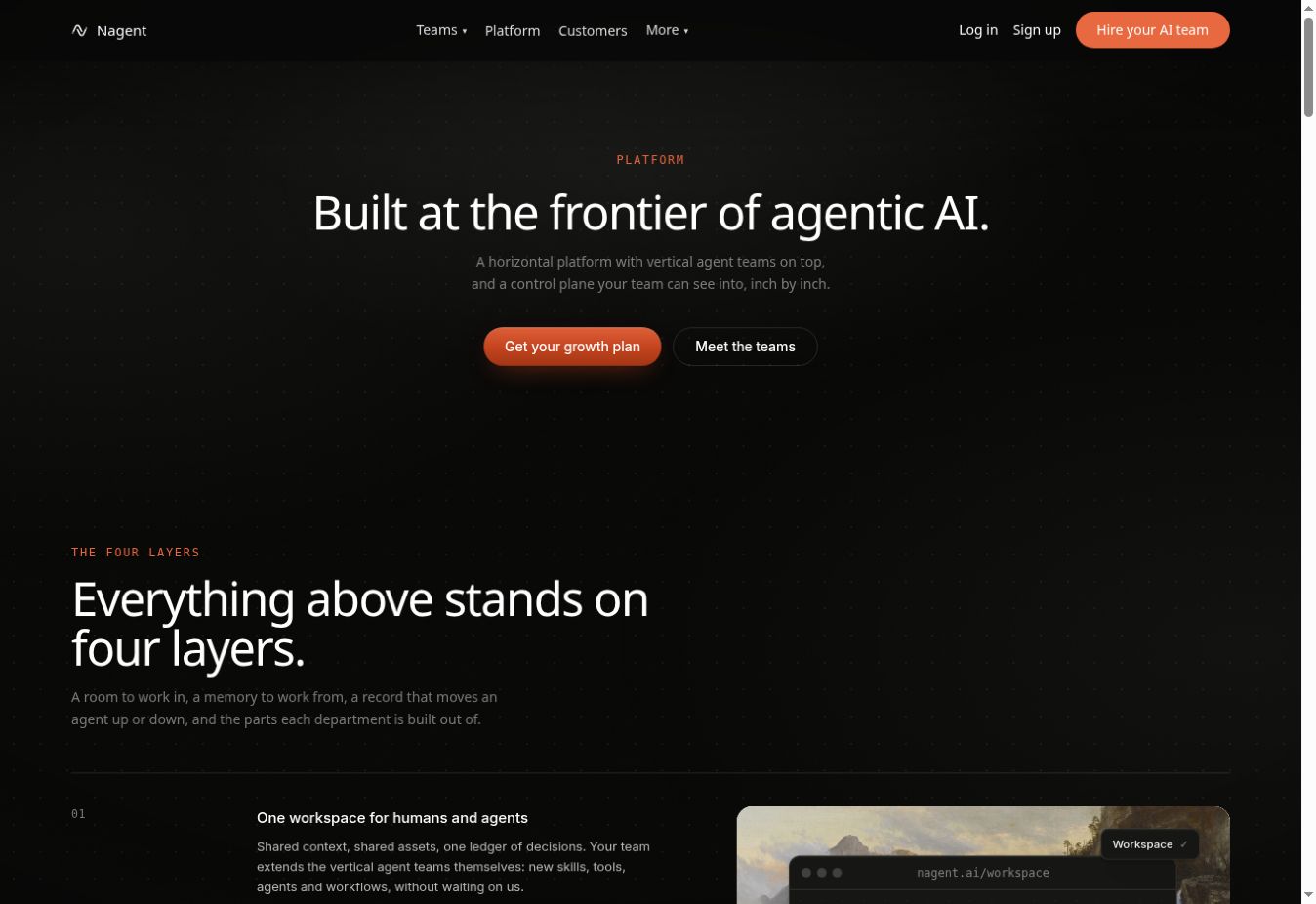
HubSpot stays the CRM and system of record, with Agent Hub covering work that lives entirely inside it. Nagent connects to HubSpot, so SERA reads deal state before drafting outreach and MIRA's campaigns stay tied to real pipeline. Nagent adds the work that reaches beyond HubSpot, such as DRIS for answer-engine visibility and MOXA for LinkedIn and X, all behind Inbox approvals.
What HubSpot Agent Hub is and does
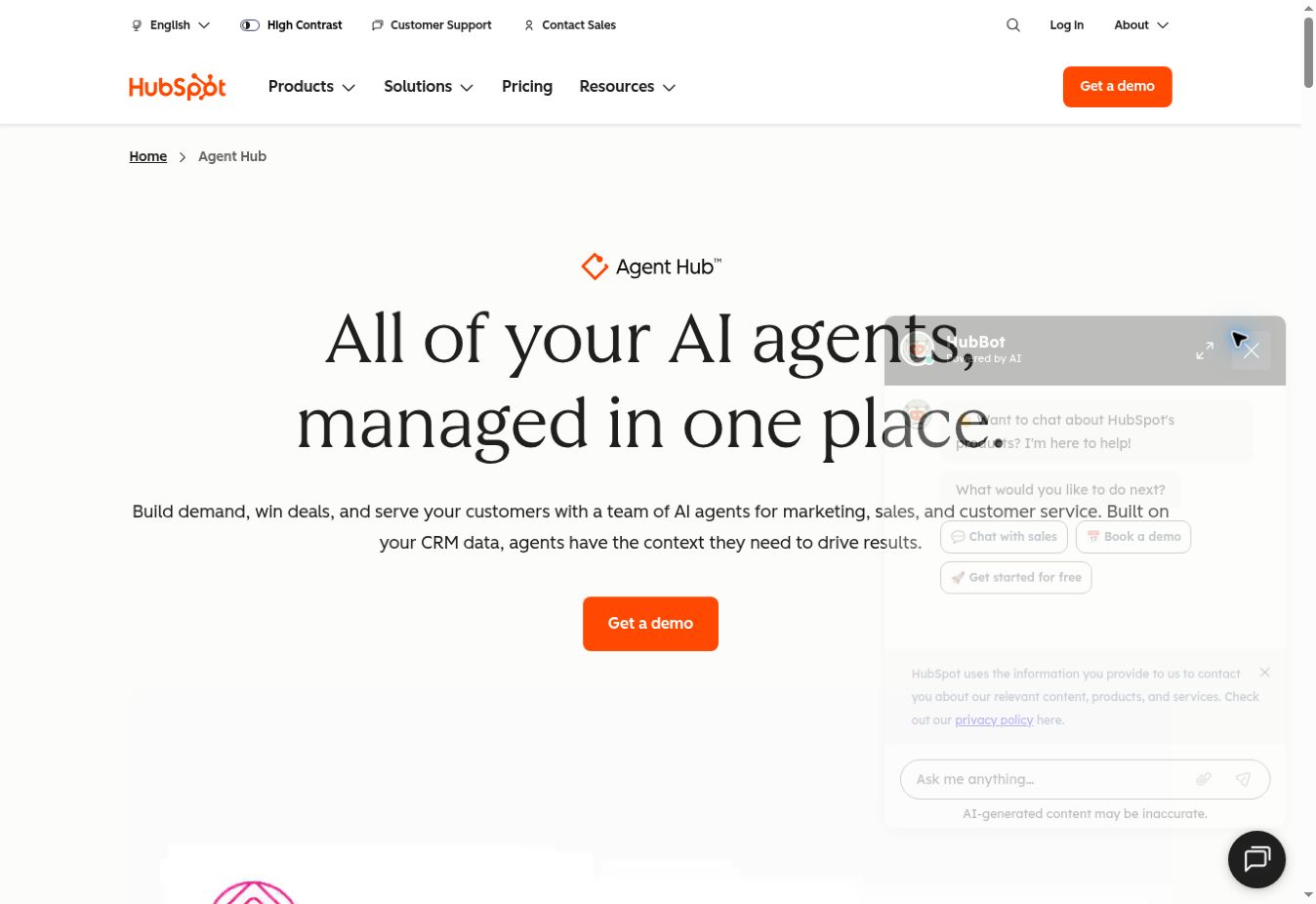
HubSpot now groups campaign, content, nurture, prospecting, customer and data agents around Agent Hub and its CRM context. Its AEO offering is presented separately as beta. [V1] [V2]
HubSpot Agent Hub promotes:
- Plan and produce campaigns
- Research and nurture prospects
- Resolve customer queries using CRM context
What HubSpot Agent Hub claims: Claims one central home to deploy and manage agents across marketing, sales and service.
What its pages show: HubSpot publicly groups campaign, content, nurture, prospecting, customer and data agents around unified CRM context.
Specific published product behaviour
Breeze Studio approval, Agent Inbox and credit accounting
HubSpot’s prospecting-agent setup requires an account administrator or an explicit agent permission and enabled AI access to CRM, conversation and file data. Its help page describes the recent engagement data used by the agent, including activity up to a year old, and says credit-consuming agent actions cannot be completed in a sandbox account.
Breeze Studio lets a builder configure agent inputs, extra instructions, tools, knowledge vaults and supported automation. HubSpot says its prebuilt agent’s default instructions and tools cannot simply be deleted. For CRM-write tools, the builder can turn on Review before running this tool; the Studio guide says that switch requires approval for CRM updates. Automation has a stated 1,000-run daily limit and needs a Professional or Enterprise subscription for configuration. These are edition- and configuration-dependent boundaries, not an assertion that every HubSpot agent needs human approval.
Agent Inbox records run status, trigger, user, estimated credits and sources in output. For automated runs the agent owner’s permissions apply, so a failed action may reflect that owner’s access. The Customer Agent has a separate resolution-based credit rule: a qualifying visitor-initiated human handoff prevents a conversation from counting as resolved, while a manual reassignment alone does not. For replies, resolution is assessed after 72 hours; later replies can trigger another billable resolution. Do not infer its economics from a seat subscription or equate a vendor-defined resolution with sustained customer satisfaction.
That sandbox constraint matters when comparing a CRM-native agent with a custom growth team: a realistic controlled test may require a paid production-adjacent scope. HubSpot says its prospecting agent currently supports only the default brand voice. Test prospecting, CRM writes and customer-agent resolution as separate scenarios, then ask for the relevant credits and role entitlements.
Agent Hub, marked Beta in the product, organises agents by four outcomes: Build demand (content, campaign and nurture agents), Win deals (prospecting, deal progression and revenue agents), Delight customers (customer and knowledge base agents) and Scale growth (a data agent). Its tabs are Overview, Agents, Workflows, Needs attention and Context, with an Agent Inbox, and a custom agent or workflow is described to Breeze Assistant in plain words. HubSpot says Agent Hub is included in all Starter, Professional and Enterprise editions, and that many AI features and agents run on HubSpot Credits, bought up front or pay as you go. Captured on hubspot.com on 6 October 2026.
Organising agents by outcome is close to how Nagent organises teams, each owning one outcome. The difference to test is what sits around the agents: in Nagent the agents work under named leads with people in one team room, earn autonomy per kind of action and keep their own Agentic CRM, while HubSpot’s agents work inside the HubSpot customer platform and its records. A team already standardised on HubSpot should weigh that operating environment directly.
HubSpot’s newer custom agent builder is separately marked beta. Its July documentation lists Professional or Enterprise for specified hubs and HubSpot Credits, with Super Admin or Agent Builder permission to configure. It supports HubSpot, default and MCP actions plus persistent knowledge and per-run inputs. By default, Super Admins can edit while all users can run an agent, but feature permissions can still block a run; the builder offers tighter team or user access. Builder tests do not consume credits, and its displayed credit estimates may differ from actual costs. Do not assume this beta surface is included in a lower-tier Agent Hub subscription or that its permissions match every prebuilt agent.
Primary sources: Official prospecting-agent setup and limits ↗ · Official Breeze Studio guide ↗ · Official custom agent builder beta ↗ · Official Agent Inbox guide ↗ · Official customer-agent credit definition ↗ · Agent Hub product page ↗
Governance
Pricing
HubSpot Agent Hub: Hub / credit dependent. No comparable Agent Hub price verified; underlying HubSpot subscriptions and usage matter. [V2] [N3]
| Monthly cost | A team of 5 | A growth team of 25 | A department of 100 |
|---|---|---|---|
| Nagent | $299 / month Team plan | $1,499 / month Business plan | By quote Enterprise |
| HubSpot Agent Hub | By quote No public price for a team plan | By quote No public price for a team plan | By quote No public price for a team plan |
List prices; Nagent checked 4 October 2026. Method and every vendor
Reviews and proof
G2’s HubSpot seller profile spans Marketing Hub, Sales Hub, Service Hub and other products. Its large aggregate review base is evidence about the broader suite, not a separate validation of Agent Hub. No Agent Hub-specific independent sample was established in this pass. The product page’s G2 badges and customer outcome statistics remain vendor-presented evidence.
Running the evaluation
Ask HubSpot Agent Hub in the demo: Which agents and credit allowances are included in our existing hubs, and which require upgrades? Method: evaluation framework.
Verdict
For a growth team that wants the work done with people approving, Nagent is the stronger choice, ahead of HubSpot Agent Hub on 17 of the features above.
HubSpot Agent Hub is the better fit when you run marketing, sales and service entirely in HubSpot, and the Agent Hub campaign, prospecting and customer agents never need context from outside the CRM.
HubSpot is a direct operating-environment decision for teams already using its customer platform. Nagent’s case rests on custom workflows or cross-stack coordination that the native suite does not meet in a pilot.
Screenshots and source context
Frequently asked questions
Is Nagent an alternative to HubSpot Agent Hub?
Partly, and the two also work together. HubSpot stays the CRM and system of record, with Agent Hub covering work that lives entirely inside it. Nagent connects to HubSpot, so SERA reads deal state before drafting outreach and MIRA's campaigns stay tied to real pipeline. Nagent adds the work that reaches beyond HubSpot, such as DRIS for answer-engine visibility and MOXA for LinkedIn and X, all behind Inbox approvals.
How does Nagent pricing compare with HubSpot Agent Hub?
HubSpot Agent Hub: Hub / credit dependent. No comparable Agent Hub price verified; underlying HubSpot subscriptions and usage matter. Nagent: from $29.99 per month.
Does HubSpot Agent Hub offer shared memory and human approvals like Nagent?
Context tab and knowledge vaults hold brand, ICP and product info agents read; Breeze Assistant memories are per user. Prospecting agent can require review and approval of each email before it is sent. Nagent has the Knowledge Hub and Inbox approval.
Which is better for Marketing, Sales, CX teams: Nagent or HubSpot Agent Hub?
Nagent, for most growth teams. HubSpot Agent Hub fits better when you run marketing, sales and service entirely in HubSpot, and the Agent Hub campaign, prospecting and customer agents never need context from outside the CRM.
How does HubSpot Agent Hub's security compare with Nagent's?
HubSpot Agent Hub: SOC 2: Type II; ISO 27001: not published; SSO: yes. Nagent's are on nagent.ai/security.
Sources and research notes
- V1 · Official product / pricing source
HubSpot Agent Hub · product ↗https://www.hubspot.com/products/artificial-intelligence · Public material checked 21 to 29 September 2026 - V2 · Official product / pricing source
HubSpot Agent Hub · commercial / feature reference ↗https://www.hubspot.com/products/artificial-intelligence · Public material checked 21 to 29 September 2026 - V3 · Official source
Prospecting agent · official setup and limits ↗https://knowledge.hubspot.com/prospecting/use-the-prospecting-agent · Public material checked 21 to 29 September 2026 - V4 · Independent review surface
Independent review scope · G2, HubSpot suite ↗https://www.g2.com/sellers/hubspot · Public material checked 21 to 29 September 2026 - V5 · Official source
Official Breeze Studio guide ↗https://knowledge.hubspot.com/ai/use-assistants-and-agents-in-breeze-studio · Public material checked 21 to 29 September 2026 - V6 · Official source
Official custom agent builder beta ↗https://knowledge.hubspot.com/ai/create-and-customize-agents-in-the-agent-builder · Public material checked 21 to 29 September 2026 - V7 · Official source
Official Agent Inbox guide ↗https://knowledge.hubspot.com/ai/review-agent-output · Public material checked 21 to 29 September 2026 - V8 · Official source
Official customer-agent credit definition ↗https://knowledge.hubspot.com/customer-agent/understand-the-customer-agent · Public material checked 21 to 29 September 2026 - V9 · Official source
Agent Hub product page ↗https://www.hubspot.com/products/agent-hub · Public material checked 21 to 29 September 2026 - N1 · Official source
Nagent · platform, workspace and security ↗https://nagent.ai/platform · Public material checked 21 to 29 September 2026 - N2 · Official source
Nagent · security and compliance ↗https://nagent.ai/platform/security · Public material checked 21 to 29 September 2026 - N3 · Official source
Nagent · published plans ↗https://nagent.ai/pricing · Public material checked 21 to 29 September 2026 - THESIS · Official source
The Nagent Thesis ↗https://nagent.ai/artefacts/nagent-thesis · Public material checked 21 to 29 September 2026 - GOVERNANCE-SOURCE · Official source
State of Agent Governance ↗https://nagent.ai/artefacts/state-of-agent-governance · Public material checked 21 to 29 September 2026
Editorial
Essays from Nagent's founder that argue the comparison in full.
- The record is not the team: Nagent vs HubSpot Agent Hub: CRM native agents see the customer. Growth needs agents that see the work. How HubSpot Agent Hub and Nagent differ for a growth team.