
Nagent vs Relevance AI
Compare a reusable workspace and orchestration layer with Nagent, the multiplayer AI platform for growth.
Relevance AI is a reusable workspace and orchestration layer, priced at a quoted rate. Nagent is multiplayer AI for growth: agent teams for marketing, sales and CX in one shared workspace, from $29.99 a month, with autonomy earned on approved work. Pick Nagent when you want agent teams to do the work and your people to approve what goes live.
Nagent vs Relevance AI: the short answer
Nagent leads Relevance AI on 22 of 26 features. Relevance AI publishes nothing on 22 of them.
Level: role-based access, evaluation before release and connected tools.
Where Relevance AI leads: marketplace breadth.
Where Relevance AI fits better: You want to assemble your own Relevance AI workforce from tools and agents, with your team owning the design, evaluations and A/B tests of each one.
At a glance
| Dimension | Nagent | Relevance AI |
|---|---|---|
| What it is | Multiplayer AI for growth teams | A reusable workspace and orchestration layer |
| Who does it | Ready-made marketing, sales and content teams led by MIRA, SERA and CREA, plus agents you build, extend and connect | Build coordinated sales agents; Automate support and operations; Run marketing research and repeatable tool workflows |
| Starting price | From $29.99 per month [N3] | Custom enterprise pricing [V2] |
| Pricing basis | Seats and monthly credits | Current pricing page lists Enterprise; actions and vendor credits require a quote. |
| Security | ISO/IEC 27001:2022 certified by InterCert; SOC 2 Type II programme underway | SOC 2: Type II; ISO 27001: not published; SSO: yes. Trust page |
Nagent vs Relevance AI, feature by feature
| Capability | Nagent | Relevance AI | Ahead |
|---|---|---|---|
| Shared context | |||
| Persistent cross-agent memory | Yes Knowledge Hub | Not published | Nagent |
| Shared human and agent workspace | Yes Team rooms | Not published | Nagent |
| One audit ledger per decision | Yes Decision ledger | Not published | Nagent |
| Human and agent collaboration | |||
| Multi-person live sessions | Yes Shared team rooms | Not published | Nagent |
| Approval before irreversible actions | Yes Inbox approval | Not published | Nagent |
| Inbox and hand-off | Yes Inbox | Not published | Nagent |
| Instruction capture | Yes Captured instructions | Not published | Nagent |
| Governance | |||
| Role-based access | Yes 6 workspace roles | Yes | Level |
| Per-agent budget caps | Yes Per-agent caps | Not published | Nagent |
| Kill switch | Yes Kill switch | Not published | Nagent |
| Tenant isolation | Yes Tenant isolation | Not published | Nagent |
| Append-only audit | Yes Append-only trail | Not published | Nagent |
| Data residency options | Yes Private VPC | Not published | Nagent |
| Bounded autonomy | |||
| Graded autonomy levels | Yes L1 Observe to L5 Lead | Not published | Nagent |
| Promotion on evidence | Yes On approved work | Not published | Nagent |
| Demotion and reform | Yes On its record | Not published | Nagent |
| Guardrail types | Yes Scope, budget, approval | Not published | Nagent |
| Learning loop | |||
| Feedback without retraining | Yes Instructions, memory | Not published | Nagent |
| KPI-linked agent score | Yes Agent scorecards | Not published | Nagent |
| Evaluation before release | Yes Tested before release | Yes | Level |
| Growth depth | |||
| Marketing, sales and CX agents out of the box | Yes MIRA, SERA, CREA | Not published | Nagent |
| Marketplace breadth | No Ready-made teammates | Not published | Relevance AI |
| Model choice | Yes Per agent | Not published | Nagent |
| Connected tools | Yes Composio, your API | Yes | Level |
| Forward deployed delivery | Yes Growth Pods | Not published | Nagent |
| Outcome proof | Yes Customer stories | Not published | Nagent |
Running Relevance AI and Nagent together
Teams that already run Relevance AI workforces for support and operations can keep them and hand marketing and sales work to Nagent's ready-made teams. Research from a Relevance agent can be exported into the Knowledge Hub for SERA and MIRA to use. If a Relevance workflow exposes an API, Nagent can call it through your own API, with each run still passing through approvals.
What Relevance AI is and does
The reviewed enterprise offer lists unlimited agents, tools, users and workforces, with custom action and vendor-credit allocations. It also lists agent evaluations, A/B testing, SSO, RBAC and audit logs. [V1] [V2]
Relevance AI promotes:
- Build coordinated sales agents
- Automate support and operations
- Run marketing research and repeatable tool workflows
What Relevance AI claims: Claims AI workforces can execute multi-step work across business functions.
What its pages show: Public pages show agent teams, integrations, approval steps, tracing, RBAC and usage controls.
Specific published product behaviour
Workforce connections: approval modes and an explicit limit
The Workforce Edge Settings documentation distinguishes an agent-selected connection from a mandatory next step. For an agent-selected handoff, the builder can choose automatic execution, approval before completion or a mode in which the agent asks when it lacks context or confidence. A custom maximum for automatic runs triggers a later approval request.
The same page says connections in its Workforce Builder currently communicate in one direction. Parallel handoffs require separate task instances and the parallel tool-call feature is labelled beta. Its current product page also advertises a shared context layer, persistent project/user memory, per-tool and conditional approvals, cost-based pauses, eval thresholds, pinned versions and production sampling. Those are vendor-published capabilities, whose edition and enforcement still need testing. The page labels native scheduled deployments and webhooks beta, even while describing broader orchestration as generally available. Do not describe all autonomy and trigger options as equally mature; test a failed step, retry, approval, shared context correction and version rollback in the quoted plan.
Primary sources: Official Edge Settings documentation ↗ · Official current product and availability claims ↗
Governance
Pricing
Relevance AI: Custom enterprise pricing. Current pricing page lists Enterprise; actions and vendor credits require a quote. [V2] [N3]
| Monthly cost | A team of 5 | A growth team of 25 | A department of 100 |
|---|---|---|---|
| Nagent | $299 / month Team plan | $1,499 / month Business plan | By quote Enterprise |
| Relevance AI | By quote No public price for a team plan | By quote No public price for a team plan | By quote No public price for a team plan |
List prices; Nagent checked 4 October 2026. Method and every vendor
Reviews and proof
G2 exposes mixed individual experiences. A March 2026 invited review by Leopoldo E. is enthusiastic about custom-agent creation but describes an early learning journey. An organic November 2025 review by Griffin S. raises refund and billing concerns. Neither establishes typical production outcomes. Validate cancellation terms and production usefulness in your own pilot.
Running the evaluation
Ask Relevance AI in the demo: Demonstrate a human approval gate that survives a retry, a handoff between agents and an external tool failure. Method: evaluation framework.
Verdict
For a growth team that wants the work done with people approving, Nagent is the stronger choice, ahead of Relevance AI on 22 of the features above.
Relevance AI is the better fit when you want to assemble your own Relevance AI workforce from tools and agents, with your team owning the design, evaluations and A/B tests of each one.
Relevance is close to the custom-agent-team thesis, particularly where buyers want to assemble their own workforce. The procurement question is who owns design, evaluation and maintenance after the initial build.
Screenshots and source context
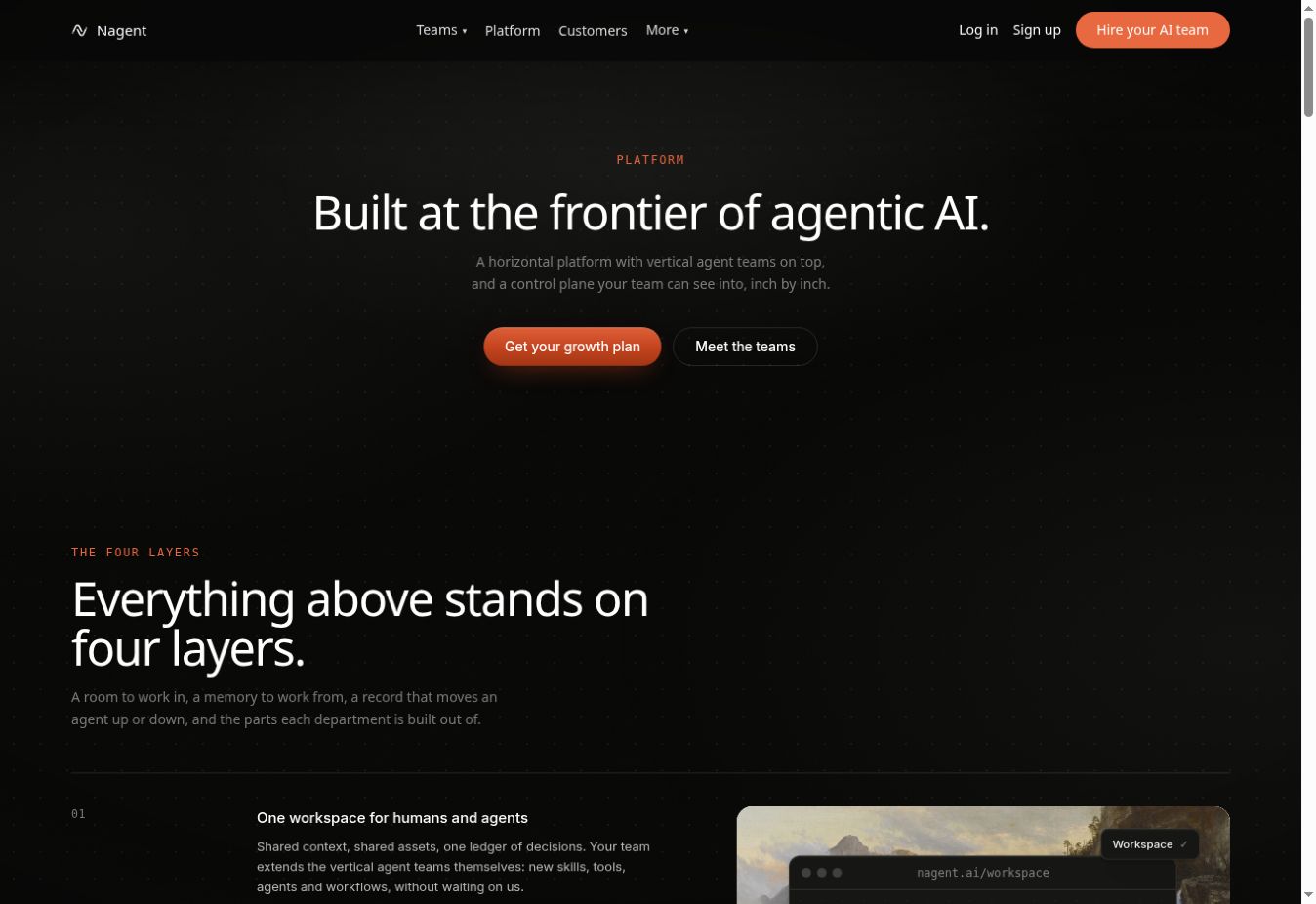
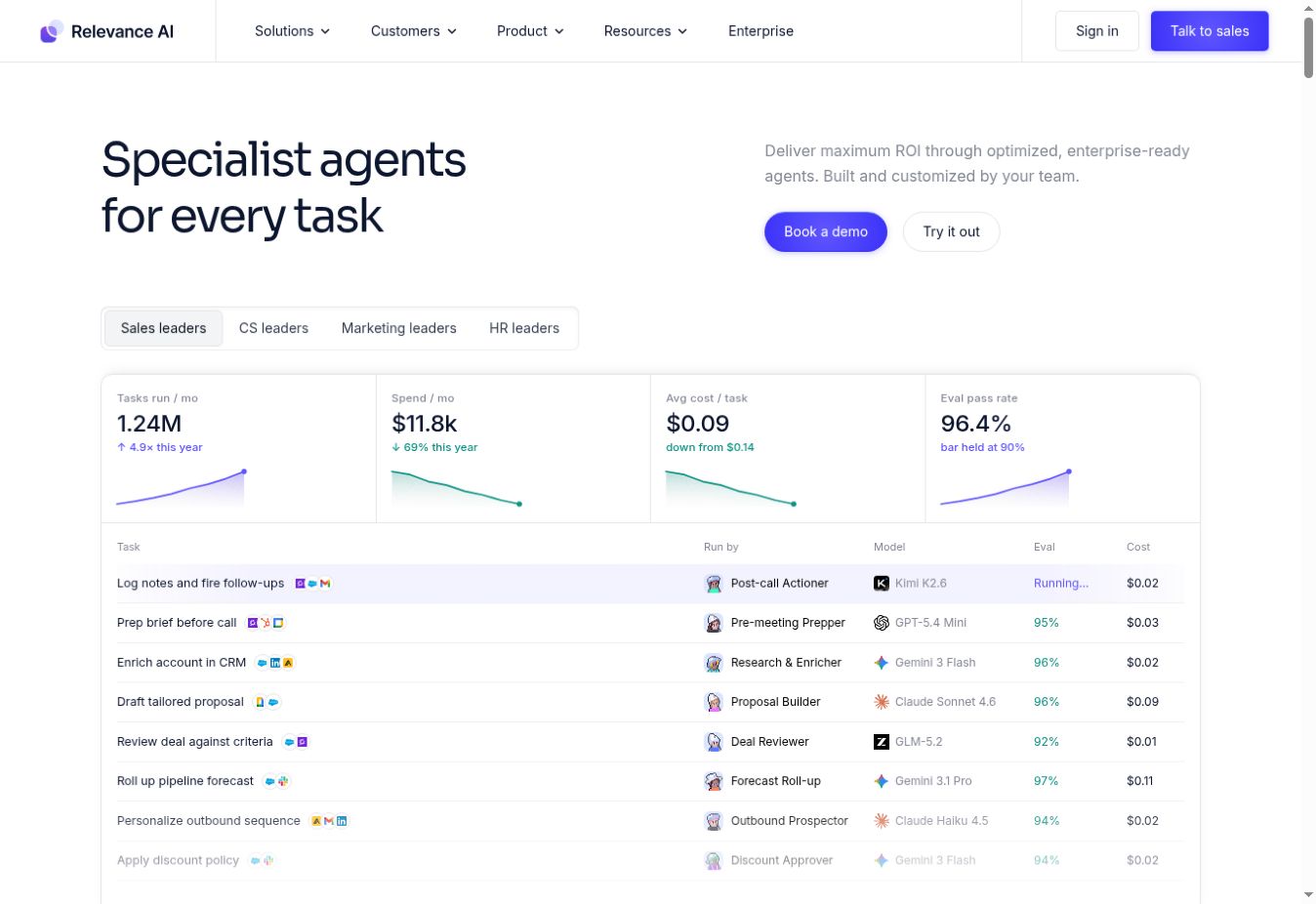
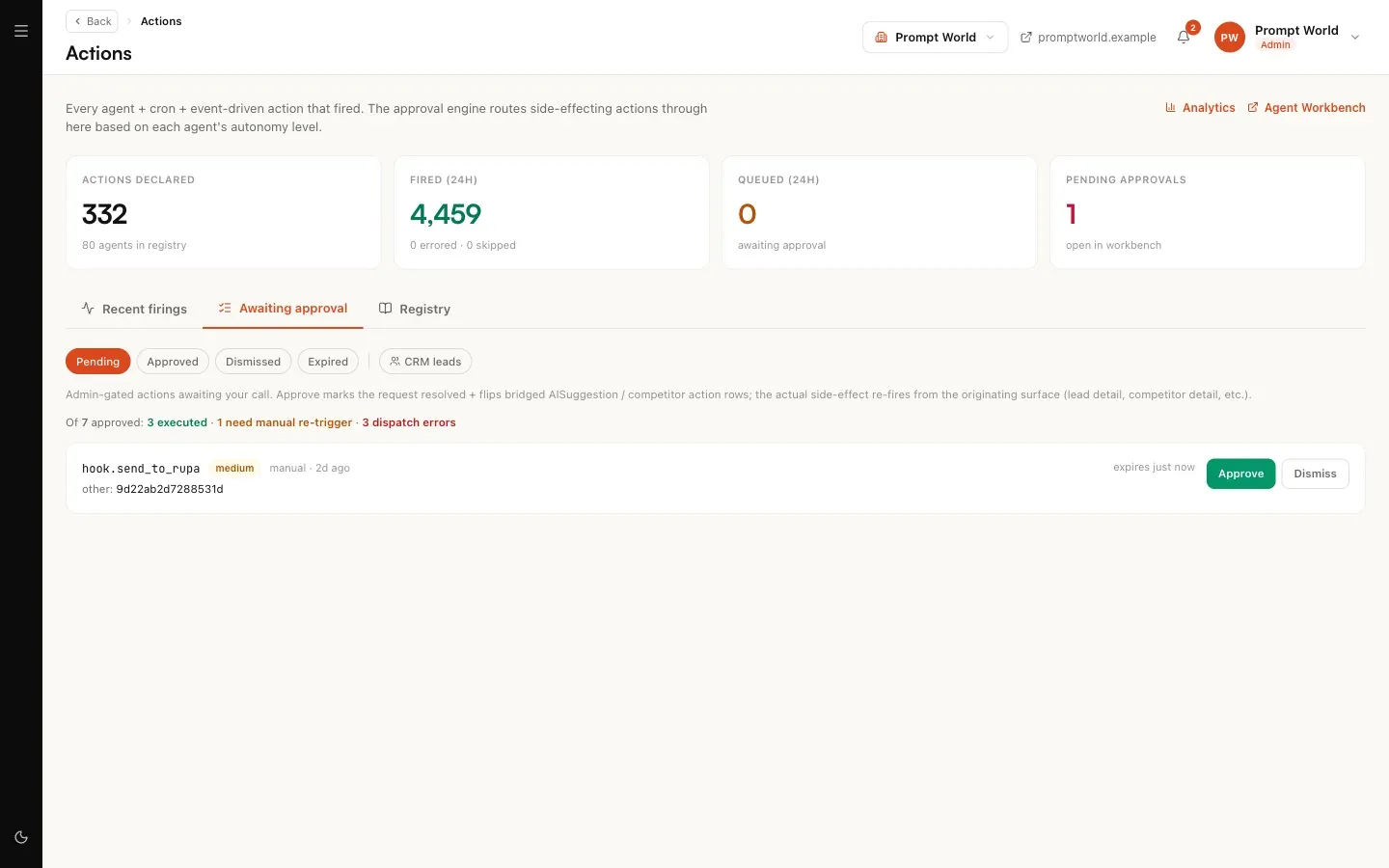
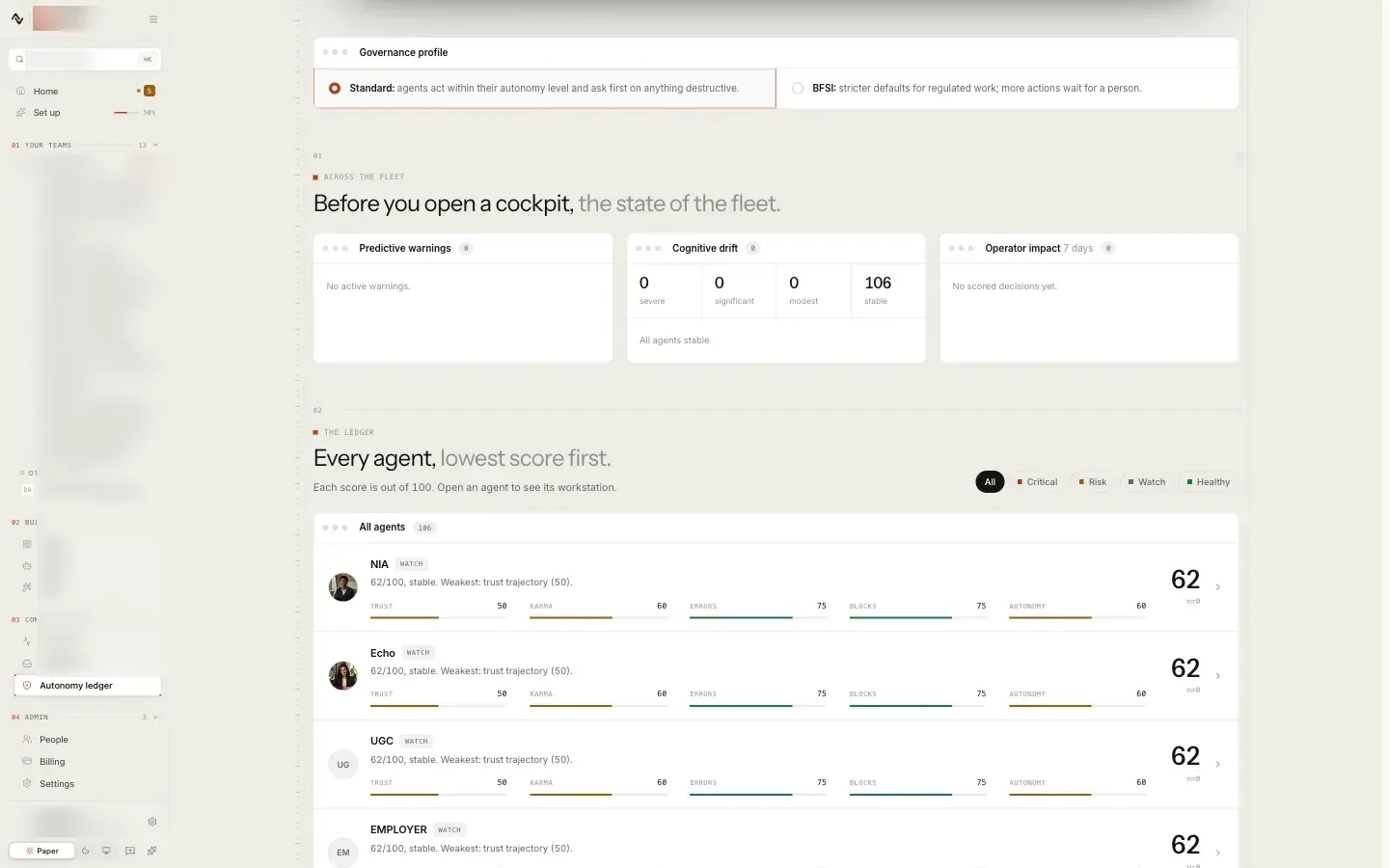
Frequently asked questions
Is Nagent an alternative to Relevance AI?
For some of the work. Teams that already run Relevance AI workforces for support and operations can keep them and hand marketing and sales work to Nagent's ready-made teams. Research from a Relevance agent can be exported into the Knowledge Hub for SERA and MIRA to use. If a Relevance workflow exposes an API, Nagent can call it through your own API, with each run still passing through approvals.
How does Nagent pricing compare with Relevance AI?
Relevance AI: Custom enterprise pricing. Current pricing page lists Enterprise; actions and vendor credits require a quote. Nagent: from $29.99 per month.
Does Relevance AI offer shared memory and human approvals like Nagent?
Access controls and audit features are listed in the enterprise offer. Confirm where approvals are enforced, what traces contain and which costs fall outside actions. Nagent has the Knowledge Hub and Inbox approval.
Which is better for Marketing, Sales, CX teams: Nagent or Relevance AI?
Nagent, for most growth teams. Relevance AI fits better when you want to assemble your own Relevance AI workforce from tools and agents, with your team owning the design, evaluations and A/B tests of each one.
How does Relevance AI's security compare with Nagent's?
Relevance AI: SOC 2: Type II; ISO 27001: not published; SSO: yes. Nagent's are on nagent.ai/security.
Sources and research notes
- V1 · Official product / pricing source
Relevance AI · product ↗https://relevanceai.com/ · Public material checked 21 to 29 September 2026 - V2 · Official product / pricing source
Relevance AI · commercial / feature reference ↗https://relevanceai.com/pricing · Public material checked 21 to 29 September 2026 - V3 · Official source
Workforce edge settings · approvals and limits ↗https://relevanceai.com/docs/build/workforces/build-an-ai-workforce/edge-settings · Public material checked 21 to 29 September 2026 - V4 · Independent review surface
Independent reviews · G2 ↗https://www.g2.com/sellers/relevance-ai · Public material checked 21 to 29 September 2026 - V5 · Official source
Official current product and availability claims ↗https://relevanceai.com/product · Public material checked 21 to 29 September 2026 - N1 · Official source
Nagent · platform, workspace and security ↗https://nagent.ai/platform · Public material checked 21 to 29 September 2026 - N2 · Official source
Nagent · security and compliance ↗https://nagent.ai/platform/security · Public material checked 21 to 29 September 2026 - N3 · Official source
Nagent · published plans ↗https://nagent.ai/pricing · Public material checked 21 to 29 September 2026 - THESIS · Official source
The Nagent Thesis ↗https://nagent.ai/artefacts/nagent-thesis · Public material checked 21 to 29 September 2026 - GOVERNANCE-SOURCE · Official source
State of Agent Governance ↗https://nagent.ai/artefacts/state-of-agent-governance · Public material checked 21 to 29 September 2026