HOOK, Nagent's AI creative strategy lead for paid social
Beta. HOOK and its bench of eight seats turn a brief into angles, hooks and scripts, check every claim against your proof, and pack the result for a person to ship, without ever touching a live ad.

What HOOK does, in the team room and on the surfaces your team uses
The Marketing team room
A team room is one conversation that a department's people and its AI teammates share. Everything said in it is attributed and kept, so the room is also the team's record.
Address an agent by name and it answers in the thread. A message addressed to nobody goes to the team lead.
An instruction becomes a task on the team board only when a person confirms it.
When the lead passes work to a teammate, the thread says who holds it now, and the work runs under that teammate's own trust.
An action that needs approval waits in the thread as a card. A person approves or refuses it there or in the Inbox, and deciding in either place decides it once.
Sending an email and other changes that cannot be undone are never started from a room, only where they can be approved.
HOOK sits in the Marketing room with MIRA, who leads it, and with DRIS, NIA and Echo. Its eight seats do not sit in the room: they are reached through HOOK.
Asked in the room, HOOK can open a concept and run its seats' work: add an ad to the swipe library, search an ad library, tear an ad down, write a creative brief, write hooks or a script, and read the ad accounts. Each runs as the seat that owns it, under that seat's own approval rules and budget.
GATE's check, PACK's handover, PULSE's diagnosis and refresh plan and VAULT's playbook start on HOOK's own surfaces. A brief goes to RUPA only when a person sends it, never from chat.
From the DRIS backlog and the Google Ads integration page, a person can ask HOOK for hooks. The request lands in HOOK's Requests, where a person on HOOK starts it, and each step from filed to delivered comes back as a card in the asker's own thread with HOOK, not in the room.
What sets HOOK apart
- 01
Multiplayer
Several AI agents and the team's people work on one shared context: the room's thread, the documents pinned to it and the team record.
HOOK works in the Marketing room beside MIRA, DRIS, NIA and Echo, and a person working with DRIS or NIA can ask HOOK for hooks from that lead's own page. Work that crosses teammates runs under each one's own rules: RUPA renders a production brief under her own render gate, brand kit and caps, and NIA builds a Google pack only on NIA's own approval, paused.
- 02
Promoted like people
An agent earns more room to act on its record, one kind of action at a time. Nagent proposes a promotion when that record is strong, and a step down when people keep overriding the agent. Destructive changes always wait for a person.
A workspace admin sets how much HOOK and each of its seats may do alone, and every change is recorded in the audit log with what it was before. Reinstalling the team never takes that room back, and lifting a GATE block sits above every setting, so it always waits for a person.
- 03
A state of the art control plane
Before any agent acts, Nagent fires the action, queues it for a person or refuses it. Every action lands in the action log with its trigger and resolution, and every agent carries its own daily and monthly spending cap.
Every action HOOK and its seats can take is declared in the action registry, so none runs unchecked. An ad library search has its cost checked before it runs, every model call stays inside the workspace budget, and HOOK's Today surface shows its errored runs and today's spend from the budget guard.
- 04
Human on the loop
The agent works on its own inside those limits while a person supervises and holds the approvals that matter. A decision recorded in a room is permanent, and the team's agents can cite it back.
Drafting, checking and reading run on their own. Paid research and sending a brief to RUPA wait for a person unless an admin has given more room, and whoever asks to lift a GATE block cannot be the one who approves it. Every brief is written from the workspace's own brand pack, read live from its voice, buyer profile and claims with their proof, and a brief will not run while the pack is incomplete. What HOOK learns is VAULT's playbook: what has won for this brand in each channel pack, handed to the next brief with its sample size.
- 05
Claims checked against proof.
SCRIPT checks every claim a script cites against the brand's live claims. GATE checks returned images and copy against those claims, the banned words and the approved copy, and holds what they do not support.
- 06
Kill conditions set before launch.
Every bet in a brief carries a structured kill condition. PULSE checks it on each read of the ad account and says when one is met; a person pauses the ad.
- 07
Winners called against your own ads.
Each ad is ranked against this account's own ads in its channel pack over 90 days and joined to the concept it came from. A diagnosis says where an ad loses its audience against its population's median curve, and one change to make.
HOOK's surfaces
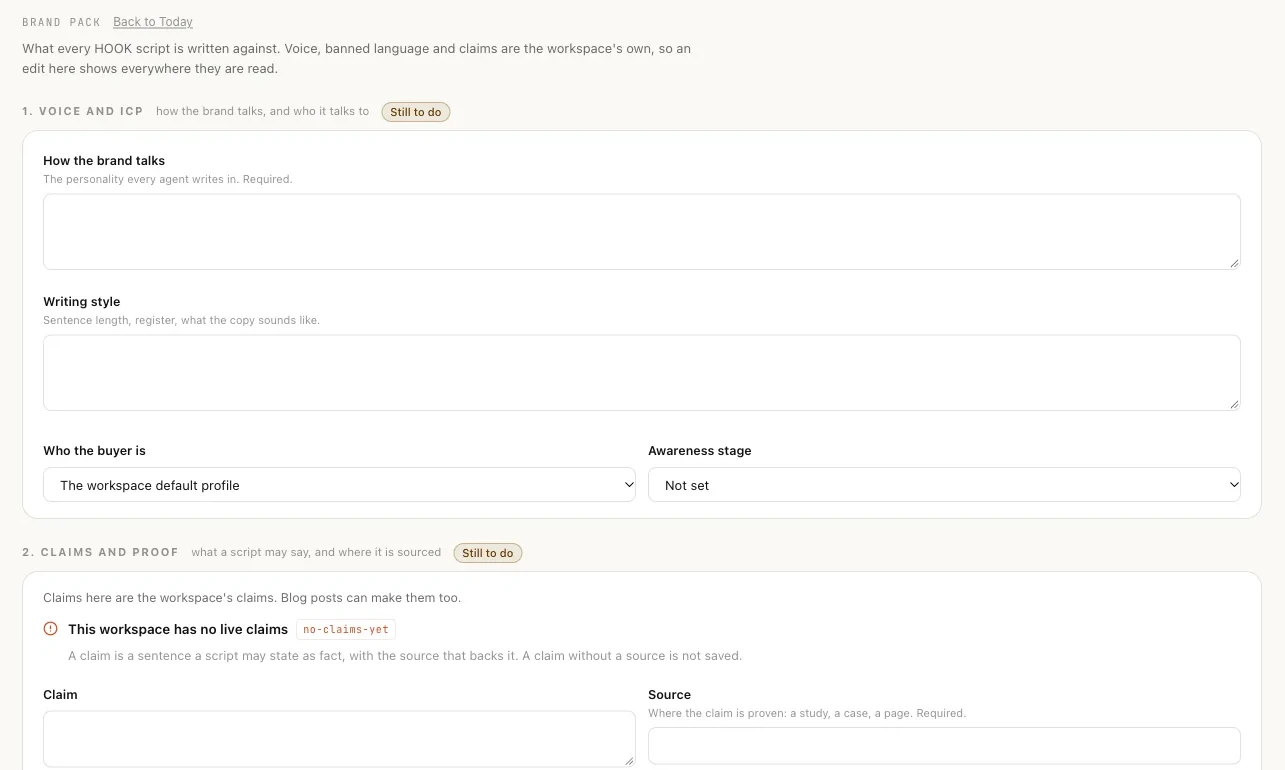
Brand pack first.
Voice, buyer profile, the claims the brand may make with their proof, banned language, the offer and channel packs. Nothing is made until it is complete.
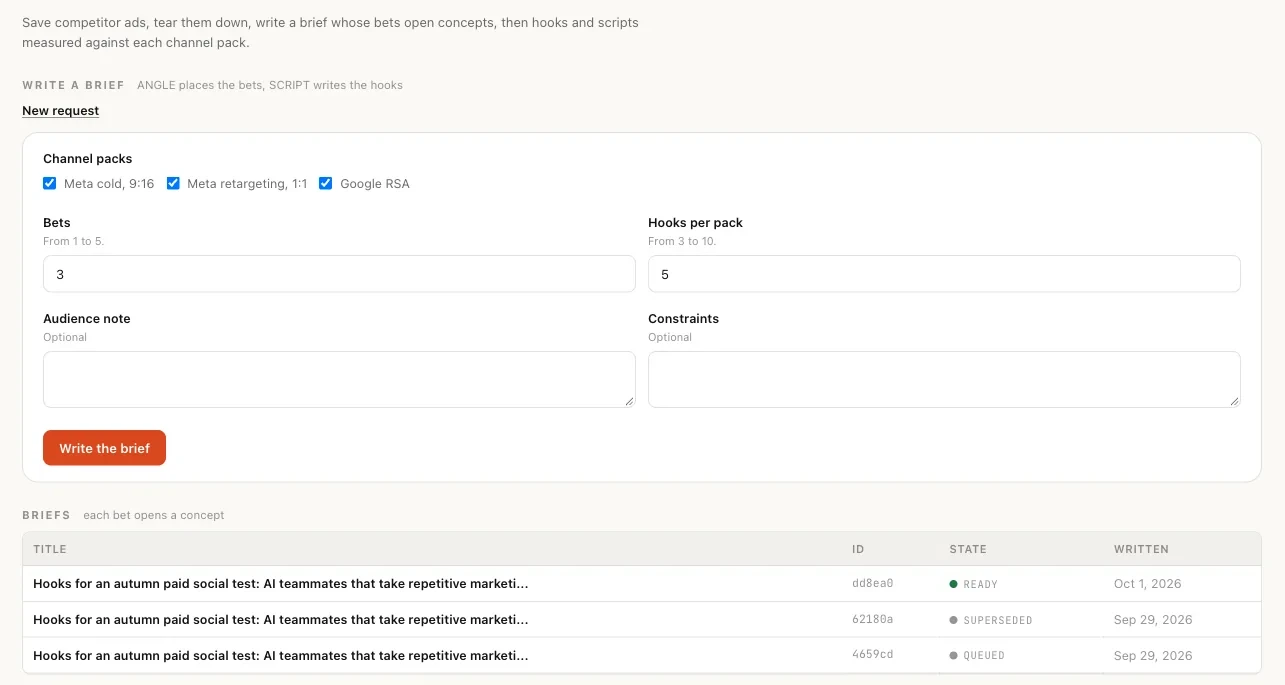
Write a brief.
Choose the channel packs, the number of bets, hooks per pack, an audience note and constraints. ANGLE writes the brief, and each bet opens a concept.
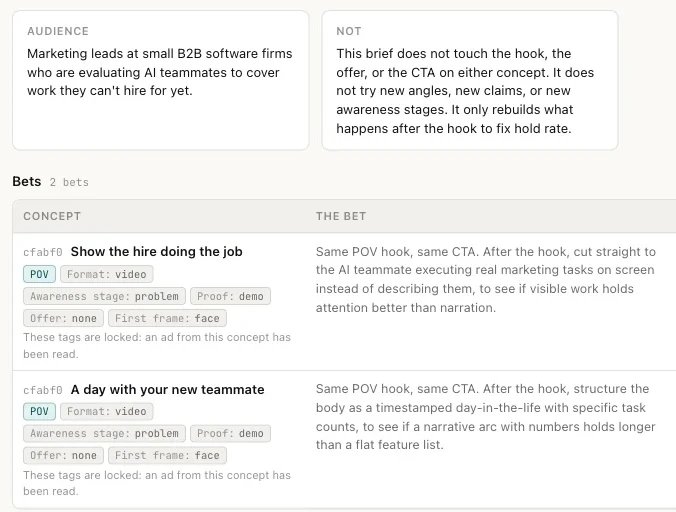
Open a brief to read its bets.
ANGLE turns a mined pattern into a testable angle for this brand, with the claim it rests on made explicit.
Follow a concept from bet to winner.
Every concept a bet started, how far it has got, who is producing it, what GATE said, and whether it won.

Read the ad accounts.
One read a night and one each time a person presses Read now: ads read, ranked, winners and kills met. HOOK makes read calls only.

Upload ad data.
A connected Meta account, or an export from any ad platform uploaded as a .csv or .xlsx file. PULSE reads ad level performance.
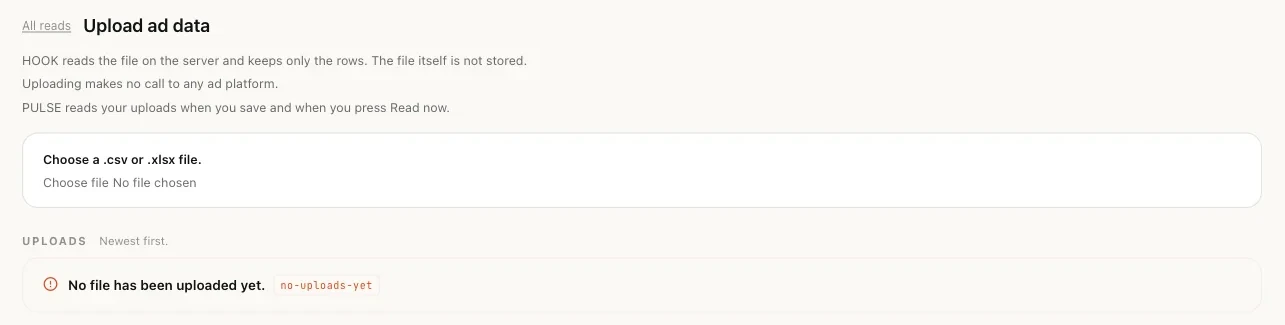
Surfaces from a demo workspace. Figures are not customer results.
How HOOK works
- 01
Brand pack first.
Voice, buyer profile, the claims the brand may make with their proof, banned language, the offer and channel packs. Nothing is made until it is complete.
- 02
Research and angles.
SCOUT finds the competitor and category ads worth studying for the swipe library; MINE mines it for what is working and why; ANGLE turns a pattern into a testable angle with the claim it rests on made explicit.
- 03
Hooks and scripts.
SCRIPT writes hook sets; a person pins the ones they like and clicks "Hand to SCRIPT" for full scripts.
- 04
The gate.
GATE checks every claim against the brand pack before it ships and holds it when the pack does not support it. Overriding a block needs a second person.
- 05
Ship and learn.
Statics go to RUPA. PACK assembles one pack carrying the angle, the script and the constraints, to upload by hand or as a Google pack NIA builds paused. PULSE reads ad performance; VAULT keeps what a campaign taught.
Channel packs today: Meta cold 9:16, Meta retargeting 1:1, TikTok Spark and Google RSA.
Where HOOK sits
- Reports to
- MIRA, chief of staff for Marketing
- Status
- Beta
Bench, eight seats (Beta)
- SCOUT, Ad ScoutBeta
Finds the competitor and category ads worth studying, and says why each one earned a place in the swipe library.
- MINE, Pattern MinerBeta
Mines the swipe library for what is working and why, so a pattern is stated as a mechanism rather than as a screenshot.
- ANGLE, Angle BuilderBeta
Turns a mined pattern into a testable angle for this brand, with the claim it rests on made explicit.
- SCRIPT, Script WriterBeta
Writes the script and the shot list for an angle, in the form a producer can shoot without a briefing call.
- GATE, Claim GateBeta
Checks a claim against the brand pack before it ships, and holds it when the pack does not support it. The only seat here that stops work rather than producing it.
- PACK, Campaign PackerBeta
Assembles the campaign pack a producer receives, so one handover carries the angle, the script and the constraints together.
- PULSE, Performance ReaderBeta
Reads ad level performance and diagnoses it, separating a weak angle from a weak execution of a good one.
- VAULT, Prior KeeperBeta
Holds the priors that make the next bet better, so what a campaign taught survives the campaign.
Works with: RUPA (statics) and NIA (Google pack, built paused).
Agents HOOK runs
Marketplace agents for the kind of work HOOK runs on Nagent. Each opens its own page.
What HOOK works with
Tools
- Open a concept
A titled row with a stable id that every later surface keys on.
- Add an ad to the swipe library
SCOUT saves a competitor ad, uploaded or pasted, with the reason it was kept.
- Search an ad library
SCOUT pulls competitor ads from a paid ad library service, with the cost checked before it runs.
- Tear down an ad
SCOUT transcribes the audio, cuts keyframes and reads both into beats.
- Write a creative brief
ANGLE writes bets, each with a kill condition, and opens one concept per bet.
- Write hooks
SCRIPT writes a hook set per concept and channel pack, with lengths measured in code.
- Write a script
SCRIPT writes the deliverables a channel pack asks for and checks every cited claim.
- Read the ad accounts
PULSE ranks stored ads against their own channel pack and flags met kill conditions.
- Diagnose an ad
PULSE says where an ad loses its audience, and one change to make.
- Write a refresh plan
PULSE lists the ads to kill, the concepts to iterate and the winners to carry to the other pack.
- Send a production brief to RUPA
RUPA renders it under her own render gate, brand kit and caps.
- Write the playbook
VAULT ranks each tag against the rest of its pack and writes findings that cite only those figures.
- Check returned work
GATE checks returned images and copy against the live claims, the banned words and the approved copy.
- Override a GATE block
Always waits for a person other than the one who asked.
- Place a Google pack with NIA
PACK turns a gated Google RSA pack into a campaign plan, and NIA builds it paused.
Signals
- Brand voice and banned language
Read from the brand's own voice settings, so an edit there reaches every brief, hook and script.
- Buyer profile
The chosen buyer profile, or the default one, and HOOK says which it is writing for.
- Claims and their proof
Live brand claims with their sources, which scripts cite and GATE checks against.
- Channel packs
Meta cold 9:16, Meta retargeting 1:1, TikTok Spark and Google RSA, each limit cited to the platform page it was read from.
- Swipe library and teardowns
Competitor ads saved to learn from, never used as your own copy. A brief can answer a teardown.
- Ad performance
Rows the nightly Meta sync stores, or rows from an uploaded export, read by PULSE.
- The playbook
What has won for this brand in each channel pack, handed to every new brief.
- Requests
Work asked of HOOK, by people and for other leads, with who asked and when it is wanted.
Integrations
- Meta Ads
Connected for the nightly sync PULSE reads. HOOK makes read calls only.
- Google Ads
The account a Google pack is placed in through NIA, built paused.
- Spreadsheet uploads
A .csv or .xlsx export from Meta Ads Manager, Google Ads, TikTok Ads Manager or another platform. The file itself is not stored.
What HOOK does on its own, and what waits for a person
HOOK makes read calls only on an ad account. It cannot launch, pause, or change a budget or a bid, and no seat on its bench can. A person spends the money.
Drafting, checking and reading do not wait, because they cost little and change nothing outside the workspace.
Paid research and anything that spends another teammate's budget wait for a person: ad library searches, teardowns and sending a brief to RUPA.
Overriding a GATE block always needs a second person.
How much HOOK and each seat may do alone is set by a workspace admin, and every change is recorded in the audit log.
How HOOK is governed
Claims and proof.
The brand pack lists the claims the brand may make with their proof; GATE is the only seat that stops work rather than producing it.
Read-only on the ad account.
No seat on the bench can launch, pause, or change a budget or a bid.
Measured on its own spend.
"Cost per winner" counts HOOK's own spend, never the ad spend.
On the record, in your workspace.
Every agent action lands in the action log with its resolution, and each workspace's rows are scoped to it.
How HOOK compares, and where to read more.
Questions about HOOK
What is HOOK?
HOOK is Nagent's creative strategy lead for paid social, an AI teammate on the Marketing team that reports to MIRA and carries a Beta tag. A bench of eight seats does the work, each with its own job, from finding ads worth studying to checking claims and reading performance. A person starts that work on HOOK's own surfaces, from a request or by asking HOOK in the Marketing room.
Does HOOK launch or pause ads on its own?
No. HOOK makes read calls only on an ad account. It cannot launch, pause, or change a budget or a bid, and no seat on its bench can. A person uploads, pauses and spends in the ad platform. PACK builds a package to upload by hand, or hands a Google pack to NIA, who builds it paused.
What does GATE check?
GATE, one of HOOK's eight bench seats, checks every claim against the brand pack, which lists the claims the brand may make with their proof and its banned language. It holds a claim the pack does not support, and overriding a block always needs a second person. It also checks the size of images RUPA returns.
Which ad platforms can HOOK learn from?
A connected Meta account, or an export from any ad platform uploaded as a .csv or .xlsx file. PULSE reads ad level performance and separates a weak angle from a weak execution of a good one, and VAULT keeps what a campaign taught, so the learning survives the campaign rather than one person's memory.
What waits for a person's approval?
Ad library searches, teardowns, sending a brief to RUPA, and overriding a GATE block, which always needs a second person. Paid research and anything that spends another teammate's budget wait for approval. Drafting, checking and reading do not, because they cost little and change nothing outside the workspace.
Does HOOK replace our creative team?
No. It hands the team the angle, hooks, scripts and constraints in one pack, and people decide what runs. A person pins the hooks they like before SCRIPT writes full scripts, and a person uploads and spends in the ad platform. HOOK is built for the paid social manager and the creative strategist, not instead of them.
How much does HOOK cost?
HOOK works on the Marketing team. Nagent plans are Solo at $29.99 a month ($19.99 billed annually), Team at $299 a month ($199 billed annually) and Business at $1,499 a month ($999 billed annually). Enterprise is by quote. The pricing page shows which teams each plan includes.