
Nagent vs Okara: the founder is not a queue
Okara gives a founder an AI CMO whose agents draft for approval. Nagent gives a growth team whose AI coworkers earn trust and reach pipeline.
Okara suits a solo founder with no marketer who wants ten marketing agents drafting from one strategy, with every draft approved by the founder. Nagent suits a company that wants the outcome of a growth team: AI coworkers that earn freedom through a track record you approve and carry the work to pipeline and customers.
It is 11:40 at night, and a founder is doing her marketing.
Not writing it. That part is done. Her AI CMO has been busy all day. The Reddit agent has found 36 threads worth answering. The SEO agent has 46 recommendations ready. The X agent has 137 ideas. The articles agent has 32 topics. There is a LinkedIn post, a Hacker News post, a UGC video and a queue of influencer campaigns, each one drafted, formatted and waiting.
Waiting for her.
She approves eleven of them, rejects four, edits two, and closes the laptop at half past midnight with the rest still in the queue. Tomorrow the agents will be even more productive. The queue will be longer. And somewhere in that queue, among the posts and the fixes and the video, is the thing she actually needs, which is not more content. It is customers.
This is the most important thing to understand about the first generation of AI marketing: it solved generation so completely that it moved the bottleneck onto the one person the company can least afford to spend. The founder is no longer the writer. She has become the queue.
The best version of the first answer
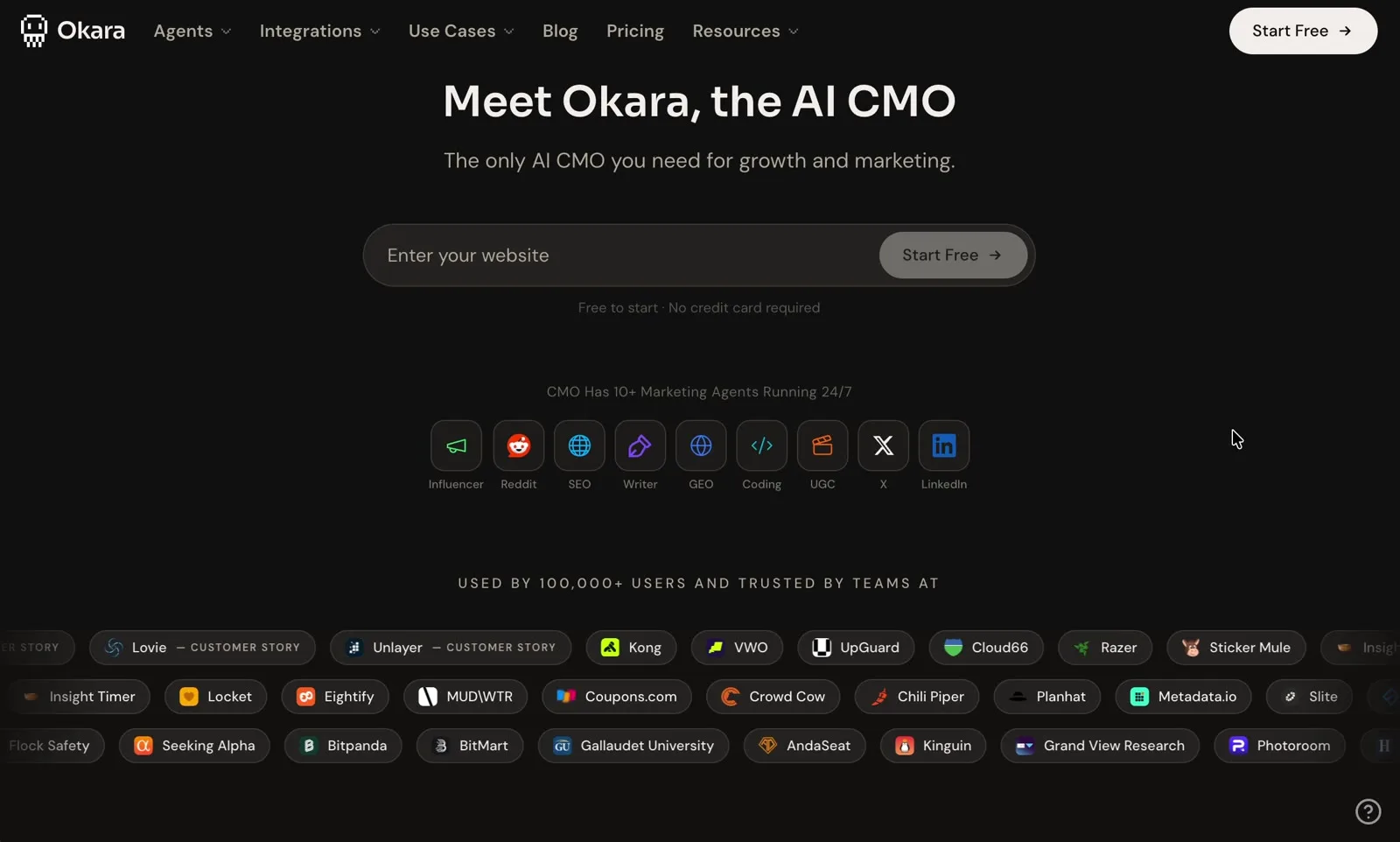
Okara is the clearest example of what that first generation got right, and it deserves credit. Its homepage makes the proposition in five words, Meet Okara, the AI CMO, and then asks you for exactly one thing: your website. Ten agents, from SEO and GEO to Reddit, X, LinkedIn, UGC video and a coding agent for technical fixes, get to work from a strategy the product writes for you. It says more than 100,000 people have used it.
The product behind the homepage is carefully designed. A company panel holds the strategy documents. An analytics panel watches traffic, links and technical SEO. A feed shows what each agent has ready. And a chat lets you talk to the AI CMO directly.
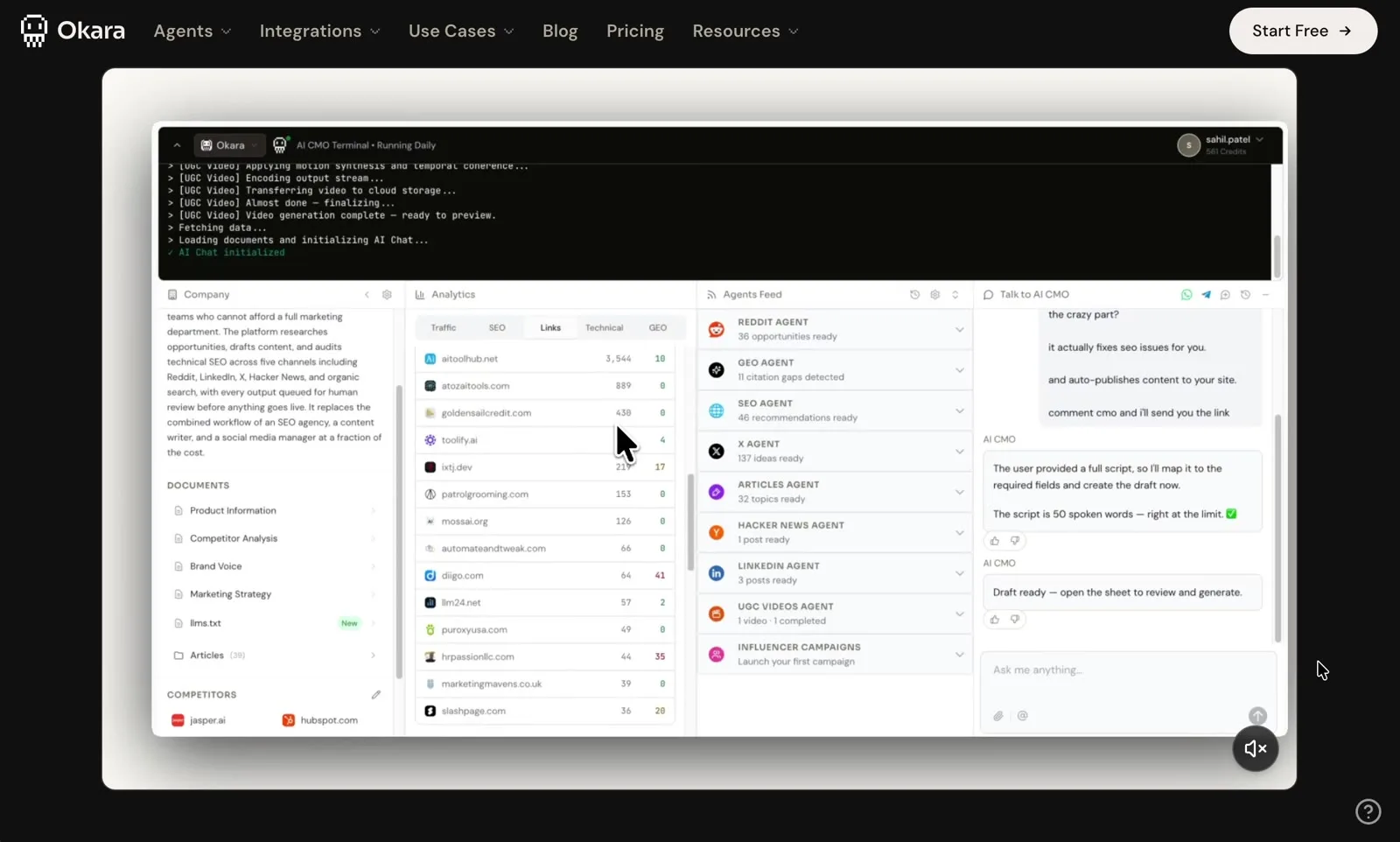
The rule that holds it together is simple. Every agent drafts; you approve. Nothing is posted until the founder has seen it. For community channels like Reddit, where automatic posting is the fastest way to get banned, that is exactly the right instinct.
And the economics are persuasive. On its pricing page, Okara frames itself as the USD 14,000 a month job for USD 129 a month, and lays out, line by line, what a founder would otherwise pay for a marketing hire, an SEO agency and a content writer.
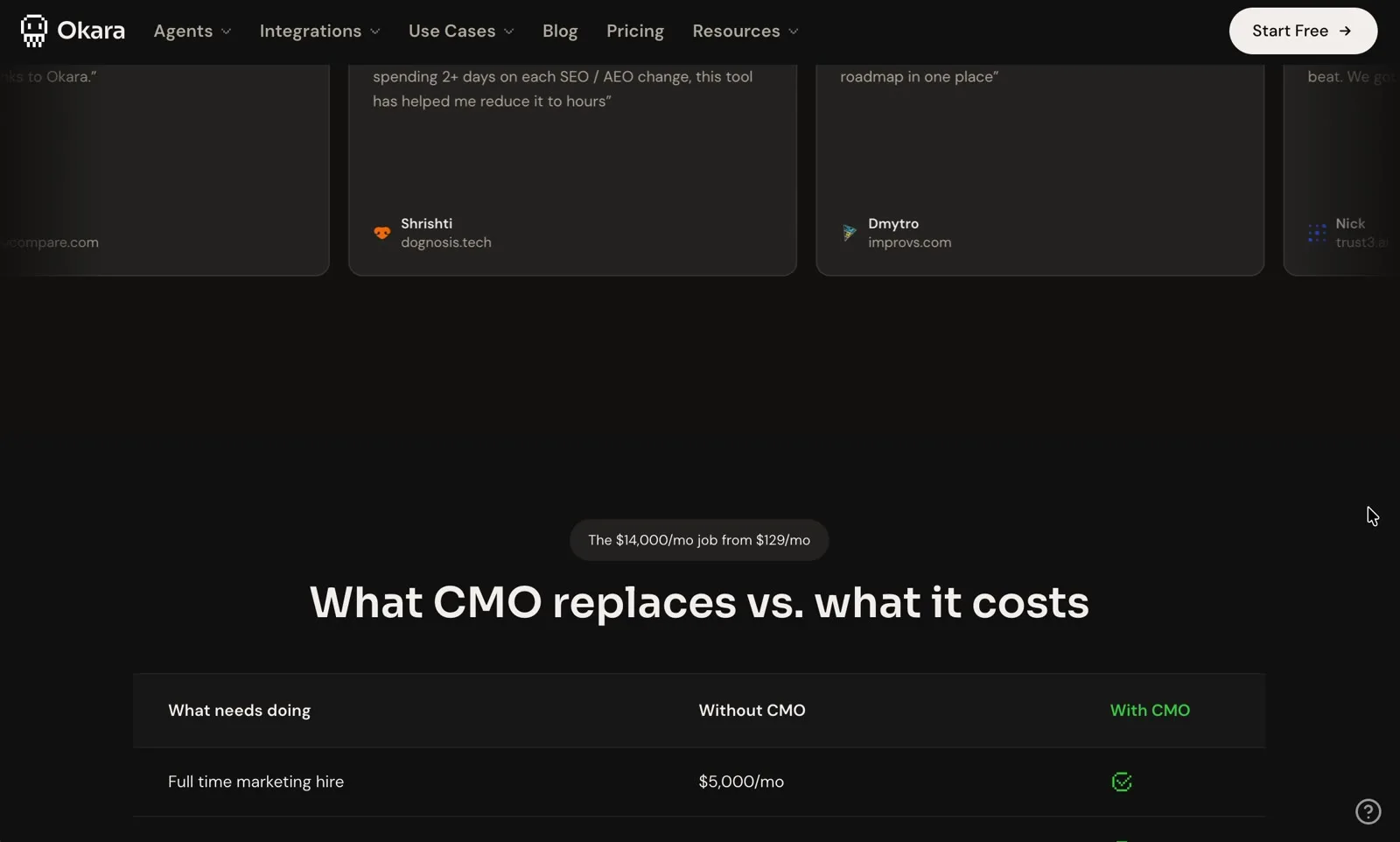
For a solo founder with no marketer, this is a genuine gift. It is also where the first generation's thinking stops.
Draft debt
Here is the problem with a system in which every agent drafts and one person approves. Each draft is a small liability. Until somebody reads it, it is not distribution; it is inventory. The more capable the agents become, the faster the inventory grows, and the more of the founder's evening it consumes.
We call this draft debt, and it compounds. A founder who clears the queue on Monday faces a bigger one on Tuesday, because the agents have learned to find more opportunities. The only ways to pay it down are to hire people to review, which defeats the point, or to let some agents act on their own, which the draft first model never allows. Every agent in an AI CMO is permanently on probation. Its thousandth excellent Reddit reply waits at the same gate as its first.
There is a second, quieter problem. Look at what the queue contains: posts, articles, fixes, videos, influencer lists. It is marketing output, and good marketing output. But the job Okara prices at USD 14,000 a month was never really producing output. It was turning attention into customers. That work begins where the queue ends: researching the accounts that showed interest, writing to the right person at each one, recording the conversation, following up, and handing the deal to whoever closes it. An AI CMO drafts your brand's LinkedIn post. It does not write to the buyer who liked it.
So the founder at 11:40 has two jobs the product cannot do for her. She is the approver of everything, and she is still the entire sales team.
The same night, in Nagent
Give the same founder a Nagent workspace and the evening looks different.
She is not the only person in it. Her own team works alongside the AI coworkers, and an AI chief of staff called MIRA plans the week, hands out the work and only brings her what genuinely needs her. Everyone sees the same work in the same place.
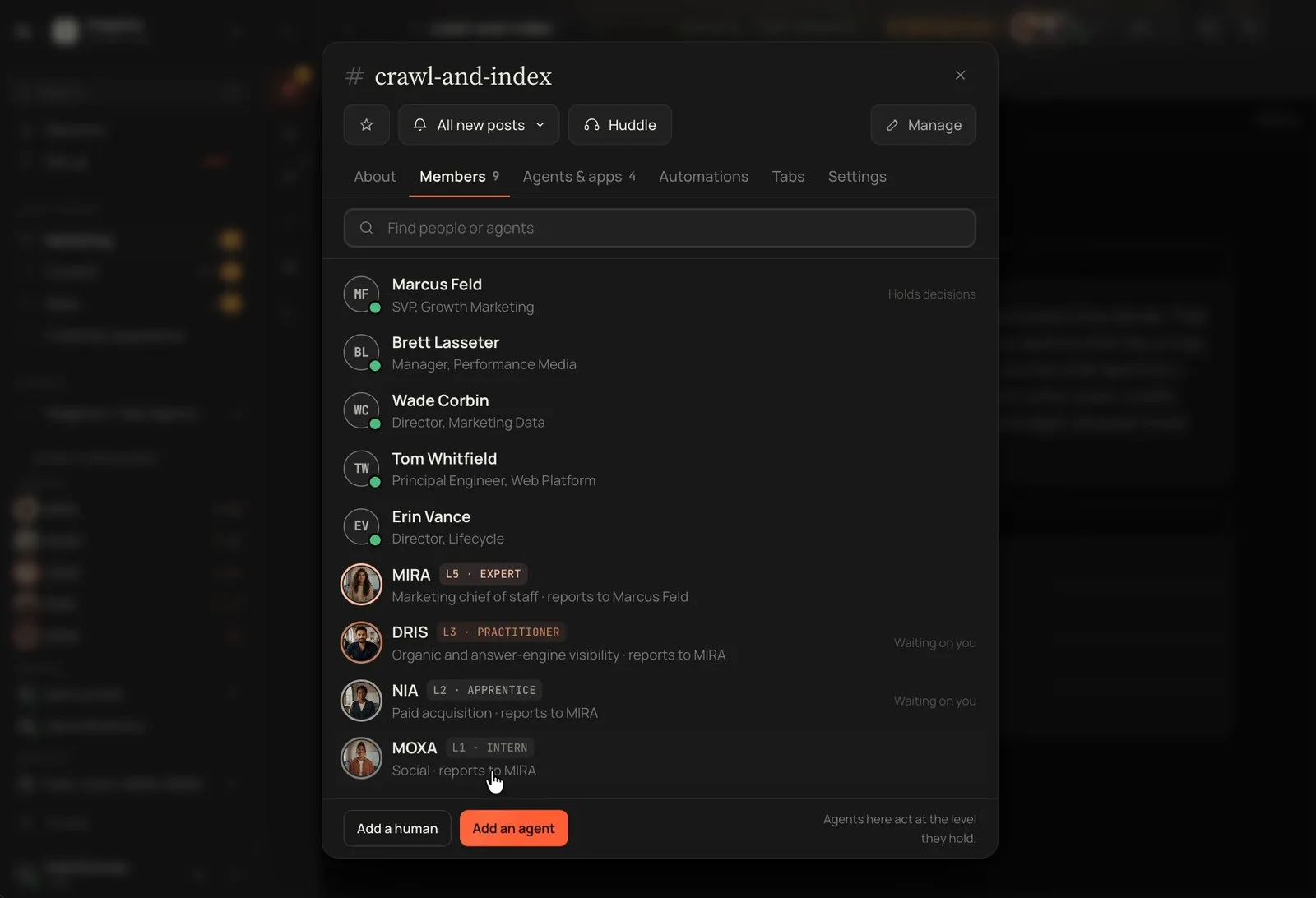
And the queue gets shorter over time instead of longer. Every AI coworker starts like a new hire, with everything it produces waiting for a person, exactly as in an AI CMO. But it does not stay there. As it proves itself, with good work approved without edits and risky calls handed up instead of made alone, Nagent recommends a promotion and she signs it off. A promoted coworker needs her less; one that slips loses the freedom it had. The things that must always stay human, like sending to a customer or spending more budget, stay human. That is how draft debt gets paid down.
Most importantly, the work does not stop at the post. When her content brings a business buyer to the site, NORA, the AI coworker for outbound, researches the account and drafts a first message to the right person, and keeps the record in a CRM that comes with Nagent. Her sales lead reads the messages before anything is sent.
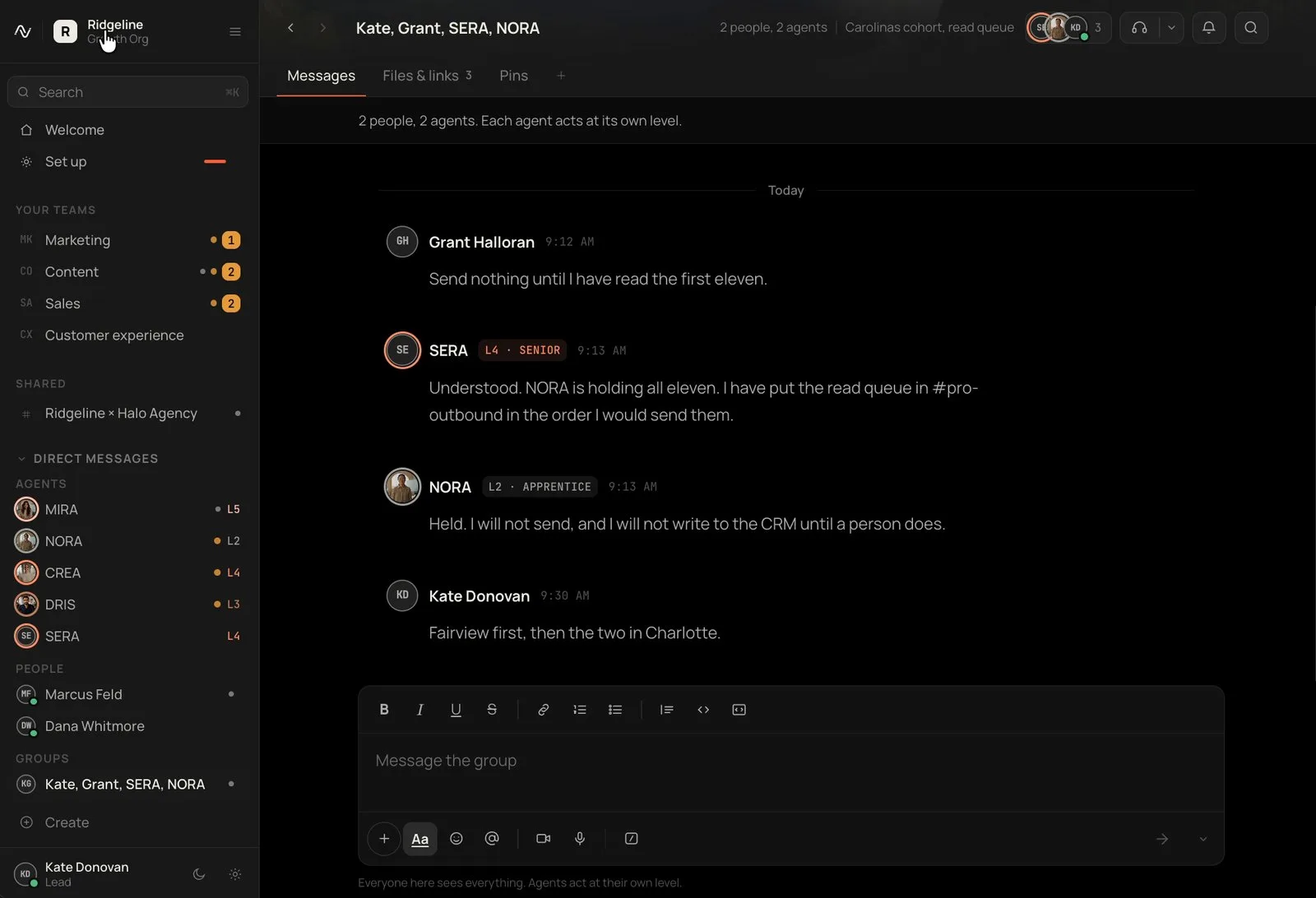
At 11:40 she is not approving tweets. She is looking at who replied. And where her plan includes it, a Nagent marketer sits in the same workspace and owns the number with her.
The question to ask at midnight
The first generation of AI marketing asked how one person could produce the output of a marketing team, and the answer is a founder with more drafts than hours. The better question is how to get the outcome of a growth team without the founder becoming its bottleneck.
Okara product details are taken from okara.ai, its pricing page and its launch post, as they appeared in September 2026. Nagent examples come from Ridgeline, a demonstration workspace for a fictional manufacturer.
See what each plan includes on the pricing page, or book a walkthrough with the team.
At a glance
| Okara | Nagent | |
|---|---|---|
| Built around | One founder's marketing output | Your growth number |
| Who does the work | Marketing agents, each drafting for you | AI coworkers with their own manager, and your people, in one workspace |
| Who decides what AI can do alone | You approve every draft | A track record each AI coworker earns, approved by you |
| How far the work reaches | SEO, answer engines, content and social | Marketing, sales and customer experience |
| Who owns the result | You | You, with a Nagent marketer where your plan includes it |
Frequently asked questions
What is Okara and what does it do for a founder?
Okara calls itself the AI CMO. Its homepage asks for one thing, your website, and ten agents, from SEO and GEO to Reddit, X, LinkedIn, UGC video and a coding agent for technical fixes, get to work from a strategy the product writes for you. It says more than 100,000 people have used it.
How does Okara decide what its agents are allowed to publish?
Every agent drafts and the founder approves. Nothing is posted until the founder has seen it. For community channels like Reddit, where automatic posting is the fastest way to get banned, that is exactly the right instinct.
How does Okara describe its value against hiring people?
Okara frames itself as the USD 14,000 a month job for USD 129 a month, and lays out, line by line, what a founder would otherwise pay for a marketing hire, an SEO agency and a content writer. For a solo founder with no marketer, it is a genuine gift.
What is draft debt in AI marketing?
When every agent drafts and one person approves, each draft is a small liability: until somebody reads it, it is inventory, not distribution. The more capable the agents become, the faster the inventory grows and the more of the founder's evening it consumes. Draft debt compounds, because a cleared queue on Monday becomes a bigger one on Tuesday.
How does Nagent stop the approval queue from growing?
Every AI coworker starts like a new hire, with everything it produces waiting for a person. As it proves itself, Nagent recommends a promotion and a person signs it off. A promoted coworker needs you less; one that slips loses the freedom it had. Sending to a customer or spending more budget always stays human.
Does Nagent's work stop at the social post or article?
No. When content brings a business buyer to the site, NORA, the AI coworker for outbound, researches the account and drafts a first message to the right person, and keeps the record in a CRM that comes with Nagent. The sales lead reads the messages before anything is sent.
Further reading
- The comparison hub: Nagent beside the agent platforms buyers shortlist, sourced and dated
- Earned Autonomy: A 5-Level Ladder for AI Agents: How much an AI agent may do alone, decided by its record
- Anatomy of an Agent: A Configuration, Not a Program: The ten declared parts every Nagent agent is built from
- How to evaluate an agentic AI platform: Six criteria, three grades of evidence and one bounded pilot
- Autonomy is not a setting: Nagent vs NoimosAI
- Nagent vs Jasper: a hundred agents is not a team
- Nagent vs Salesforce Agentforce Marketing: assembly required
Sources
Facts about Okara are as its own pages and the reports below stated them, checked on 30 Sep 2026. Products change; the linked pages are the current word.
More comparisons
All articlesNagent vs Salesforce Agentforce Marketing: assembly required
Agentforce Marketing sells every part of a growth organisation. Nagent ships a growth team of AI coworkers that is working from the first week.
Brand OS and AI CMOsNagent vs Superscale: profit is not a creative metric
An ad engine can win the auction. Only a team can own the funnel. Nagent vs Superscale on growth that is judged by profit.
Brand OS and AI CMOsNagent vs Typeface: content was never the bottleneck
Typeface runs a superb enterprise content supply chain. Nagent carries growth past the publish line, to search, pipeline, budget and customers.
Brand OS and AI CMOsMeet the team behind the number.
Multiplayer AI for Growth. See the plans, or book a walkthrough with the team.