
No-Code Platform for Building Custom AI Agents Enterprise Needs Governance
The Evolution of the Shadow IT Crisis
To understand the current crisis in enterprise artificial intelligence, we must first look at the history of corporate technology adoption. Every major platform shift introduces a period of profound friction between the people who want to move fast and the people whose job is to keep the company safe.
During the transition to cloud computing, we witnessed the birth of Shadow IT. Marketing departments and sales teams grew tired of waiting months for their internal IT departments to provision servers and approve software. So, they simply bypassed IT entirely. They used corporate credit cards to purchase unvetted cloud software, creating fragmented data silos and massive security vulnerabilities. IT departments eventually regained control by implementing centralized identity management and secure cloud infrastructure, turning the chaotic cloud into a governed utility.
Today, we are living through Shadow IT version two. But this time, the stakes are exponentially higher.
Business operators are actively bypassing corporate IT to use public artificial intelligence models. They are feeding highly sensitive financial data, proprietary source code, and confidential client information into consumer grade chat interfaces just to save a few hours of manual work. This is happening in every major corporation in the world, whether the Chief Information Security Officer realizes it or not.
However, the threat of unvetted artificial intelligence goes far beyond simple data leakage. We are rapidly transitioning from passive chat tools that simply summarize text to active agentic systems that execute workflows. When an employee connects an unvetted artificial intelligence agent to their corporate email and internal databases, they are giving a probabilistic machine the ability to take autonomous actions. An ungoverned agent can hallucinate a policy, authorize an incorrect discount to a major client, or accidentally delete a crucial database row.
Agility without governance is not innovation. It is operational chaos. The modern enterprise cannot adopt autonomous digital workers until it can entirely trust the infrastructure they operate on.
The False Dichotomy of Speed Versus Security
Historically, the enterprise viewed governance as a tollbooth. Security reviews, compliance audits, and architecture boards existed to slow down the deployment of software to ensure it was safe. This created a false dichotomy. Business leaders believed they had to choose between moving fast and staying secure.
In the era of intent based operations and no code agent builders, that dichotomy is completely shattered. True governance is no longer a tollbooth; it is a guardrail. When guardrails are built directly into the foundational platform, vehicles can travel much faster without crashing.
When you empower a human resources manager or a supply chain analyst to build their own artificial intelligence workflows using a no code platform, you are fundamentally democratizing software engineering. But that democratization is only viable if the underlying platform enforces enterprise grade security by default. The operator should not have to think about data encryption, access controls, or audit logs. The infrastructure must handle the compliance invisibly, allowing the subject matter expert to focus entirely on designing the business logic.
The organizations that will dominate the next decade understand that governance is the ultimate enabler of speed. When the IT department inherently trusts the orchestration platform, they remove the red tape. They grant business units the autonomy to build and deploy digital workers at will, knowing the system physically cannot violate corporate policy.
The Three Pillars of Enterprise Artificial Intelligence Governance
For a no code agent builder to be viable for the Fortune five hundred, it must be architected around three non negotiable pillars of governance.
The first pillar is granular access control. An autonomous agent must inherit the exact same security permissions as the human operator who built it. If a junior analyst builds an agent to query a financial database, that agent must be physically blocked from accessing executive compensation tables. The platform must enforce strict role based access controls across every single integration and knowledge base.
The second pillar is deterministic auditability. Standard large language models are opaque black boxes. If a consumer chat model gives you a wrong answer, you cannot look inside its neural network to find out exactly which parameter caused the error. In an enterprise environment, this opacity is illegal. If an agent denies a vendor payment or flags a compliance violation, the corporate auditing team must be able to trace the exact logical path the agent took to arrive at that decision. Every prompt, every tool call, and every data retrieval must be immutably logged and completely transparent.
The third pillar is the execution boundary. There is a massive difference between read access and write access. Allowing an agent to read a corporate document to answer a question is relatively safe. Allowing an agent to write an email to a customer, update a Salesforce record, or execute a financial transaction is incredibly dangerous. A governed platform must allow administrators to define strict execution boundaries, mandating human in the loop approval steps before any high risk write action occurs.
The Orchestration Bottleneck and the Black Box Problem
If an enterprise attempts to build this level of governance from scratch using raw open source frameworks, they will hit an immediate engineering bottleneck. Securing the perimeter around an autonomous agent requires managing complex state machines, building secure retrieval augmented generation pipelines, and constantly updating integration authentication tokens.
Furthermore, simply wrapping a user interface around a large language model does not solve the black box problem. If you give a model a massive, sprawling prompt and ask it to execute a five step supply chain workflow, it might get it right ninety percent of the time. But the ten percent of the time it hallucinates, the error is buried deep within the execution cycle.
To achieve absolute compliance, the enterprise needs a fundamentally different architectural approach. They need a system that breaks complex artificial intelligence reasoning into discrete, verifiable steps.
The Nagent Architecture of Trust
This exact tension between the chaotic agility of shadow artificial intelligence and the strict requirements of enterprise compliance is precisely what Nagent solves. Nagent was engineered from the ground up to be the ultimate architecture of trust for the modern enterprise.
Nagent is not a toy for prototyping. It is a highly governed no code orchestration platform that turns subject matter experts into secure software architects.
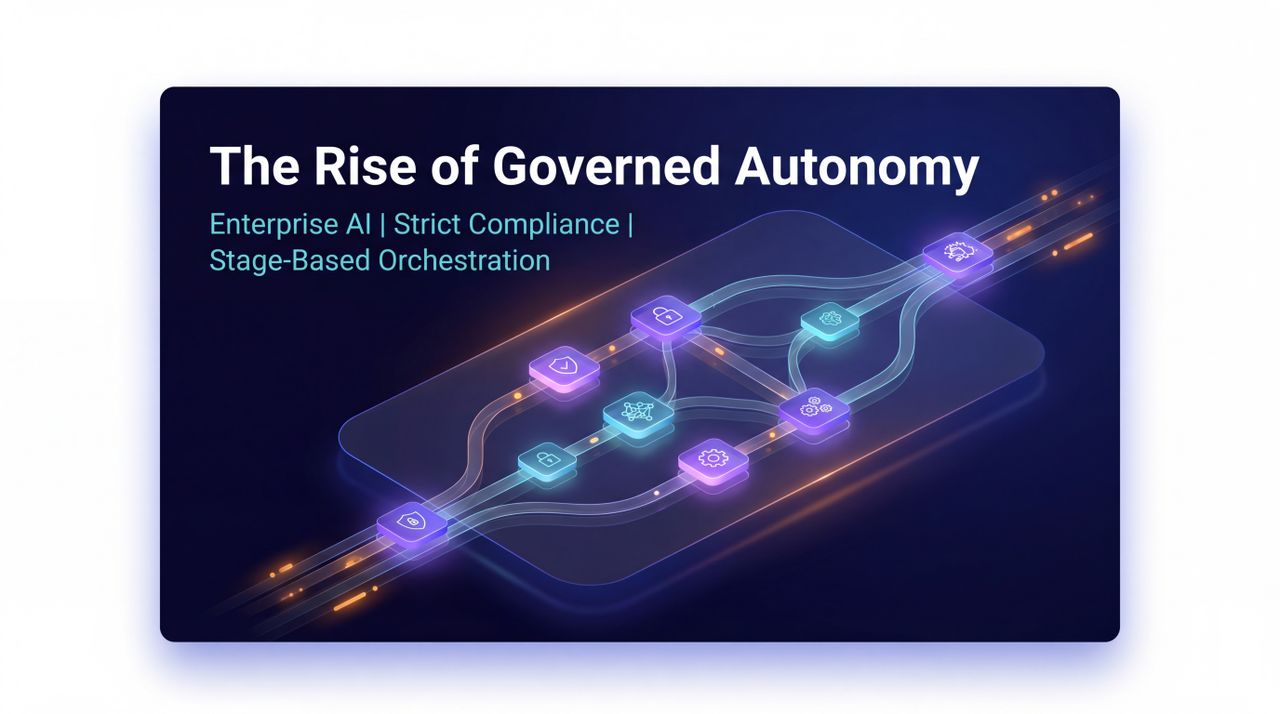
The crown jewel of the Nagent governance model is its proprietary stage based orchestration layer. Nagent fundamentally rejects the black box approach. Instead of allowing an agent to blindly guess its way through a sprawling enterprise task, the Nagent visual canvas forces the artificial intelligence into distinct, deterministic stages.
When a finance director builds a digital worker on Nagent, they can clearly map out the logic. Stage one extracts the data. Stage two validates the data against a secure policy document. Stage three prepares the approval email.
Because the orchestration is stage based, the auditability is absolute. A compliance officer can open the Nagent canvas and visually trace the exact path the agent took. If the agent makes a mistake, the error is isolated to a specific visual node. The IT department can see exactly what data was retrieved and what logic was applied at every single step. This completely satisfies the most stringent corporate auditing requirements.
Centralized Control Meets Decentralized Creation
The most dangerous aspect of building custom agents is managing the application programming interfaces that connect the agent to external corporate software. In a standard environment, operators generate API keys and paste them into their scripts. This leads to leaked credentials and massive security breaches.
Nagent entirely eliminates this massive vulnerability. The platform features over one thousand ready to use software tools and integrations built directly into the ecosystem. Crucially, this requires zero API key setups from the end user.
The corporate IT department authenticates the corporate tools centrally within the Nagent admin console. Once the tools are securely connected, the business operators can simply drag and drop the tool nodes onto their visual canvas. The operator never sees the raw API key. They cannot steal it, leak it, or misuse it. The central IT team retains absolute control over the execution boundaries, deciding exactly which departments have access to which specific tools.
This model creates the perfect harmony between the IT department and the business operators. IT centrally governs the secure connections and enforces the access control policies. The business operators use the intuitive visual canvas and the Agent Builder Co Pilot to rapidly design the business logic. Centralized control meets decentralized creation.
Sovereign Data and Model Agnostic Security
Data sovereignty is a critical concern for heavily regulated industries like healthcare, finance, and defense. These organizations cannot afford to be locked into a single artificial intelligence provider, especially if that provider changes their data retention policies or experiences an outage.
Because Nagent is fully multi modal and entirely model agnostic, it provides the ultimate safeguard against vendor lock in and data privacy risks. A company is never forced to send highly sensitive data to a specific foundational model if it violates their compliance standards.
Using the Nagent visual builder, an enterprise can strictly govern data routing. They can configure their agents to use highly secure, localized models for analyzing confidential internal documents in stage one, and then utilize faster, public models for generic text generation in stage two. This granular, node by node control over cognitive routing ensures that proprietary corporate data never leaves the authorized perimeter.
The Economic Unlock of Safe Autonomy
When an enterprise finally solves the governance problem, the economic implications are staggering.
Shadow artificial intelligence exists because employees are desperate for efficiency. When an organization deploys a platform like Nagent, they capture all of that pent up demand and channel it into a secure, auditable environment.
The time and capital required to build custom internal software completely collapses. A supply chain team no longer needs to wait six months for a heavily audited IT deployment. They can use the Nagent Agent Builder Co Pilot to map out their intent, visually verify the stage based logic, test the human in the loop guardrails, and deploy a secure digital worker in a matter of hours.
We are moving away from the era of manual instruction and entering the era of autonomous intent. But autonomy without trust is useless. By seamlessly weaving granular access controls, deterministic auditing, and zero API integrations into an elegant visual canvas, Nagent has built the definitive operating system for the secure digital workforce.
The companies that win the next decade will not be the ones that ban artificial intelligence out of fear. They will be the ones that deploy a governed orchestration layer, empowering their entire workforce to build the future safely.