
Pharma AI Content Authoring Platform: An Enterprise Guide
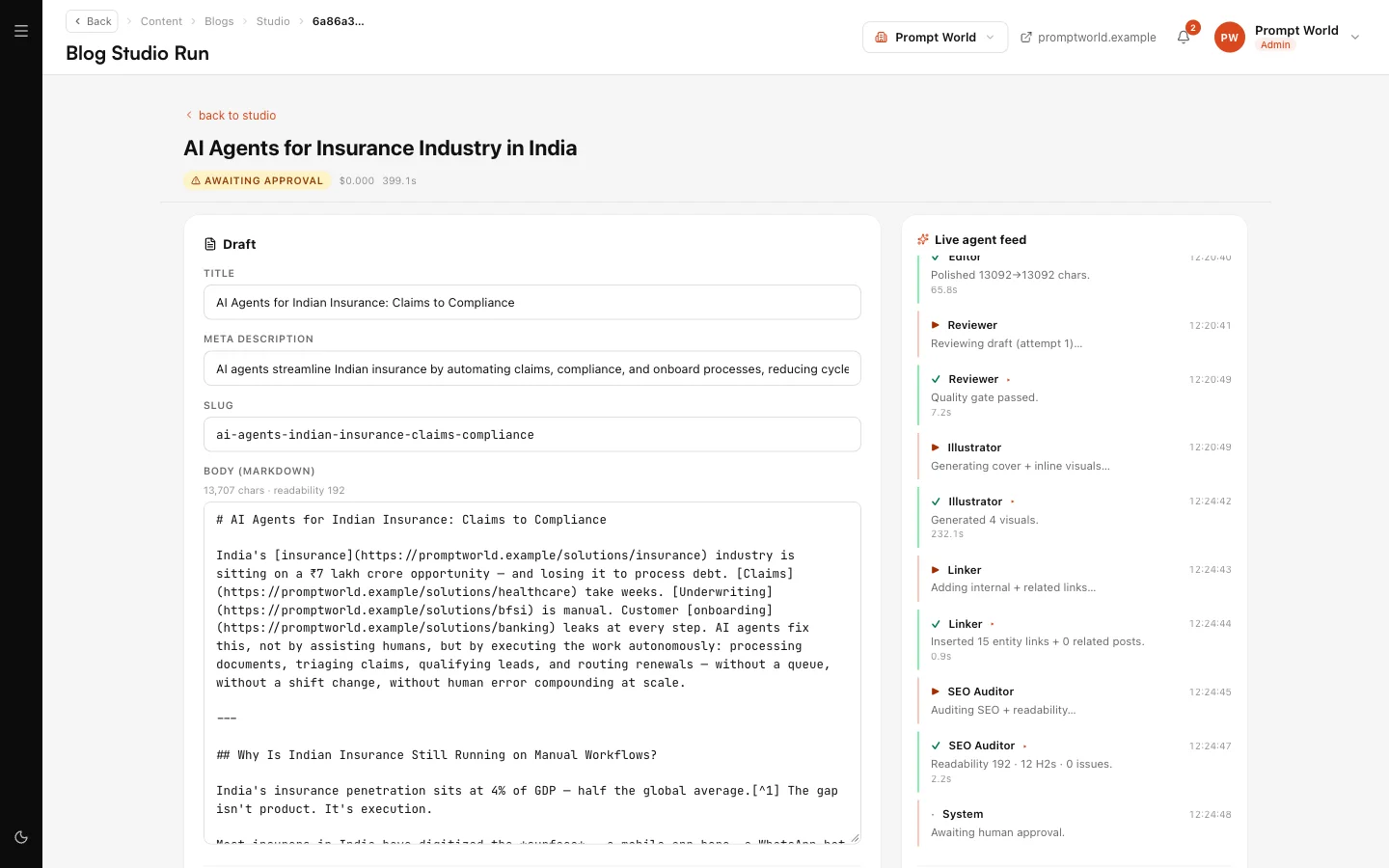
An enterprise AI content authoring platform for pharma drafts promotional, medical and disease-awareness content from approved sources only, carries a reference for every claim into medical-legal-regulatory (MLR) review, respects banned phrases and mandatory statements, and records who approved what. It speeds up the first draft and the preparation for review. It does not replace MLR. This guide covers what such a platform must do, where AI should stop, how to evaluate one, and how Nagent works for pharma teams.
What is an AI content authoring platform for pharma?
It is software that uses AI to write the first drafts of the content a pharma or life sciences company produces: disease-awareness pages, healthcare professional (HCP) emails, patient materials, sales aids, long-form documents and the variants each market and channel needs. An enterprise platform adds what a regulated company can't do without: control over which sources the AI may draw on, a review step that a person owns, and a record of every decision.
The goal is not more content. It's getting accurate, approved content through review faster, with fewer rounds of rework.
Why is pharma content authoring different?
Most marketing teams can publish a draft once it reads well. Pharma teams can't, for reasons that shape every requirement below:
Every claim needs a reference. Efficacy and safety statements must trace to the label, a study or another approved source.
Balance is a rule, not a style choice. In the US, the FDA's Office of Prescription Drug Promotion expects promotion to present a fair balance between effectiveness and risk information, and other markets have their own codes.
MLR review is the gate. Medical, legal and regulatory reviewers approve each piece before it reaches patients or professionals.
Audiences are separate. What you can say to an HCP differs from what you can say to a patient.
Content goes stale. A label update or new safety information can make approved content wrong overnight.
An AI tool built for general marketing ignores all of this. It writes fluent copy from whatever it knows, which in pharma is the problem, not the solution.
What should an enterprise pharma AI authoring platform do?
Use this as a requirements list:
Ground every draft in approved sources. The AI should write from your label, approved claims, references and brand guidelines, and say so when it has nothing on a topic rather than filling the gap.
Keep claims traceable. Each statement in a draft should point back to where it came from, so reviewers check sources instead of hunting for them.
Enforce banned phrases and mandatory statements. Prohibited claims and required wording from your guidelines should travel with every draft as rules, not suggestions.
Put a person at the gate. Nothing should publish or leave the system without a named person approving it.
Learn from review. Reviewer feedback should send a draft back with notes, and the next draft should reflect them.
Record everything. Who drafted, who reviewed, who approved and why, kept in an audit trail you can show an auditor.
Work with your MLR system. The platform prepares drafts; your existing review system, such as Veeva PromoMats, stays the system of record for approval.
Meet enterprise security. Tenant isolation, role-based access, data residency options and the certifications your procurement team asks for.
Where should AI help, and where must it stop?
Task: First drafts, What AI does: Writes from approved sources, in your voice, What stays with people: Deciding what the piece should say
Task: Variants, What AI does: Adapts approved content for channel, audience and length, What stays with people: Approving each variant for its market
Task: Review prep, What AI does: Lists the source behind each claim and flags gaps, What stays with people: Judging whether a claim is supported
Task: Disease-awareness and search content, What AI does: Structures approved content so search and answer engines can read it, What stays with people: Medical accuracy and fair balance
Task: Updates, What AI does: Finds content affected by a source change, What stays with people: Deciding what to withdraw or revise
Some things should never be handed to AI: approving claims, medical judgement, decisions on adverse events and anything that edges toward off-label promotion. A platform that blurs these lines is a risk, however fast it writes.
How do you evaluate a pharma AI content authoring platform?
Ask every vendor these questions and ask to see the answer working, not described:
Where does the AI get its facts? Can you limit it to your approved sources, and what does it do when they don't cover a topic?
How are prohibited claims handled? Are they enforced on every draft, or left to the reviewer to catch?
Who can publish? Can anything leave the system without a named person approving it?
What is recorded? Can you show who approved a piece, when, and any reason given for overriding a check?
How does it fit your MLR process? Does it replace your review system, or prepare work for it?
What is the security posture? Which certifications are held and which are in progress, where is data hosted, and is a private deployment available?
Be wary of any platform that claims to automate MLR approval or promises compliance on its own. Compliance comes from the content and the review, not from the tool.
How does Nagent fit pharma content authoring?
Nagent is multiplayer AI for growth: people and AI agents in one shared context, delivering the number. For pharma teams, content is led by CREA, the AI Content Chief of Staff, whose team researches, drafts, edits, reviews and links each piece, then stops and waits for a person. Here's how it maps to the requirements above:
Grounded drafts. CREA's team writes from your Knowledge Hub, including your products and services and the passages that match the topic, and from your brand book. If the Knowledge Hub has nothing on a topic, the draft is written without it rather than inventing detail. You add approved material by pasting text, giving a URL or uploading a file.
Your guidelines outrank everything. Upload your brand guideline document and it outranks anything read from your website. FOLIO, the long-form publications lead for PDF and DOCX documents, carries the banned claims and mandatory statements from your guidelines into every draft as prohibitions, not style notes.
A person at the gate. Nothing goes live until a person approves it. A reviewer can send a draft back with feedback, and the team runs it again.
Checks before publishing. The team's reviewer reads every post first. If it advises against publishing, a person must type a reason to publish anyway, and that reason is recorded with the post.
A record of every move. Every change to what an agent may do is recorded with who made it and why, in the audit log.
Security. Nagent is ISO/IEC 27001:2022 certified by InterCert, with SOC 2 Type II underway. Tenant isolation, role-based access, append-only audit and private VPC are available today. HIPAA is in process, and a BAA is available for healthcare customers.
Nagent is not an MLR system and does not handle adverse event reporting. Its drafts go into your existing review process, and your reviewers keep the decision. The pharma and healthcare page shows how the rest of the growth org works for pharma teams, including answer engine visibility for condition questions with DRIS.
How do you start with AI content authoring in pharma?
Start small and measure:
Pick one content type. Disease-awareness articles or HCP email variants are good first choices: high volume, clear sources.
Load approved sources first. Label text, approved claims, references and brand guidelines, before any drafting.
Run drafts through your normal MLR process. Don't create a side door.
Measure two numbers. Review cycle time and how often a draft passes review on its first round.
Expand only when both improve. Then add the next content type.
Frequently Asked Questions
Can AI write pharma promotional content?
AI can write the first draft, from approved sources, in your voice. It can't approve it. Every piece still goes through medical, legal and regulatory review, and reviewers decide whether each claim is supported and balanced.
Does an AI content authoring platform replace MLR review?
No. A good platform prepares work for MLR review so reviewers spend less time on rework. Your review system stays the system of record, and approval stays with your reviewers.
Is AI-generated pharma content compliant?
Compliance depends on the content and the review, not the tool. A platform helps by limiting the AI to approved sources, enforcing banned claims and mandatory statements, and keeping a record of every approval.
What should a pharma AI platform draw its facts from?
Only your approved material: label text, approved claims, references and brand guidelines. When those don't cover a topic, the platform should leave the gap for a person rather than fill it from general knowledge.
See AI content authoring built for review
An enterprise pharma AI content authoring platform earns its place by being strict: approved sources only, banned claims enforced, a person at the gate and every decision recorded. See how CREA's team and the rest of Nagent's growth org work for pharma.
Book a demo to see it on your own content.