
Echo, Nagent's AI reputation coworker
Beta. Echo listens where your customers and employees leave reviews, opens a case when something needs a response, and checks what answer engines say about your company against facts a person approved.

What Echo does, in the team room and on the surfaces your team uses
The Marketing team room
A team room is one conversation that a department's people and its AI teammates share. Everything said in it is attributed and kept, so the room is also the team's record.
Address an agent by name and it answers in the thread. A message addressed to nobody goes to the team lead.
An instruction becomes a task on the team board only when a person confirms it.
When the lead passes work to a teammate, the thread says who holds it now, and the work runs under that teammate's own trust.
An action that needs approval waits in the thread as a card. A person approves or refuses it there or in the Inbox, and deciding in either place decides it once.
Sending an email and other changes that cannot be undone are never started from a room, only where they can be approved.
In a workspace with the Marketing team, Echo has a seat in its room, which MIRA leads, and MIRA's instructions name Echo as the owner of reputation. Echo's six seats are not in the room; they report to Echo.
Addressed by name in the room, Echo answers from the team record with citations, or says the record does not hold the answer.
Reading sources and sampling answer engines are not started from the room: they run from Echo's own surface and on an hourly and a weekly schedule. Reply drafts wait on Echo's Approvals, not as a card in the thread.
Talking to Echo on its own surface is Coming soon.
What sets Echo apart
- 01
Multiplayer
Several AI agents and the team's people work on one shared context: the room's thread, the documents pinned to it and the team record.
Echo sits in the Marketing room with MIRA and the team's people, and works through six seats that flag what matters to it and post a weekly digest. A person can take a case over from Echo and hand it back, and the case shows who holds it.
- 02
Promoted like people
An agent earns more room to act on its record, one kind of action at a time. Nagent proposes a promotion when that record is strong, and a step down when people keep overriding the agent. Destructive changes always wait for a person.
Echo's work is not scored for promotion yet, so Nagent proposes no raise from its record. A person sets how much Echo and each of its seats may do alone, and every change is written to the audit log with who made it and what it was before and after.
- 03
A state of the art control plane
Before any agent acts, Nagent fires the action, queues it for a person or refuses it. Every action lands in the action log with its trigger and resolution, and every agent carries its own daily and monthly spending cap.
Every Echo action is declared with a note on what it may touch, and none of them publishes anything or sends a reply. A daily budget stops answer engine samples with a message, paid public reads stay inside a monthly cap, each seat carries its own daily and monthly cap, and a paused or switched off seat cannot act.
- 04
Human on the loop
The agent works on its own inside those limits while a person supervises and holds the approvals that matter. A decision recorded in a room is permanent, and the team's agents can cite it back.
The seats read, triage, flag and draft on their own on an hourly pass, and a named person approves the exact words of a reply and posts it by hand. Answer checks are grounded in facts your people approved. A reason given for sending a draft back is carried into the next draft, and a dismissed listing link is never proposed again.
- 05
Truth set by your people.
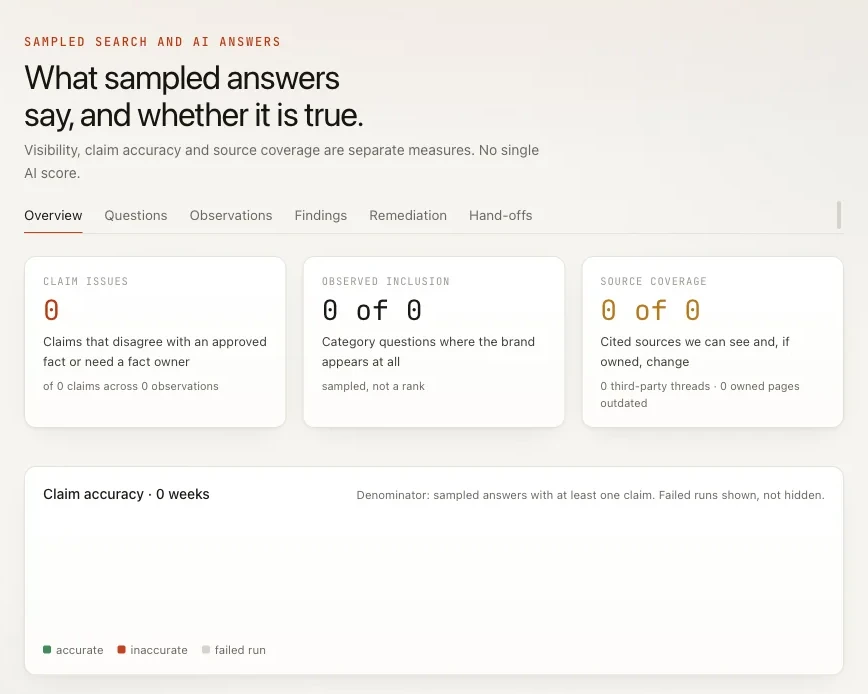
A claim is judged only against facts a person in the workspace approved, each with a version, an owner and an expiry. Claim issues, observed inclusion and source coverage stay separate, with no single AI score.
- 06
Sensitive reviews go to a person.
A review about safety, health, discrimination, harassment, a legal threat or a child's wellbeing is graded sensitive. No seat drafts its reply: the designated reviewer writes it, and its words are kept out of the seats' triage brief.
- 07
A seat for each platform.
Each platform group has its own seat and each platform its own skill. Every read checks the page still names the business, the marketplace seat says when a platform allows no public reply instead of drafting one, and the employer seat never guesses who wrote a review.
Echo's surfaces
Check what answer engines say.
Echo samples each buyer question on up to three answer engines, pulls out each claim and judges it accurate or inaccurate against the approved facts.
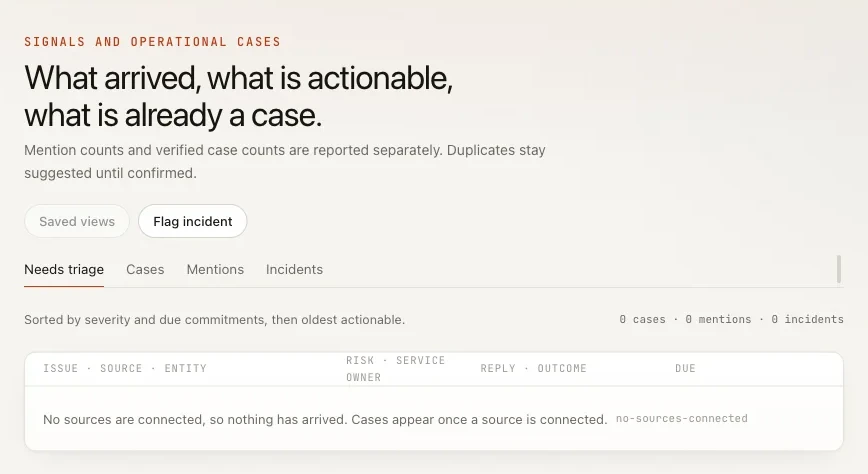
Cases with an owner.
A case carries an issue, risk, owner, reply state and due time, and a person can take it over from Echo and hand it back.
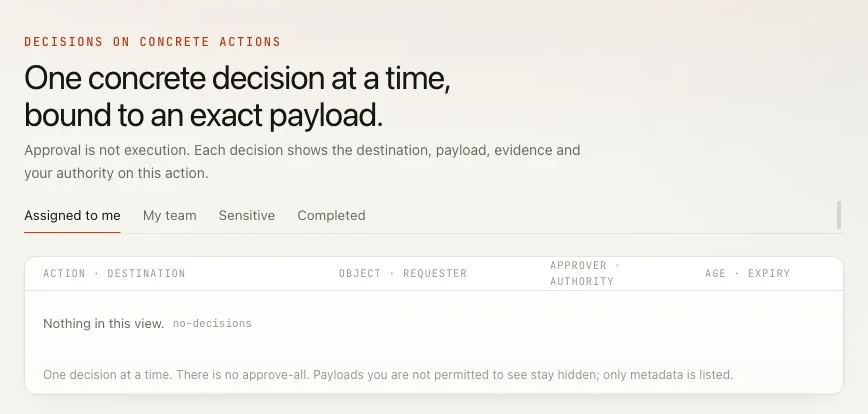
Nothing posted by Echo.
Reply drafts wait for a named approver, and a person posts the words. Public replies are decided one at a time, with no approve-all.
Write down the facts.
A person adds approved facts about the company, its offer and its prices, and edits or expires them as they change.
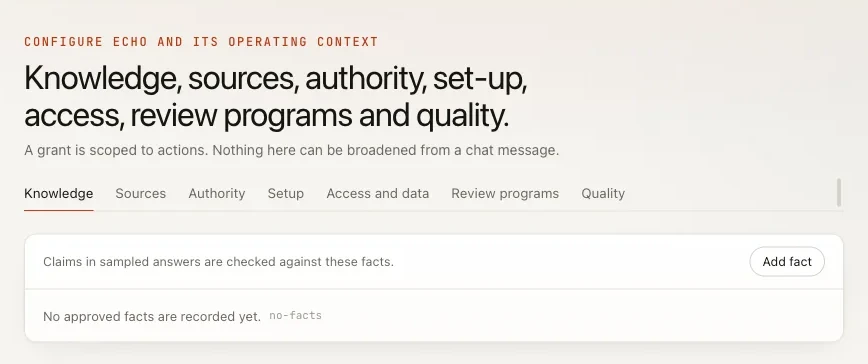
Surfaces from a demo workspace. Figures are not customer results.
How Echo works
- 01
Write down the facts.
A person adds approved facts about the company, its offer and its prices, and edits or expires them as they change.
- 02
Add the sources.
Connect Google Business Profile, or add the pages where the business is listed; each source is read by the seat that owns its platform. Serious negative reviews open cases.
- 03
Cases with an owner.
A case carries an issue, risk, owner, reply state and due time, and a person can take it over from Echo and hand it back.
- 04
Check what answer engines say.
Echo samples each buyer question on up to three answer engines, pulls out each claim and judges it accurate or inaccurate against the approved facts.
- 05
Work the findings.
A claim an answer gets wrong or disputes becomes a finding with a severity. A person sets its owner and what is done about it, and a finding never closes itself.
Where Echo sits
- Reports to
- MIRA, chief of staff for Marketing
- Status
- Beta
Listening seats, six, under Echo
- LOCAL, Local Reviews
Watches Google, Justdial, Yelp, Tripadvisor and the local review sites the business is listed on, triages what matters, drafts replies for approval and sends Echo a weekly digest.
- REVIEWS, Review Sites
Watches G2, Capterra, Trustpilot, Clutch and MouthShut, triages what matters, drafts replies for approval and sends Echo a weekly digest.
- APPS, App Reviews
Watches App Store and Google Play reviews, triages what matters, drafts developer replies for approval and sends Echo a weekly digest.
- SHOP, Marketplace Reviews
Watches product reviews on Amazon, Flipkart, Myntra, Nykaa, Meesho and the business's own store, triages what matters and sends Echo a weekly digest.
- EMPLOYER, Employer Reviews
Watches Glassdoor, AmbitionBox and Indeed, keeps employee reviews to the rules for them, triages what matters and sends Echo a weekly digest.
- SOCIAL, Social and Web
Watches the Reddit threads, X posts, YouTube videos, news and web pages a person added, triages what matters and sends Echo a weekly digest.
The six seats ship with Echo to every workspace and share its Beta.
What Echo works with
Skills
- Reputation Team Lead
How Echo rolls up its six seats: priorities, routing to people, and what to do with flags and digests.
- Reputation Triage
What counts as serious in a review or mention, how to cluster it, and the rules for employee reviews.
- Reply Craft
How a seat drafts a reply for approval: grounded, short, in the brand's voice, within what the platform allows.
- Listing Finder
How a seat finds the business's own pages on its platforms and proposes them with evidence.
- Weekly Digest
How a seat writes its weekly digest from numbers code computed.
- One skill per platform
22 more, such as Google Reviews, App Store Reviews and Glassdoor Reviews: how a seat reads, judges and drafts replies on that platform.
Tools
- Read a connected source
New and changed Google reviews for the Business Profile locations you select, read into cases and mentions.
- Sample what AI assistants say
Asks up to three answer engines a tracked question and checks each claim against the approved facts.
- Read public sources
Reads the public pages a person added, checks each still names the business, and grades what is new.
- List my due sources
A seat lists the sources it owns and which are due a read.
- Read one of my sources
A seat reads one source it owns; a source another seat owns is refused.
- Propose a listing link
A link to the business's page, with its evidence, that waits for a person to accept or dismiss it.
- Draft a reply
A reply draft for a named person to approve. It never sends.
- Flag to Echo
A mention, case or source flagged to Echo with a note and a suggested action.
- Post the weekly digest
A seat's weekly digest: the numbers come from code, the seat writes the words.
Signals
- Approved facts
The yardstick for every claim check, each with a version, an owner and an expiry.
- Buyer questions
The questions sampled on up to three answer engines, at most 12 samples a question each week.
- Reviews and mentions
Graded by severity as they land. A serious negative review opens a case and gives the seat that owns it a turn.
- Source health
A source that fails twice in a row gives its seat a turn.
- Seat numbers
Each seat's week, counted in code, for its weekly digest.
- Send-back reasons
A person's reason for sending a draft back, carried into the next draft.
Integrations
- Google Business Profile
Connected by the workspace, so Echo can read the reviews on the locations you select. Every other source is a public link a person adds.
What Echo does on its own, and what waits for a person
Every seat's write is a proposal, draft, flag or digest inside Echo.
A reply is a draft for a named approver. Echo has no send path for it; a person posts the approved words by hand.
Public replies are decided one at a time, with no approve-all.
Usage shows as counts inside a daily budget that stops Echo with a message when spent; each question has a weekly allowance of 12 samples.
Before any agent acts, Nagent fires the action, queues it for a person or refuses it.
How Echo is governed
Your facts, approved by your people.
Without approved facts Echo has nothing to judge against.
No single AI score.
Claim issues, observed inclusion and source coverage stay separate, because being absent from an answer and being misdescribed in one are different jobs.
Nothing posted by Echo.
Reply drafts wait for a named approver, and a person posts the words.
On the record, in your workspace.
Every agent action lands in the action log with its resolution, and listening is scoped by the tenancy guard.
How Echo compares, and where to read more.
Questions about Echo
What is Echo?
Echo is Nagent's reputation coworker, an AI teammate on the Marketing team that reports to MIRA and is in Beta. Six listening seats watch local listings, review sites, app stores, marketplaces, employer sites and the social threads a person adds. Echo also checks what answer engines say about the company against facts a person approved.
Does Echo reply to reviews?
Echo's seats draft replies for a named approver, and the draft lands on Approvals. Echo has no send path for it: a person posts the approved words by hand. Replies are decided one at a time, with no approve-all, so every public word is one a named person chose.
Which review sites can Echo read?
Google, Justdial, Yelp and Tripadvisor; G2, Capterra, Trustpilot, Clutch and MouthShut; App Store and Google Play; Amazon, Flipkart, Myntra, Nykaa, Meesho and your own store; Glassdoor, AmbitionBox and Indeed; and the Reddit, X, YouTube, news and web pages a person adds. Each platform group has its own listening seat.
How does Echo know an AI answer is wrong?
It compares each claim with facts a person in the workspace approved. Echo pulls the claims out of each answer and judges each accurate or inaccurate against those facts. A claim is accurate only if it matches an approved fact, so the record of truth stays with the business. Without facts it has nothing to judge against.
Can Echo change what an answer engine says about us?
No. Echo finds the claims an answer gets wrong or disputes against your approved facts and turns each into a finding with a severity. A person sets its owner and what is done about it, and a finding never closes itself. Presence in answers and accuracy of answers stay separate measures, with no single AI score.
How many answer engine checks can we run?
Up to 12 samples per question per week, where one sample is one engine's answer. Echo works inside a daily budget that stops it with a message when it is spent, and usage shows as counts. Every agent on Nagent also carries a daily and a monthly spending cap.
How much does Echo cost?
Echo works on the Marketing team. Nagent plans are Solo at $29.99 a month ($19.99 billed annually), Team at $299 a month ($199 billed annually) and Business at $1,499 a month ($999 billed annually). Enterprise is by quote. The pricing page shows which teams each plan includes.