
Echo, the reputation coworker
How Echo reads your Google Business reviews into cases, samples what answer engines say about you and checks each claim against your approved facts, and what still waits on a person.
Browse documentation
Echo turns what people and AI say about you into work
Echo is the reputation coworker, and reports to MIRA. It watches the sources you authorise, opens a case when something needs a response, and checks what AI assistants say about your company against facts you have approved. When a fix belongs to another teammate, such as a page DRIS should improve, Echo hands it to them.
Echo is in Beta for every workspace. The pill beside the breadcrumb says so, and its note lists what is still to come: "Coming soon: approving and sending, listening connectors and asking Echo in the app." Today Echo reads, checks and drafts. It drafts a reply to a review or a mention when you ask it to, and a person approves the exact words, sends them back or rejects them on Review. Echo never posts: once a reply is approved, you copy it and post it on the platform yourself.
Open it from the sidebar under Echo, or go to nagent.ai/admin/echo.
Adding Echo after sign-up
Echo arrives when you take Marketing whole at sign-up. A workspace that ticked single leads, or chose only Sales or Content, does not have Echo until someone adds it.
- Open Welcome and choose Add a team, then Choose a prebuilt team.
- On the Marketing card, under Or add one lead, press Add Echo. The button reads Seating while it runs. Adding a team needs the settings write permission, which an Organisation admin holds.
What arrives:
- A room called Echo team, with Echo and its six seats: LOCAL, REVIEWS, APPS, SHOP, EMPLOYER and SOCIAL, one for each kind of place you are reviewed. Its charter line reads "Echo and the reputation seats watch what is said about the workspace and answer it", and it works inside the Marketing room, led by MIRA.
- A seat for Echo in the Marketing room. If your workspace has no Marketing room yet, one is made with MIRA and Echo in it.
- Five workflows in the room: Reputation scan, What AI assistants say about you, Review reply drafts, Reputation against competitors and Weekly mentions digest. Each can be started from the room at once; its schedule arrives switched off, and Keep running on the card switches it on.
- Echo's screens in the sidebar, under Echo.
See prebuilt teams for what else a lead brings.
The screens
The rail down the left holds eight screens, in this order.
| Screen | What it is for |
|---|---|
| Today | What is active, what needs a person, what has been verified |
| Missions | Sustained work Echo is running toward an objective |
| Inbox | What arrived: triage, cases, mentions and incidents |
| Review | Decisions waiting on a named person |
| AI answers | What answer engines say, and whether it is right |
| Results | Service, themes and usage counts |
| Team | Who Echo works with, and the digest for MIRA |
| Settings | Facts, sources, authority and set-up |
A panel on the right, Echo activity, shows Echo's current objective, task, next check and next action, so you can see what it is doing without asking.
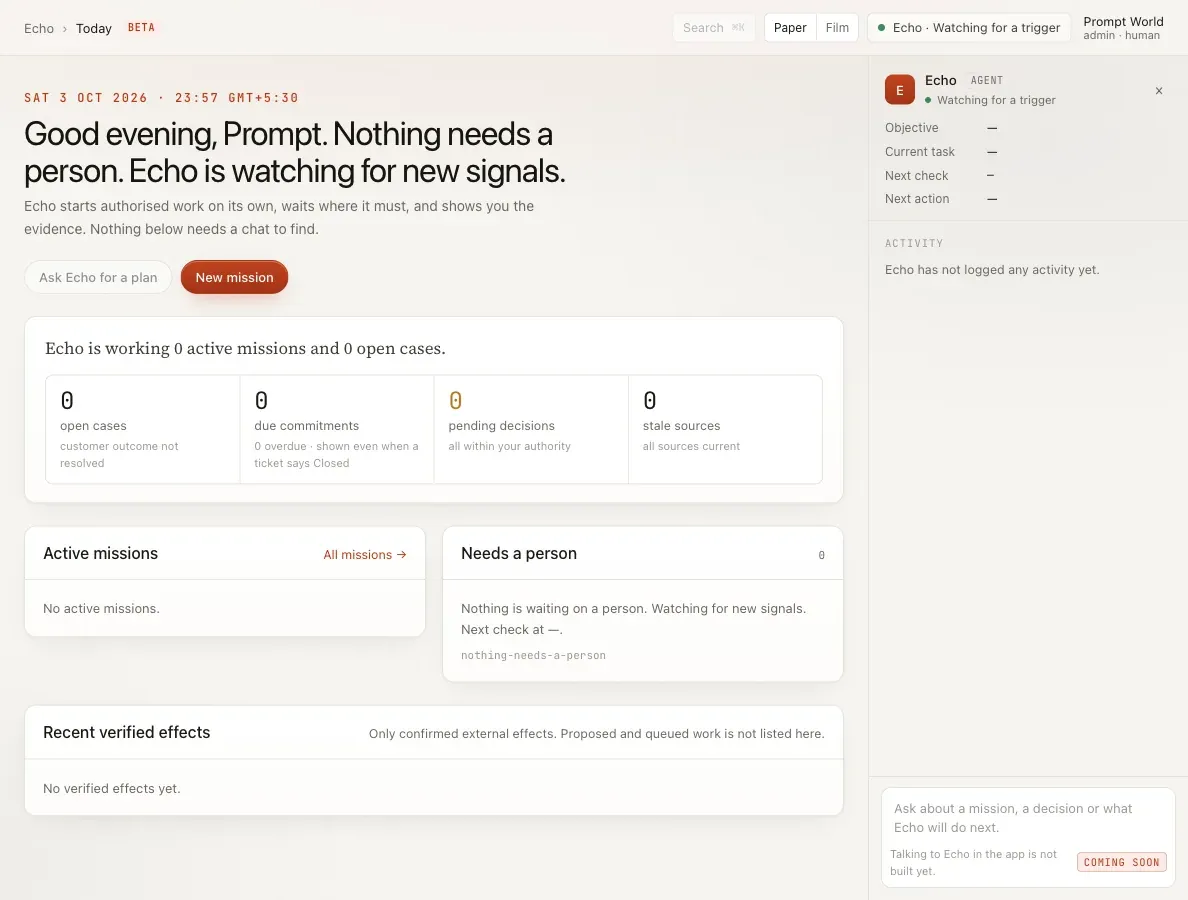
Set Echo up in Settings
Start in Settings. The Knowledge and Sources tabs matter on day one.
1. Write down the facts Echo checks against
The Knowledge tab holds your approved facts: what is true about your company, your offer and your prices. Click Add fact for each one. You can Edit a fact or Expire it when it stops being true.
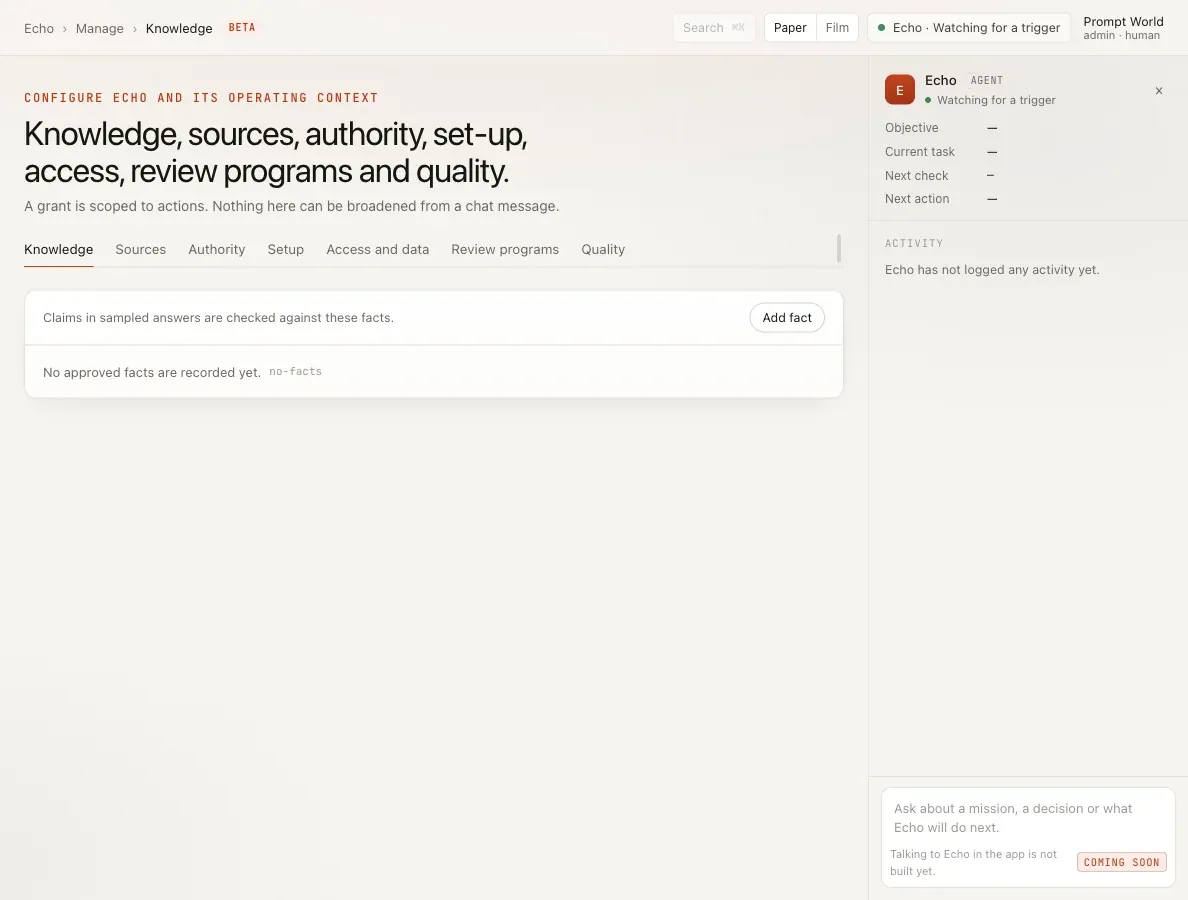
These facts are what Echo judges every AI answer against. For Prompt World, facts might be "Workshops run in English, in person or online" and "Workshops are for marketing and sales teams, not individuals".
Our logic: Echo never decides on its own what is true about you. A claim is accurate only if it matches a fact a person in your workspace approved.
2. Connect Google Business Profile
On the Sources tab, click Connect Google Business Profile and sign in with the Google account that manages your listing. Then Choose the locations Echo reads and click Connect selected. You need permission to manage integrations to do this.
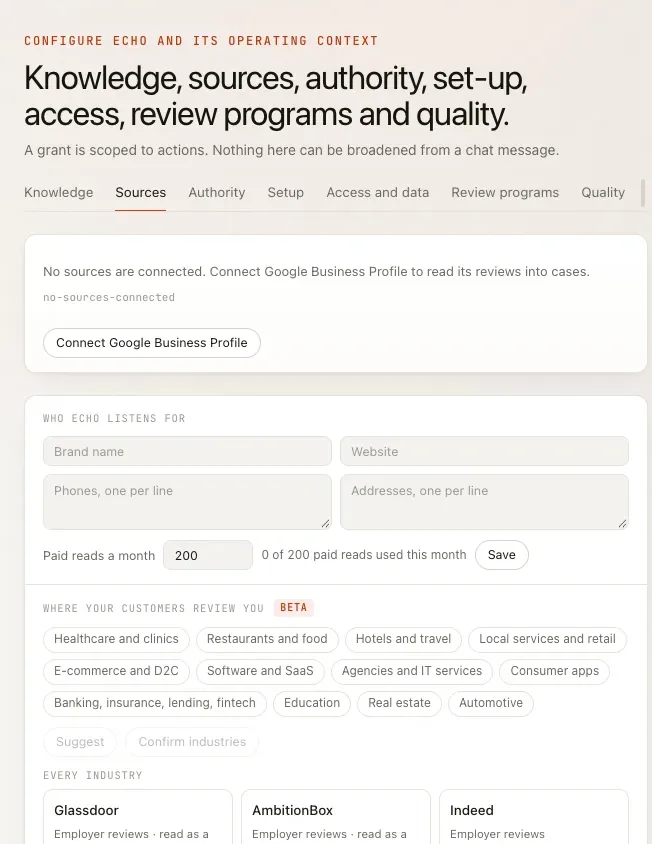
Once connected, the source card offers Fetch now to read reviews immediately, View affected work and Disconnect. Echo reads up to 500 reviews per location; older ones are not read.
The Google connection reads reviews only. Echo drafts a reply for you to approve, and you post it on Google yourself; Echo never posts through the connection.
3. Tell Echo who it listens for
Lower on the Sources tab, Who Echo listens for takes your Brand name, Website, phones and addresses, one per line. Click Save. Echo needs the brand name and a website, phone or address before it can add any other source. If your workspace has no Echo programme yet, saving this starts one.
Paid reads a month caps the reads that cost money, 200 by default. The line beside it counts them: "0 of 200 paid reads used this month". When the cap is reached, paid reads resume the next month; free reads carry on.
4. Add the sites where customers review you
Where your customers review you is marked Beta. Pick your industries and click Confirm industries, or click Suggest. The cards below list review sites for every industry, then more sites, such as employer review sites, Reddit, YouTube, local review sites and software review sites. A card marked "read as a page" is read from its public web page.
On a card, Add my page opens Add a link: paste the public page, optionally name the product, app or branch it is about, and click Check and add. Echo checks the page names your business before it saves it. It reads public pages only and never logs in. Find it for me asks one of Echo's seats to search the public web and propose links under Proposed pages, where you Accept and read or Dismiss each one. Nothing is added until you accept it. A site that is not listed can be added under A site that is not listed.
Each source you add shows when it was last read, its rating and its mentions in the last 30 days, with Read now and a pause button.
If your workspace runs DRIS, it proposes the review pages AI engines cite for you. Each waits under Proposed pages on Sources, with DRIS's evidence, until someone accepts or dismisses it, and Sources says which of your sources AI engines cited in the last 28 days.
Reviews become cases in the Inbox
Reviews Echo reads arrive in the Inbox: "What arrived, what is actionable, what is already a case." The tabs are Needs triage, Cases, Mentions and Incidents.
A case lists the issue and source, its risk and owner, the reply state and when it is due. Open one to see Overview, Evidence, Response, Resolution and Activity.
On a case you can:
- Draft a reply. The seat that owns the source writes a reply of up to 1,500 characters, grounded in your approved facts, and the case's reply state turns to Draft: "Draft in progress. Nothing is published until it is approved." The draft lands on Review and on the case's Response tab. One draft is open per review; asking again replaces it. A case marked Sensitive is not drafted, and nor is one whose reply is already posted or approved and waiting to be posted. After a draft is sent back, the button reads Draft again.
- Take over from Echo, and later Return to coworker.
- Add completion evidence and Record customer confirmation once the issue is resolved.
A mention on the Mentions tab has its own Draft a reply. Closing a case with a disposition is not available yet. The other mention actions (create a case from a mention, confirm a link, mark it non-actionable) are shown but not yet active. If nothing is connected, the Inbox says so: "No sources are connected, so nothing has arrived."
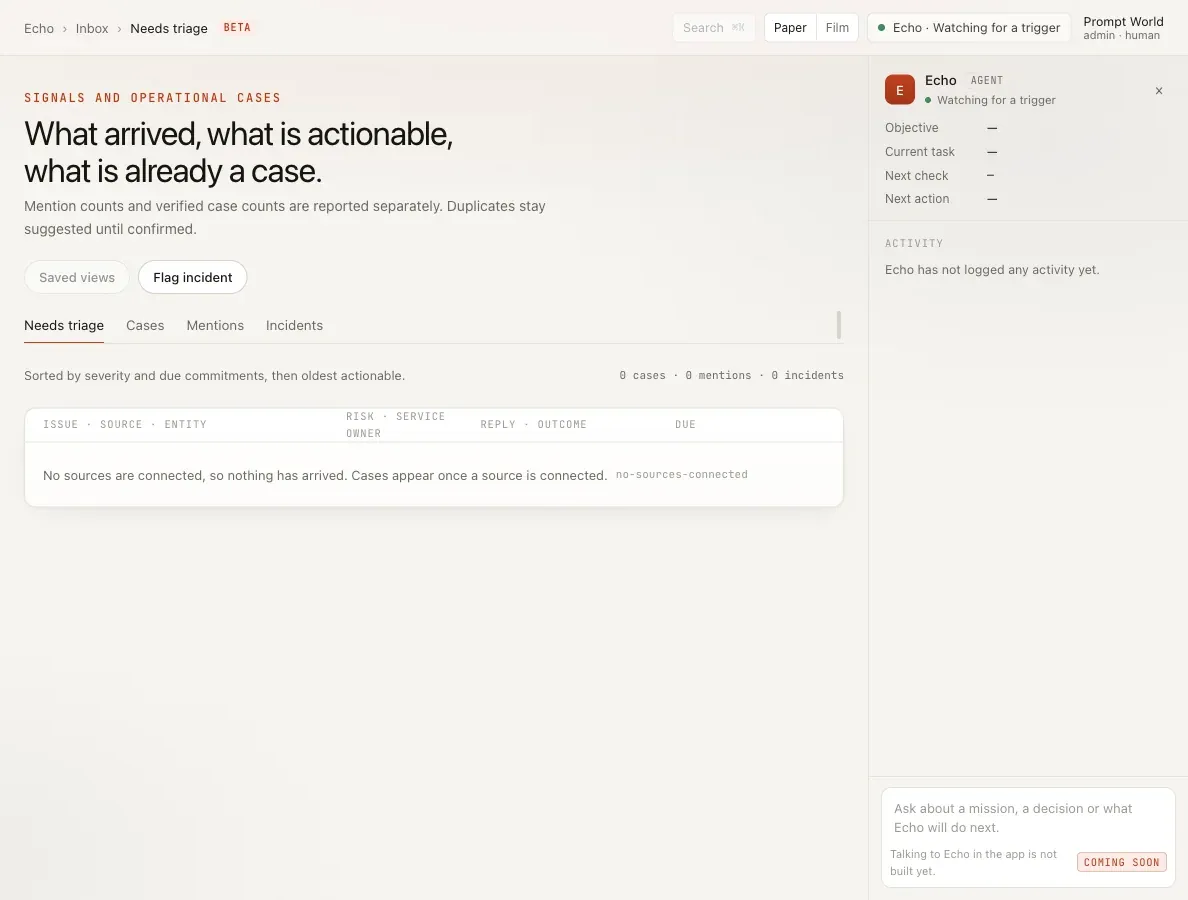
You can also Flag incident for something that needs urgent handling.
What answer engines say about you
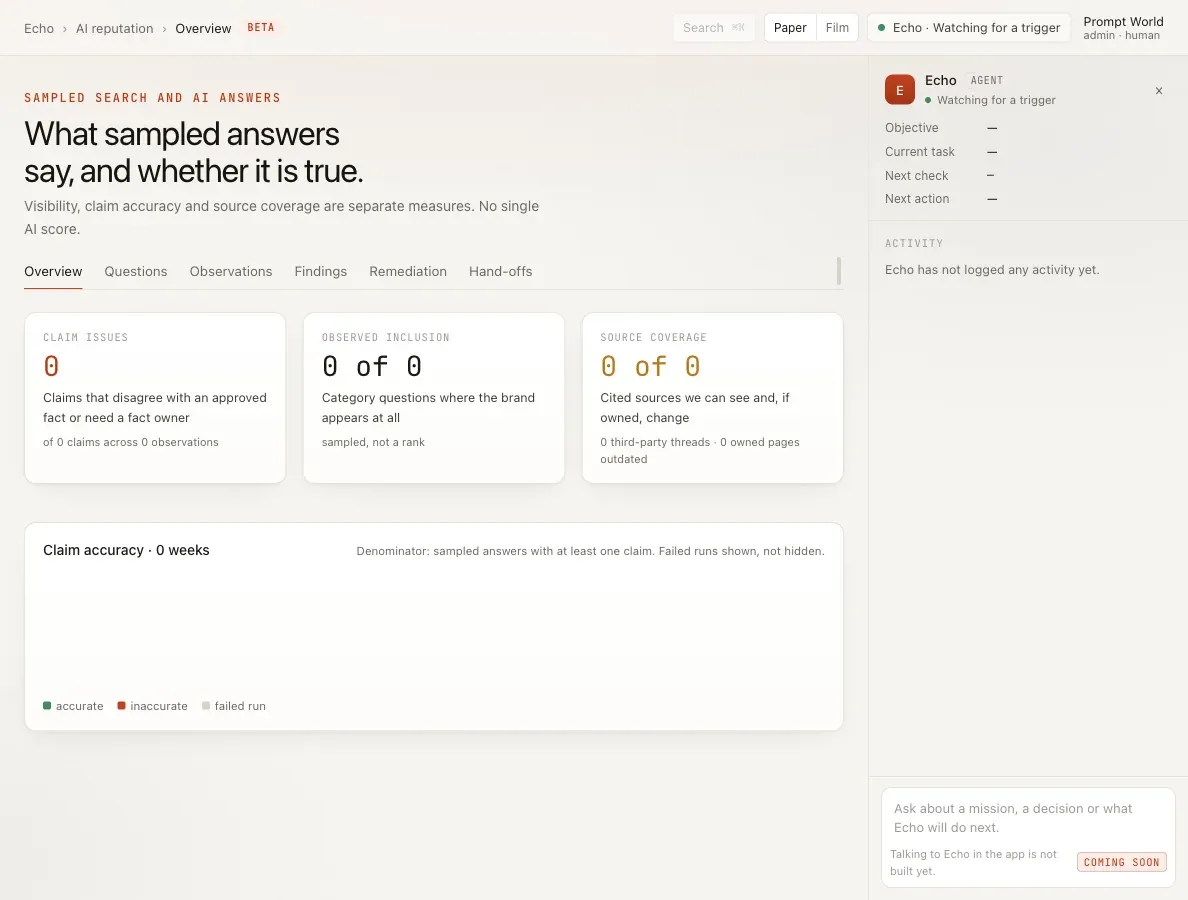
AI answers is where Echo asks AI assistants the questions your buyers ask, and checks the answers. Its own subtitle sets the rule: "Visibility, claim accuracy and source coverage are separate measures. No single AI score."
1. Add the questions
On Questions, click Add question and write it as a buyer would. For Prompt World: "Who runs prompt engineering workshops for B2B marketing teams in Singapore?" Then click Run sample on one question or Run all.
Echo also samples every question once a week, on Mondays.
2. Read the answers
Each run asks up to three answer engines and stores what they said under Observations. Open one to see the claims Echo pulled out of the answer and its verdict on each: accurate or inaccurate against your facts.
From an observation you can Create finding, Request fact review, Add to remediation or Compare observations.
3. Work the findings
Findings lists what is wrong or missing, with a state, an owner and a severity you can set and Save. Remediation and Hand-offs show work Echo has passed to other teammates.
The Overview tab shows three separate cards, Claim issues, Observed inclusion and Source coverage, and a weekly Claim accuracy chart.
What it costs
Echo shows counts, never prices. Each question has a weekly allowance of 12 samples, and one sample is one engine's answer, so a run across three engines uses three. The run button tells you what is left: "Runs on up to 3 engines · X of 12 samples left this week". The allowance resets on Monday.
Every read and every sample also counts against Echo's daily budget. When it is spent, Echo stops and says so: "Echo has reached its budget for today." Reads resume when the budget resets.
What asks for approval
Reading a connected source and sampling an answer engine are read-only, and both run on their own: neither waits for an approval.
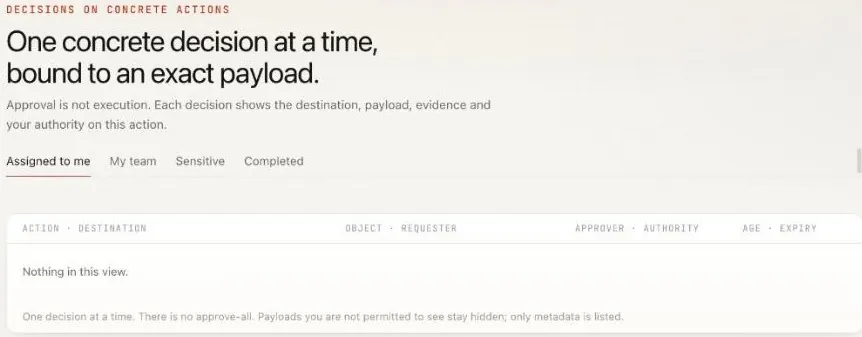
A reply draft always waits for a person. It appears on Echo's own Review screen, whose rule is printed at the foot: "One decision at a time. There is no approve-all." Open a draft to see the exact words, the review it answers, the checks and the facts it rests on. Then decide:
- Approve this exact version records your decision. The note beside it says what that means: "Approval records your decision. Echo never posts; you copy the reply and post it." The buttons Copy reply and Mark posted then appear: post the words on the platform yourself and mark them posted, and the case records who posted it and when.
- Request changes asks for a reason, which goes back with the draft. Press Draft again on the case for a new version.
- Reject closes the draft.
Anyone with permission to change Echo can decide a draft. The approval holds the exact words that were read: a new draft takes a new reference and needs its own approval, and an older draft's decision never moves a case whose reply is already posted. Until a draft is posted and marked posted, no new draft is written for that review.
Asking Echo for the same things in its room or the Marketing room, to draft a reply, decide a draft or mark one posted, files a card for approval first, like every other Echo action asked for in a room. See the team room.
Our logic: anything Echo says in public speaks for your company. It always waits for a person, and that person approves the exact version that goes out, never a summary of it. Echo does not post because the platforms it reads give it no safe way to, and a reply posted by a person is one a person has read.
Limits today
- Reads and checks only: no replies are sent.
- Google Business Profile must be granted API access by Google before reviews flow; until then a fetch may report that Google is rate limiting reads. Review sites and web pages added under Where your customers review you are in Beta.
- Talking to Echo in the app is not built: the composer reads "Talking to Echo in the app is not built yet." Ask Echo for a plan, New mission and Redirect are marked Coming soon.
- Missions, incidents, insights and the MIRA digest stay empty on a live workspace until those parts are built.
- Team, Results and the Setup, Authority, Access and data, Review programs and Quality tabs of Settings appear once Echo has a programme. Saving Who Echo listens for, adding a fact or connecting Google Business Profile starts one.
- Some disabled buttons carry an internal note such as "Approval runs from E4". Read it as Coming soon.
- Search inside Echo is Coming soon.
Where to go next
- DRIS, AI Visibility: improving how often answer engines include you, as distinct from whether they are right.
- MOXA: social media. Replies on your social channels are MOXA's.
- The Knowledge Hub: the wider source of truth your teammates draw on.