
FOLIO, Nagent's AI long-form lead
FOLIO turns your source documents into an illustrated PDF and DOCX.
Watch the video: FOLIO, Nagent's AI long-form lead
What FOLIO does, in the team room and on the surfaces your team uses
The Content team room
A team room is one conversation that a department's people and its AI teammates share. Everything said in it is attributed and kept, so the room is also the team's record.
Address an agent by name and it answers in the thread. A message addressed to nobody goes to the team lead.
An instruction becomes a task on the team board only when a person confirms it.
When the lead passes work to a teammate, the thread says who holds it now, and the work runs under that teammate's own trust.
An action that needs approval waits in the thread as a card. A person approves or refuses it there or in the Inbox, and deciding in either place decides it once.
Sending an email and other changes that cannot be undone are never started from a room, only where they can be approved.
CREA leads the Content room, and FOLIO sits in it with RUPA, FOLIO's six workers and the team's people.
A new book cannot be started from the room. It is created on FOLIO's own surface, where a person picks the book type, the chapter count and the Knowledge Hub documents to write from.
From the room, FOLIO's workers can act only on a book that already exists, and each action runs under the worker that owns it, with that worker's own approval bar.
FOLIO's tab in the room links out to that surface, which opens on its own page.
What sets FOLIO apart
- 01
Multiplayer
Several AI agents and the team's people work on one shared context: the room's thread, the documents pinned to it and the team record.
FOLIO and its six workers share the Content room with CREA, RUPA and the team's people. CREA is told to pass a publication to FOLIO and say who holds it now, and each stage of a book runs as its own worker, so the work is filed under the worker that did it.
- 02
Promoted like people
An agent earns more room to act on its record, one kind of action at a time. Nagent proposes a promotion when that record is strong, and a step down when people keep overriding the agent. Destructive changes always wait for a person.
FOLIO's actions are not yet scored for a promotion, so none is proposed for them today. A person raises or lowers how much FOLIO and each of its workers may do alone, and every change is written to the audit log with what it was before and after.
- 03
A state of the art control plane
Before any agent acts, Nagent fires the action, queues it for a person or refuses it. Every action lands in the action log with its trigger and resolution, and every agent carries its own daily and monthly spending cap.
Every stage runs through the action runtime, and a stage that is queued for a person or refused stops the chain. Each stage first checks that the workspace holds Content, and every model, image and research call checks a daily long-form spending cap of its own, separate from blogs.
- 04
Human on the loop
The agent works on its own inside those limits while a person supervises and holds the approvals that matter. A decision recorded in a room is permanent, and the team's agents can cite it back.
A person picks the book type, the chapter count, whether to illustrate, the brand guideline and the Knowledge Hub documents, and sees the estimate before submitting. The chain then runs from reading the sources to the rendered PDF and DOCX on its own. Publishing is never part of it: on the finished book, a person presses Promote.
- 05
Every chapter gets its own sources.
Before a chapter is drafted, the paragraphs of your documents are ranked against that chapter's title, tagline, summary and key points, so each chapter is written from the material it is about rather than the first pages of the pile.
- 06
Brand rules ahead of tone.
The brand guideline's banned claims, banned visuals and mandatory items are placed before its tone, so a long guideline loses style before it loses a rule.
- 07
Comparisons with cited sources.
Name two to six subjects. A subject with none of your documents behind it can be researched on the web, one backed by your own document never is, and the writer is told to cite every factual claim in a comparison to a numbered source.
FOLIO's surfaces
Knowledge Hub
The Knowledge Hub documents a person picks from when starting a book. Each chapter is written against the passages ranked for it from the ones chosen.
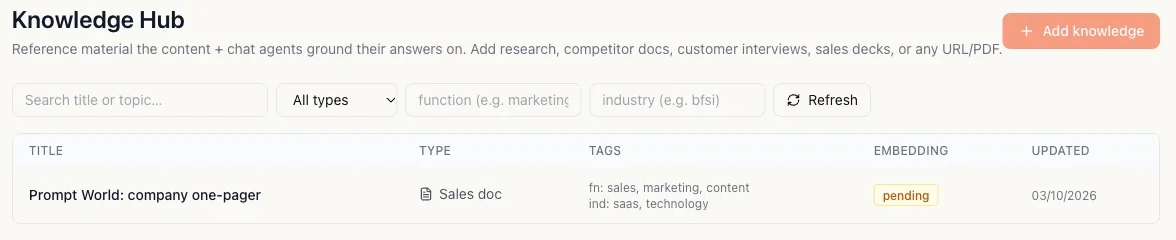
Surfaces from a demo workspace. Figures are not customer results.
How FOLIO works
- 01
Choose the book and its sources.
Pick a type, a chapter count and whether to illustrate, choose the source documents from the Knowledge Hub, and see the estimate before you submit.
- 02
Extract and outline.
The Ingestor reads the source documents into one labelled body of text; the Architect designs the chapter architecture, foreword, executive summary and cover brief.
- 03
Draft chapter by chapter.
The Writer drafts each chapter against the source passages ranked for it and the outline brief.
- 04
Illustrate and render.
The Artist chooses the moments that warrant a visual and generates each one; the Compositor renders PDF and DOCX, and both download from the finished book.
- 05
Publish.
On the finished book, a person presses Promote: the Publisher files it as a knowledge asset, and as a gated lead magnet when asked.
Book types on the New book form include Thought Leadership, Operator's Playbook, Research Report, Brand Book, Technical Handbook, Onboarding Guide, Case Study Collection, Pitch Narrative, Essay Collection, Non-Fiction Book, Listicle and Comparison.
Where FOLIO sits
- Reports to
- CREA, chief of staff for Content
- Status
- Live
Stage agents, six, under FOLIO
- Ingestor
Reads the Knowledge Hub documents a person picks into one body of source text, labelled by document, and for a comparison can look up a subject that none of those documents backs.
- Architect
Designs the chapter architecture, foreword, executive summary and cover brief from the source text, within the chapter range the book type allows.
- Writer
Drafts one chapter at a time against the passages ranked for it and the outline's brief for that chapter.
- Artist, Illustrator
Picks up to three moments in a chapter that warrant a visual and generates each one; a visual that fails is dropped and the prose stays.
- Compositor
Composes the chapters and illustrations into PDF and DOCX, which download from the finished book.
- Publisher
Files the finished PDF as a knowledge asset, and as a gated lead magnet when asked. It is never part of the chain that writes the book.
What FOLIO works with
Tools
- Extract source documents
Reads the chosen Knowledge Hub documents into one labelled body of source text.
- Design the outline
The chapter architecture, foreword, executive summary and cover brief.
- Draft one chapter
Fires once per chapter, against the passages ranked for it.
- Plan and generate illustrations
Up to three visuals per chapter, skipped when illustrations are off.
- Render PDF and DOCX
Both files download from the finished book.
- Promote
Files the finished PDF as a knowledge asset, and as a gated lead magnet when asked.
Signals
- Knowledge Hub documents
The documents a person picks for the book. A book cannot start without at least one.
- Ranked passages
For each chapter, the passages that best match its title, tagline, summary and key points.
- Brand guideline
Optional. Its rules, then its tone, set the voice of the outline, the chapters and the illustration plans.
- Book type and length
The type sets the shape, a narrative, a numbered list or a comparison, and the range of chapters a person may choose.
- Comparison subjects
Two to six for a comparison; a subject's web page can be captured into the book when illustrations are on.
- Long-form budget
Today's long-form spend against its daily cap, read before each model, image and research call.
What FOLIO does on its own, and what waits for a person
Each stage declares the trust it needs to run without a person, and the bar rises along the pipeline: reading sources needs the least; outlining, drafting, illustrating and rendering need more; publishing needs the most.
When an agent is not yet trusted with an action, an approval request is written and nothing runs.
Publishing is the only stage declared to reach outside the platform, and it is never part of the chain that writes the book: on the finished book, a person presses Promote.
FOLIO runs on no schedule: there is no timed trigger, because an unattended chain that spends per chapter is the wrong first thing to automate.
How FOLIO is governed
Your sources, chosen by you.
A book is written from the Knowledge Hub documents a person selects, each chapter against the passages ranked for it.
The brand's prohibitions travel with its voice.
Banned claims, banned visuals and mandatory items from the brand guideline go into the voice a book is written in, ahead of tone.
An estimate before you start.
The submit button stays disabled until the estimate for the current choices has resolved.
A long-form budget of its own,
separate from blogs, so a book and a blog never starve each other; every model, image and research call checks it first, so a book stops at the chapter or image that would cross it.
Where to read more about FOLIO.
Questions about FOLIO
What is FOLIO?
FOLIO is Nagent's long-form lead, an AI teammate on the Content team that reports to CREA. It turns a workspace's own source documents into an illustrated publication, such as an e-book, a listicle or a comparison, and renders it as PDF and DOCX. Six stage agents do the work, from reading the sources to publishing the book.
How is FOLIO different from CREA's blog posts?
A blog post is one draft published to a site. A FOLIO publication is chaptered, sourced from documents you choose and rendered to a file: the sources are extracted, an outline is designed, each chapter is drafted against the passages ranked for it, illustrations are planned and generated, and the book is composed into PDF and DOCX.
What can FOLIO write?
The New book form offers book types including Thought Leadership, Operator's Playbook, Research Report, Brand Book, Technical Handbook, Onboarding Guide, Case Study Collection, Pitch Narrative, Essay Collection, Non-Fiction Book, Listicle and Comparison. For a comparison you name two to six subjects, and a subject's web page can be captured into the book when illustrations are on.
Does FOLIO publish on its own?
Publishing is never part of the chain that writes the book: the chain stops at the rendered PDF and DOCX, and on the finished book a person presses Promote. Publishing needs more trust to run without a person than any other FOLIO stage, and it is the only one declared to reach outside the platform. When an agent is not yet trusted with an action, an approval request is written and nothing runs.
Will a FOLIO book sound like our brand?
FOLIO writes in the voice built from your brand guideline, and the guideline's banned claims, banned visuals and mandatory items travel with that voice, placed ahead of tone so a long guideline loses style before it loses a rule. Each chapter is written against the passages of the documents you choose that rank highest for it.
How much does FOLIO cost?
FOLIO works on the Content team. Nagent plans are Solo at $29.99 a month ($19.99 billed annually), Team at $299 a month ($199 billed annually) and Business at $1,499 a month ($999 billed annually). Enterprise is by quote. The pricing page shows which teams each plan includes.