Software is Eating Media Buying: The End of Creative Latency
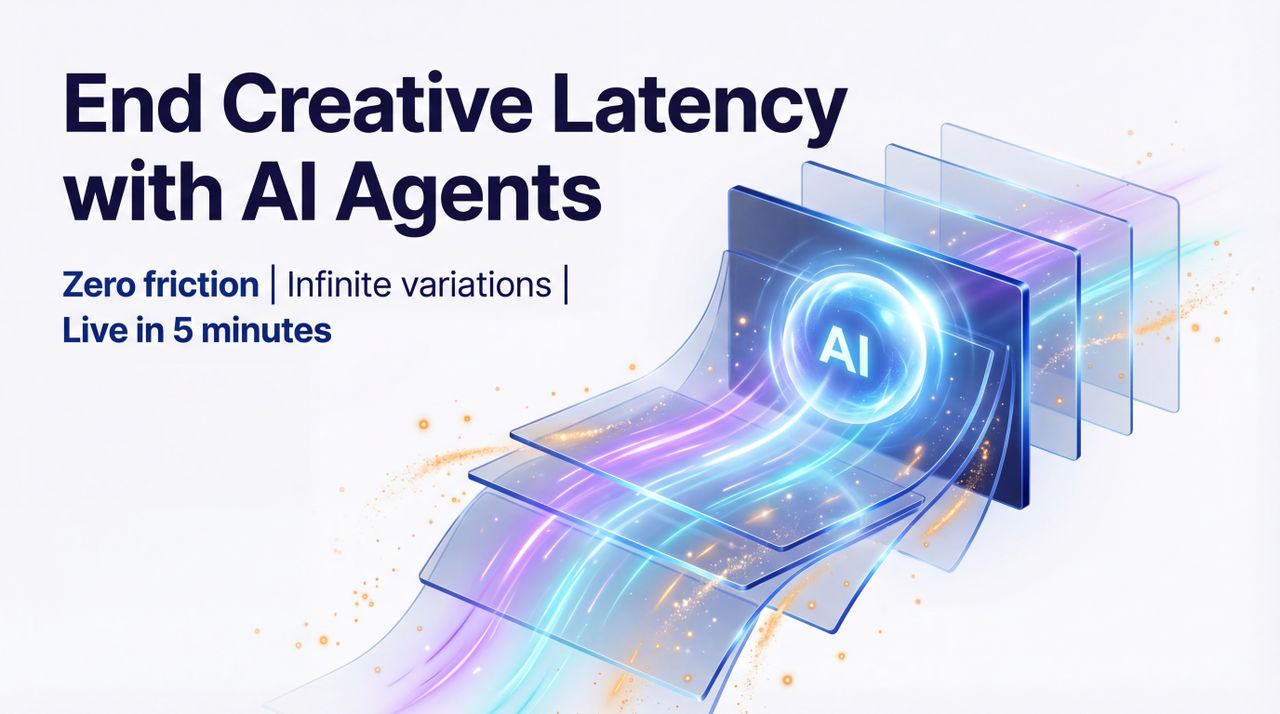
Software is Eating Media Buying: The End of Creative Latency
The creative agency model is dead; it just doesn't know it yet. For the last decade, we've treated ad creation as a bespoke art form. But in the trenches of performance marketing, it is strictly a latency problem.
We all know the open secret to winning at performance marketing: it is a game of pure volume. The platforms (Meta, Google, TikTok) have essentially solved distribution. The algorithms know who your buyers are. The only remaining variable you control is the creative payload you feed the machine. To find the alpha, you have to test hundreds of creatives.
But let’s look at what actually happens in a modern growth team.
A strategist spots a fleeting trend or a data-backed angle. They ping a copywriter to draft a hook. The copy gets approved, and a brief is tossed over the wall to the design team. Then, you wait. You wait for three days for a designer to assemble the assets. By the time the ad is finally rendered, resized, and approved, the trend is completely dead.
That friction right there is exactly where campaigns die.
We have been artificially constrained by human latency. The industry has been trying to solve a computing problem with headcount. But a paradigm shift is happening. We are moving from a world of assisted creation (tools that require human pilots) to agentic generation (software that thinks and executes autonomously).
Nagent is at the forefront of this infrastructure shift, striving toward a reality where your go-to-market motion is never bottlenecked by production workflows.
The Fallacy of the "Design Tool"
When most people think of AI in marketing, they picture a copilot, a tool that helps a human designer work slightly faster. But this still relies on human orchestration. It still requires a human to bridge the gap between the strategic messaging and the visual execution.
This is exactly why, at Nagent, the Product Ad Creative Generator was developed as an autonomous agent.
The Product Ad Creative Generator isn't just another design tool. It is a comprehensive ad creation agent that actually thinks like a media buyer. It fundamentally removes the gap between design and messaging by generating visuals and copy together in a single, unified action.
Here is how the architecture of this workflow functions:
Strategic Ingestion: You don't manage a project; you provide a creative brief. You describe the desired look, the target audience, and the core communication goals.
Visual Anchoring: You upload your brand logo and high-quality product images, ensuring the agent is grounded in your actual product realities.
Simultaneous Generation: The agent doesn't do things sequentially. It simultaneously writes persuasive copy, builds the visual layout, and instantly sizes it for every necessary platform.
Native Output: It exports correctly sized assets for Story, Feed, Search, and display placements on socials, ensuring campaigns look native across all devices automatically.
The result? Infinite, conversion-ready ads generated in about five minutes.
SOP & Best Practices to use Product AD-Creative Generator
Key Steps:
1. Provide a Creative Brief 0:54
:quality(80))
Describe how you want the ad to look.
Specify the target audience and key messages.
2. Select Image Size 1:21
:quality(80))
Choose the desired image size for the ad.
Recommended size: 4K.
3. Upload Brand Logo 1:30
:quality(80))
Upload the brand logo that will be used in the ad.
4. Select Aspect Ratio 1:42
:quality(80))
Choose the aspect ratio for the ad.
Recommended ratio: Landscape (16:9).
5. Upload Product Images 1:49
:quality(80))
Upload at least three clear, high-quality images of the product.
6. Submit the Creative 2:06
:quality(80))
Click on the submit button to generate the ad creative.
7. Review the Generated Ad 2:23
:quality(80))
Check the generated ad for clarity, impact, and conversion readiness.
Cautionary Notes
Ensure all images uploaded are high quality to maintain ad effectiveness.
Double-check the creative brief for accuracy before submission.
Tips for Efficiency
Prepare all necessary images and logos in advance to speed up the process.
Use a consistent format for creative briefs to streamline communication.
Check out the video for better understanding:
The Economic Impact of Zero-Cost Creative
When you strip away the design bottlenecks, something profound happens to your growth strategy.
Marketing teams use the Product Ad Creative Generator to scale testing by rapidly producing many distinct concepts. Because the agent is trained on campaign results and creative best practices, it selects compositions, typographic scale, and image treatments specifically designed to increase attention and click-through rates.
You are no longer guessing; you are running high-frequency, data-driven experimentation. You uncover high-performing ad orders of magnitude faster than traditional design workflows allow. This is perfect for marketers, founders, and growth teams who demand consistent ad creatives without the friction of traditional processes.
Nagent: The Underlying Infrastructure of Success
The Product Ad Creative Generator is just one node in a larger revolution. Nagent’s products are fundamentally driving change across enterprises by replacing rigid, linear workflows with dynamic, agentic orchestration.
We aren't just giving teams a slightly sharper knife; we are automating the entire kitchen. By removing the technical friction of AI adoption, Nagent allows organisations to deploy enterprise-grade reasoning engines that solve actual business bottlenecks. The goal isn't to replace your team, it's to elevate them from task executors to strategic orchestrators.
When the marginal cost of a high-converting asset drops to zero, and the turnaround time shrinks from 72 hours to five minutes, you don't just save money. You fundamentally rewrite how your company goes to market.
Frequently Asked Questions (FAQs)
1. How is Nagent different from other AI agent builder platforms?
Unlike rigid workflow automation tools or open-ended platforms that cause setup paralysis, Nagent provides true dynamic orchestration with opinionated defaults. It offers an enterprise-grade, visual Agent Builder Studio alongside a rich Agent Store. Nagent doesn't just give you a blank canvas; it gives you pre-built, best-practice templates so your team can achieve outcomes immediately.
2. How can I know my existing software tools are integrated with Nagent?
Nagent makes connectivity effortless. The platform boasts over 1,000 out-of-the-box integrations with the most popular enterprise and SMB tools (CRMs, ERPs, marketing platforms, and more). Furthermore, if you use highly niche or proprietary software, Nagent fully supports custom API integrations.
3. Which AI models are available on the Nagent platform?
Nagent is a fully multimodal, model-agnostic platform. You are never locked into a single provider. You can seamlessly switch between top-tier models like OpenAI (GPT-4), DeepSeek, and others with a single click inside the Agent Builder Studio, ensuring you always have the right reasoning engine for the job.
4. Do I need to know how to code to build agents on Nagent?
Not at all. Nagent features a zero-code and no-code AI agent builder. Its intuitive, visual node-based interface allows non-technical business operators, marketers, and founders to build and deploy sophisticated, reasoning AI agents simply by dragging and connecting logical blocks.
5. Do we need to provide our own API keys to run agents on the platform?
No, you do not need to bring your own API keys for the underlying language models. Nagent is a fully managed platform, which removes a massive layer of technical friction and billing complexity, allowing small teams to start building and deploying immediately.
6. Do we have to build our own AI agents, or can Nagent build them for our organization?
You have ultimate flexibility. You can build your own using the zero-code studio, instantly deploy pre-built agents from the Agent Store, or utilise Nagent’s "Agentic AI Lab as a Service." With this premium service, Nagent’s internal experts will architect and build highly tailored, multi-agent workflows specifically for your business.
7. How does the Product Ad Creative Generator ensure our brand identity isn't lost in automation?
While the agent works autonomously, it is tightly constrained by your brand primitives. The platform features robust colour and logo controls and anchors the final designs strictly around the high-quality product images you upload. This ensures that, as you scale testing volume, your visual identity remains native and fully consistent.
8. Does the AI agent only generate images, or does it write the ad copy too?
It is a unified, multimodal workflow. The Product Ad Creative Generator bridges the historical gap between design and messaging. Based on your initial brief, it simultaneously generates persuasive headlines, clear calls to action, and a visual layout, ensuring the copy and design work together to drive conversions.
9. Can the agent format ads for different social media platforms automatically? Yes. The agent is built for omnichannel distribution. During the generation process, it automatically exports correctly sized assets for various formats, including Story (9:16), Feed (1:1, 4:5), Search, and landscape (16:9) display placements, ensuring your ads look native no matter where they are served.
10. How does this agent improve actual campaign performance compared to a human designer?
Human designers are often constrained by time and subjectivity. The Product Ad Creative Generator is specifically trained on historical campaign results and creative best practices. It selects visual compositions and typographic scales designed for attention and click-throughs, allowing you to launch and test dozens of variations in the time it traditionally takes to design just one.