
Comparing AI Systems for Creative Media Asset Generation
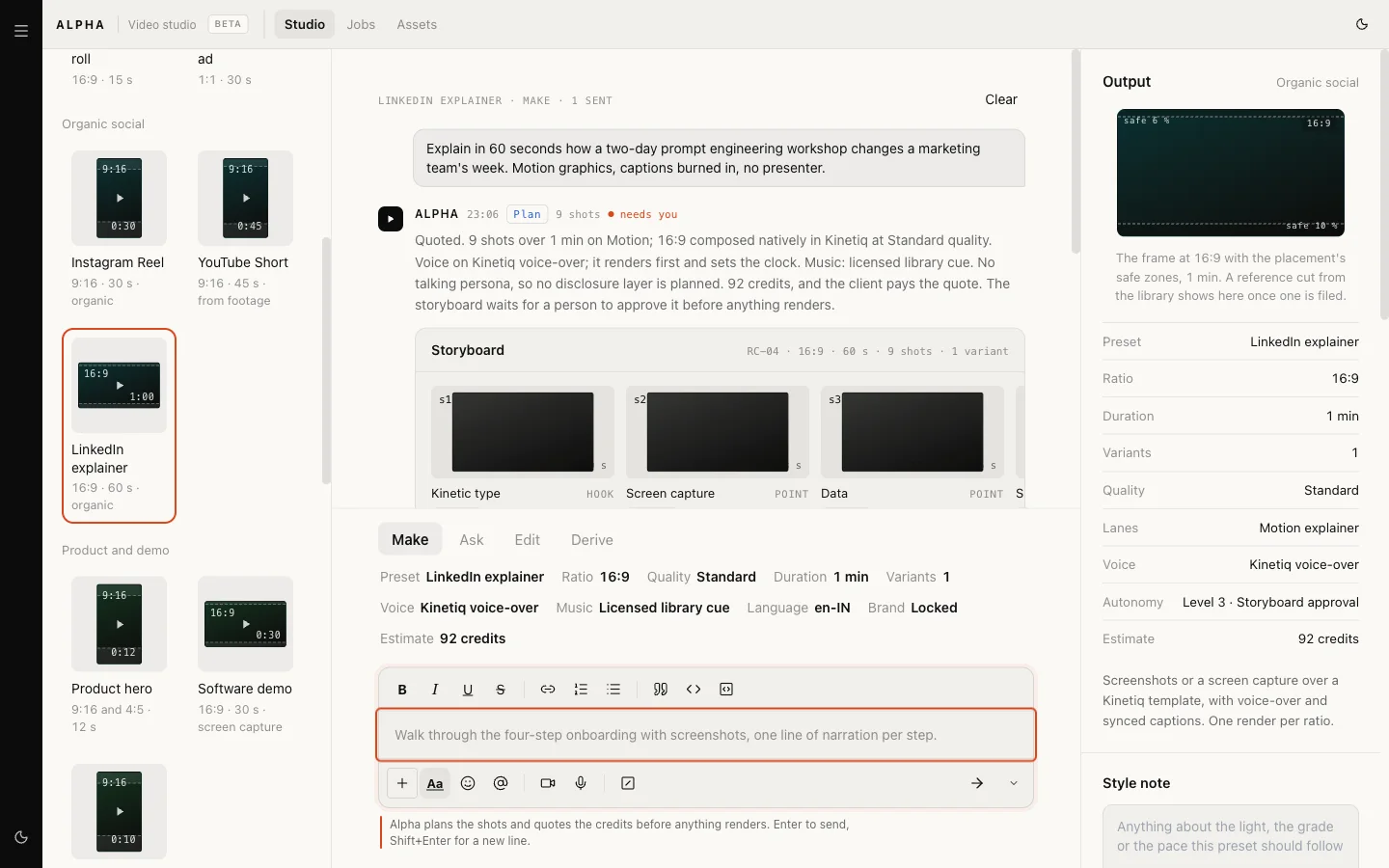
To compare leading AI systems engineering solutions for advanced creative media asset generation, sort them into three kinds first: foundation models that generate images or video, creative studios that wrap models in editing tools, and agent systems that run the work from brief to approved asset. Then judge each on brand control, approvals, provenance, rights, cost control and integration. This guide walks through each criterion, names real examples, and shows where Nagent's creative teammates, including Alpha, the AI video studio, fit.
What kinds of AI systems generate creative media assets?
The products in this space look similar in a demo and behave very differently at scale. Most fall into one of three kinds.
Foundation models. The engines that turn a prompt, an image or a clip into new media. Google DeepMind describes Veo as its leading video generation model, and says videos made with it are marked with SynthID, its technology for watermarking and detecting AI-generated content. Runway builds its own models, names Gen-4.5 as a video model, and offers an API platform, Runway Dev, alongside its creative tools. Models give you the most raw capability and the least process: brand rules, approvals and budgets are yours to build.
Creative studios. Applications that put models inside an editing workflow. Adobe describes Firefly as "an AI-powered creative space that helps you create and edit images, videos, audio, and vector graphics", says its own Firefly models are commercially safe, notes that Firefly outputs include Content Credentials indicating AI was used, and offers partner models from other companies in the same space. Studios suit designers and editors who want control over each frame.
Agent systems. Platforms where AI agents take a brief, plan the work, call models and return assets for review. Typeface describes itself as "agentic AI for enterprise marketing teams", an orchestration platform for coordinating people, AI agents and systems. Pencil describes a platform that brings multiple AI models together for marketing teams, with enterprise governance and a brand safety feature. Nagent belongs here too. Agent systems trade some frame-level control for process: plans, checks, approvals and budgets built in.
What should you compare AI creative systems on?
Six criteria separate a system you can run across a brand from one that only works in a demo.
Criterion: Brand control, Foundation models: Prompt and reference images; brand rules live outside the model, Creative studios: Brand assets and styles inside the editor, applied by the user, Agent systems: Brand guidance and claims stored once and sent with every job
Criterion: Approvals, Foundation models: None built in; you add review steps, Creative studios: A person edits and exports, so review is manual, Agent systems: Plans, quotes and checks wait for named people before work runs or ships
Criterion: Provenance, Foundation models: Model-level watermarks where the provider applies them, Creative studios: Content Credentials where the studio applies them, Agent systems: Provenance plus a record of who asked, who approved and what was sent
Criterion: Rights and consent, Foundation models: Your responsibility per output, Creative studios: Depends on the studio's model training and licence terms, Agent systems: Rules for likeness, releases and disclosure enforced per job
Criterion: Cost control, Foundation models: Usage-based API spend you meter yourself, Creative studios: Plan or credit allowances per seat, Agent systems: Quotes before render, budgets and caps per agent and per job
Criterion: Integration, Foundation models: API first; you build the workflow, Creative studios: Plugins and exports into design tools, Agent systems: Connections to ad, content and work tools, plus an API
None of these columns is better in every case. A team with engineers and a clear pipeline may want models. A design-led team may want a studio. A marketing team producing many assets across channels, with legal review, usually needs the process an agent system provides.
How do you keep generated assets on brand?
Brand control fails quietly: one off-colour pack shot or an unapproved claim, repeated across hundreds of variants. Ask three questions of any system:
Is the brand guidance sent every time, or only when someone remembers? An image model knows nothing about a brand unless it is told, every time.
Can you see what was sent? If you can't inspect the instructions behind an asset, you can't fix the next one.
Does the real product come from a real image? Generating a product from words alone invites a wrong label or colour.
On Nagent, RUPA, the AI image studio, attaches the workspace's brand guidelines to every render with Brand Lock, which is on by default, and the bench shows the exact text sent. Alpha renders a product shot only from an image of the real product in RUPA's library, and her PROOF check compares the frames against it for pack, label and colour.
Who should approve AI-generated assets before they ship?
At enterprise scale, the question isn't whether a person reviews, it's which decisions wait for one. Good systems make that explicit:
Before spend. A plan and a cost estimate before anything expensive renders.
Before claims go out. A check of every claim against what the brand can prove.
Before publishing. A named person releases the final asset.
For sensitive cases. Real people's likenesses, budget overruns and overrides need a second decision.
Nagent builds these into each teammate. Alpha plans a video shot by shot and quotes it in credits; the storyboard and its quote wait for a person until a person raises how far she is trusted, and spending past a cap, binding a real person's likeness and releasing a finished cut after PROOF always wait for a person. RUPA can write a plan and stop, show the estimate and wait for "Approve and run", or render on standing approval with every render written to the audit log. HOOK, the AI Ad Creative Strategy Lead (Beta), checks every claim in its ad copy against the brand's approved claims through its GATE seat, and overriding a GATE block always needs a second person.
How do provenance and rights differ between systems?
Provenance tells a viewer, a platform or a regulator how an asset was made. C2PA, a coalition, develops an open technical standard for showing where digital content came from and how it was edited, called Content Credentials. Some providers also watermark at the model level, as Google DeepMind says it does with SynthID for Veo.
Rights are broader: whether the model was trained on content you're comfortable using commercially, and whether any real person in the asset agreed to appear. Read each provider's terms for the first. For the second, look for enforcement, not policy text. Alpha signs each rendition with Content Credentials, puts a disclosure layer on every synthetic presenter, and renders a digital twin of a real person only with a written release on file. Revoking a release blocks new renders at once and flags every video made with it.
How do you control the cost of AI creative generation?
Generative media is cheap per asset and expensive in aggregate. Variants multiply, re-renders add up and nobody sees the total until the invoice. Look for:
A quote before work starts. Not an estimate after the fact.
Budgets per agent or project, with hard caps that stop work rather than warn.
Reuse. Changing a hook or a size shouldn't mean paying to regenerate everything.
Nagent meters agent work in credits, visible in the workspace; as a rough guide, a rendered video is about 700 credits. Alpha's quote is fixed when the storyboard is approved, she carries a daily and a monthly budget and a cap on any one job, and variants reuse the shots already rendered. RUPA checks her budgets before anything is sent and refuses when over a limit. FOLIO, the AI Long-Form Publications Lead, turns Knowledge Hub documents into illustrated PDF and DOCX publications, shows an estimate before you submit and runs on a long-form budget of its own.
How do AI creative systems integrate with your stack?
Models integrate through APIs and need you to build everything around them. Studios integrate through plugins and exports. Agent systems should connect to the tools the work touches and expose their own API. On Nagent, agents connect to hundreds of tools via Composio, plus your own API, and the developer API, MCP server and signed webhooks are documented at /developers. Nagent is ISO/IEC 27001:2022 certified, with a SOC 2 Type II programme underway, and can deploy in a customer's private cloud.
Frequently Asked Questions
What is the difference between an AI model and an AI creative platform?
A model generates media from inputs. A platform, whether a studio or an agent system, adds the workflow around it: brand assets, review, provenance, budgets and integration. Most enterprises use models through a platform rather than directly.
Which AI systems are best for enterprise creative asset generation?
It depends on who does the work. Engineering-led teams often build on models such as Veo or Runway's. Design-led teams lean on studios such as Adobe Firefly. Marketing teams producing many assets under legal review tend to need agent systems with approvals and budgets built in, such as Typeface, Pencil or Nagent.
What are Content Credentials?
An open technical standard from C2PA for recording where digital content came from and how it was edited. Adobe says Firefly outputs include them, and Nagent's Alpha signs each video rendition with them.
Can AI generate brand-safe creative assets?
Yes, when the system sends brand guidance with every job, starts product shots from real product images, checks claims against what the brand can prove, and leaves release to a named person.
Choose the system that matches how your team works
Compare AI creative systems on process, not just output quality: brand guidance sent every time, approvals where money or claims are at stake, provenance on every asset, consent for every real person, quotes before spend and an API for the rest of your stack. See how Alpha plans, quotes and proofs every video before it renders, beside RUPA for images, HOOK for ad strategy and FOLIO for long-form.
Book a demo to see Nagent's creative teammates work from your own brand.
AI agents for Media & Publishing
Continue learning
Agents that match this read.
ComicDirector AI
This AI Comic Advertisement Agent is a complete multi-stage cinematic production system designed to create highly engaging comic-style animated advertisements for platforms like TikTok, Instagram Reels, YouTube Shorts, gaming promos, anime edits, brand campaigns, and social media storytelling. The agent intelligently converts user ideas, product references, character images, comic styles, audio preferences, and creative briefs into professional animated comic advertisements through a structured AI pipeline built specifically for visual consistency, emotional storytelling, and cinematic short-form retention. The workflow begins with a Story Intelligence Engine that analyzes uploaded character or product images, comic panel styles, audio direction, and user briefs to generate a cinematic comic advertisement story structure with emotional pacing, viral hooks, transformation moments, and scene-by-scene progression. The system then creates detailed character blueprints and generates animation-ready character assets while preserving consistent visual identity across the entire production workflow. Uploaded characters and products are intelligently integrated into the story without redesigning their core appearance, ensuring brand and character consistency throughout the advertisement. Next, the Cinematic Storyboard Engine transforms the story into a sequence of highly visual storyboard image prompts optimized for short-form animated content. These prompts include cinematic camera compositions, comic framing, anime-inspired action moments, dramatic lighting, emotional close-ups, manga-style energy effects, and visually engaging scene progression designed to maximize audience retention. The generated storyboard images are then processed by the Motion Direction Engine, which creates professional image-to-video prompts optimized for AI video generation systems like Seedance. This stage introduces controlled cinematic movement such as slow camera pushes, subtle character animation, environmental motion, glowing effects, comic-style action dynamics, and smooth visual transitions while maintaining scene stability and visual coherence.
View agent AAdMaker Alpha
Create cinematic high-engagement AI advertisements up to 15 seconds with automated scripting, storyboarding, visuals, motion planning, and video generation optimized for social media and performance marketing.
View agent