
Site Migration Without Losing AI Answer Visibility

A site migration without an AEO-specific checklist is a citation-destruction event. Traditional migration guides protect your crawl budget, your redirects, and your Core Web Vitals. They do not protect the structured data signals, entity associations, and token-efficient content patterns that determine whether AI answer engines cite you, or your competitor. SEO migration AI visibility is a separate problem, and most teams discover that too late.
Why do traditional migration checklists miss AI answer visibility?

Standard migration checklists were written for Google's blue-link index. They measure what Search Console measures: impressions, clicks, crawl errors, redirect chains.
But AI answer engines, Google's AI Overviews, Perplexity, ChatGPT's web browsing, do not rank pages. They cite sources. The signals that earn a citation are different from the signals that earn a ranking.
When you migrate, you can execute a flawless redirect map, hit zero 404s, and still watch your AI citation share collapse. Here is why.
Three AEO-specific risks traditional checklists ignore:
Structured data breaks silently. Schema markup that references your old domain or CMS-generated IDs becomes orphaned. AI engines lose the entity associations they had built around your content.
Citation memory decays. AI models trained on crawl snapshots remember your old URLs. When those URLs 301 to a new domain, the model's internal association does not automatically transfer. There is a re-indexing lag that can last weeks or months.
Content structure degrades. CMS migrations frequently flatten heading hierarchies, strip FAQ schema, or reformat content into components that are harder for token-efficient machine extraction. The content looks identical to a human. To an AI crawler, it is a different document.
What is "AI answer visibility" and why does migration threaten it?

AI answer visibility is your Share of Voice in AI-generated responses, not your share of clicks from a results page.
The distinction matters enormously during a migration. A page that ranked third for a keyword and earned 40% of its traffic from AI citations can drop to zero AI citations even if the redirect is clean and the keyword ranking holds. The AI engine cited the old URL's entity graph. The new URL has not yet built one.
Think of it this way. A ranking is a position in a list. A citation is a trust relationship. Redirects transfer positions. They do not transfer trust relationships.
How does structured data loss affect AI citations specifically?
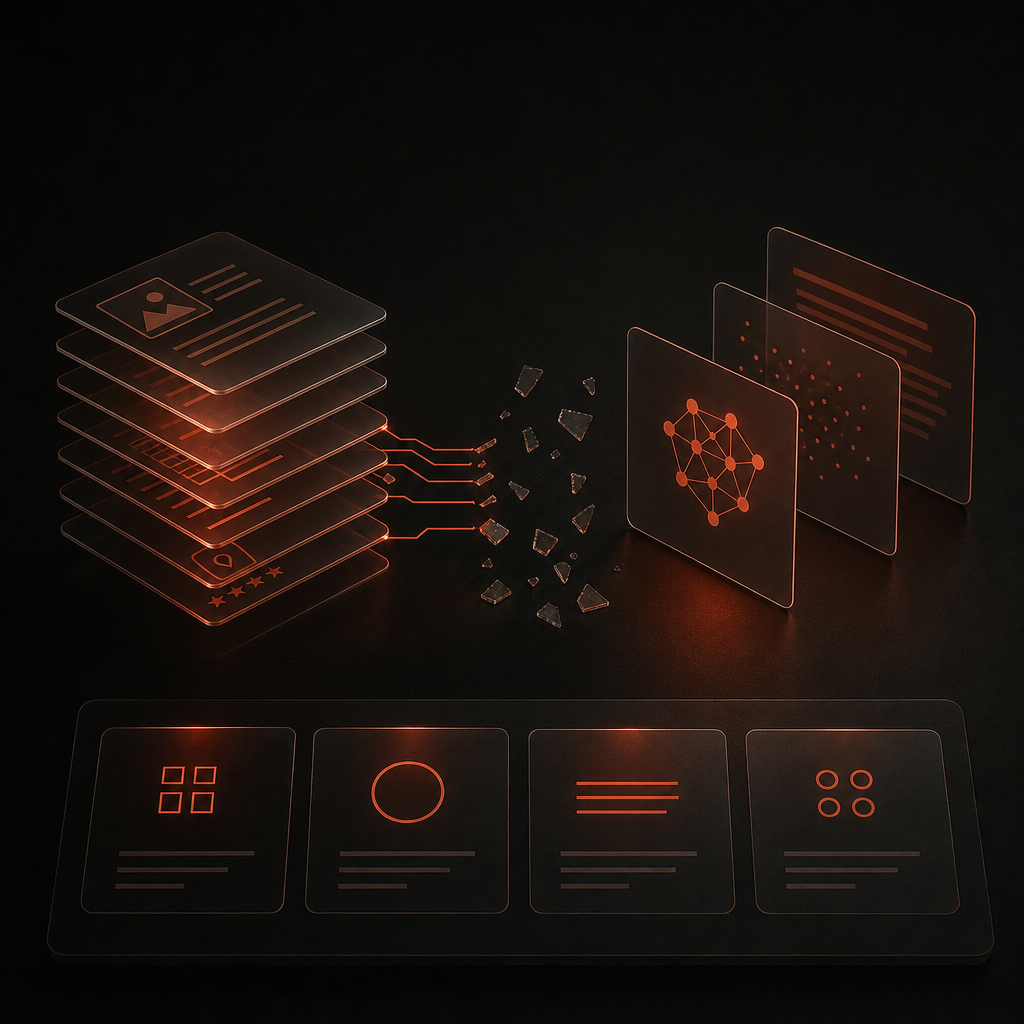
Broken or missing structured data removes the machine-readable signals AI engines use to classify and cite your content.
When a CMS migration happens, the following schema types are most commonly lost or corrupted:
FAQPage schema, the single highest-value schema type for AI snippet extraction
Article and BlogPosting schema, carries author, datePublished, and publisher entity signals
BreadcrumbList schema, helps AI engines understand content hierarchy and topical authority
SpeakableSpecification, marks the exact passages AI engines should read aloud or extract
A migration that moves content from WordPress to Webflow, or from a monolith to a headless CMS, frequently drops these entirely. The new CMS renders the page correctly. The schema is gone.
Run a structured data audit before you migrate, not after. Capture a full export of every schema type on every URL. Validate it against the post-migration environment before DNS cutover.
Which pre-migration steps protect your AI citation share?
Protecting SEO migration AI visibility requires three pre-migration actions that most teams skip.
Step 1: Baseline your AI citation share now.
Search Console does not measure this. Add an AI answer monitoring tool to your stack before you touch the migration. Tools like Nagent's DRIS, Profound, Brandwatch, or Semrush's AI Overviews tracking will give you a pre-migration baseline. You cannot protect what you have not measured.
Step 2: Audit your entity associations.
AI engines build entity graphs around your brand, your authors, and your content topics. Export your existing structured data. Document which pages carry which entity signals. Flag the pages with the highest AI citation rates, these are your highest-risk URLs.
Step 3: Freeze your content structure.
The biggest AEO risk in a CMS migration is not the URL change. It is the content restructuring that happens alongside it. Teams use migrations as an opportunity to redesign page templates, consolidate content, or move to component-based layouts. Each of those changes can degrade the heading hierarchy and FAQ patterns that AI engines extract from.
Freeze content structure changes until after the migration stabilises. Separate the technical migration from the content redesign. Do them in sequence, not in parallel.
What should your post-migration AEO monitoring cover?
Post-migration monitoring for AI visibility requires a different dashboard from your standard SEO monitoring.
Your standard stack watches rankings, crawl errors, and Core Web Vitals. Your AEO stack needs to watch:
AI citation frequency, are you being cited in AI Overviews and Perplexity answers for your target queries?
Citation URL accuracy, are citations pointing to your new URLs or your old ones?
Structured data validation, run Google's Rich Results Test and Schema.org validator weekly for the first 90 days
Entity re-association speed, monitor how quickly your new domain builds the same topical authority signals your old domain held
Set a 90-day monitoring window. AI engine re-indexing is slower than Google's standard crawl. Citation share typically lags ranking recovery by four to six weeks. If you stop monitoring at the standard 30-day post-migration mark, you will miss the AEO recovery curve entirely.
How does a headless CMS migration create specific AEO risks?
Headless CMS migrations introduce a rendering risk that traditional CMS migrations do not.
In a headless architecture, content is delivered via API and rendered client-side or at the edge. AI crawlers, including Googlebot when it processes content for AI Overviews, may crawl the raw API response rather than the rendered page. If your structured data lives in the rendered HTML and not in the API payload, the crawler sees no schema at all.
This is not a theoretical risk. It is the most common cause of schema loss in headless migrations.
The fix is to implement structured data server-side, in the <head> of the document, before JavaScript renders. Confirm this with a fetch-as-Google test on your staging environment before cutover. Do not assume your headless framework handles this automatically.
What is the fastest way to rebuild AI citation share after a migration?
Rebuild citation share by re-establishing entity signals, not by waiting for re-crawl.
Three actions accelerate recovery:
Resubmit your sitemap immediately after DNS cutover. Do not wait for Googlebot to discover your new URLs organically.
Publish new content on your new domain within the first two weeks. Fresh, well-structured content with complete schema signals to AI engines that the new domain is the authoritative source.
Update external citations. Find every external site that links to your old domain and request URL updates. This includes press mentions, partner pages, and directory listings. AI engines weight external citation patterns heavily when building entity associations.
The Technical SEO Audit Checklist for the Agentic AI Era covers the full measurement stack you need to run this process systematically.
Related reading
Frequently Asked Questions
How long does AI citation recovery take after a domain migration?
AI citation recovery typically lags ranking recovery by four to six weeks. AI engines rebuild entity associations more slowly than standard crawlers update index positions. Run a 90-day monitoring window using an AI answer tracking tool, and expect the steepest recovery curve to happen between weeks four and ten post-migration.
Does a 301 redirect preserve AI citation share?
A 301 redirect preserves ranking signals but does not automatically transfer AI citation associations. AI engines cite specific URLs based on entity graphs built over time. A redirect tells the crawler where to go next, it does not transfer the trust relationship or entity associations attached to the old URL. You need to actively rebuild those signals on the new domain.
What structured data types matter most for AI answer visibility?
FAQPage, Article, and BreadcrumbList schema are the highest-priority types for AI answer visibility. FAQPage schema directly feeds the question-and-answer extraction that AI Overviews and Perplexity use. Article schema carries author and publisher entity signals. BreadcrumbList helps AI engines understand your topical authority structure. All three must be validated on your new environment before DNS cutover.
Can a headless CMS hurt AI citation share even without a domain change?
Yes. If your headless CMS delivers structured data only through client-side JavaScript rendering, AI crawlers may not execute that JavaScript and will see no schema at all. Implement structured data server-side in the document <head> and validate with a fetch-as-Google test on staging before any launch.
How do I baseline my AI citation share before a migration?
Search Console does not measure AI citation frequency. Add a dedicated AI answer monitoring tool, such as Nagent's DRIS, Profound, Brandwatch, or Semrush's AI Overviews tracking, at least four weeks before your migration begins. This gives you a pre-migration baseline to measure recovery against and helps you identify your highest-risk URLs before you touch the codebase.
What should you do next?
A migration is the highest-risk moment in your site's SEO lifecycle, and most teams go into it without any visibility into their AI citation share. Book a free 30-minute demo at nagent.ai to see how Nagent's agents can monitor, protect, and rebuild your AI answer visibility through a migration and beyond.