
AI Ad Script Generator: How to Get Scripts That Perform
An AI ad script generator writes the lines and shots for a video ad from a brief. The useful ones do more than produce copy: they start from an angle, put the hook in the first seconds, fit the script to the channel it runs on, and check every claim before anyone shoots. This guide covers each step, a script structure you can reuse, and how HOOK, Nagent's AI Ad Creative Strategy Lead, works through them.
Why do most AI-generated ad scripts fall flat?
Most generators are handed a product name and a tone, and return something that reads like an ad but says nothing a competitor couldn't say. The cause is usually one of three things, and none of them is the writing.
No angle. The script lists features instead of making one argument for one buyer.
No proof. The script makes claims the brand can't back up, so legal cuts them or, worse, nobody does.
No format. A slow, story-led script lands in a placement where viewers decide in a second or two whether to keep watching.
A script is only as specific as the brief behind it.
What should an ad script generator start from?
Before you ask for a single line, give the generator what a good creative strategist would ask for:
The buyer. Who they are, what they already believe and what they're tired of hearing.
The angle. One reason this buyer should care now.
The claims and their proof. What the brand may say, with the source for each claim.
Banned language. Words legal or the brand team won't accept.
The offer. What the viewer gets for acting today.
The channel. Where the ad runs, which decides its length, shape and pace.
This is how HOOK works on Nagent. It won't make anything until its brand pack is complete: voice, buyer profile, the claims the brand may make with their proof, banned language, the offer and channel packs.
How do you write the hook for the first seconds?
The hook carries the ad. On YouTube, Google's help page for video ad formats says viewers can skip a skippable in-stream ad after 5 seconds. In a feed, the scroll is the skip button, and it's always available.
Hooks that tend to earn the next few seconds:
The problem in the buyer's own words.
The outcome first. Show the finished result, then explain how you got there.
A belief, contradicted. "You don't need a bigger budget. You need fewer ads."
A specific, provable detail. A number or fact the brand can source, never a rounded boast.
A visual interrupt. Something in the first frame that doesn't look like an ad.
Write the opening so it works as a spoken line and as on-screen text, and write several hooks for every body. Hooks are cheap to produce, so test them rather than picking a favourite in a meeting.
What is an angle, and why does it matter more than the copy?
An angle is the argument: which pain, which promise, for which buyer, resting on which claim. One product can carry many angles, such as cost, time saved, ease or status. A good execution of the wrong angle still loses.
On Nagent, this step belongs to three of HOOK's sub-agents. SCOUT finds competitor and category ads worth studying and saves them to a swipe library with the reason each one was kept. MINE reads what is working and why, so a pattern is stated as a mechanism rather than a screenshot. ANGLE turns a pattern into a testable angle for your brand, with the claim it rests on made explicit, and every bet in a brief carries a kill condition set before launch.
How should a script change by channel?
The same angle needs a different script for each placement.
Channel: Instagram and Facebook Reels, What the script has to do: Feel native to the feed. Hook in the first line and the first frame, keep the pace quick, and land the brand early.
Channel: YouTube Shorts, What the script has to do: Shoot vertical. Google's Shorts ads guide says 9:16 vertical video is best suited to Shorts, and recommends sound and text overlays.
Channel: TikTok, What the script has to do: Write like a creator, not a brand. TikTok's help centre describes Spark Ads as ads that run on existing organic posts, from your own account or a creator's with their permission.
Channel: YouTube pre-roll, What the script has to do: Put the brand and the promise inside the first five seconds, before the skip appears.
Channel: Meta retargeting, What the script has to do: The viewer already knows you. Lead with the offer or the objection that stopped them, not the introduction.
HOOK's channel packs today are Meta cold 9:16, Meta retargeting 1:1, TikTok Spark and Google RSA, and each limit is cited to the platform page it was read from. YouTube Shorts and pre-roll aren't HOOK packs yet, so treat that row as craft advice rather than a feature.
What does a performing ad script look like?
Here's a structure for a short vertical ad that you can hand to any script generator, or a writer, to fill.
Concept. The angle in one line.
Claim it rests on. The claim, with its proof source.
Hook, first two to three seconds. The on-screen line and the spoken line, plus what's in the first frame.
Problem. One beat that names the pain in the buyer's words.
Proof. A demo, a before and after, or the sourced fact.
Offer. What the viewer gets and why now.
Call to action. One ask, said and shown.
Shot list. What a producer needs to shoot it without a briefing call.
Kill condition. The result at which you stop spending on it.
A filled example, for a project management app aimed at agency owners:
Hook: On screen, a calendar packed with grey blocks. Voice: "Your team spent Monday in meetings about meetings."
Problem: "Status updates eat the hours you meant to bill."
Proof: Screen recording of one board replacing the weekly status call.
Offer: "Try it free for your next project."
Call to action: "Start free" on screen, said once.
Every line in the proof and offer beats should trace back to the claims list. If it doesn't, it doesn't ship.
How many variants should you test, and how?
Test in layers, and change one thing at a time:
Hooks first. Several hooks on one body tell you which opening holds attention.
Angles next. Two or three angles, each with its best hook, tell you which argument sells.
Executions last. Pacing, voice and visuals.
Set the kill condition before launch, not after a bad week. Read results by angle and by execution separately: a weak execution of a good angle is worth fixing, a weak angle isn't.
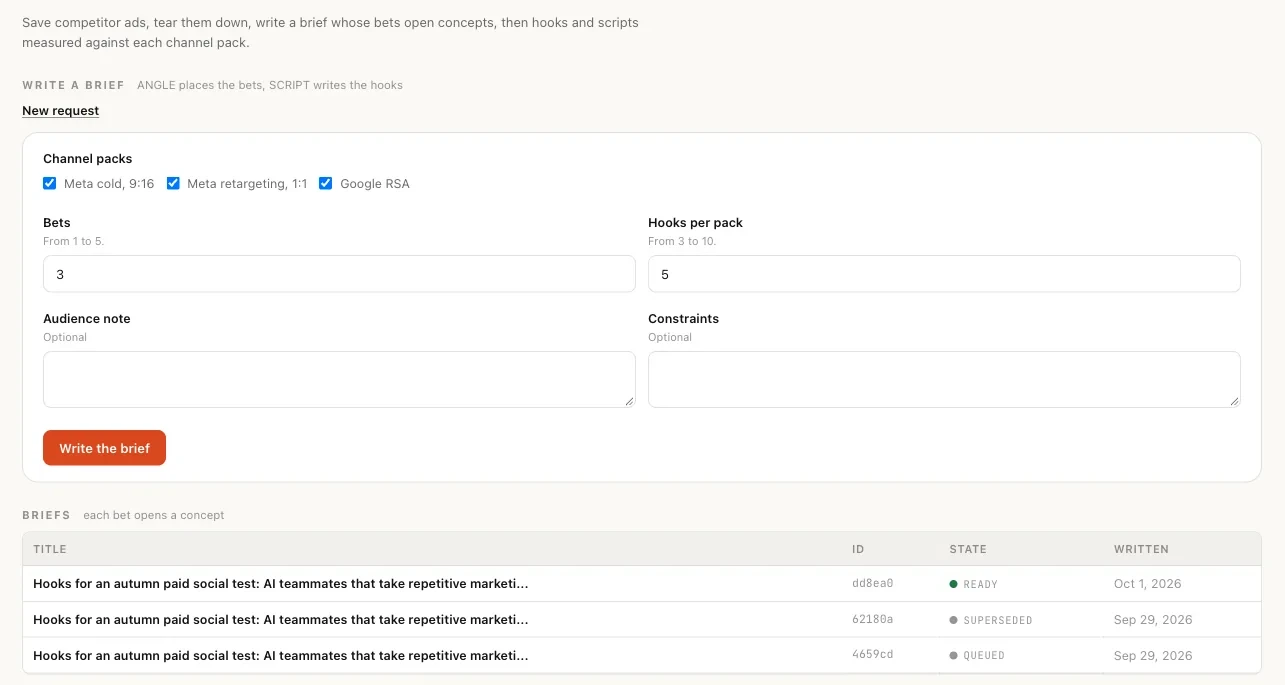
In HOOK, you write a brief by choosing the channel packs, the number of bets and the hooks per pack. SCRIPT writes a hook set per concept and channel pack, a person pins the ones they like and clicks "Hand to SCRIPT" for full scripts. To learn from results, PULSE reads ad level performance from a connected Meta account or from a .csv or .xlsx export you upload from any ad platform, and separates a weak angle from a weak execution. VAULT keeps what each campaign taught as a playbook for the next brief.
How do you keep AI ad scripts brand-safe?
An ad that claims what the brand can't prove costs more than a weak ad. Build these checks into the process:
A claims list with a source for every claim.
A banned language list, kept current by the brand and legal teams.
Extra care in regulated categories such as health, finance and food.
A named person who signs off before anything is produced.
On Nagent, GATE is the only one of HOOK's eight seats that stops work rather than producing it. It checks every claim against the brand pack and holds the work when the pack doesn't support it, and overriding a GATE block always needs a second person. HOOK also makes read calls only on an ad account: it can't launch, pause, or change a budget or a bid, and none of its sub-agents can. A person spends the money. Paid research, such as ad library searches and teardowns, and sending a brief to RUPA for statics wait for a person's approval.
Where does HOOK fit if you already have a script generator?
A script generator answers "write me an ad". HOOK covers the steps around it: the angle, the claims, the gate and the learning. It's in Beta, it sits on the Marketing team and it reports to MIRA, the AI Marketing Chief of Staff. PACK assembles one handover carrying the angle, the script and the constraints, to upload by hand, or as a Google pack that NIA builds paused. HOOK doesn't replace your creative team: people decide what runs.
If you want a generator that starts from what your brand can prove, read how HOOK, the AI Ad Creative Strategy Lead works, from brand pack to playbook.
Frequently Asked Questions
What is the best AI ad script generator?
The best one is the one that starts from your angle, your buyer and your proof, writes for the channel the ad runs on, and checks claims before production. Judge a tool on its inputs and checks, not on how polished its first draft sounds.
Can an AI ad script writer replace a copywriter?
It can take on volume: many hooks, many variants, quick rewrites. A person still owns the angle, the claims and what runs. HOOK is built for the paid social manager and the creative strategist, not instead of them.
Are AI-generated ad scripts any good?
They're as good as the brief. Given a buyer, an angle, sourced claims and a channel, an AI ad script generator writes usable scripts quickly. Given only a product name, it writes generic copy.
How long should an ad script be?
As long as the placement allows and no longer. Put the hook in the first two to three seconds whatever the length, and on skippable YouTube ads land the brand and the promise before the skip appears at 5 seconds.
Does HOOK launch or pause ads on its own?
No. HOOK makes read calls only on an ad account. A person uploads, pauses and spends in the ad platform, and NIA builds any Google pack paused.
Want to see HOOK write against your own brand pack? Book a demo.