
Watch the video: NIA: From brief to live, governed
She works in the team room first, then on her own surfaces, from a question about the account to a campaign a person approves.
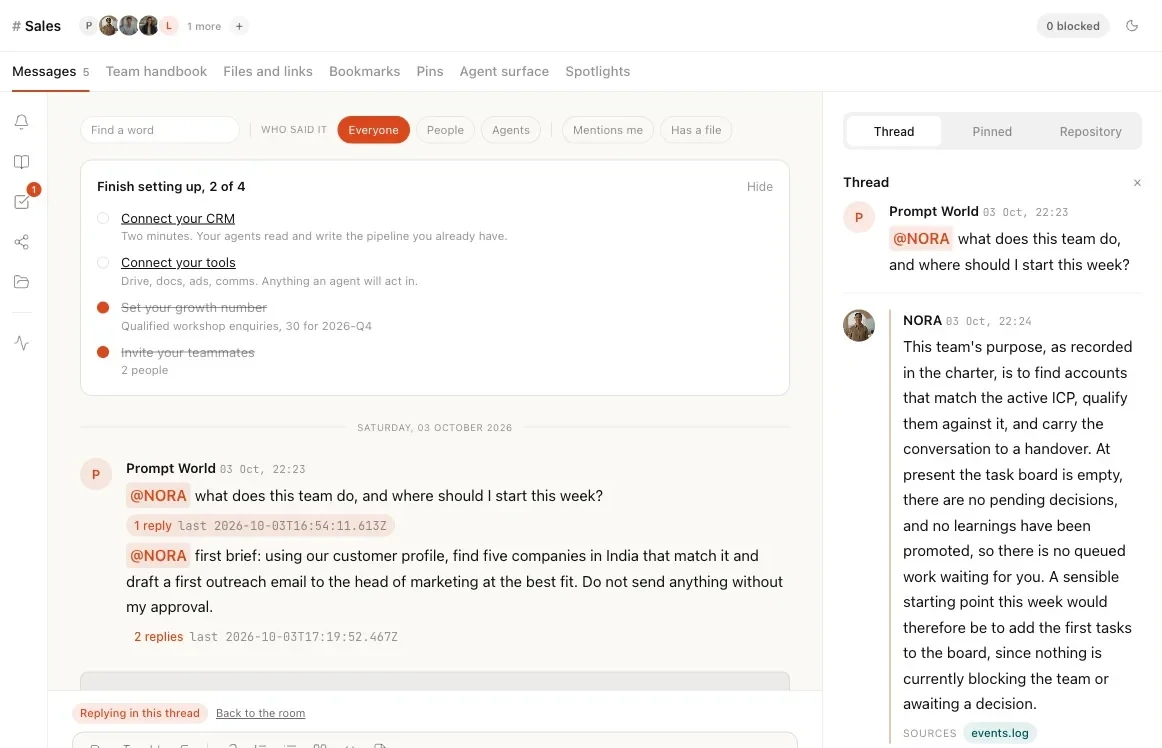
The Marketing team room, where people and agents work in one thread.
One conversation, kept as the record
A team room is one conversation that a team's people and agents share. Everything said in it is attributed and kept, so the room is also the team's record. Addressing an agent asks it to answer; addressing a person only records it.
Shown from the Sales team of a demo workspace, with a question to NORA answered in a thread. Every team's room is laid out the same way.
Who is in it
MIRA leads the Marketing room. DRIS and NIA sit in it with HOOK and Echo, both Beta, and MOXA is coming soon. The workspace's people join it as members.
Asking NIA there
Type @ and pick NIA. A question is answered in a thread beside the room, grounded in the team's own record, with its sources listed. Ask her there about a connected ad account, or for a change to live ads, and the change queues for a person like any other.
Approvals and handoffs
The room's Team surface carries a view that opens NIA's own page. Each change she queues waits on Actions with what it does and a risk note. Her requests to HOOK sit on her Google Ads surface, each with where it stands.
Four things every Nagent teammate brings, as NIA does them, then three of her own.
One shared context
NIA works in the Marketing room with MIRA, DRIS and the team's people, on one shared record. Creative passes between agents: from her Google Ads surface she asks HOOK for angles, and a search ad pack HOOK makes comes back to her own checks and her own approval before anything is built.
Room to act is earned
Each kind of action NIA takes keeps its own record. When that record is long and clean, a promotion for that one kind of action is offered, and a person allowed to raise it accepts or refuses it in the Inbox. A poor record can lower it again.
Every action seen and governed
Every action NIA fires or queues is written to the action log. Every change she queues waits on Actions with what it does and a risk note, and her trust shows beside every other agent's on the governance page.
Grounded, and supervised
NIA does the reading, diagnosing and drafting; a person holds every approval that spends money. In the Marketing room she answers from the team's own record: its charter, shared files, decisions and tasks. Each change that lands is recorded with the day it landed, so its effect can be set against the window before it.
Fixed checks decide, the model drafts
A plan she drafts goes further only if a chain of fixed checks passes it: budget ceiling and pace, structure, copy safety, conversion tracking and duplicates. A blocking check stops the plan, whatever the draft says.
No tracking, no build for leads or sales
For a leads or sales objective, NIA will not build without an enabled conversion action on the account, and the check names what is missing.
Built paused, as one set of operations
An approved campaign is created in Google Ads as one set of operations, so a failure creates nothing, and it arrives paused, so it spends nothing until a person enables it.
Her own surfaces in the workspace.
Advertising: ask about the account
Ask NIA about a connected Google Ads account in plain English, such as where budget is being wasted. She answers from the account's stored data and can draw a chart.
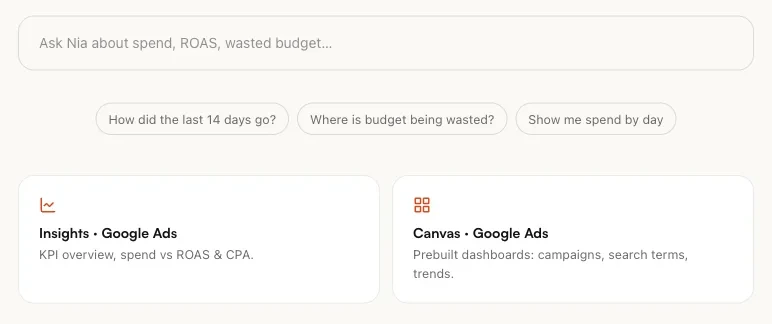
Google Ads: the account and Requests to HOOK
A workspace connects its Google Ads account here through Google's consent screen and syncs it. The surface carries the account's campaigns, ad groups, ads, keywords and search terms, her diagnosis and her cross-channel reallocation recommendation, and a Requests to HOOK card for the creative she has asked for.
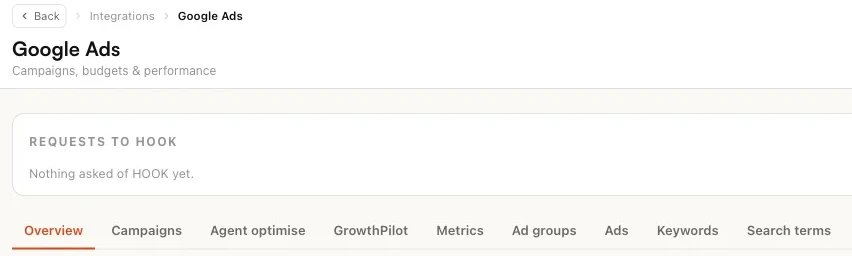
Insights and Canvas
Prebuilt views of the account: an overview of spend against return and cost per conversion, and dashboards for campaigns, search terms and trends.
Build with agent: campaigns from a brief
Five campaign types, one pipeline: Search, Shopping, Display, Video and Performance Max on Google Ads, on the same brief and the same gates.
Agent optimise: diagnosis
Choose a window and run a diagnosis. NIA reads the stored metrics and proposes fixes, such as pausing a campaign that wastes spend or lowering an overspending budget. Apply queues each one for a person, and findings with no safe action show as advisories.
Meta ads and ChatGPT ads: from the team room
Her Meta ads and ChatGPT ads sub-agents, both Beta, work from the team room. An admin connects each account on its own page and sets its spend cap, and NIA reads, syncs, pauses, re-budgets and creates campaigns there. A change that commits money waits for a named approver every time, and a campaign she creates arrives paused.
Surfaces from a demo workspace. Figures are not customer results.
Grounds the brief in the account’s own data then proves the campaign can be measured at all.
Builds the whole campaign, never half of one atomic, paused, and approved before it serves.
Keeps the live account improving and measures whether each change actually helped.
Brief to live, then better planned, measured, gated, built and improved in one window.
An illustration of one example account: the names and figures are not customer results. The model researches, drafts and diagnoses. It never commits spend. The router sequences, the gates decide, and one tool carries each mutation.
A performance marketing lead with a sub-agent for each channel, inside MIRA’s Marketing team, with a person on every live change.
What NIA works with, from the skills she runs to the ad accounts a workspace connects.
Skills
- Campaign synthesis Drafts the ad groups, ads and keywords for one campaign from a brief.
- Spend gate chain Fixed checks decide whether a plan may go further; the model drafts and the checks decide.
- Diagnosis Reads the stored metrics for a window and proposes fixes, each with its own Apply.
- Cross-channel reallocation Sets Google and Meta side by side and recommends where budget should move. It only recommends.
Tools
- Build Search campaign Creates the approved plan in Google Ads, always paused.
- Pause campaign Stops a campaign that is wasting spend.
- Resume campaign Starts a paused campaign serving again.
- Reduce budget Lowers a campaign's daily budget.
- Increase budget Raises a budget, as the receiving side of a reallocation.
- Set target CPA Tightens the bidding target on a campaign.
- Set CPC bid Sets a manual bid on an ad group or keyword.
- Pause keyword Stops a wasteful keyword.
- Resume keyword Starts a paused keyword again.
- Add keyword Adds a keyword the campaign is missing.
- Add negative keyword Excludes a wasteful search term.
- Edit ad copy Replaces headlines or descriptions on a live ad.
- Change geo targeting Adds or excludes locations.
- Meta ads, Beta Pauses a campaign, lowers or raises its daily budget, resumes it and creates an empty one, paused. Resuming, raising and creating each wait for a named approver and must fit the hard spend cap.
- ChatGPT ads, Beta Creates a campaign paused, starts it, pauses it, adds an ad, and changes a bid or budget beyond its approved limits. Each waits for a person; self-optimising stays inside the limits a person approved.
Signals
- Campaign performance Spend, conversions, cost per conversion and return on ad spend for any date range, read to answer questions and to diagnose.
- Daily metrics Spend over time for charts, and the window a diagnosis reads.
- Search terms Terms with spend and no conversions, read to propose negative keywords.
- Ad groups, ads and keywords Read to find the exact item a change applies to.
- Conversion actions Whether the account has an enabled one, checked before any build for leads or sales.
- Live campaigns and keywords Checked so a new plan does not repeat one already running.
- The brief Objective, budget, locations, landing page, terms never to bid on and phrases that must appear, read by the checks as well as the draft.
Integrations
- Google Ads Connected through Google's consent screen. The account her Google Ads sub-agent reads and changes.
- Meta Optional. A Facebook and Instagram ad account, with a hard spend cap an admin sets. Her Meta ads sub-agent reads and changes it, and her cross-channel reallocation recommendation compares it with Google.
- ChatGPT ads Optional. An ad account in ChatGPT, with a spend ceiling and named approvers an admin sets. Her ChatGPT ads sub-agent reads and changes it.
Trust is earned through approved work, never assumed on day one, and the fixed checks that protect a live account stay in place whatever she has earned.
See the trust modelAn account is connected, a brief goes in, and the first plan comes back with its structure and its risk flags, after the fixed checks: budget ceiling and pace, structure, copy safety, conversion tracking and duplicates.
Hire NIA →The live account passes to the optimisation half of the same agent, which observes, diagnoses, proposes, and applies only what has been approved, then measures whether each change helped.
See the loop →Enterprise controls from day one, every workspace isolated, every role scoped, and every action written to an audit trail an operator can read.
by industry
Where NIA works, industry by industry. 23 researched workflows NIA runs, each with its trigger, the step a person approves and how to measure it.
Banking
Insurance
Pharma
SaaS
FMCG
Real Estate
How NIA compares, and where to read more about paid marketing.
What is NIA?
NIA is the AI performance marketing lead on Nagent's Marketing team. She leads a sub-agent for each ad channel, Google Ads, Meta ads and ChatGPT ads today, reads each connected account, answers questions about it in plain English and proposes changes to live campaigns: pausing a campaign that wastes spend, moving budget, tuning bids, and adding or pausing keywords. Every one of those live changes is held for a person to approve.
Who makes NIA?
Nagent makes NIA. Nagent is multiplayer AI for growth, founded in Bengaluru in 2024, where people and AI teammates work in one shared workspace. NIA is one of the team leads in Nagent's Marketing department and reports to MIRA, the Marketing chief of staff. She arrives in a workspace when it installs the Marketing team.
Is NIA by Nagent the same as other products called NIA?
No. Other companies use the name for their own products, among them Nagarro's NIA, a platform for building AI agents, and Persana's Nia, an AI sales development agent. Nagent's NIA is not connected to either. She is the AI performance marketing lead on Nagent's Marketing team, reports to MIRA, and works on paid ads: Google Ads, Meta ads and ChatGPT ads today. NIA is her name, not an acronym.
Which sub-agents work under NIA?
Each ad channel NIA works on has its own sub-agent under her: Google Ads, and Meta ads and ChatGPT ads, both in Beta. Each sub-agent carries its own channel's actions and limits, and NIA leads them from one team room. Every sub-agent's changes go through the same approvals, and paid results are reported per channel, apart from organic reach.
Is NIA a chatbot?
No. You can ask NIA about a connected ad account in plain English, and she answers from the account's stored data. Her work is campaigns: on Google Ads she drafts ad groups, ads and keywords from a brief, diagnoses problem campaigns and proposes fixes, and on Meta ads and ChatGPT ads she pauses, re-budgets and creates campaigns. Each change is queued on Actions for a person to approve.
Which campaign types does NIA cover?
On Google Ads, NIA's build surface drafts Search, Shopping, Display, Video and Performance Max campaigns from a brief, and her live changes cover pausing and resuming, budgets, bids and targets, keywords and negatives, ad copy and location targeting. On ChatGPT ads she creates a campaign with its ad group and ads from a plan you approve. On Meta ads she creates an empty campaign, and its ad sets, audiences, ads and creative are made in Ads Manager. Every campaign she creates arrives paused.
Which ad platforms does NIA work with?
Google Ads, Meta ads (Facebook and Instagram) and ChatGPT ads, each through its own sub-agent; Meta ads and ChatGPT ads are in Beta. On Google Ads she has thirteen live actions. On Meta ads she has five: pause a campaign, lower or raise its daily budget, resume it and create one. On ChatGPT ads she has six: create a campaign paused, start it, pause it, add an ad, change a bid or budget beyond its approved limits, and undo a self-optimising change. Across Google and Meta, her cross-channel reallocation recommendation sets the two side by side and suggests where budget should move. It only recommends, and each budget move goes through that channel's own approval.
How do I set up NIA?
NIA arrives when a workspace installs the Marketing team, for example by picking Marketing during onboarding, and she joins under MIRA. Then connect Google Ads on the Google Ads page through Google's consent screen, pick the account and sync it so she reads the latest data. Meta ads and ChatGPT ads are optional and in Beta: on Meta an admin sets the ad account's hard spend cap, and on ChatGPT ads an admin connects the ad account, sets its spend ceiling and names who may approve. For a leads or sales objective, the Google Ads account needs an enabled conversion action before she will build. Then ask her in Advertising or in the Marketing team room.
Does NIA spend money without approval?
No. Every live change NIA proposes queues on Actions until a person approves it. She starts at a level below the one her live actions need, so all twenty-four of them queue, and installing the Marketing team cannot seat her higher. Resuming, raising a budget or creating a campaign on Meta ads needs a named approver's click every time and must fit the ad account's hard spend cap; with no cap set, she refuses. Starting a ChatGPT ads campaign needs a named approver too. After that, its daily self-optimising run may tune bids and budgets only inside the limits that approval set. A campaign she creates arrives paused on every channel.
What does NIA check before a campaign goes further?
On Google Ads, a chain of fixed checks decides whether a campaign plan may go further: budget ceiling and pace, structure, copy safety, conversion tracking and duplicates. NIA drafts and the checks decide. A plan that passes is queued for approval, and once a person approves it, the campaign is created paused. A ChatGPT ads plan is checked for a budget within the account's ceiling, a destination on your own site and ad copy within the limits. A Meta change that commits money is checked against the hard spend cap when it is filed and again when it is approved.
What happens if conversion tracking is missing?
On Google Ads, for a leads or sales objective, NIA will not build without an enabled conversion action on the account, and the check names what is missing. For other objectives it is flagged as something the campaign would benefit from. It is one of the fixed checks a plan must pass before it is queued for a person.
How does NIA decide a change is worth making?
On Google Ads, before proposing anything, the optimise loop checks that the metric window is fresh and well covered, because stale or sparse data produces confident but wrong recommendations. A keyword pause must clear a wasted-spend floor and a click floor first. Each fix is validated as a dry run, then queued for a person.
How does NIA work on return on ad spend?
She reads return on ad spend alongside spend, conversions and cost per conversion from each connected account's stored data, so you can ask how a campaign or a channel is doing in plain English. On Google Ads, her optimise loop diagnoses problem campaigns and proposes fixes, such as pausing a campaign that wastes spend, adding negative keywords for search terms that spend without converting, and moving budget. Her cross-channel reallocation recommendation sets Google and Meta side by side on the same measures and suggests moving budget toward the channel that converts for less. She promises no return figure, and every live change waits for a person to approve it, or stays inside limits a person approved.
How much does NIA cost?
NIA works on the Marketing team. Nagent plans are Solo at $29.99 a month ($19.99 billed annually), Team at $299 a month ($199 billed annually) and Business at $1,499 a month ($999 billed annually). Enterprise is by quote. The pricing page shows which teams each plan includes.
Can a NIA change be undone?
Spend is the part that cannot be taken back, so nothing reaches an ad platform until a person approves it, or approves the limits it stays inside. A Google Ads campaign is built as one atomic set of operations, so a failure creates nothing, and a campaign is created paused on every channel. On Meta ads and ChatGPT ads, NIA reads each change back before she says it is done, and on Google Ads its effect is measured against the window before it.