
Watch the video: DRIS: Named in the answer
What is DRIS?
DRIS is Nagent's visibility control plane for answer engines. It asks the questions your buyers ask in ChatGPT, Claude, Gemini and Perplexity, scores every page on six dimensions, ranks the gaps that cost you citations, and drafts the fixes. Nothing changes on your site until a named person approves it.
Last reviewed
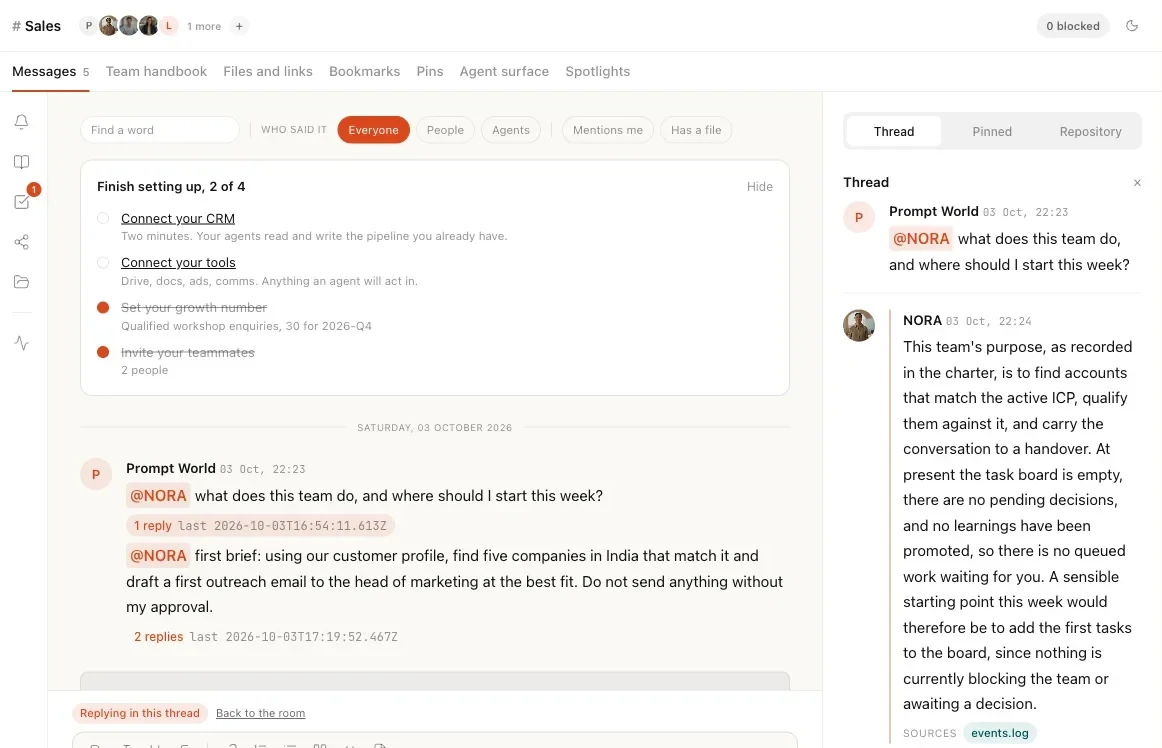
He works in the Marketing team room, where your people and your agents share one thread.
One room, on the record
A team room is one conversation your colleagues and your agents share. Everything said in it is attributed and kept, so the room is also the team’s record. MIRA leads the Marketing room, and DRIS works in it beside the other Marketing leads and the people you add.
Type @DRIS in the Marketing room. Addressing an agent asks it to answer, and he replies in a thread beside the room, with his sources.
He reads where the workspace stands: the visibility grade, the score for each pillar, and the open work across the search, answer engine and content backlogs. He says which pillars are not measured yet instead of scoring them as zero. He hands a job to the sub-agent who owns it, a page audit to the SEO Auditor or a competitor scan to the Competitive Content Analyst. The specialist runs it under its own limits and its own budget, and may wait for approval.
Work that needs a person is held at the gate in the room, with Approve and release or Refuse. Leaving it alone keeps it held: nothing runs until someone decides. A content gap he finds goes to the content team as a task on their board.
Accepting the weekly prompt set and changing how the queue is weighted are not done from the room. The person asking also needs the same access his own surfaces require, so a room is never a side door.
What sets DRIS apart, told through what he does.
People and agents on one shared context
DRIS works in the Marketing room beside MIRA, NIA and the people you add, on one attributed thread. He grounds on the same knowledge hub every agent in the workspace reads, and a content gap he finds goes to the content team as a task on their board, within a daily limit.
He earns room to act on his record
Autonomy is earned on his record, one level at a time. Thirty days at a level, with at least 25 decided approvals and few dismissed, earn a nomination for the next, and an admin approves or declines it. Publishing to a live page, changing index or canonical rules and changing how the queue is weighted stay with a person however far he rises.
Every action, approval and spend in one place
Each of his actions carries its own approval bar, and work above it is held until a person decides. His Autonomy surface shows what he may do alone, per kind of action, with its track record. You set his daily spend cap, and answer engine reads pause at it. Every fix served on your site records who approved it and when.
He works alone inside limits, a person holds the approvals
He runs site audits, answer engine reads and competitor snapshots on his own inside the spend cap, and ranks what he finds as proposals. He grounds on your organisation’s knowledge. When a fix’s measurement window closes he measures what it moved, keeps the lesson in the workspace memory when the evidence is strong enough, and ranks that kind of fix by its record.
An objective, not a dashboard
You declare one number, a target and a date. He captures the baseline first, refuses a target that does not beat it, and measures every proposal against it.
Measurement that will not guess
An engine that could not be reached is never recorded as not naming you. A pillar with no data shows as not measured rather than scored zero. On priority targets, repeated samples tell a real change from one answer’s noise before he raises an alert.
Fixes that go live, and come off
Approved title, description, heading and structured data fixes go live on your site through the site connection, which is in Beta, and Withdraw takes one off within about five minutes. Index rule and canonical changes are never served that way.
Then his surfaces: one objective, one measurement, one ranked queue, and reports that say what moved.
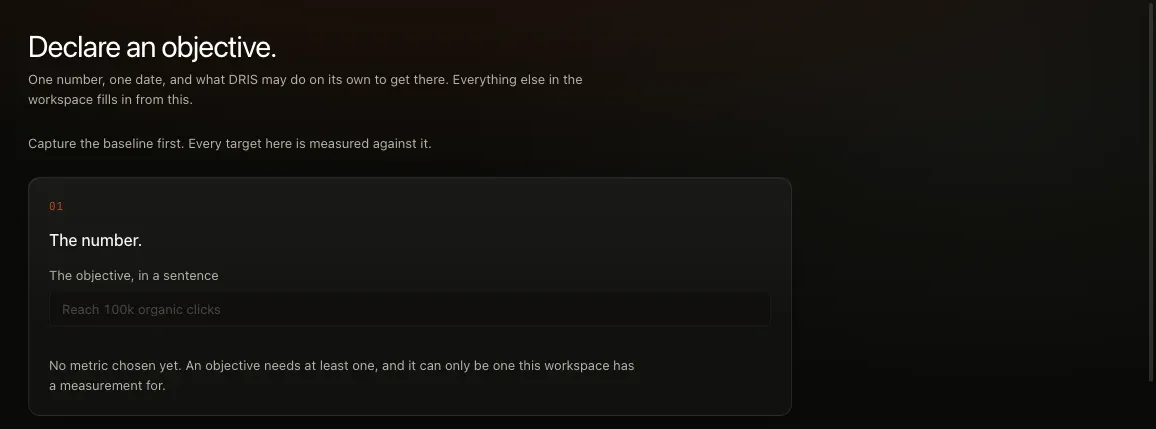
Declare an objective
One number, a target and a date: organic clicks, organic impressions, mean page score or AI answer presence. Search Console and Analytics connect first, a baseline sweep and a site audit run, and every target is measured against that baseline.
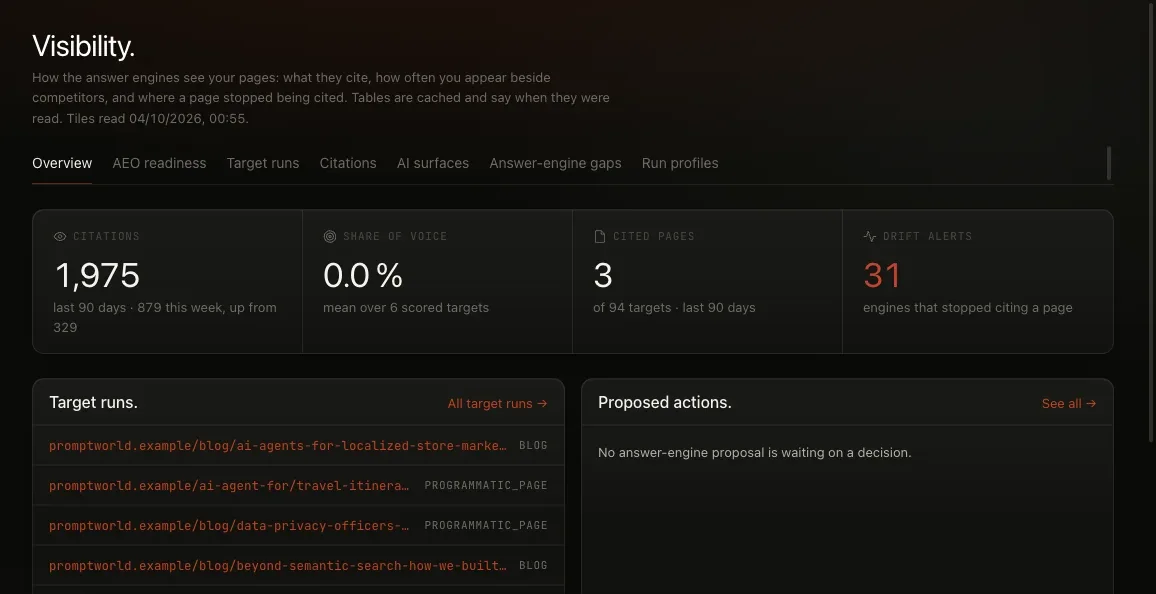
Three measurements, one score
Answer engine tracking across ChatGPT, Claude, Gemini and Perplexity, the live citation graph, and full stack SEO with competitive content analysis, all folding into a single measurement rather than three dashboards nobody reconciles.
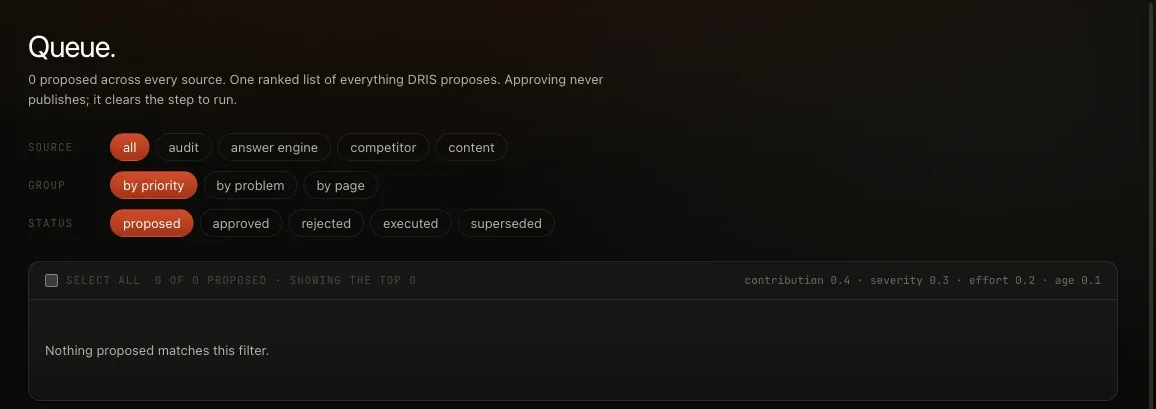
Every proposal shows its work
Each row in the queue carries its reason, a confidence figure, an effort rating and an impact score, and its diagnosis says so when the evidence is thin. A recommendation that cannot explain itself is worth less than one that admits the doubt. Approving one clears a step to run; it does not publish.
Reporting that will say nothing moved
Monthly, weekly and milestone reports are generated from persisted data rather than written to flatter, and they state plainly when a period produced no evidenced movement.
Surfaces from a demo workspace. Figures are not customer results.
One score per target, six dimensions, measured the same way before and after, so movement shows against the baseline it started from.
Measures how the answer engines describe the brand across every prompt a buyer would actually type.
Turns every gap into one ranked queue with the reason, the fix and the confidence attached.
Executes only what was approved then re-scores the same targets against the same six dimensions.
Measured, ranked, approved, executed and re-scored against the baseline it started from.
Every proposal carries its reason and its confidence. Structural changes never auto-fire, and nothing reaches the site without an approval.
One strategist, one ranked queue.
His skills, his tools, the signals he reads and what you connect.
Skills
- Citation-worthiness auditScores how citable a page is to an answer engine and lists the fixes.
- Answer-block authoringWrites short answer blocks for a target’s accepted questions, checks each and opens it as a proposal.
- Schema engineeringGenerates structured data from a page’s content, validates it against what the page shows, then proposes it.
- Machine-readability layerRecommends which AI crawlers to allow, proposes llms.txt lines, checks pages render without scripts and reports bot activity.
- Knowledge-consistency enforcementCompares the facts your pages state with your brand facts and flags where they differ or are missing.
- Third-party presence auditRanks the outside domains the engines cite most and checks what each says about you.
- Competitor gap analysisFinds the queries where a competitor is cited and you are not, scores each and routes it to its owner.
- Intent classificationTags each query by intent, and by whether an answer engine or a click is the likelier result.
- AI answer share of voiceHow often each engine mentions and cites you against each tracked competitor, per engine and blended.
- Citation source tracingMaps the sources the engines cite for each question, with your own share of them.
Tools
- Read the current visibility positionThe visibility grade, the score per pillar and the open work, from the room or his surfaces.
- Route a job to the sub-agent who owns itHands a page audit, a page score, a keyword lookup or a competitor scan to the agent whose tool covers it.
- Discover targetsSuggests the pages and topics to track, from your sitemap, your top traffic or a competitor.
- Generate promptsBuilds the buyer questions a target is checked against, for a person to accept.
- Start a full auditAudits the whole site in the background; Run audit checks a single page.
- Discover keywordsFinds new keywords from a seed phrase, your own site or a saved competitor; Upload a CSV adds your own.
- ScanReads what a competitor covers and can open proposals for what you do not.
- Approve and RejectDecides each proposal in the Queue, with a short window to undo.
- WithdrawTakes an approved fix back off your site.
- Hand to content teamSends a content gap to the content team as a task on their board.
- Generate this weekWrites the weekly digest from what was measured, saying so when nothing moved.
Signals
- Search performanceClicks, impressions, click rate and position by page and query, for the baseline, rank tracking and each proposal’s diagnosis.
- Site analyticsSessions and conversions by source, including visits referred by AI assistants, for attribution.
- Answer engine answersWhat each engine says to a buyer’s question, which sources it cites and whether it names you, for the six dimensions.
- AI answers in search resultsThe AI summaries search pages show, kept apart from the chat engines.
- Site crawlPage structure, metadata, robots rules for AI bots and llms.txt, for the site audit and agent readiness.
- Page performanceLoad and interaction timings, for performance regressions.
- AI crawler visitsWhich AI bots read which pages, for whether the engines can see the site at all.
- Keyword dataVolume, difficulty and intent, for ranking the keywords worth winning.
- BacklinksWho links to you and to competitors, for the off page score.
- Competitor contentWhat competitors publish, for the gaps you can close.
- Your knowledge hubThe documents your organisation uploads, so his answers and fixes stay grounded in your facts.
Integrations
- Google Search ConsoleConnected from the workspace, so he reads your search performance.
- Google Analytics 4Connected from the workspace, so he reads traffic and conversions by source.
- Site connection (Beta)Your developers connect your site once with a key; approved fixes then go live on it, and withdrawn ones come off.
Autonomy is earned against outcomes. Approved work, edited messaging and rejected drafts all feed back, and the structural changes that cannot be undone stay behind a gate however high the level climbs.
See the trust modelA property is connected, targets are discovered from the sitemap, and the first run returns the quadrant plot, the six dimension scores per page, the citation graph naming who the engines reached for instead, and a ranked list of the gaps with the fix that closes each one.
Hire DRIS →Read how teams use Nagent’s AI teammates in their own growth work.
Read the customer stories →by industry
Where DRIS works, industry by industry. 15 researched workflows DRIS runs, each with its trigger, the step a person approves and how to measure it.
Banking
Insurance
Pharma
Real Estate
Fashion
How DRIS compares, and where to read more.
What does DRIS actually measure?
Whether the answer engines name the brand, and how. Six dimensions per target: coverage, share of voice, entity strength, recommendation position, sentiment, and whether the page is legible to an agent at all. Every figure carries the run count, the window and the engine it was measured on.
Which answer engines are covered?
DRIS asks ChatGPT, Claude, Gemini, Perplexity and Grok. The exact prompt that produced each result is recorded alongside the citation, and the prompt set is fixed per account so a trend means something.
What is the Leaders quadrant?
Every target is plotted on brand coverage against recommendation position. The top right quadrant is where an answer both mentions the brand and recommends it well. Driving targets into it is the goal the whole workflow is organised around.
Does DRIS change our website on its own?
No. Every fix is a proposal carrying its reason and its confidence, and publishing a change to a live page needs a person at every level. Approving in the Queue clears a step to run; it does not publish. Destructive changes such as index rules and canonicals never earn autonomy.
What is live in DRIS today?
The objective and baseline, answer engine sampling and citations, gaps, the site audit, ranked keywords, Search Console, traffic and competitor tracking, the Queue and Backlog, and reports. Approved metadata fixes go live through the site connection, with Withdraw to take one off. Content gaps go to the content team as tasks.
Who does DRIS work with?
DRIS leads organic visibility on Nagent's Marketing team and reports to MIRA, the AI Marketing Chief of Staff. He routes search, answer engine and content work to the teammates who own it. Content gaps go to CREA's content team as tasks, and blog production reports to the Content lead.
Where does the data live?
In the tenant, encrypted in transit and at rest, with role based access and an audit trail carrying the actor and timestamp on every executed fix. Enterprise plans deploy in the customer's private VPC.
How much does DRIS cost?
DRIS works on the Marketing team. Nagent plans are Solo at $29.99 a month ($19.99 billed annually), Team at $299 a month ($199 billed annually) and Business at $1,499 a month ($999 billed annually). Enterprise is by quote. The pricing page shows which teams each plan includes.