
When AI Agents fail to deliver: Inadequate Data Exchange Layer
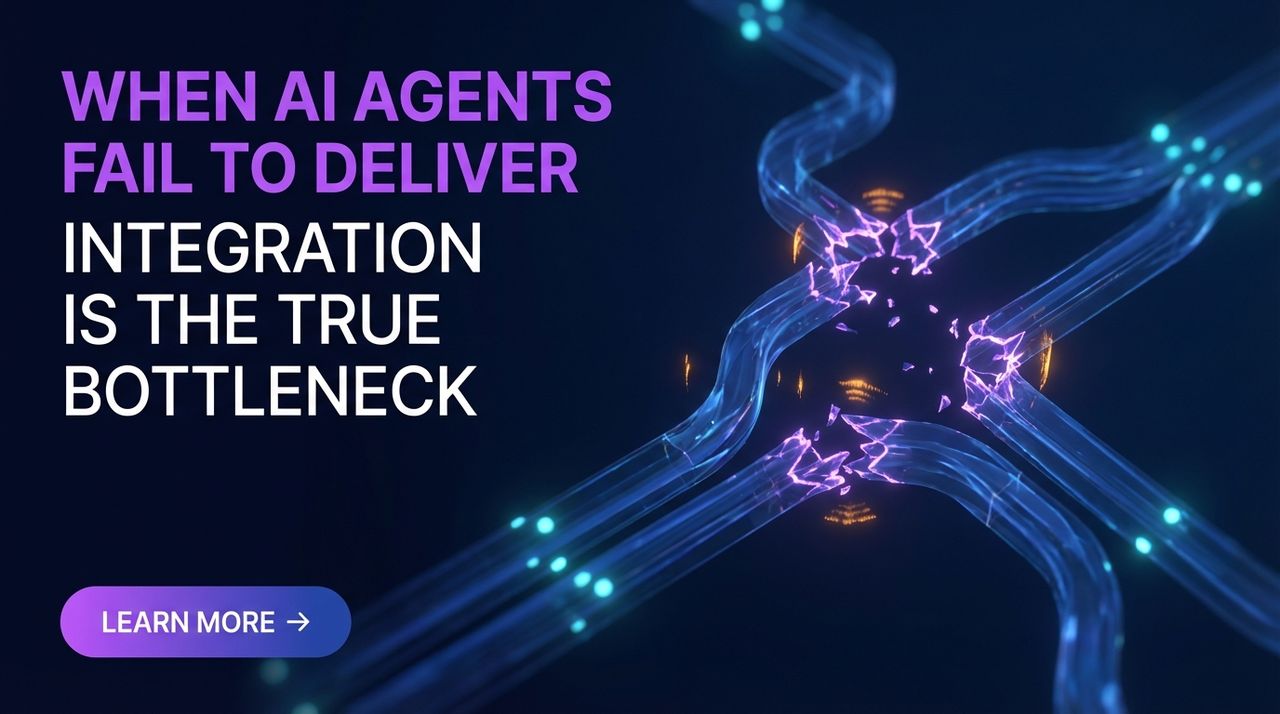
When AI Agents Fail to Deliver: The Inadequate Data Exchange Layer
Over the last year, AI agents have been positioned as the next major leap in enterprise productivity. Analyst reports, conference keynotes, and vendor narratives promise autonomous workflows, human like reasoning, and meaningful cost savings.
Yet, despite the momentum, real enterprise outcomes remain mixed. Across industries, pilots struggle to scale and ROI consistently lags behind expectations.
The root cause is often misunderstood. It is not weak models or lack of intelligence. The real bottleneck is the data exchange layer. AI agents are only as effective as their ability to interact with enterprise tools in reliable, secure, and business relevant ways. When integration breaks down, value creation stalls.
To address this, many teams adopt orchestration and integration platforms. These tools standardize APIs, manage authentication, handle retries, and abstract tool specific complexity. This foundation is essential.
However, it is not enough. Several deeper technical and business challenges remain, and these often prevent agents from delivering real value at scale.
1. Business Logic Does Not Map Cleanly
Integration platforms excel at abstracting API calls. An agent can call a generic action like send_message, and the platform routes it to Slack, Teams, or email.
But enterprise workflows require business logic level precision.
Consider a CRM monitoring agent. The integration layer may expose a trigger like “row updated.” From a business perspective, this is too broad. A new lead should trigger action. A typo correction should not.
When agents lack this distinction, they fire at the wrong time, spam teams, and quickly lose trust.
What works
Business logic must live above the integration layer. Agents need explicit rules such as triggering only when a record is newly created or when a specific status changes. External tools cannot decide what matters to the business. That responsibility sits with agent design.
2. Dynamic Tool Selection Is Still Hard
Agents often need to schedule or modify meetings across tools. While integration layers expose a generic create_event or update_event action, calendar systems behave very differently underneath.
For example, Google Calendar allows adding video links automatically and supports flexible guest permissions. Outlook, on the other hand, treats meeting ownership, room resources, and external guests differently.
A generic calendar call might successfully create a meeting, but:
Fail to attach the correct conferencing link
Block required attendees due to permission rules
Create duplicate meetings instead of updating an existing thread
Without contextual awareness of the calendar system, an agent may “succeed” technically while breaking real-world workflows and expectations.
What works
Agents need a metadata layer that defines tool preferences, feature differences, and account context. This includes rules like which platform to use for internal versus external communication, and which mailbox applies to which workflow.
Integration tools simplify execution. Decision making still belongs to the agent.
3. Latency Quickly Erodes Trust
Integration introduces latency, and in agent driven workflows, even small delays matter.
Latency comes from network hops, API rate limits, and data serialization overhead. When agents make multiple external calls sequentially, delays compound.
Imagine an agent summarizing weekly marketing performance using Google Ads, Meta Ads, and LinkedIn Ads. If these calls run one after another, the experience feels slow and unreliable.
What works
Agents should be designed for parallel execution wherever possible. Requests should be batched, critical data prioritized, and retry strategies carefully tuned. Users care less about perfect completeness and more about timely insight.
Integration tools provide connectivity. Performance must be engineered at the agent level.
4. Failures Are Inevitable, Recovery Is Not
APIs fail. Tokens expire. Networks time out. What differentiates a reliable agent from a frustrating one is how it recovers.
Integration platforms help with token refresh and basic retries, but they stop short of intelligent failure handling.
Blind retries can be dangerous. If an API rate limits requests and the platform retries aggressively, the agent can trigger a retry storm that worsens the outage. Sensitive actions like sending invoices or emails also require idempotency to avoid duplication.
What works
Agents need exponential backoff, strict retry limits, and idempotent action design using unique reference IDs. Critical failures should escalate to humans after defined thresholds.
External platforms enable retries. Judgment must live in the agent.
5. Authorization Is More Than Authentication
Integration platforms simplify OAuth flows and credential storage, but granular access control remains a challenge.
For example, an HR agent intended to fetch payroll summaries may gain access to individual salary details due to broad permissions. In other cases, agents may perform actions that require administrative approval, but organizational policies are not enforced.
What works
Enterprises must apply least privilege access, restrict tokens to required APIs, and enforce policies through additional governance layers. Detailed audit logs are essential for visibility and accountability.
Authentication is easier. Governance remains an enterprise responsibility.
6. Testing Environments Rarely Match Reality
Testing is where many agent integrations break down.
Sandboxes often lack realistic data volumes or feature parity. Some platforms provide no sandbox at all, forcing teams to test in live or incomplete environments.
Approval workflows highlight this gap clearly. A bot that works in a test workspace may fail in production when coordinating approvals across multiple teams and managers.
What works
Staging environments should mirror production scale as closely as possible. Feature flags allow gradual rollout, and mock connectors can fill sandbox gaps. Even then, limited production pilots are necessary before broad deployment.
Integration tools simplify connection. Real validation still requires enterprise rigor.
Closing Thoughts: Integration Is the Real Differentiator
Enterprise AI success is no longer about whether models can generate text or reason over data.
The real question is whether agents can integrate deeply enough to operate within real business systems.
Integration is not just plumbing. It is a design challenge. Organizations that invest beyond basic connectivity, and build intelligent layers on top of the data exchange foundation, will be the ones that turn agentic AI from hype into durable enterprise value.
https://nagent.ai/
Written by Anmol Shrivastava
Chief of Staff and Lead of Strategic Initiatives, Nagent AI
See an AI team at work
Book a 15-minute demo and watch a Nagent team plan, do and hand back real work in its room.