
Agentic Ad Creation: Generate, Test & Localize at Scale
Agentic Ad Creation: Generate, Test & Localize at Scale
Agentic ad creation workflows that continuously generate, test, optimize, and localize creatives are the structural replacement for static production cycles, not a faster version of them. When a single brief can spawn 50 creative variations, route them to the right channels, measure performance in real time, and self-localize for regional markets, the bottleneck shifts from production to strategy. That is the shift this post is about.
Why Is Static Ad Production Killing Your Performance Marketing Velocity?
Static production cycles create a compounding lag problem that compounds with every market you enter.
Here is the typical sequence: brief to agency, creative review, rounds of revision, platform formatting, legal sign-off, launch. That cycle runs 3 to 5 weeks on average. By the time the ad is live, the trend it was designed to capture has passed. The audience signal that prompted the brief has shifted. And your competitor, running a leaner creative system, has already tested 40 variations and found the winner.
This is not a resourcing problem. Hiring more designers does not fix it. The constraint is architectural. Static workflows are sequential by design. Agentic workflows are parallel by design.
The gap between those two architectures is where performance marketing velocity is won or lost.
What Does an Agentic Ad Creation Workflow Actually Do?
An agentic ad creation workflow takes a single brief and executes the full creative-to-performance loop without a human handoff at each stage.
It does four things simultaneously:
Generates creative variations: scripts, visuals, hooks, CTAs, from one input brief
Formats and adapts each variation for every target platform (Meta, YouTube Shorts, TikTok, Display)
Routes variations into live A/B tests and reads performance signals as they accumulate
Localizes: language, cultural reference, visual style, regulatory compliance, for each regional market
No agency handoff. No revision round. No formatting queue.
On Nagent, AI teammates each own a part of this loop. HOOK (Beta), the creative strategy lead for paid social, turns one brief into angles, hooks and scripts and checks every claim against your proof. Alpha plans the video ads to a preset, quotes each one before anything renders and waits for storyboard approval. RUPA renders the product shots and ad stills. A person approves what goes live.
That is not incremental improvement. That is a different operating model.
How Does Continuous Generation Change the Creative Testing Game?
Continuous generation means you are always in test, not preparing to test.
Traditional A/B testing assumes scarcity. You produce 2 to 3 variations, run them for 2 to 3 weeks, declare a winner, and brief the next round. The cycle is slow because production is slow.
When generation is continuous, the testing model inverts. You run 20 to 50 variations simultaneously. Losing variants are paused automatically. Winning variants spawn new generations, slightly different hooks, adjusted CTAs, alternative visual treatments. The system learns what works and produces more of it.
On Nagent, the learning stays with your team and your record. HOOK reads the results from the ad data you upload and says which concepts won, every approval and outcome is recorded and audited, and AI teammates earn autonomy level by level on their track record. HOOK never changes a live ad: a person decides what to pause and what to scale.
The practical result: creative performance compounds over time instead of plateauing after the first winning ad.
Why Does Localization Break Traditional Ad Workflows, and How Does Agentic Fix It?
Localization is where most multi-market campaigns collapse under their own weight.
A single campaign running across five regional markets requires five sets of translated copy, five visual adaptations, five rounds of cultural review, and in regulated categories, five compliance checks. That is not five times the work, it is closer to fifteen, because each market introduces its own revision cycle.
Agentic ad creation workflows handle localization as a parallel output, not a downstream task.
The brief enters once. The agent generates the base creative. It then applies regional parameters, language, visual tone, cultural reference points, format preferences, and produces market-ready variants simultaneously. A campaign targeting India, Southeast Asia, and the UK does not run through three sequential localization queues. It runs through one parallel generation pass.
For FMCG and D2C brands managing multi-market paid campaigns, this changes the economics of market entry. Launching a new regional market no longer requires a 6-week creative production sprint. It requires a brief update and a regional parameter set.[^2]
On Nagent, HOOK (Beta) does this from a single offer: many distinct angles and hooks, each claim checked against your proof, ready for a person to approve before any test runs in any market.
What Is the Strategic Shift CMOs Need to Make?
The shift is from managing creative production to managing creative intelligence.
In the static model, the CMO's job is to approve outputs, review the creative, sign off on the brief, manage the agency relationship. The work is sequential and approval-gated.
In the agentic model, the CMO's job is to set the parameters, define the brand guardrails, set the performance thresholds, determine the regional priorities. The agents execute, test, and iterate within those parameters continuously.
This is not about removing human judgment. It is about moving human judgment upstream, to strategy, brand standards, and market prioritization, and removing it from the production queue where it creates bottlenecks.
On Nagent, that memory lives in the Knowledge Hub and the shared record of the team room. What worked for a segment six months ago, which hooks underperformed in a regional market, the brand's own claims and proof: AI teammates answer from it and cite it, so a new brief does not start from zero.
For D2C brands scaling across markets, this compounds: every campaign adds to the record the next brief starts from.[^1]
How Do AI Teammates Handle the Full Creative-to-Performance Loop?
No single agent handles every step of the creative-to-performance loop. A chief of staff routes the work.
On Nagent, MIRA, the AI chief of staff for Marketing, takes the goal and hands each piece to the teammate who owns it, in the Marketing team room: HOOK for angles, hooks and scripts, Alpha for video ads, RUPA for product shots and ad stills. You describe the goal; she plans the work and keeps the thread together.
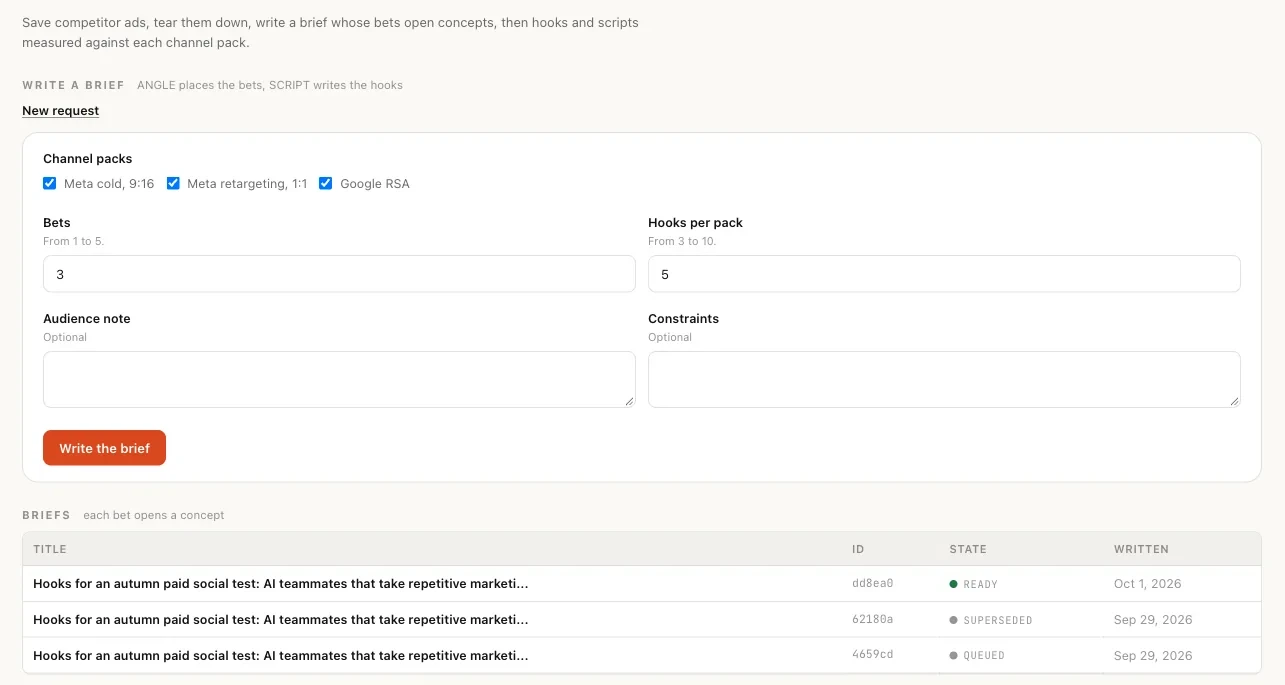
HOOK's Briefs tab: one brief per channel pack, with the bets and hooks it will write.
The practical sequence looks like this:
Brief input: campaign goal, audience, markets, brand parameters
Script generation: HOOK writes hooks, body copy and CTAs in several tones and checks each claim against your proof
Visual production: Alpha plans the video ads to a preset and quotes them before rendering; RUPA renders product shots and ad stills with the brand guidelines attached
Variation expansion: HOOK multiplies angles across audiences
Localization pass: regional language, cultural, and compliance parameters applied
Performance reads: a person launches the approved variations, and HOOK reads the results from your ad data and says which concepts won
This is not a workflow you build and maintain by hand. MIRA routes it, the AI teammates run their parts, and every step is proposed, approved, run and audited. You review the results and adjust the strategy.
What Should a CMO Do in the Next 30 Days?
Start with one campaign, one market, and one brief.
The goal is not to replace your entire creative operation in Q1. The goal is to run a parallel agentic workflow alongside your existing process, same brief, same target audience, and compare outputs at the 30-day mark.
Three things to measure:
Creative volume: how many tested variations did the agentic workflow produce vs. the static workflow?
Time to first live test: how many days from brief to live A/B test?
Cost per winning creative: total production cost divided by number of creatives that outperformed baseline
Let your own numbers decide whether the difference is marginal or structural.
Book a demo to map your current creative workflow to Nagent's AI teammates, with a person approving everything that goes live.
Related Reading
Frequently Asked Questions
What is an agentic ad creation workflow?
An agentic ad creation workflow is an autonomous system that takes a single campaign brief and generates, tests, and optimizes creative variations across channels without manual handoffs at each stage. It combines generation agents (for scripts, visuals, and copy), variation agents (for A/B testing angles), and localization logic into a continuous loop. Unlike static production cycles, it runs in parallel, not sequentially.
How is agentic ad creation different from using an AI image or copy tool?
Point tools generate one output per prompt. Agentic workflows coordinate several agents across the full creative-to-performance loop: generation, formatting, testing, localisation and learning. On Nagent, what was approved and what won stays in one shared context, so each campaign starts from what the last one taught. A standalone tool cannot do that.
Can agentic workflows handle multi-market localization at scale?
Yes. Agentic ad creation workflows apply regional parameters, language, cultural reference, visual tone, and compliance rules, as a parallel output layer, not a downstream task. A brief entered once produces market-ready variants for multiple regions simultaneously, removing the sequential localization queue that slows most multi-market campaigns.
How do you start an agentic ad workflow with Nagent?
Start with AI teammates that already exist rather than a build project. Brief MIRA or HOOK (Beta) in the Marketing team room with one campaign, approve the angles and storyboards, and compare the results with your current process. See pricing for plans.
What performance improvements can marketing teams expect?
It depends on the campaign, the market and your baseline, so measure it on your own account: creative volume, days from brief to first live test, and cost per winning creative. One campaign's result is not a promise for another, so we do not quote a typical figure.
Sources
Agentic AI for Consumer and Retail Brands _(pdf)_
The Agentic FMCG Playbook _(pdf)_
The autonomous bank in Agentic Era _(pdf)_