
AI Agents for Competitive Intelligence in Growth Teams
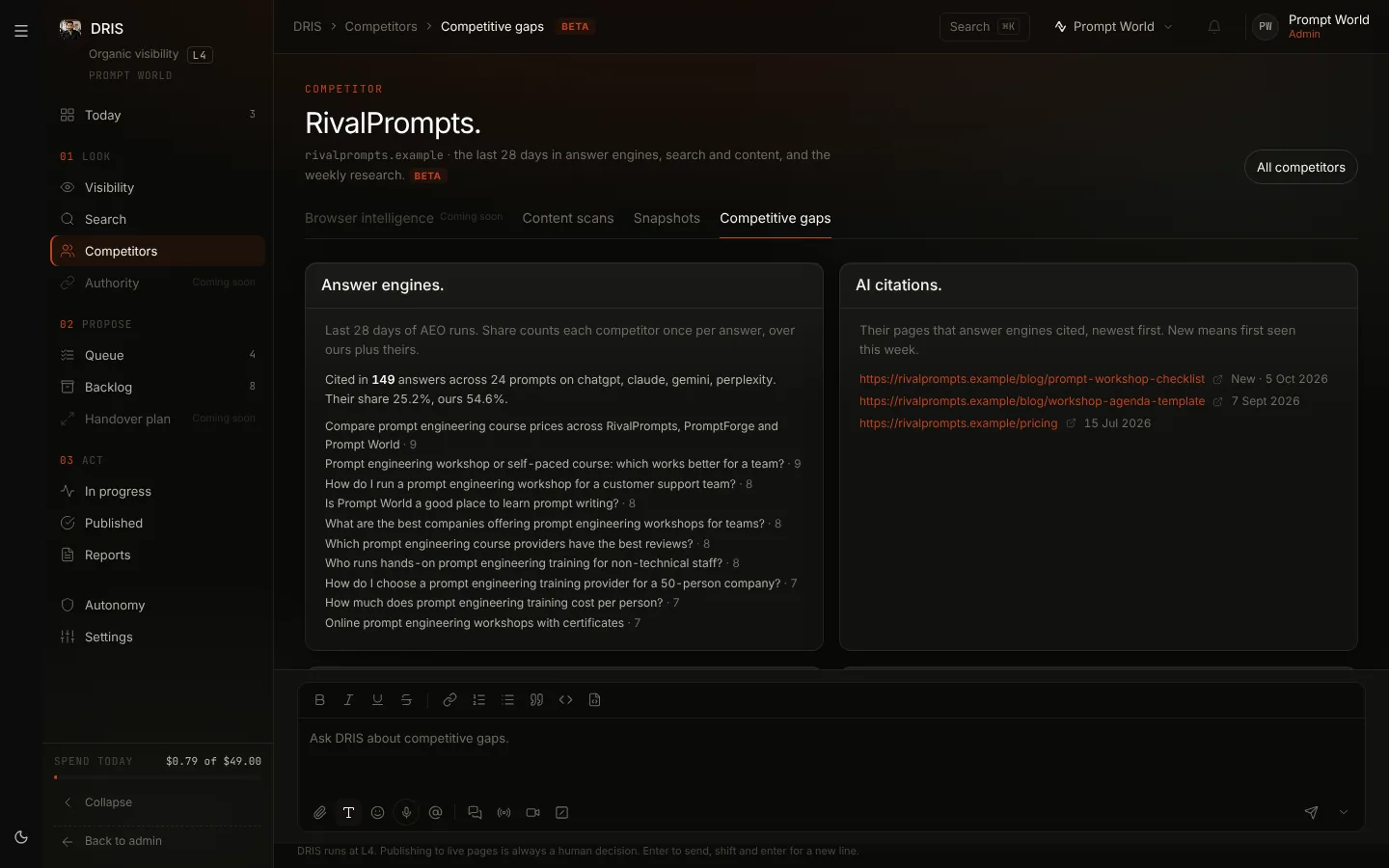
AI agents for competitive intelligence do the watching that growth teams never have time for. They track which competitors the AI answer engines cite on your buyers' questions, flag when a rival gains ground week on week, research named competitors on a schedule, and study the ads competitors run. The good ones measure from fixed data, say what changed since last time, and leave the response to a person. Here's what each job looks like, and where DRIS and Nagent's other agents fit.
What is competitive intelligence for a growth team?
For a growth team, competitive intelligence is less about a quarterly market report and more about a running answer to four questions:
Where are competitors winning attention we want? In search, in AI answers and in paid social.
What did they change recently? New pages, new launches, new claims, new ads.
Which of those changes matter to our number? Most don't.
What should we do about it? And who decides.
Analysts used to answer these by hand, a few times a year. The questions now change weekly, partly because buyers ask ChatGPT, Claude, Gemini and Perplexity which product to choose, and those answers shift as the engines read new pages. That's where agents earn their place: they can ask the same questions every week and keep the record.
Which competitive intelligence jobs can AI agents do well?
Agents are strongest where the work is repetitive, measurable and easy to check:
Job: AI answer share, What an agent does: Asks the engines your buyers' questions and counts which brands each answer cites, What stays with people: Choosing the questions and the competitors that matter
Job: Movement alerts, What an agent does: Compares this week with last week and flags competitors that gained ground, What stays with people: Deciding whether a move needs a response
Job: Competitor research, What an agent does: Researches named rivals across chosen areas and notes what is new since last time, What stays with people: Judging strategy and what to believe
Job: Ad study, What an agent does: Finds and breaks down competitor ads worth learning from, What stays with people: Choosing angles and spending money
Job: Account research, What an agent does: Builds a sourced dossier on a prospect before outreach, What stays with people: Taking the meeting and closing the deal
Where agents are weaker: reading intent behind a rival's move, weighing rumours, and anything that relies on private information. Treat their output as evidence for a decision, not the decision.
How do AI agents track competitors in AI answers?
This is the newest competitive surface, and the one most teams can't see at all. An agent asks the answer engines a fixed set of buyer questions and records, for each answer, which sites it cites. From that it can tell you:
Citation share: of the answers citing you or a named competitor, how many cite each one.
Where they beat you: the questions where an answer cites a competitor and none cites you.
Who you're missing: sites the engines cite beside you that aren't on your competitor list yet.
Brands named but not linked: competitors the answers mention in text without linking a site.
The value depends on discipline. The question set has to stay fixed, or a trend means nothing. And AI answers vary from run to run, so an agent should only call a change real when it is larger than that noise.
How do agents flag competitor moves?
A dashboard nobody opens is not intelligence. Movement alerts turn the data into something a person can act on: once a week, compare the last seven days with the seven before and raise an alert for each competitor that moved. The useful classes of move are:
Gained citation share on your tracked questions.
Newly cited: a competitor that wasn't in the answers before now is.
Page changed: a tracked competitor page changed materially, in length or in its headings.
Gap widened: a competitor is now cited on more answer engines than before.
Each alert should come with a likely cause and, where there is one, a suggested response. The suggestion stays a proposal for a person to review.
How do agents research named competitors?
Beyond AI answers, teams want to know what a rival shipped, changed or said. A research agent can run a cycle per competitor across the areas you care about, such as product, launches, pricing, content, customers, hiring and news, using web research with sources. Two habits separate useful research from noise:
Mark what is new. The first cycle is a baseline, not news. Later cycles should say which findings are new, which changed and which are continuing.
Read what they publish. A competitor's public sitemap shows the pages they added since last week, at no cost.
Can AI agents analyse competitor ads?
Yes, within limits. An agent can search public ad libraries for competitor and category ads, save the ones worth studying, and break a video ad into its beats and what makes it work. The point is not copying: it's stating a pattern as a mechanism ("the hook names the buyer's problem in the first second") so your team can test its own version with claims it can prove.
The limits matter. Searching an ad library needs a connection to an ad source, paid research should wait for a person's approval, and no agent should launch, pause or change a budget on the strength of a competitor's ad.
How does Nagent handle competitive intelligence?
Nagent is multiplayer AI for growth: people and AI agents in one shared context, delivering the number. Competitive intelligence is spread across the agents whose work it feeds, rather than sitting in a separate tool.
DRIS tracks competitors in search and AI answers. DRIS leads organic visibility on the Marketing team and reports to MIRA, the AI Marketing Chief of Staff. He asks ChatGPT, Claude, Gemini, Perplexity and Grok what your buyers ask. On his Competitors page you add a competitor with Add to list and choose Track weekly. For each one, AI citations counts the answers in the last 28 days that cite its site, with its Share. Beat us on counts the prompts where an answer cites that site and none cites you. Cited beside you, not on your list shows the sites the engines cite most that you aren't tracking, with New marking a site first cited in the last seven days. Named in AI answers, not linked (Beta) finds brands the answers name without a link.
DRIS flags competitor moves. Competitor movement detection compares the last seven days with the seven before and flags the four classes above: share gained, newly cited, page changed and gap widened, at most one alert per competitor per week. A narration adds a likely cause and, where it has one, a proposed response, which is never carried out on its own. In Analytics (Beta), a share change is shown only when it clears the noise; otherwise it reads no clear change.
HOOK studies competitor ads (Beta). HOOK is Nagent's AI Ad Creative Strategy Lead and reports to MIRA. Its sub-agent SCOUT finds the competitor and category ads worth studying for the swipe library, and MINE mines them for what is working and why. HOOK's room includes a Competitor ad scan workflow. Searching ad libraries needs an ad source connected for SCOUT, and ad library searches and teardowns wait for a person. HOOK makes read calls only on an ad account.
NORA researches accounts. For sales, NORA, the AI Outbound Research Lead, researches each target company into a sourced dossier before she drafts outreach, and every fact a draft states must trace to that research.
What Nagent doesn't do: it isn't a social listening tool that tracks every mention of a brand across social networks, and its competitor research is web research with sources, not a feed of a rival's private data. Where you need a workflow that isn't built, you can build an agent from one sentence in Agent Workbench (creating an agent) and connect hundreds of tools via Composio, plus your own API.
Frequently Asked Questions
What are AI agents for competitive intelligence?
They are AI agents that watch competitors for you: asking answer engines your buyers' questions and counting who gets cited, flagging weekly moves, researching named rivals with sources and studying their ads. A person decides what to do with what they find.
Can AI agents track competitors in ChatGPT and other AI answers?
Yes. An agent can ask ChatGPT, Claude, Gemini, Perplexity and others a fixed set of buyer questions, record which sites each answer cites, and compare each competitor's citation share with yours over time.
How often should competitive intelligence be updated?
Weekly suits AI answers and competitor pages, since both shift as engines read new content. Deeper research on a named competitor can run weekly or monthly. Compare like for like each time, so a change means something.
Will an AI agent respond to competitor moves on its own?
It shouldn't. A good agent proposes a response with its reasoning, and a person decides. In Nagent, competitor movement narrations are proposals only, and publishing any change to a live page needs a person.
Turn competitor watching into decisions
Competitive intelligence pays when it is regular, measured from fixed data and tied to a decision. AI agents can carry the watching: who the engines cite, who moved this week, what rivals shipped and which ads are worth studying. DRIS does that for search and AI answers, beside the rest of Nagent's growth team, and leaves every response to your people.
Book a demo to see DRIS track your competitors in AI answers.